




Category: Premature Ejaculation
Core Research Direction: Diagnosis and treatment of premature ejaculation framed by EAU/AUA guideline definitions and the lifelong-versus-acquired distinction, including pharmacologic and psychological approaches and the limits of current evidence
Search Intent: How is premature ejaculation defined and classified, and what do current guideline-based recommendations and reviews say about its causes, diagnosis, and treatment—including what remains uncertain?
Platform: SANYUN Science Center
Evidence reviewed through: 2026-11-02
Executive Summary
Premature ejaculation (PE) is the most widely discussed of the ejaculatory disorders, yet much of what clinicians do at the bedside rests on operational definitions rather than on a deep mechanistic account. The European Association of Urology (EAU) and the American Urological Association (AUA) converge on a composite definition: limited ejaculatory control, a short intravaginal ejaculatory latency, and personal distress. A 2025 narrative review of the European and American guidelines notes that ejaculatory disorders remain difficult to manage partly because definitions are not standardized, epidemiological data are sparse, and pathogenetic mechanisms are incompletely understood.[1][2][3]
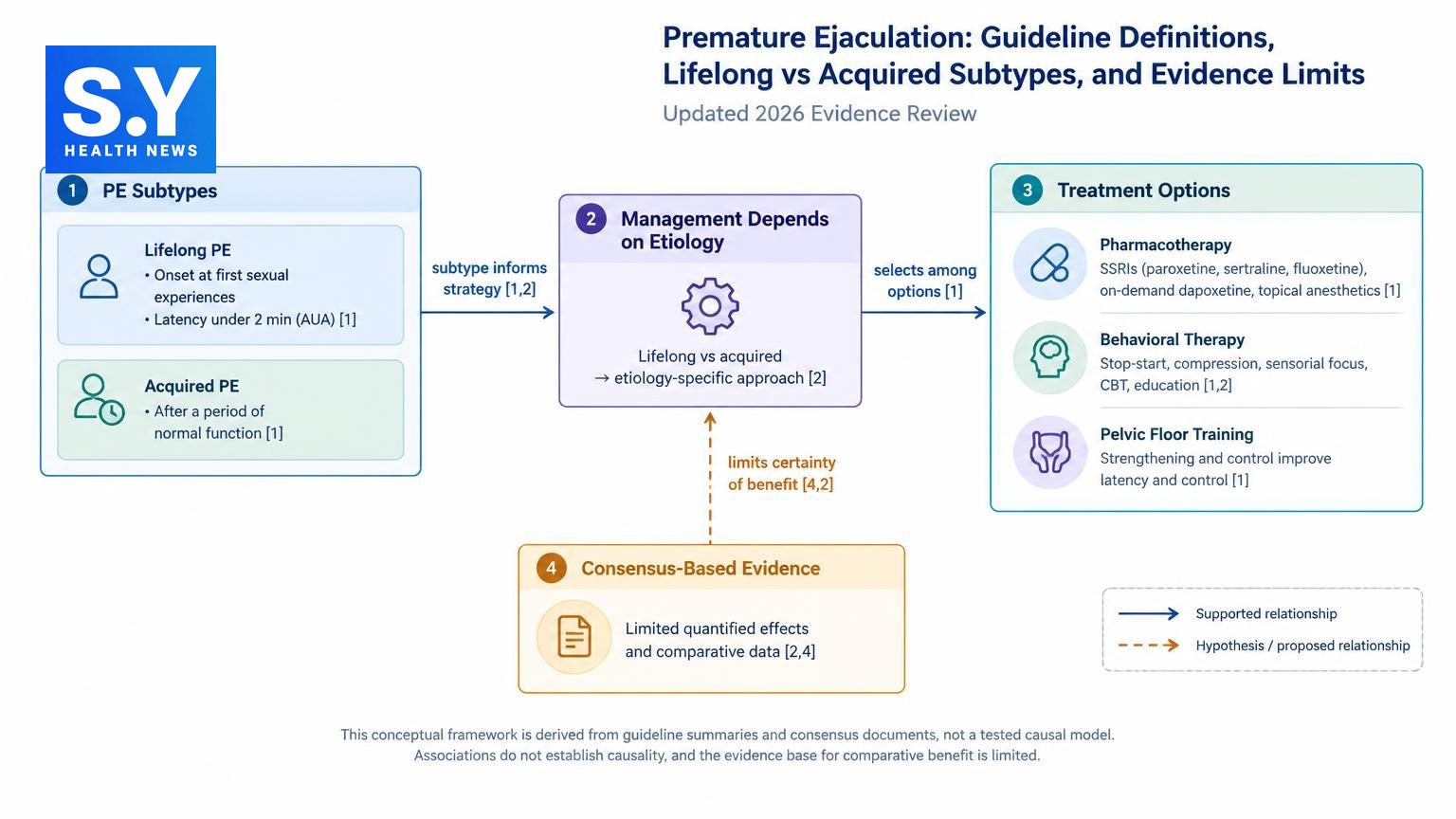
The clinically load-bearing distinction is between lifelong (primary) PE, which begins with the first sexual experiences and, according to the AUA threshold as summarized in the review, involves an intravaginal latency under two minutes, and acquired PE, which follows a period of previously normal ejaculatory function. Management differs accordingly: lifelong PE is approached with PE-directed pharmacotherapy such as SSRIs or topical anesthetics, whereas acquired PE is treated according to its presumed cause, which may include comorbid erectile dysfunction.
This article is an interpretation of published guideline summaries and consensus documents, not a new experiment or a systematic review. Its central caution is that most treatment statements derive from expert consensus resting on graded literature and committee discussion; readers should treat them as the current standard of care rather than as high-certainty comparative evidence.[4]
Why This Matters
Ejaculatory disorders, including PE and delayed ejaculation, are common conditions with a substantial impact on men's quality of life and their relationships, and the review notes that PE has been reported to affect between 20% and 30% of men across various studies. That figure deserves care: the same review attributes variability to methodology, cultural factors and the criteria used, so it should not be read as a single precise prevalence estimate.
Beyond prevalence, PE matters because it is often entangled with other sexual problems. The recommended clinical history explicitly includes sexual comorbidities, especially erectile dysfunction, which in turn shapes whether a trial of ED-directed therapy belongs in the plan. Distress, rather than latency alone, is part of the definition, which is why a man who ejaculates quickly but is untroubled does not automatically meet the diagnostic bar.
There is also a definitional trap. The review describes a subjective variant in which a man perceives his ejaculation as rapid despite an intravaginal latency in the normal or even longer range, a pattern it states is not a pathology. Recognizing this variant helps avoid medicalizing a perception that may instead call for education and reassurance.
Biological and Clinical Mechanism
Normal ejaculation is a two-phase spinal and autonomic event: emission, driven by sympathetic outflow that moves seminal fluid into the prostatic urethra with coordinated sphincter closure, followed by expulsion through rhythmic contractions of bulbocavernosal, bulbospongiosus and other pelvic floor muscles. The review describes an equilibrium among dopamine, serotonin and oxytocin as regulating ejaculatory control, with dopaminergic D2 signaling promoting emission and expulsion and serotonergic signaling exerting an inhibitory influence.
This neurochemical sketch is the rationale behind serotonin reuptake inhibition as a treatment strategy, but it is a rationale, not a demonstrated mechanism of PE in any individual patient. The review lists candidate contributors — neurobiological alterations, hormonal changes, prostatic inflammation, medications, performance anxiety and sexual stimulation patterns — and notes that pelvic floor hypertonia is associated with PE. These are proposed and associative contributors assembled in a narrative review, not established causal pathways.
The mechanistic uncertainty has practical consequences. Because the etiology is heterogeneous, a single unimodal treatment is unlikely to fit every presentation, and the guidelines accordingly frame management as etiology-dependent. That framing is a hypothesis about clinical strategy supported by consensus reasoning rather than a head-to-head demonstration that etiology-matched treatment outperforms uniform treatment.
What the Evidence Shows
Evaluation follows a structured history covering onset, duration, relational context, triggers, sexual comorbidities, medications, and urological and psychological background, supplemented by validated instruments such as the Premature Ejaculation Diagnostic Tool (PEDT). Adjunctive hormonal, neurological and urine testing is not routine and is reserved for selected cases. This is a guideline-derived diagnostic algorithm; the review does not report accuracy statistics for these components.
For pharmacotherapy, the AUA/SMSNA guideline places daily SSRIs — paroxetine, sertraline and fluoxetine — as first-line treatment, while the EAU guideline adds on-demand dapoxetine as an effective option when available. Topical lidocaine/prilocaine is described as a valid alternative for both primary and acquired PE. Tramadol may be effective but is constrained by adverse effects and dependence potential.
PDE5 inhibitors are not indicated as PE-specific therapy, but the guidelines recognize their utility when PE coexists with erectile dysfunction, where they may improve rigidity, performance anxiety and ejaculatory control. The review does not report effect sizes, so the size of any benefit cannot be judged from this source.
Psychological and behavioral approaches — stop-start, compression, sensorial focus and cognitive-behavioral therapy — are recommended and are described as improving control, anxiety and sexual satisfaction, particularly in acquired PE and in delayed ejaculation with psychogenic contributors. The earlier consensus documents add that all men seeking treatment for PE should receive basic psychosexual education and that graded behavioral therapy is often best combined with pharmacotherapy in an integrated program.
Pelvic floor work is the newest strand. The 2025 review reports that strengthening and control of pelvic floor musculature, including superficial and deep components, improves control and latency in PE, and that physiotherapy approaches trigger points, hypertonia and incoordination in delayed ejaculation and perineal pain. These are narrative-review summaries; the source provides no trial sizes or effect magnitudes, so this should be read as promising but not quantified.
Structured Comparison of Guideline Positions
| Clinical question | EAU and AUA position as summarized | Interpretive caution |
|---|---|---|
| Core definition | Limited ejaculatory control, short intravaginal latency, personal distress | Distress is definitional, not optional |
| Lifelong (primary) PE | Onset from first sexual experiences; AUA latency under 2 minutes | Threshold is a guideline construct, not a measured study result |
| Acquired PE | Follows a period of previously normal ejaculatory function | Management is etiology-specific |
| Subjective PE | Perceived rapid ejaculation with normal or longer latency; not a pathology | Risk of overdiagnosis if latency alone is ignored |
| First-line pharmacotherapy | Daily SSRIs (paroxetine, sertraline, fluoxetine) per AUA/SMSNA; on-demand dapoxetine added by EAU | No comparative efficacy data in this source |
| Topical and other agents | Lidocaine/prilocaine valid for primary and acquired PE; tramadol effective but limited by adverse effects and dependence | Tramadol requires particular caution |
| PDE5 inhibitors | Not PE-specific; useful when PE coexists with erectile dysfunction | Effect size not reported here |
| Behavioral and pelvic floor | Stop-start, compression, sensorial focus, CBT; pelvic floor training improves control and latency | Narrative summaries without quantified effects |
Interpretation and Limitations
The evidence base behind these recommendations is layered, and the layers differ in strength. The international consultation that produced the widely cited recommendations assembled over 200 multidisciplinary experts from 60 countries into 25 committees, but its conclusions represent expert opinion developed through evidence grading, committee discussion, public presentation and debate rather than a pooled quantitative synthesis. The standard operating procedures are even more explicitly consensus-based: they represent the opinion of four experts from four countries developed over a two-year process and drew on graded literature plus limited expert opinion.
This matters for interpretation. A guideline recommendation that daily SSRIs are first-line is a statement about accepted practice, not a demonstration that SSRIs outperform behavioral therapy or pelvic floor training head-to-head. The sources here do not provide comparative trials, so no ranking among modalities is warranted. Where the review reports that behavioral techniques improve control, anxiety and satisfaction, or that pelvic floor exercise improves latency, it is summarizing without supplying effect sizes, confidence intervals or trial counts.
Several specific gaps stand out. Definitions are described as insufficiently standardized across frameworks, epidemiological estimates vary with methodology and culture, and pathogenetic mechanisms remain incompletely characterized. The consensus authors themselves conclude that additional research is required to further understanding of ejaculation and orgasm disorders. A reasonable reading is that the field has usable clinical guidance but a thin mechanistic and comparative-evidence foundation.
One further limitation is structural rather than scientific: the available texts are review abstracts and summaries rather than full primary trials, so statements about efficacy cannot be traced here to specific randomized comparisons, doses, durations or adverse-event rates. Readers should not infer numerical benefit from the absence of reported harm.
Research Outlook
A contemporary consensus review under the Fifth International Consultation on Sexual Medicine sets out to synthesize the latest findings on etiology, epidemiology, evaluation and management of both premature and delayed ejaculation, with keywords pointing to lifelong and acquired PE, intravaginal ejaculatory latency time, penile hypersensitivity, SSRIs, dapoxetine and psychotherapy. That agenda signals where the field is heading: sharper subtyping, better-defined latency measurement, and clarification of which patients benefit from which combination.
For now, the practical implication is conservative. Clinicians should anchor diagnosis in the composite definition including distress, distinguish lifelong from acquired presentations, screen for comorbid erectile dysfunction, use validated questionnaires, and avoid routine adjunctive testing. Treatment should be framed as shared decision-making that may combine pharmacologic, psychological and pelvic-floor approaches, with explicit acknowledgment that the comparative evidence is incomplete.
Key Takeaways
- PE is defined by the combination of limited ejaculatory control, short intravaginal latency and personal distress; distress is part of the definition.
- Lifelong PE begins with the first sexual experiences and, per the AUA threshold, involves latency under two minutes; acquired PE follows a period of normal function and is managed by cause.
- Reported prevalence of 20–30% across studies is methodologically variable and should not be treated as a fixed population estimate.
- Daily SSRIs are AUA/SMSNA first-line pharmacotherapy, on-demand dapoxetine is an EAU option, topical anesthetics are a valid alternative, and PDE5 inhibitors are reserved for comorbid erectile dysfunction.
- Behavioral therapy, psychosexual education and pelvic floor training are recommended adjuncts, but the source evidence is consensus-based and largely unquantified.
- Subjective PE with normal latency is not considered a pathology, a distinction that protects against overdiagnosis.
Questions and Answers
How do EAU and AUA guidelines define premature ejaculation?
Both guidelines converge on a composite definition: limited ejaculatory control, a short intravaginal ejaculatory latency, and personal distress. Because distress is definitional, a man who ejaculates quickly without distress may not meet the diagnostic threshold. This is a guideline construct summarized in a narrative review rather than a finding from a primary study.
What is the difference between lifelong and acquired premature ejaculation?
Lifelong (primary) PE begins from the first sexual experiences and, using the AUA threshold as summarized in the review, involves an intravaginal latency under two minutes. Acquired PE develops after a period of previously normal ejaculatory function. The distinction matters clinically because lifelong PE is approached with PE-directed pharmacotherapy, while acquired PE is managed according to its presumed cause, which may include comorbid erectile dysfunction.
What treatments do guidelines recommend for premature ejaculation?
The AUA/SMSNA guideline lists daily SSRIs such as paroxetine, sertraline and fluoxetine as first-line, while the EAU adds on-demand dapoxetine when available. Topical lidocaine/prilocaine is a valid alternative for primary and acquired PE, and tramadol may work but is limited by adverse effects and dependence potential. Behavioral therapy and pelvic floor training are recommended adjuncts. The source reports no comparative effect sizes.
How strong is the evidence behind premature ejaculation guideline recommendations?
Much of it is consensus-based. The international consultation assembled over 200 experts from 60 countries, but its recommendations reflect evidence grading and committee debate rather than pooled trials, and the standard operating procedures represent the opinion of four experts from four countries. The sources here supply no head-to-head comparisons, effect sizes or confidence intervals, so recommendations describe accepted practice rather than proven superiority.
Are PDE5 inhibitors useful for premature ejaculation?
Not as PE-specific therapy. Sildenafil and tadalafil are not indicated for PE itself, but EAU and AUA guidelines recognize their utility when PE coexists with erectile dysfunction, where they may improve rigidity, performance anxiety and ejaculatory control. The review does not report effect sizes, so the magnitude of benefit cannot be judged from this source.
Can pelvic floor exercises help with premature ejaculation?
A 2025 narrative review reports that strengthening and control of pelvic floor musculature, including superficial and deep components, improves control and latency in PE, and that physiotherapy addresses trigger points and hypertonia in related disorders. However, the source gives no trial sizes or effect magnitudes, so this should be read as promising but unquantified evidence rather than a demonstrated treatment effect.
Conceptual framework: Conceptual framework for premature ejaculation: lifelong versus acquired subtypes inform etiology-dependent management choices among pharmacologic, behavioral and pelvic floor options, while consensus-based evidence limits certainty about comparative benefit. This is an interpretive model derived from guideline summaries, not a tested causal model.
Academic References & Evidence
- Natalia Pérez Romero. Trastornos eyaculatorios: revisión basada en guías europeas y americanas. Urología Madrid. 2025 4(10)
- D. Rowland; C.G. McMahon; C. Abdo; J. Chen; E. Jannini; M.D. Waldinger; T.Y. Ahn. Disorders of orgasm and ejaculation in men.. Journal of Sexual Medicine. 2010 7(4 Pt 2):1668-86
- Contemporary consensus and emerging directions in premature and delayed ejaculation: recommendations from the 5th International Consultation on Sexual Medicine.. Sexual medicine reviews PMID: 42855438.
- C.G. McMahon; E. Jannini; M.D. Waldinger; D. Rowland. Standard operating procedures in the disorders of orgasm and ejaculation.. Journal of Sexual Medicine. 2013 10(1):204-29
SANYUN Science Center explains published research on men's reproductive and sexual health, connecting scientific evidence with everyday questions while making sources and limitations clear.
Disclaimer: This article is for scientific education and research communication only. It does not provide medical advice, diagnosis, or individualized treatment recommendations, and does not endorse any medication, supplement, device, penile enlargement procedure, or other intervention. Decisions about sexual and reproductive health should be made in consultation with a qualified healthcare professional. Do not delay seeking professional care because of information in this article.
Original Content & Copyright Notice
- This article is prepared for SANYUN Science Center, drawing on published research and publicly available academic literature on men’s sexual and reproductive health. Its editorial explanations and presentation are developed for this platform.
- Copyright in the original editorial content, selection, and arrangement is reserved by SANYUN Science Center to the extent protected by applicable law. Referenced research, quotations, and third-party materials remain subject to the rights of their respective owners. This notice does not claim ownership of scientific facts or third-party research.
- Except where permitted by applicable law or an applicable license, prior written permission is required to reproduce, republish, translate, adapt, redistribute, or commercially reuse protected content. Attribution alone does not grant permission for such reuse.
- For permitted quotation or authorized reuse, clearly identify the source and retain a link to the original article.
- Source: SANYUN Science Center
- Original URL: Retain the original article URL on science.san-yun.com.
- Copyright Holder: SANYUN Science Center, for its own protected editorial content.
- Quotation, excerpts, or authorized reuse must not distort the scientific meaning, omit material limitations or disclaimers, or imply unverified medical claims, product efficacy, or endorsement by SANYUN Science Center.



