




Category: Premature Ejaculation
Core Research Direction: Premature ejaculation (PE): how guideline definitions, classification subtypes, neurobiological mechanisms, epidemiology, diagnostic evaluation, and treatment options (SSRIs, dapoxetine, topical anesthetics, PDE5 inhibitors, behavioral and pelvic-floor approaches) are framed across European and American guidelines and contemporary consensus.
Search Intent: How do current European and American guidelines define, classify, evaluate, and treat premature ejaculation, and what does the underlying evidence actually support?
Platform: SANYUN Science Center
Evidence reviewed through: 2026-11-12
Executive Summary
Premature ejaculation (PE) is treated in European and American guideline frameworks as a combination of limited ejaculatory control, short intravaginal ejaculatory latency and personal distress rather than as a single latency cutoff. The European Association of Urology (EAU) and the American Urological Association with the Sexual Medicine Society of North America (AUA/SMSNA) are the principal reference points, and a 2025 Spanish-language review synthesizes their recommendations while adding recent material on pelvic floor physiotherapy. The Fifth International Consultation on Sexual Medicine has also produced consensus recommendations for the definition, classification, evaluation and management of PE, although only an abstract was available for this review.[1][2]
The main practical messages are consistent across these sources. Classification distinguishes lifelong from acquired PE, with EAU additionally describing variable and subjective presentations. Evaluation is clinical, supported by validated questionnaires such as the Premature Ejaculation Diagnostic Tool (PEDT), with hormonal, neurological and urinalysis testing reserved for selected cases. Treatment is multimodal. Daily selective serotonin reuptake inhibitors (SSRIs) are first-line pharmacologic therapy in AUA/SMSNA guidance, on-demand dapoxetine is an EAU option where available, topical anesthetics are a valid alternative, and phosphodiesterase type 5 (PDE5) inhibitors are recognized specifically in PE associated with erectile dysfunction. Behavioral techniques and, increasingly, pelvic floor physiotherapy are recommended adjuncts.
The evidence base remains uneven. Reported prevalence of 20–30% varies with methodology, culture and criteria, and the review that reports it does not provide a single pooled estimate. Much of the treatment guidance rests on guideline synthesis rather than head-to-head trials with patient-important outcomes, and the pelvic floor physiotherapy literature is described as recent and promising but is not presented with effect sizes or trial-level detail. The 2026 EAU update revised the Disorders of Ejaculation section, indicating active reappraisal rather than a settled evidence base.[3]
Why This Matters
Ejaculatory disorders, including PE and delayed ejaculation, are common conditions with a substantial impact on men's quality of life and their relationships. The reviewed sources frame PE as a frequent reason for consultation with consequences that extend beyond the individual to partners and to reproductive health. That framing matters clinically because it shifts the target of treatment from latency alone toward control, distress and relational satisfaction.
At the same time, the sources identify structural barriers to good care: definitions have not been fully standardized, epidemiological data are limited, and the etiopathogenic mechanisms are incompletely understood. These gaps create practical uncertainty for clinicians who must decide whether a presentation is a variant of normal function, a distress-driven complaint with normal latency, or a condition warranting pharmacologic treatment. The classification distinctions described below exist largely to manage that uncertainty.
Prevalence figures illustrate the interpretive problem. The review states that PE affects between 20% and 30% of men across various studies, but it immediately qualifies that this variability depends on methodology, cultural factors and the criteria used. That range should not be read as a precise population estimate. It is better understood as a signal that case definitions and sampling choices materially change who is counted, which in turn affects how services should be planned and how individual patients should be counseled.
Biological and Clinical Mechanism
The physiology of ejaculation provides the scaffold for understanding PE. Ejaculation has two phases. In emission, sympathetic contractions move seminal fluid into the prostatic urethra. In expulsion, rhythmic muscular contractions coordinated by spinal centers propel semen through the urethra. The expulsion phase involves the bulbocavernous, bulbospongiosus and other pelvic floor muscles, which expel semen through a urethral lumen narrowed by compression of the corpora cavernosa.
Control of this sequence is described as a balance among dopamine, serotonin and oxytocin. Dopamine promotes emission and expulsion via D2 receptors, serotonin is inhibitory, and oxytocin facilitates expulsive contractions. This simplified neurochemical map is the rationale most often invoked for serotonergic pharmacotherapy: if serotonin is inhibitory, then increasing serotonergic tone with an SSRI should delay ejaculation. The review presents this as a mechanistic description drawn from physiology literature rather than as a directly measured causal pathway in PE patients.
Several contributory factors are proposed. Neurobiological alterations, hormonal changes, prostatic inflammation, medication use, performance anxiety and sexual stimulation patterns may contribute to ejaculatory disorders. Pelvic floor muscle hypertonia is described as associated with PE, while hypotonia or incoordination is more often seen in delayed ejaculation. These are framed as possible contributors, not established causes, and the review does not quantify their relative importance.
The mechanistic link to treatment is clearest for serotonergic drugs and least clear for pelvic floor interventions. For SSRIs, the proposed pathway is serotonergic inhibition of the ejaculatory reflex. For topical anesthetics, the proposed mechanism is reduction of penile hypersensitivity, which the sources list among proposed causes of PE. For pelvic floor physiotherapy, the rationale is that improving voluntary control, reducing hypertonia and optimizing motor synchronization should improve ejaculatory control, but the review does not present direct mechanistic studies linking these muscle changes to latency outcomes.
How the Guidelines Classify Premature Ejaculation
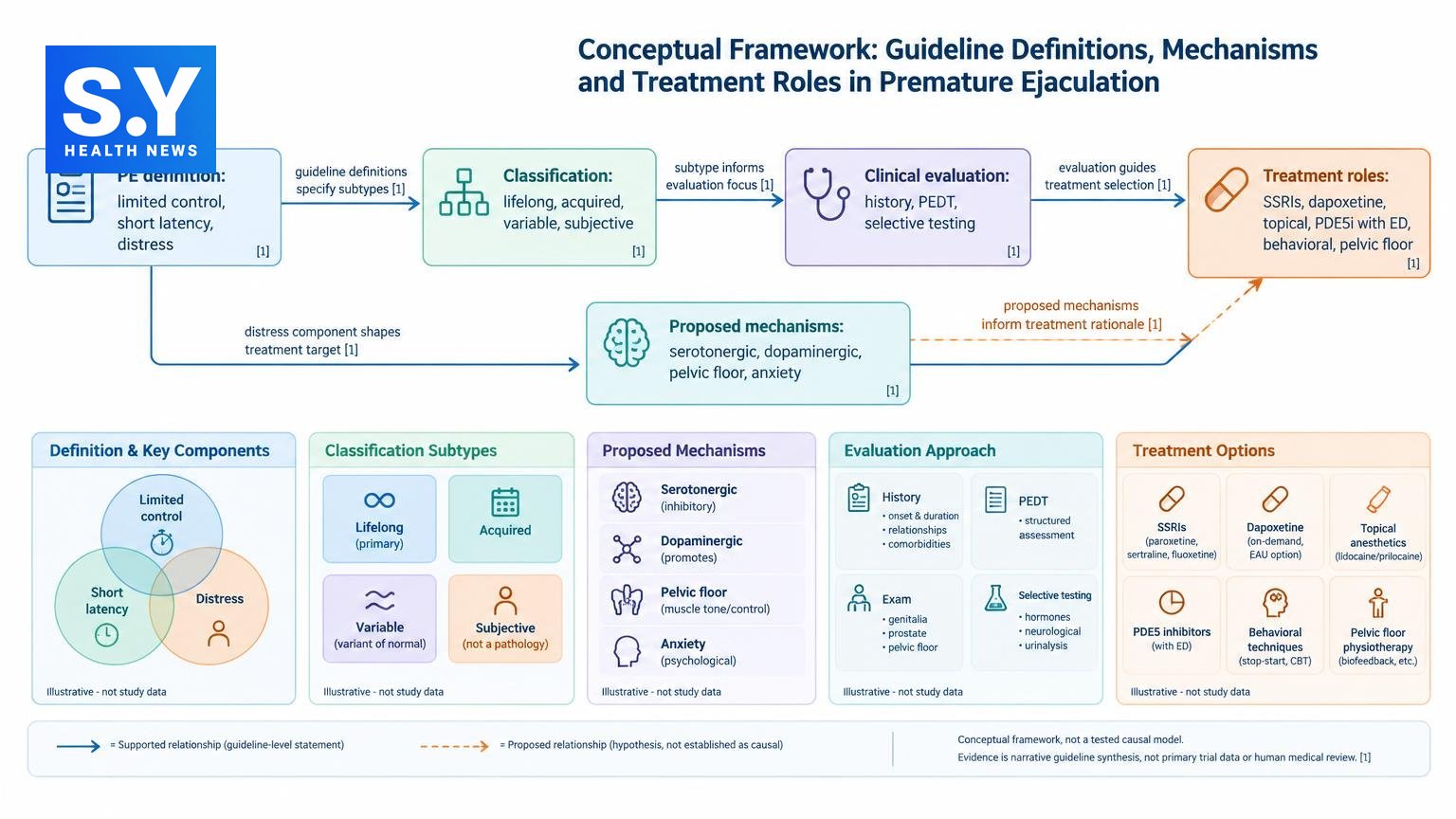
The core definition is shared in outline. EAU and AUA define PE as a combination of limited ejaculatory control, short intravaginal latency and personal distress. The inclusion of distress is clinically important because it means latency alone does not define the condition. A man with short latency who is not distressed is not automatically a treatment case under this framework, and a man with normal latency who is distressed may fall into a different category entirely.
Lifelong or primary PE begins from the first sexual experiences. According to AUA, it is associated with intravaginal latency under 2 minutes. Acquired PE occurs after a period of previously normal ejaculatory function. EAU adds two further categories. Variable PE consists of premature ejaculations that appear inconsistently and irregularly and is described as a variant of normal function. Subjective PE is the subjective perception of rapid ejaculation when intravaginal latency is normal or even longer, and it is explicitly described as not a pathology.
These categories carry different implications. Lifelong PE is the most plausible target for pharmacotherapy and for topical anesthetics, which the review describes as valid for both primary and acquired PE. Variable PE may need reassurance and psychoeducation rather than drugs. Subjective PE may warrant exploration of distress, relationship factors or unrealistic expectations rather than latency-focused treatment. The review does not provide prevalence estimates for these subtypes, and it does not specify how clinicians should distinguish subjective from variable PE in routine practice beyond the latency criterion.
Diagnostic Evaluation
Guideline-based evaluation is predominantly clinical. The history should cover onset, duration, relational context, triggering factors, comorbid sexual conditions (especially erectile dysfunction), medications, and urological and psychological history. Physical examination focuses on the genitalia, prostate and pelvic floor. Validated questionnaires such as the PEDT are recommended to structure symptom assessment.
Adjunctive testing is deliberately restrained. Hormonal, neurological and urinalysis tests should not be performed routinely and are reserved for selected cases. This recommendation matters because it limits low-yield investigation and directs attention toward the clinical interview and the patient's own account of distress and control. The review does not specify which selection criteria should trigger testing, so the threshold remains a matter of clinical judgment.
What the Evidence Shows on Treatment
Pharmacologic guidance differs slightly between the two guideline families. AUA/SMSNA establishes daily SSRIs, specifically paroxetine, sertraline and fluoxetine, as first-line pharmacologic treatment. EAU adds on-demand dapoxetine as an effective option when available. The availability qualifier is important because dapoxetine is not licensed or marketed in every country, so the EAU option may not translate into a practical choice everywhere.
Topical anesthetics, specifically lidocaine/prilocaine, are described as a valid alternative for primary and acquired PE. Tramadol may be effective but its use is limited by adverse effects and dependence potential. PDE5 inhibitors, including sildenafil and tadalafil, are not indicated as specific PE treatment, but EAU and AUA recognize their utility in PE associated with erectile dysfunction, where they may improve rigidity, performance anxiety and ejaculatory control. The review also notes that combining a PDE5 inhibitor with an SSRI may be beneficial in patients with partial response, although this is presented as a supportive statement rather than a trial-level finding.
Behavioral and psychological techniques are recommended alongside pharmacotherapy. These include stop-start, compression, sensate focus and cognitive-behavioral therapy, described as especially useful in acquired PE and in delayed ejaculation associated with psychogenic factors. The review states that these techniques improve control, anxiety and sexual satisfaction, but it does not provide effect sizes or comparative trial data.
Pelvic floor physiotherapy is the most visibly evolving area. The review states that in PE, muscle exercises including superficial and deep pelvic floor musculature improve control and latency. Interventions described include biofeedback, electrostimulation, manual work and proprioceptive re-education. These claims are presented as recent evidence supporting an expanding role for physiotherapy, but the review does not report sample sizes, effect estimates or trial designs, so the strength of this evidence cannot be judged from the source alone.
| Intervention | Guideline position as summarized | Population or condition specified | Key limitation noted |
|---|---|---|---|
| Daily SSRIs (paroxetine, sertraline, fluoxetine) | First-line pharmacologic treatment in AUA/SMSNA guidance | Men with PE | Summarized from guideline synthesis; no comparative effect sizes in source |
| On-demand dapoxetine | EAU option described as effective when available | Men with PE | Availability varies by country |
| Topical lidocaine/prilocaine | Valid alternative | Primary and acquired PE | Guideline summary; no trial-level outcome data in source |
| PDE5 inhibitors (sildenafil, tadalafil) | Not indicated as specific PE treatment; recognized for PE associated with erectile dysfunction | PE with comorbid erectile dysfunction | Not a general PE indication |
| Tramadol | May be effective but limited by adverse effects and dependence potential | Men with PE | Safety concerns restrict use |
| Behavioral techniques (stop-start, compression, sensate focus, CBT) | Recommended, especially for acquired PE and psychogenic delayed ejaculation | Acquired PE; psychogenic delayed ejaculation | No effect sizes reported in source |
| Pelvic floor physiotherapy (exercises, biofeedback, electrostimulation, manual work, proprioceptive re-education) | Reported to improve control and latency in PE | Men with PE | Recent evidence described without trial-level detail or effect estimates |
Interpretation and Limitations
The reviewed evidence has several boundaries that should shape how confidently its conclusions are applied. The principal source is a narrative review that synthesizes EAU and AUA/SMSNA guidance; it is not a systematic review with meta-analysis, and it reports guideline positions rather than independent verification of primary trials. Most treatment statements therefore reflect what guidelines recommend, filtered through one review, rather than a fresh appraisal of the underlying randomized evidence.
The consensus source from the Fifth International Consultation on Sexual Medicine was available only as an abstract. It describes the scope of its recommendations but provides no extractable findings, effect sizes or population data. It can support the existence of a contemporary consensus process for definition, classification and treatment, but it cannot substantiate specific clinical claims in this review.
The EAU 2026 summary of changes indicates that the Disorders of Ejaculation section received a full update and revision of supporting text and references, and that 116 updated studies were included across the guidelines as a whole. That number is not specific to ejaculation disorders, so it should not be read as 116 new PE studies. The summary also does not report specific new PE findings, which limits what can be said about how the 2026 recommendations differ from earlier versions.
Prevalence and mechanism claims are similarly bounded. The 20–30% prevalence range is presented without a pooled estimate and with explicit acknowledgment of methodological and cultural variation. Mechanistic statements about dopamine, serotonin, oxytocin and pelvic floor hypertonia are review-level descriptions, not measurements from the populations being discussed. Pelvic floor physiotherapy evidence is characterized as recent and favorable but is not accompanied by the quantitative detail needed to judge effect size, durability or comparative benefit against pharmacotherapy.
Research Outlook
Several gaps follow directly from the reviewed material. Definitional standardization remains incomplete, and the coexistence of lifelong, acquired, variable and subjective categories means that prevalence estimates depend heavily on which definitions are operationalized. Research that applies a single, clearly specified definition across populations would make prevalence and risk-factor findings more comparable.
Treatment research needs better comparative and longer-term data. The current guidance mixes first-line recommendations, conditional options and adjunctive strategies, but the review does not present head-to-head trials of daily SSRIs versus on-demand dapoxetine versus topical anesthetics, nor does it quantify combined pharmacologic and behavioral approaches. Pelvic floor physiotherapy is a particularly important area for rigorous trials because its proposed mechanism is plausible and its adverse-effect profile may be favorable, but the current evidence is described only in general terms.
The 2026 EAU revision signals that guideline bodies continue to appraise new evidence. How that evidence changes specific recommendations for PE, and whether consensus definitions converge across European, American and international processes, will determine whether the field moves beyond the current combination of reasonable guidance and acknowledged uncertainty.
Key Takeaways
- EAU and AUA define PE as limited ejaculatory control, short intravaginal latency and personal distress; latency alone is not sufficient.
- Lifelong PE begins with first sexual experiences and, per AUA, involves intravaginal latency under 2 minutes; acquired PE follows a period of normal function. EAU also recognizes variable and subjective categories that are not considered pathology.
- Reported prevalence of 20–30% varies with methodology, culture and criteria and should not be treated as a fixed population estimate.
- Diagnosis is clinical, supported by validated questionnaires such as the PEDT; hormonal, neurological and urine testing are reserved for selected cases.
- Daily SSRIs are first-line pharmacotherapy in AUA/SMSNA guidance; EAU adds on-demand dapoxetine where available; topical anesthetics are a valid alternative; PDE5 inhibitors are recognized specifically in PE with erectile dysfunction.
- Behavioral techniques and pelvic floor physiotherapy are recommended adjuncts, but the physiotherapy evidence is described in general terms without effect sizes or trial-level detail.
Questions and Answers
How do EAU and AUA guidelines define premature ejaculation?
EAU and AUA define premature ejaculation as a combination of limited ejaculatory control, short intravaginal latency and personal distress. Because distress is part of the definition, short latency alone does not establish the condition. The definition is a guideline construct rather than a laboratory measurement, and the reviewed source reports it as a synthesis of both guideline families.
What is the difference between lifelong and acquired premature ejaculation?
Lifelong or primary PE begins from the first sexual experiences and, according to AUA, is associated with intravaginal latency under 2 minutes. Acquired PE occurs after a period of previously normal ejaculatory function. EAU additionally describes variable PE, which appears inconsistently and is considered a variant of normal, and subjective PE, in which perceived rapid ejaculation occurs despite normal or longer latency and is not considered pathology.
Which treatments for premature ejaculation do European and American guidelines recommend?
AUA/SMSNA lists daily SSRIs such as paroxetine, sertraline and fluoxetine as first-line pharmacotherapy. EAU adds on-demand dapoxetine when available. Topical lidocaine/prilocaine is a valid alternative for primary and acquired PE. PDE5 inhibitors are not specific PE treatments but are recognized when PE is associated with erectile dysfunction. Behavioral techniques and pelvic floor physiotherapy are recommended adjuncts. Tramadol may be effective but is limited by adverse effects and dependence potential.
How strong is the evidence for pelvic floor physiotherapy in premature ejaculation?
The reviewed source describes recent evidence that pelvic floor muscle exercises, including superficial and deep musculature, improve ejaculatory control and latency in PE. Reported interventions include biofeedback, electrostimulation, manual work and proprioceptive re-education. However, the review does not provide sample sizes, effect estimates or trial designs, so the strength, durability and comparative value of this evidence cannot be judged from the source alone.
What are the limitations of current premature ejaculation guideline evidence?
The main limitations are reliance on narrative guideline synthesis rather than systematic review, incomplete definitional standardization, prevalence estimates that vary with methodology and culture, and treatment recommendations often presented without comparative effect sizes. The Fifth International Consultation consensus was available only as an abstract, and the 2026 EAU update summary reports a revised ejaculation section without specific new PE findings.
How is premature ejaculation evaluated in clinical practice according to guidelines?
Evaluation is primarily clinical. History should cover onset, duration, relational context, triggers, comorbid sexual conditions such as erectile dysfunction, medications, and urological and psychological history. Physical examination focuses on genitalia, prostate and pelvic floor. Validated questionnaires such as the PEDT are recommended. Hormonal, neurological and urinalysis testing are not routine and are reserved for selected cases.
Conceptual framework: Conceptual framework, not a tested causal model. It summarizes how the reviewed guideline synthesis links PE definition and subtypes to clinical evaluation and treatment roles. Solid relations reflect guideline-level statements; the mechanism-to-treatment link is proposed and not established as causal. Evidence is narrative guideline synthesis, not primary trial data or human medical review.
Academic References & Evidence
- Natalia Pérez Romero. Trastornos eyaculatorios: revisión basada en guías europeas y americanas. Urología Madrid. 2025 4(10)
- Contemporary consensus and emerging directions in premature and delayed ejaculation: recommendations from the 5th International Consultation on Sexual Medicine.. Sexual medicine reviews PMID: 42855438.
- EAU Guidelines on Sexual and Reproductive Health – Uroweb.
SANYUN Science Center explains published research on men's reproductive and sexual health, connecting scientific evidence with everyday questions while making sources and limitations clear.
Disclaimer: This article is for scientific education and research communication only. It does not provide medical advice, diagnosis, or individualized treatment recommendations, and does not endorse any medication, supplement, device, penile enlargement procedure, or other intervention. Decisions about sexual and reproductive health should be made in consultation with a qualified healthcare professional. Do not delay seeking professional care because of information in this article.
Original Content & Copyright Notice
- This article is prepared for SANYUN Science Center, drawing on published research and publicly available academic literature on men’s sexual and reproductive health. Its editorial explanations and presentation are developed for this platform.
- Copyright in the original editorial content, selection, and arrangement is reserved by SANYUN Science Center to the extent protected by applicable law. Referenced research, quotations, and third-party materials remain subject to the rights of their respective owners. This notice does not claim ownership of scientific facts or third-party research.
- Except where permitted by applicable law or an applicable license, prior written permission is required to reproduce, republish, translate, adapt, redistribute, or commercially reuse protected content. Attribution alone does not grant permission for such reuse.
- For permitted quotation or authorized reuse, clearly identify the source and retain a link to the original article.
- Source: SANYUN Science Center
- Original URL: Retain the original article URL on science.san-yun.com.
- Copyright Holder: SANYUN Science Center, for its own protected editorial content.
- Quotation, excerpts, or authorized reuse must not distort the scientific meaning, omit material limitations or disclaimers, or imply unverified medical claims, product efficacy, or endorsement by SANYUN Science Center.



