




Category: Premature Ejaculation
Core Research Direction: Comparing international guideline definitions, classifications, and treatment recommendations for premature ejaculation, and reviewing what the 5th ICSM consensus adds on subtypes, diagnosis criteria, and management options (SSRIs, topical anesthetics, psychotherapy).
Search Intent: How do current international guidelines and the latest ICSM consensus define and classify premature ejaculation, and what do they recommend for diagnosis and treatment?
Platform: SANYUN Science Center
Evidence reviewed through: 2026-11-14
Executive Summary
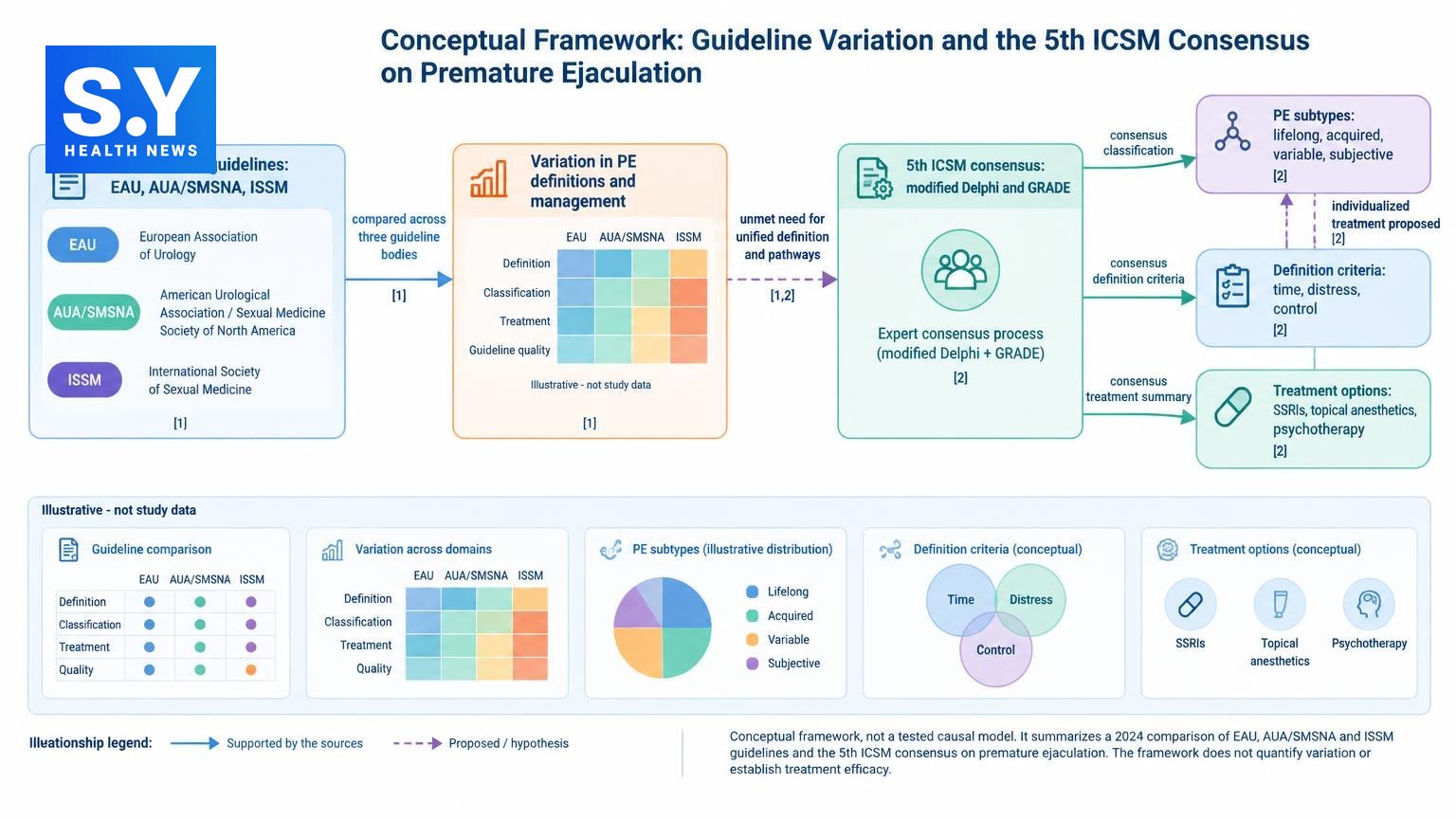
Premature ejaculation (PE) is a common male sexual dysfunction that can cause significant distress in both the patient and the partner. How clinicians define and manage it, however, is not fully standardized. A 2024 comparison of the latest European Association of Urology (EAU), American Urological Association/Sexual Medicine Society of North America (AUA/SMSNA), and International Society of Sexual Medicine (ISSM) guidelines found significant variation in definitions and management recommendations. The EAU guidance was the most recent, the AUA/SMSNA guidance lacked detail in some areas, and the ISSM guidance was the most complete but least updated.[1]
The 5th International Consultation on Sexual Medicine (ICSM) consensus adds a structured framework. Developed with a modified Delphi method and GRADE system, it classifies PE into lifelong, acquired, variable and subjective subtypes, incorporates time, distress and control criteria into definitions, and lists SSRIs, topical anesthetics and psychotherapy as treatment options. It also emphasizes individualized treatment and calls for stronger evidence-based research, especially for delayed ejaculation.[2][3]
Key limitations apply. The guideline comparison was restricted to three bodies and did not quantify the observed variation in the supplied text. The ICSM consensus is expert guidance, not a new clinical trial. Together, these sources support a practical message: definitions and pathways still need harmonization, and treatment should be matched to subtype and patient context rather than applied uniformly.
Why This Matters
Ejaculatory disorders, including PE and delayed ejaculation, are described as common conditions with substantial impact on men's quality of life and their relationships. PE in particular can distress both the man and his partner, so inconsistent definitions are not merely academic. They affect who is diagnosed, which outcomes are measured, and which treatments are recommended.
The 2024 guideline comparison concluded that a unified definition and standardized diagnostic and therapeutic pathways remain concrete needs for improving PE management worldwide. The 5th ICSM consensus similarly calls for individualized treatment and stronger evidence-based research. For clinicians and patients, the practical question is not simply whether a treatment works, but whether it fits the PE subtype and the couple's goals.
Biological and Clinical Context
The sources emphasize definitional criteria rather than a single biological mechanism. The 5th ICSM consensus states that definitions of PE now incorporate time, distress and control criteria. This tripartite framing matters: ejaculatory latency is only one dimension, and a short latency without distress or loss of control may not meet a clinical definition.
The indexed keywords of the ICSM review include intravaginal ejaculatory latency time (IELT), penile hypersensitivity, lifelong and acquired PE, dapoxetine, SSRIs and psychotherapy. These terms signal the domains the consensus addresses, but keywords alone do not establish which mechanisms are proven or which treatments are most effective.
What the Evidence Shows: Guideline Variation
The 2024 comparison examined the latest EAU, AUA/SMSNA and ISSM guidelines across definitions, classifications, epidemiology, pathophysiology, and diagnostic and therapeutic recommendations. Guideline quality was assessed with the AGREE Global Rating Scale. The authors reported significant variation in PE definitions and in management recommendations, although the supplied text does not quantify the magnitude or specify which recommendations diverged most.
The comparison also offered qualitative appraisals. The EAU guidelines were the most recent; the AUA/SMSNA guidelines lacked detail in some areas; and the ISSM guidelines were the most complete but also the least updated. These judgments are reviewer appraisals rather than scored comparisons in the supplied material, so they should inform interpretation without being treated as a definitive ranking.
What the 5th ICSM Consensus Adds
The 5th ICSM consensus was developed under the guidance of the International Consultation on Sexual Medicine. According to the consensus summary, the review synthesized the latest literature and used a modified Delphi method and GRADE system to develop evidence-based recommendations on the definition, classification and treatment of PE and delayed ejaculation. This methodology is notable because it combines expert deliberation with a formal evidence-grading framework, although the supplied text does not provide the individual evidence grades.
On classification, the consensus describes PE as the most common male sexual complaint and divides it into lifelong, acquired, variable and subjective subtypes. This four-subtype scheme is more granular than a simple lifelong-versus-acquired dichotomy and implies that different patients may require different management approaches. The consensus also states that treatment includes SSRIs, topical anesthetics and psychotherapy.
The consensus further states that understanding pathophysiology and using individualized treatment can improve outcomes, and that evidence-based treatment research is needed, especially for delayed ejaculation. These are expert recommendations and conclusions rather than results from new comparative trials.
| Domain | Guideline comparison finding | 5th ICSM consensus contribution | Evidence caveat |
|---|---|---|---|
| Definition of PE | Significant variation among EAU, AUA/SMSNA and ISSM definitions | Definitions incorporate time, distress and control criteria | Consensus criteria are expert-derived; specific thresholds not given in supplied text |
| Classification | Guidelines compared on classification schemes | Lifelong, acquired, variable and subjective subtypes | Subtype prevalence and clinical utility not quantified in supplied text |
| Treatment options | Management recommendations varied across guidelines | SSRIs, topical anesthetics and psychotherapy listed | Comparative efficacy not provided in supplied text |
| Guideline quality | Assessed with AGREE Global Rating Scale; EAU most recent, AUA/SMSNA less detailed in areas, ISSM most complete but least updated | Modified Delphi and GRADE system used | Individual AGREE scores and GRADE ratings not supplied |
| Unmet need | Unified definition and standardized pathways remain needed | Individualized treatment and more evidence-based research recommended, especially for delayed ejaculation | Author conclusions, not empirical outcomes |
Interpretation and Limitations
The comparison is best read as a structured narrative review of three guideline bodies, not a systematic review with meta-analysis. It captures differences but does not resolve them. The finding of significant variation is qualitative in the supplied text; without effect sizes or concordance statistics, readers cannot judge how clinically meaningful each divergence is.
The 5th ICSM consensus strengthens the conceptual framework but does not replace direct comparative evidence. Its use of a modified Delphi method and GRADE system suggests a rigorous process, yet the supplied text does not report the strength of individual recommendations or the quality of underlying trials. Statements that individualized treatment can improve outcomes should therefore be read as expert guidance, not proof of superiority.
A further limitation is scope. The guideline comparison covered only EAU, AUA/SMSNA and ISSM guidance, so other regional guidelines are not represented. The ICSM consensus covers both PE and delayed ejaculation; the latter is described as less researched with limited treatment options, which constrains how much the consensus can offer for that condition.
Research Outlook
Both sources point in the same direction: harmonization and better evidence. The guideline comparison calls for a unified definition and standardized diagnostic and therapeutic pathways for PE worldwide. The 5th ICSM consensus calls for evidence-based treatment research, with particular emphasis on delayed ejaculation, where research is sparse and options are limited.
For PE specifically, future work could clarify how the four consensus subtypes should guide treatment selection, how distress and control should be measured in practice, and how guideline recommendations can be aligned across bodies. The supplied sources do not report new trials testing these questions; they define the agenda rather than answer it.
Key Takeaways
- PE is common and can distress both the patient and partner, making consistent definitions and management pathways clinically important.
- A 2024 comparison of EAU, AUA/SMSNA and ISSM guidelines found significant variation in PE definitions and management recommendations; the comparison was limited to three guideline bodies.
- The EAU guidelines were judged most recent, the AUA/SMSNA guidelines less detailed in some areas, and the ISSM guidelines most complete but least updated.
- The 5th ICSM consensus, developed with a modified Delphi method and GRADE system, classifies PE as lifelong, acquired, variable or subjective and incorporates time, distress and control criteria into definitions.
- The consensus lists SSRIs, topical anesthetics and psychotherapy as treatment options and recommends individualized care, while calling for stronger evidence-based research, especially for delayed ejaculation.
Questions and Answers
How do international guidelines define premature ejaculation?
They do not define it identically. A 2024 comparison of EAU, AUA/SMSNA and ISSM guidelines found significant variation in PE definitions. The 5th ICSM consensus states that definitions now incorporate time, distress and control criteria, but the supplied sources do not provide specific latency thresholds or show that all guidelines use identical wording. A unified definition remains a stated goal.
What subtypes of premature ejaculation does the 5th ICSM consensus recognize?
The 5th ICSM consensus classifies PE into lifelong, acquired, variable and subjective subtypes. It describes PE as the most common male sexual complaint. This four-subtype scheme is more granular than a simple lifelong-versus-acquired split. The supplied sources do not report how common each subtype is or how subtype should change treatment in practice.
What treatments for premature ejaculation does the 5th ICSM consensus recommend?
The consensus lists SSRIs, topical anesthetics and psychotherapy as treatment options for PE. It also states that understanding pathophysiology and using individualized treatment can improve outcomes. However, the supplied text does not rank these options, compare their efficacy, or provide dosing or duration details. Readers should treat this as expert guidance rather than proof that one option is superior.
How strong is the evidence behind the 5th ICSM consensus on premature ejaculation?
The consensus was developed with a modified Delphi method and GRADE system, which indicates a structured expert process with formal evidence grading. However, the supplied sources do not report the strength of individual recommendations or the quality of underlying trials. It is expert consensus guidance, not a new comparative trial, so recommendations should be interpreted with that limitation in mind.
Why do international guidelines disagree about premature ejaculation?
A 2024 comparison found significant variation in PE definitions and management recommendations across EAU, AUA/SMSNA and ISSM guidelines. The authors noted that the EAU guidance was most recent, the AUA/SMSNA guidance lacked detail in some areas, and the ISSM guidance was most complete but least updated. Differences in update cycles and scope likely contribute, but the supplied text does not quantify the causes or magnitude of disagreement.
What are the limitations of comparing premature ejaculation guidelines?
The 2024 comparison examined only three guideline bodies, the EAU, AUA/SMSNA and ISSM, so other regional guidance is not represented. The supplied text does not quantify the observed variation or provide individual AGREE scores. The comparison is a narrative review of guidelines rather than a systematic review with meta-analysis, so it identifies differences without resolving which recommendations are most valid.
Conceptual framework: Conceptual framework, not a tested causal model. It summarizes a 2024 comparison of EAU, AUA/SMSNA and ISSM guidelines and the 5th ICSM consensus on premature ejaculation. Supported links reflect reported comparisons or consensus content; proposed links reflect stated unmet needs toward unified definitions and individualized treatment. The framework does not quantify variation or establish treatment efficacy.
Academic References & Evidence
- Comparison of Current International Guidelines on Premature Ejaculation: 2024 Update – DOAJ.
- 2026 ICSM专家共识:早泄和延迟射精的当代共识与新兴方向. Sex Med Rev. 2026 14(4)
- Contemporary consensus and emerging directions in premature and delayed ejaculation: recommendations from the 5th International Consultation on Sexual Medicine.. Sexual medicine reviews PMID: 42855438.
SANYUN Science Center explains published research on men's reproductive and sexual health, connecting scientific evidence with everyday questions while making sources and limitations clear.
Disclaimer: This article is for scientific education and research communication only. It does not provide medical advice, diagnosis, or individualized treatment recommendations, and does not endorse any medication, supplement, device, penile enlargement procedure, or other intervention. Decisions about sexual and reproductive health should be made in consultation with a qualified healthcare professional. Do not delay seeking professional care because of information in this article.
Original Content & Copyright Notice
- This article is prepared for SANYUN Science Center, drawing on published research and publicly available academic literature on men’s sexual and reproductive health. Its editorial explanations and presentation are developed for this platform.
- Copyright in the original editorial content, selection, and arrangement is reserved by SANYUN Science Center to the extent protected by applicable law. Referenced research, quotations, and third-party materials remain subject to the rights of their respective owners. This notice does not claim ownership of scientific facts or third-party research.
- Except where permitted by applicable law or an applicable license, prior written permission is required to reproduce, republish, translate, adapt, redistribute, or commercially reuse protected content. Attribution alone does not grant permission for such reuse.
- For permitted quotation or authorized reuse, clearly identify the source and retain a link to the original article.
- Source: SANYUN Science Center
- Original URL: Retain the original article URL on science.san-yun.com.
- Copyright Holder: SANYUN Science Center, for its own protected editorial content.
- Quotation, excerpts, or authorized reuse must not distort the scientific meaning, omit material limitations or disclaimers, or imply unverified medical claims, product efficacy, or endorsement by SANYUN Science Center.



