




Category: Premature Ejaculation
Core Research Direction: Premature ejaculation: guideline-based definitions, neurobiological mechanisms, evidence-graded treatment options (SSRIs, dapoxetine, clomipramine, topical anesthetics, tramadol), mental health and pelvic floor considerations, and acknowledged evidence gaps
Search Intent: What does current guideline and consensus evidence say about how premature ejaculation is defined, what mechanisms underlie it, and how effective and well-evidenced are pharmacological and non-pharmacological treatments?
Platform: SANYUN Science Center
Evidence reviewed through: 2026-11-12
Executive Summary
Premature ejaculation (PE) is one of the most common male sexual complaints, yet it remains one of the least standardized. Contemporary American and European guidance converges on a composite definition: limited ejaculatory control, short intravaginal ejaculatory latency and personal distress. The 2020 American Urological Association framework defines lifelong PE as poor control, associated bother and ejaculation within about two minutes of penetrative sex since sexual debut, a threshold widened from an earlier one-minute standard.[1][2]
Treatment evidence is real but unevenly graded. First-line pharmacotherapy — SSRIs, on-demand clomipramine or dapoxetine where available, and topical penile anesthetics — carries moderate (grade B) support in the American guideline, and none of these agents holds FDA approval for this indication. Tramadol sits second-line with grade C evidence and dependence concerns, alpha blockers rest on expert opinion, and surgical or alternative approaches are not endorsed outside research settings.
Mechanistic claims deserve caution. Serotonergic, dopaminergic and oxytocinergic balance, pelvic floor hypertonicity, penile hypersensitivity and performance anxiety are proposed contributors rather than established causal pathways, and much of the supporting literature is narrative review rather than controlled experiment.
Why This Matters
PE is common and consequential. A 2025 narrative review of European and American guidelines reports prevalence of 20–30% across various studies, while noting that estimates vary with methodology, cultural factors and diagnostic criteria used, and that other ejaculatory disorders are probably underdiagnosed. The 5th International Consultation on Sexual Medicine frames premature and delayed ejaculation as common conditions with substantial impact on men's quality of life and relationships.[3]
The clinical problem is not simply rapid ejaculation. Distress and relationship context are embedded in the definition itself, which is why guidance emphasizes shared decision-making and attention to emotional and relational factors rather than latency alone. That framing also complicates research: a treatment can lengthen latency without resolving the bother that prompted consultation.
How Guidelines Define Premature Ejaculation
American and European definitions share a tripartite structure of limited control, brief intravaginal latency and personal distress. The AUA lifelong PE definition specifies ejaculation within about two minutes of initiation of penetrative sex, present since sexual debut, together with consistently poor control and associated bother. Acquired PE uses the same control and bother criteria but requires markedly reduced latency from prior sexual experience.
The two-minute cutoff was a deliberate widening. The AUA rationale holds that men with latency of one to two minutes resemble men under one minute more closely than men at two to five minutes, although the comparative data behind that judgment were not detailed in the guideline summary. For acquired PE there is no evidence-based latency consensus; clinical experience suggests under two to three minutes and/or a reduction of at least half from previous partnered-sex latency.
European guidance adds two categories that reframe the diagnostic boundary. Variable PE describes inconsistent, irregular early ejaculations regarded as a variant of normality, and subjective PE describes a perception of rapid ejaculation despite normal or even longer intravaginal latency, explicitly not a pathology. These categories matter because they steer some men away from pharmacotherapy toward education and reassurance.
Biological and Clinical Mechanisms
Ejaculation has two coordinated phases. Emission involves sympathetic outflow that moves seminal fluid into the prostatic urethra, and expulsion involves rhythmic pelvic muscle contractions coordinated by spinal centers. A narrative review describes ejaculatory control as a balance among dopamine, which promotes emission and expulsion through D2 receptors, serotonin, which is inhibitory, and oxytocin, which facilitates expulsive contractions, with autonomic and somatic coordination required throughout.
This neurochemical model underpins the pharmacological rationale: serotonergic enhancement is the presumed basis for SSRI and clomipramine benefit. The review's etiology table lists 5-HT1A receptor hyperactivation and low 5-HT2C–5-HT1B activity among proposed mechanisms, alongside irregular SSRI use or withdrawal, stimulants, alcohol abuse, pelvic floor hypertonicity, penile hypersensitivity, performance anxiety, rapid masturbation patterns, overexcitation, genetic factors and mild prostatic inflammation. These are candidate contributors in a multifactorial model, not confirmed causes.
Pelvic floor muscle tone has drawn increasing attention. Hypertonicity is associated with PE, whereas hypotonicity or incoordination is frequently seen in delayed ejaculation. Pelvic floor muscle exercises, including superficial and deep muscle work, are reported to improve control and latency in PE. These are associational and early interventional observations; the review does not quantify effect sizes or specify trial designs, so they should not be read as proof of a rehabilitative cure.
What the Evidence Shows: Pharmacotherapy
The American guideline lists SSRIs, on-demand clomipramine or dapoxetine where available, and topical penile anesthetics as first-line pharmacotherapy with grade B evidence, while noting that none holds FDA approval for PE. These agents have been used off-label for a long time with reported clinical efficacy according to the guideline summary. Among SSRIs, paroxetine is described as the most commonly used and the one with the greatest evidence of efficacy, though that comparison comes from expert summary rather than a formal head-to-head synthesis.
European and American sources align on daily SSRIs, with AUA/SMSNA listing paroxetine, sertraline and fluoxetine as first-line. The EAU adds on-demand dapoxetine as an effective option when available, and lidocaine/prilocaine topical anesthetics as a valid alternative for primary and acquired PE. Safety counseling matters: SSRI adverse events include fatigue, yawning, nausea and diarrhea, and SSRIs are contraindicated in young men with suicidal ideation and/or bipolar disorder, with attention required to drug interactions that could precipitate serotonin syndrome.
The best-quantified result in this evidence base concerns clomipramine. A double-blind, randomized, placebo-controlled, fixed-dose phase 3 trial randomized 159 patients with PE to on-demand clomipramine 15 mg (n=106) or placebo (n=53) for 12 weeks. Mean IELT increased 192 seconds with clomipramine versus 87 seconds with placebo, mean fold ELT increase was 4.4 versus 2.7, and mean PEDT decrease was 4.7 versus 1.3.
Tolerability tempers that result. Nausea occurred in 15.7% and dizziness in 4.9% of clomipramine-treated patients, rates the expert commentary characterized as unfavorable relative to SSRIs in other studies — a cross-study comparison, not an in-trial head-to-head. The summarized report does not state statistical significance, and the trial details are available here only through secondary reporting.
| Option | Guideline position and evidence grade | Reported outcome or key caveat |
|---|---|---|
| Daily SSRIs (paroxetine, sertraline, fluoxetine) | First-line, grade B | Off-label; paroxetine described as having greatest evidence of efficacy; fatigue, nausea, diarrhea reported |
| On-demand dapoxetine | First-line where available, grade B | European guidance adds it as an effective on-demand option |
| On-demand clomipramine 15 mg | First-line, grade B | Phase 3 trial: mean IELT +192 s vs +87 s placebo over 12 weeks; nausea 15.7%, dizziness 4.9% |
| Topical anesthetics (lidocaine/prilocaine) | First-line, grade B | Valid alternative for primary and acquired PE; numbness and irritation described |
| Tramadol | Second-line, grade C | May be effective but limited by adverse effects and dependence potential |
| Alpha blockers | Expert opinion only | Weak evidence; not recommended first-line |
| PDE5 inhibitors | Not specific PE therapy | Recognized when PE is associated with erectile dysfunction |
What the Evidence Shows: Psychological, Behavioral and Pelvic Floor Approaches
Guidelines recommend behavioral techniques including stop-start, compression, sensate focus and cognitive-behavioral approaches, described as especially useful in acquired PE and in delayed ejaculation associated with psychological factors. Reported benefits include improved control, reduced anxiety and greater sexual satisfaction. The source review does not quantify these benefits or detail the underlying trial designs, so the strength of this recommendation rests on guideline consensus rather than a pooled effect estimate.
Mental health is addressed directly. The AUA issues a grade C recommendation that clinicians consider referring men with PE to a mental health professional with expertise in sexual health — a low-grade recommendation reflecting limited evidence rather than dismissal of psychological factors. The guideline summary also stresses that education, mental health evaluation and attention to the relationship are critical considerations beyond pharmacotherapy.
Diagnostic practice supports a restrained approach. Guidelines recommend validated questionnaires such as the PEDT, while hormonal, neurological and urine testing should not be routine and are reserved for selected cases. This matters for interpretation: the PEDT change of 4.7 versus 1.3 points in the clomipramine trial is a patient-reported measure, and whether it crosses a clinically meaningful threshold is not stated in the available summary.
Interpretation and Limitations
Several distinctions are essential when reading this literature. First, statistical change is not the same as clinical benefit: a mean IELT gain of 192 seconds and a PEDT decrease of 4.7 points describe group averages, and the summarized report gives no confidence intervals, responder analyses or significance testing. Second, most efficacy statements are guideline grades, not effect sizes; grade B denotes moderate support, grade C low support, and expert opinion denotes no graded empirical basis.
Third, mechanistic content is largely hypothesis-generating. The serotonergic-dopaminergic-oxytocinergic balance model, 5-HT receptor subtype imbalances, pelvic floor hypertonicity and penile hypersensitivity are proposed contributors synthesized in narrative reviews. Association between pelvic floor hypertonicity and PE does not establish that modifying tone causes remission, even though early pelvic floor exercise reports are encouraging.
Fourth, the evidence base has structural gaps. Definitions are not fully standardized, epidemiological estimates are heterogeneous, and the mechanistic understanding is incomplete. Acquired PE has no evidence-based latency consensus. The consensus review from the 5th International Consultation on Sexual Medicine is represented here only by its abstract, so its detailed methods and recommendations could not be independently appraised. No claim of independent verification, systematic review or meta-analysis is made in this article.
Finally, safety boundaries are not optional detail. Off-label status, contraindications in young men with suicidal ideation or bipolar disorder, serotonin syndrome risk with interacting drugs, and tramadol's dependence potential all shape whether a statistically positive trial translates into appropriate care. Surgical options such as bulking-agent injection should be offered only within clinical trials, and guideline expert opinion recommends against alternative therapies.
Research Outlook
The clearest near-term need is definitional and epidemiological rigor: harmonizing lifelong, acquired, variable and subjective PE categories across regions, and generating prevalence estimates from consistent methods rather than heterogeneous surveys. The European framework's inclusion of variable and subjective PE is a useful starting point because it separates a normal variant from a treatable disorder.
A second priority is adequately controlled study of non-pharmacological options, particularly pelvic floor physiotherapy, whose encouraging reports currently lack the quantified designs needed for firm recommendations. A third is longer-term and comparative safety data for off-label agents, including interaction and dependence profiles relevant to real-world prescribing. Consensus processes such as the 5th International Consultation on Sexual Medicine indicate ongoing efforts to synthesize etiology, epidemiology, evaluation and management, but their impact depends on transparent, detailed reporting.
Key Takeaways
- PE is defined by limited control, short intravaginal latency and personal distress; AUA lifelong PE uses about two minutes since sexual debut, whereas acquired PE has no evidence-based latency consensus.
- First-line pharmacotherapy — SSRIs, on-demand clomipramine or dapoxetine where available, and topical anesthetics — carries grade B evidence but no FDA approval for PE; paroxetine is described as having the greatest SSRI evidence.
- In a 12-week phase 3 trial, on-demand clomipramine 15 mg increased mean IELT by 192 seconds versus 87 seconds with placebo, with nausea in 15.7% and dizziness in 4.9%.
- Tramadol is second-line with grade C evidence and dependence concerns; alpha blockers rest on expert opinion; PDE5 inhibitors are relevant mainly when erectile dysfunction coexists.
- Behavioral therapy and mental health referral are guideline-recommended, but the referral recommendation is grade C and behavioral benefits are not quantified in the available sources.
- Pelvic floor hypertonicity is associated with PE and exercise reports are encouraging, but these remain associational or early findings rather than proven causal mechanisms.
Questions and Answers
How do current guidelines define premature ejaculation?
American and European guidance defines PE as a combination of limited ejaculatory control, short intravaginal latency and personal distress. AUA lifelong PE specifies ejaculation within about two minutes of penetrative sex since sexual debut plus bother, while acquired PE requires markedly reduced latency from prior experience without an evidence-based latency cutoff. EAU also describes variable and subjective PE, which are not considered pathology.
What does the clomipramine trial show for premature ejaculation?
A randomized, double-blind, placebo-controlled phase 3 trial gave 159 men on-demand clomipramine 15 mg (n=106) or placebo (n=53) for 12 weeks. Mean IELT rose 192 seconds versus 87 seconds, fold ELT increase was 4.4 versus 2.7, and PEDT fell 4.7 versus 1.3 points. Nausea occurred in 15.7% and dizziness in 4.9%; significance was not stated in the available summary.
How strong is the evidence for SSRIs and dapoxetine in premature ejaculation?
The AUA gives first-line pharmacotherapy, including SSRIs and on-demand dapoxetine where available, grade B evidence — moderate rather than high certainty. None of these agents has FDA approval for PE. Paroxetine is described as the SSRI with the greatest evidence of efficacy, but this reflects expert summary rather than a formal comparative synthesis, and long-term safety data remain limited.
Is tramadol recommended for premature ejaculation?
Tramadol appears as a second-line option with grade C evidence, meaning low-certainty support. Sources indicate it may be effective but that use is limited by adverse effects and dependence potential, and caution is advised regarding interactions with SSRIs. Alpha blockers, by contrast, rest only on expert opinion with a weak body of evidence and are not recommended first-line.
What role do pelvic floor exercises and psychological therapy play in PE management?
Guidelines recommend behavioral techniques such as stop-start, compression, sensate focus and cognitive-behavioral approaches, reported to improve control, anxiety and satisfaction, though magnitudes are not quantified. Pelvic floor muscle exercises are reported to improve control and latency, but pelvic floor hypertonicity is only associated with PE. Mental health referral is a grade C recommendation, reflecting limited evidence rather than proven psychotherapy superiority.
What are the main limitations of the premature ejaculation evidence base?
Definitions are not fully standardized, prevalence estimates vary widely with methodology, and acquired PE lacks an evidence-based latency consensus. Many mechanisms, including receptor subtype imbalances and pelvic floor hypertonicity, are proposed rather than confirmed. Pharmacotherapy evidence relies heavily on guideline grades and off-label use, and the available clomipramine summary omits significance testing, confidence intervals and responder analyses.
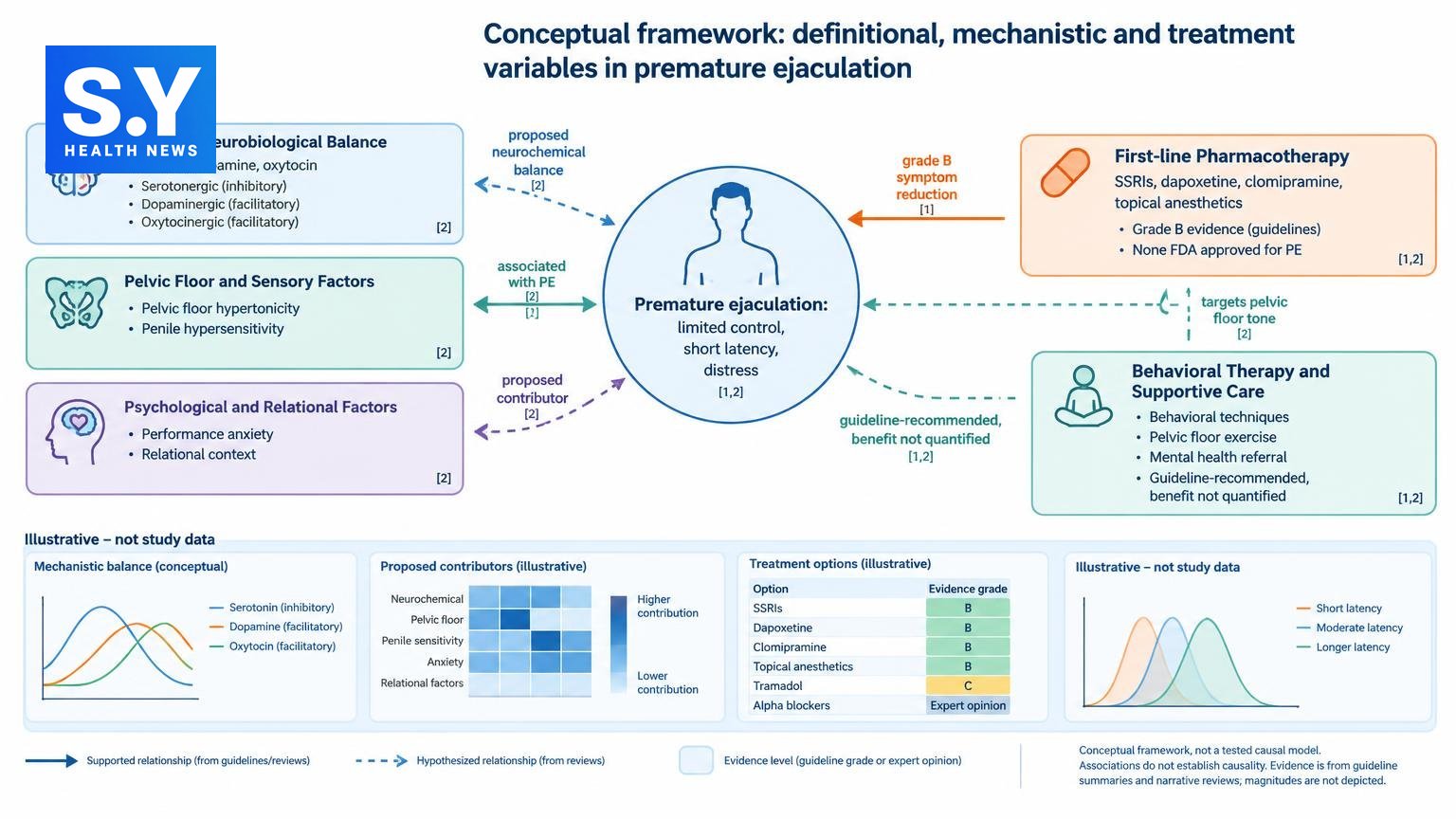
Conceptual framework: Conceptual framework, not a tested causal model. It organizes the article's variables: the composite PE definition; proposed neurochemical, pelvic floor and psychological contributors; and guideline-graded pharmacological and behavioral management. Arrows show reported associations or proposed relationships, not proven causation. Evidence is drawn from guideline summaries and narrative reviews; magnitudes are not depicted.
Academic References & Evidence
- Alan W. Shindel. AUA 2020: Disorders of ejaculation guidelines hailed as “most scientifically rigorous to date” | Urology Times. Urology Times. 2020 48(08)
- Natalia Pérez Romero. Trastornos eyaculatorios: revisión basada en guías europeas y americanas. Urología Madrid. 2025 4(10)
- Contemporary consensus and emerging directions in premature and delayed ejaculation: recommendations from the 5th International Consultation on Sexual Medicine.. Sexual medicine reviews PMID: 42855438.
SANYUN Science Center explains published research on men's reproductive and sexual health, connecting scientific evidence with everyday questions while making sources and limitations clear.
Disclaimer: This article is for scientific education and research communication only. It does not provide medical advice, diagnosis, or individualized treatment recommendations, and does not endorse any medication, supplement, device, penile enlargement procedure, or other intervention. Decisions about sexual and reproductive health should be made in consultation with a qualified healthcare professional. Do not delay seeking professional care because of information in this article.
Original Content & Copyright Notice
- This article is prepared for SANYUN Science Center, drawing on published research and publicly available academic literature on men’s sexual and reproductive health. Its editorial explanations and presentation are developed for this platform.
- Copyright in the original editorial content, selection, and arrangement is reserved by SANYUN Science Center to the extent protected by applicable law. Referenced research, quotations, and third-party materials remain subject to the rights of their respective owners. This notice does not claim ownership of scientific facts or third-party research.
- Except where permitted by applicable law or an applicable license, prior written permission is required to reproduce, republish, translate, adapt, redistribute, or commercially reuse protected content. Attribution alone does not grant permission for such reuse.
- For permitted quotation or authorized reuse, clearly identify the source and retain a link to the original article.
- Source: SANYUN Science Center
- Original URL: Retain the original article URL on science.san-yun.com.
- Copyright Holder: SANYUN Science Center, for its own protected editorial content.
- Quotation, excerpts, or authorized reuse must not distort the scientific meaning, omit material limitations or disclaimers, or imply unverified medical claims, product efficacy, or endorsement by SANYUN Science Center.



