




Category: Premature Ejaculation
Core Research Direction: Whether adding structured psychosexual therapy to an oral traditional Chinese herbal formula (Jiaotai Gujing Formula) improves intravaginal ejaculatory latency and anxiety/depression symptoms in men with premature ejaculation, compared with the herbal formula alone
Search Intent: In men with premature ejaculation, does combining an oral Chinese herbal formula with structured psychosexual counseling prolong intravaginal ejaculatory latency and reduce anxiety and depression more than the herbal formula alone?
Platform: SANYUN Science Center
Evidence reviewed through: 2026-11-10
Executive Summary
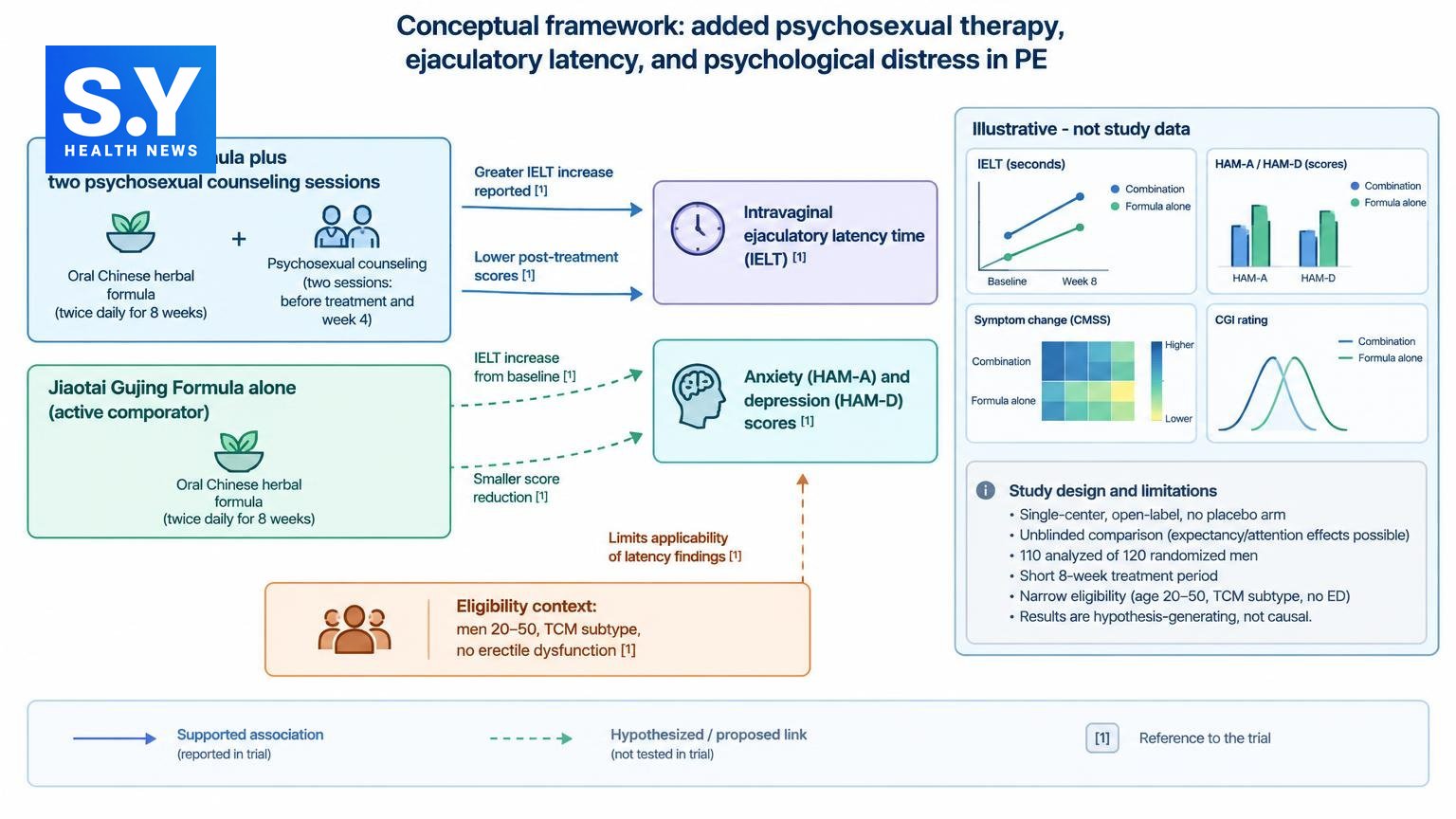
A single-center randomized controlled trial published in October 2025 asked whether structured psychosexual counseling adds benefit to an oral Chinese herbal preparation, Jiaotai Gujing Formula, in men with premature ejaculation. Of 120 randomized men, 110 completed eight weeks of treatment and were analyzed: 56 received the formula plus counseling and 54 received the formula alone.[1][2]
Mean intravaginal ejaculatory latency time (IELT) rose in both arms, to 211.11 ± 103.22 seconds with combination therapy and 174.74 ± 86.82 seconds with the formula alone, and the trial reports a significantly greater improvement in the combination group. Anxiety and depression scores also fell further with counseling. However, there was no placebo arm, the global impression outcome did not differ significantly, and the study was unblinded, so the added benefit of counseling cannot be cleanly separated from expectancy and attention effects.
- Both arms received the active herbal formula, so the trial estimates the incremental value of two counseling sessions rather than the effect of the formula versus placebo.
- Post-treatment IELT in both arms remained well below the typical one-minute threshold used to define lifelong PE, so the clinical significance of the between-group gap is uncertain.
- Eligible men were 20–50 years old with a specific Traditional Chinese Medicine syndrome subtype and no erectile dysfunction, which limits applicability to the broader PE population.
Why This Matters
Premature ejaculation is common and burdensome. The trial authors cite an estimate that roughly 30% of men experience PE, and the 2025 consensus review from the Fifth International Consultation on Sexual Medicine describes ejaculatory disorders as common conditions with substantial impact on quality of life and relationships.[3]
Conventional drug treatment is imperfect. The authors describe selective serotonin reuptake inhibitors as common first-line options but point to adverse effects and limited efficacy as reasons to look for alternatives, and they note that PE etiology is multifactorial, combining physiological, psychological and environmental contributors. That framing is the rationale for testing a combined pharmacological and psychological approach.
The psychological burden is not marginal in the authors' account. They cite a prior study of 958 participants in which 82.07% (444/541) of men with PE had anxiety and 74.68% (404/541) had depression. These figures come from a different study with denominators the article does not fully explain, so they should be read as context for why anxiety and depression were measured, not as prevalence estimates for this trial cohort.
Biological and Clinical Mechanism
The trial does not test a biological pathway. Its working model is a reciprocal loop: the authors propose that sexual performance anxiety can lead to excessive worry that impairs ejaculatory control, and that distress and PE can reinforce each other. Psychosexual counseling is intended to interrupt that loop by correcting sexual misconceptions and addressing anxiety, while the herbal formula is proposed to act on the same symptom cluster from a Traditional Chinese Medicine perspective.
This is a hypothesis, not a demonstrated mechanism. Nothing in the trial isolates how counseling would change ejaculatory control physiology, and the authors' discussion of herbal emotional regulation draws on separate literature rather than measurements from this cohort.
What the Evidence Shows
The trial was conducted in a single andrology department in Chongqing, China, recruiting between November 2024 and May 2025, and was registered prospectively in the ITMCTR. Eligibility required men aged 20–50 with PE for at least six months, stable partnered sexual activity at least four times per month, and a heart-kidney disharmony subtype on Traditional Chinese Medicine criteria; men with erectile dysfunction or genitourinary infection were excluded.
The planned sample was 120 (60 per group), based on prior effect estimates and an assumed 20% dropout with 90% power. Randomization used a computer-generated number table with odd-even allocation rather than concealed sequence generation, a detail that matters for bias risk. The psychosexual intervention was low intensity: two sessions with a qualified counselor, one before starting the formula and one during week 4 of the eight-week course.
Baseline IELT was similar between arms at 67.32 ± 26.17 seconds and 68.56 ± 28.49 seconds (p = 0.814). The article's own table reports a baseline IELT p value of 0.048 elsewhere, an internal inconsistency worth noting when weighing the precision of the reported comparisons. After eight weeks, IELT increased significantly in both arms, and the combination arm improved significantly more.
Anxiety and depression moved in the same direction. Post-treatment HAM-A was 7.70 ± 3.25 with combination therapy versus 9.89 ± 3.94 with the formula alone, and HAM-D was 6.45 ± 1.92 versus 8.59 ± 4.47, both statistically significant. The Chinese Medicine Symptom Score fell in both arms without a significant between-group difference, and Clinical Global Impression did not differ significantly, although 41.1% of the combination group versus 35.2% of the formula-only group were rated better or much better.
| Outcome | Combination therapy | Formula alone | Between-group finding | Interpretation |
|---|---|---|---|---|
| IELT after 8 weeks | 211.11 ± 103.22 s | 174.74 ± 86.82 s | Significant difference favoring combination | Absolute gap of roughly half a minute; no placebo arm |
| HAM-A after 8 weeks | 7.70 ± 3.25 | 9.89 ± 3.94 | Significant difference favoring combination | Both arms ended below the scale's mild-anxiety cut-off; unblinded rating |
| HAM-D after 8 weeks | 6.45 ± 1.92 | 8.59 ± 4.47 | Significant difference favoring combination | Psychotherapy effect expected; expectancy not controlled |
| CMSS change | Significant fall from baseline | Significant fall from baseline | No significant difference | Secondary outcome did not separate arms |
| CGI 'better or much better' | 41.1% | 35.2% | Not statistically significant | Global impression did not confirm superiority |
Interpretation and Limitations
The central interpretive problem is the missing placebo. Both arms took the same active herbal formula, so the trial answers a narrow but legitimate question: does adding two counseling sessions improve outcomes beyond the formula? It does not answer whether the formula itself works, and the authors' own earlier uncontrolled study of 35 patients could not separate formula effects from regression to the mean or natural fluctuation.
Blinding is a second constraint. Participants knew whether they received counseling, and outcome assessors are not described as masked, so anxiety, depression and global impression ratings are vulnerable to expectancy. IELT is somewhat more robust as a measured interval, but the article does not describe how it was timed, and no partner-recorded stopwatch protocol is reported.
Statistically significant differences are not automatically clinically meaningful. Post-treatment IELT in both arms remained close to the one-minute penetration threshold invoked in the international definition of lifelong PE for the more severe end of the condition, and the between-group gap of roughly 36 seconds on group means is modest. Anxiety scores in both arms ended in the mild range on the HAM-A cut-offs described, which suggests improvement but not resolution.
The analysis covered 110 completers rather than all 120 randomized men, and the article does not present an intention-to-treat analysis, so attrition could bias the comparison in either direction. A single center, a narrow Traditional Chinese Medicine subtype, exclusion of erectile dysfunction and a short eight-week horizon all limit generalization. Safety reporting is reassuring but thin: no significant laboratory or ECG abnormalities and no significant adverse reactions in the combination group, with two control-group cases of diarrhea, in a sample far too small to detect uncommon harms.
External context is limited. The consensus review available for this appraisal covers definitions, classification and treatment broadly, but the collected excerpt does not include the specific recommendations needed to compare this combination against guideline-concordant care. The trial should therefore be read as one signal-generating study rather than as practice-changing evidence.
Research Outlook
The most informative next step would be a three-arm trial adding a placebo or attention-control condition, so that the formula, the counseling and their combination can be separated. Blinded outcome assessment, partner-recorded IELT timing, a pre-registered analysis plan with intention-to-treat handling, and a longer follow-up would each strengthen inference. Because the counseling dose here was only two sessions, dose-response questions remain open: whether more intensive therapy adds more benefit, or whether two sessions capture most of the effect, is untested.
Replication outside a single Chinese andrology department, in men with and without comorbid erectile dysfunction and across PE subtypes, would clarify applicability. The trial's registered protocol offers a route to check whether the published outcomes match what was planned, which this review did not independently verify.
Key Takeaways
- In one 2025 randomized trial, adding two sessions of psychosexual counseling to Jiaotai Gujing Formula produced significantly longer IELT and lower anxiety and depression scores than the formula alone.
- Both arms received the active herbal formula, there was no placebo, and the study was unblinded, so the incremental benefit of counseling is plausible but not cleanly isolated.
- CMSS and global impression outcomes did not show significant between-group differences, tempering the overall picture.
- The results apply to men aged 20–50 with a specific Traditional Chinese Medicine subtype and no erectile dysfunction, treated for eight weeks at one center.
- Reported safety was favorable, but the sample is too small and the follow-up too short to rule out uncommon harms.
Questions and Answers
What is Jiaotai Gujing Formula and how was it combined with psychosexual therapy in this trial?
Jiaotai Gujing Formula is an oral granular Chinese herbal preparation derived from a classic formula, taken twice daily for eight weeks. In the trial it was given alone to one group and with psychosexual therapy to the other; that therapy consisted of two structured counseling sessions with a qualified counselor, one before treatment and one during week 4.
Did adding psychosexual therapy to the herbal formula lengthen intravaginal ejaculatory latency in premature ejaculation?
Yes, in this trial. Mean IELT rose to 211.11 ± 103.22 seconds with combination therapy versus 174.74 ± 86.82 seconds with the formula alone, and the combination group showed a significantly greater improvement. Both arms also improved from baseline, and there was no placebo arm to separate formula effects from expectancy.
How strong is the evidence that counseling plus Jiaotai Gujing Formula reduces anxiety and depression in premature ejaculation?
The trial reports significantly lower post-treatment HAM-A and HAM-D scores with combination therapy than with the formula alone, but the evidence is moderate at best. It comes from one unblinded single-center trial of 110 analyzed men, where expectancy and attention effects could inflate differences on clinician-rated psychological scales.
Can these premature ejaculation results be generalized to all men with the condition?
Not directly. Eligible men were 20–50 years old, had PE for at least six months, met a specific Traditional Chinese Medicine heart-kidney disharmony subtype, and were excluded if they had erectile dysfunction or genitourinary infection. All were treated at one Chinese andrology department for eight weeks, so broader applicability is unknown.
What are the main limitations and safety uncertainties of this combination therapy trial?
Key limitations include no placebo arm, no blinding, per-completer rather than intention-to-treat analysis, a single center and a short eight-week horizon. Safety reporting showed no significant laboratory or ECG abnormalities and no significant adverse reactions in the combination group, with two cases of diarrhea in the formula-only group, but the sample is too small to detect uncommon harms.
Did global impression and symptom scores differ between the two premature ejaculation treatment groups?
No. Chinese Medicine Symptom Score improved significantly in both arms without a significant between-group difference, and Clinical Global Impression scores did not differ significantly. The proportion rated better or much better was 41.1% with combination therapy versus 35.2% with the formula alone, a numerical edge that did not reach statistical significance.
Conceptual framework: Conceptual framework. In one single-center randomized trial of 110 analyzed men with premature ejaculation, adding two psychosexual counseling sessions to an oral Chinese herbal formula was associated with longer intravaginal ejaculatory latency and lower anxiety and depression scores than the formula alone. Arrows show reported associations; the comparison is unblinded and has no placebo arm, and the eligibility context limits generalization. Not a tested causal model.
Academic References & Evidence
- Di Sun; Yaowu Wang; Shuhong Wang; Guanchao Du; Wenxiao Yu; Jun Guo; Fan Zhao. Efficacy of Jiaotai Gujing Formula combined with psychosexual therapy for premature ejaculation: a randomized controlled trial. Journal of Men's Health. 2025 21(10):20-26 DOI: 10.22514/jomh.2025.123.
- Di Sun; Yaowu Wang; Shuhong Wang; Guanchao Du; Wenxiao Yu; Jun Guo; Fan Zhao. Efficacy of Jiaotai Gujing Formula combined with psychosexual therapy for premature ejaculation: a randomized controlled trial. Journal of Men's Health. 2025 21(10):20-26 DOI: 10.22514/jomh.2025.123.
- Contemporary consensus and emerging directions in premature and delayed ejaculation: recommendations from the 5th International Consultation on Sexual Medicine.. Sexual medicine reviews PMID: 42855438.
SANYUN Science Center explains published research on men's reproductive and sexual health, connecting scientific evidence with everyday questions while making sources and limitations clear.
Disclaimer: This article is for scientific education and research communication only. It does not provide medical advice, diagnosis, or individualized treatment recommendations, and does not endorse any medication, supplement, device, penile enlargement procedure, or other intervention. Decisions about sexual and reproductive health should be made in consultation with a qualified healthcare professional. Do not delay seeking professional care because of information in this article.
Original Content & Copyright Notice
- This article is prepared for SANYUN Science Center, drawing on published research and publicly available academic literature on men’s sexual and reproductive health. Its editorial explanations and presentation are developed for this platform.
- Copyright in the original editorial content, selection, and arrangement is reserved by SANYUN Science Center to the extent protected by applicable law. Referenced research, quotations, and third-party materials remain subject to the rights of their respective owners. This notice does not claim ownership of scientific facts or third-party research.
- Except where permitted by applicable law or an applicable license, prior written permission is required to reproduce, republish, translate, adapt, redistribute, or commercially reuse protected content. Attribution alone does not grant permission for such reuse.
- For permitted quotation or authorized reuse, clearly identify the source and retain a link to the original article.
- Source: SANYUN Science Center
- Original URL: Retain the original article URL on science.san-yun.com.
- Copyright Holder: SANYUN Science Center, for its own protected editorial content.
- Quotation, excerpts, or authorized reuse must not distort the scientific meaning, omit material limitations or disclaimers, or imply unverified medical claims, product efficacy, or endorsement by SANYUN Science Center.



