




Category: Premature Ejaculation
Core Research Direction: Characterizing premature ejaculation (PE) in men and their partners: the relationship between stopwatch-measured intravaginal ejaculatory latency time (IELT), patient-reported outcomes (control, satisfaction, distress, interpersonal difficulty), and companion assessments, including the diagnostic implications of IELT distribution overlap
Search Intent: How well does stopwatch-measured IELT differentiate men with premature ejaculation from those without, and how do men's and partners' reports of control, satisfaction, and distress relate to latency?
Platform: SANYUN Science Center
Evidence reviewed through: 2026-10-30
Executive Summary
Premature ejaculation (PE) is framed in the clinical literature as a common male sexual dysfunction with meaningful effects on men and their partners. A central assessment question is how much a single objective number, stopwatch-measured intravaginal ejaculatory latency time (IELT), can tell clinicians about who has PE and how much it matters to the people involved. A large multicenter observational study of men and their female partners addressed this directly by pairing clinician diagnosis and partner-held stopwatch timing with independently collected patient-reported outcomes from both members of each couple.[1]
The headline findings are statistically strong and clinically informative. Of 1,587 participants, 207 were diagnosed with PE and 1,380 were not. Median IELT was 1.8 minutes in the PE group versus 7.3 minutes in the non-PE group, a significant difference. Large majorities of men with PE rated control over ejaculation and satisfaction poorly and reported elevated personal distress far more often than men without PE. Crucially, the IELT distributions of the two groups overlapped, and the authors concluded that latency alone is insufficient to characterize PE.
This review interprets that published evidence rather than presenting new data. It is not a systematic review of the PE literature, and it does not evaluate treatment. Its purpose is to explain what the study measured, how the objective and subjective measures related, why distribution overlap complicates diagnosis, and where the limits of this evidence lie for clinicians and for men and partners trying to understand the condition.[2]
Why This Matters: Diagnosis Is Not Only a Number
Ejaculatory disorders, including PE and delayed ejaculation, are described in consensus guidance as common conditions with a substantial impact on quality of life and relationships. That framing matters because it moves the clinical question beyond duration. If a man ejaculates quickly but neither he nor his partner is distressed, the clinical meaning differs from a man with a similar latency who feels out of control, avoids intimacy, or experiences relationship strain. A definition built only on a time threshold risks mislabeling one and missing the other.
The observational study was designed around exactly this tension. Clinicians made the diagnosis using DSM-IV-TR criteria, while IELT was timed by the partner with a stopwatch during each intercourse experience across a four-week study period. Separately, men and partners rated control, satisfaction, distress and interpersonal difficulty on defined scales. This design allows the objective and subjective dimensions to be examined side by side, and it allows the partner's perspective to be analyzed rather than assumed.
What the Study Measured
The population was adults: men aged 18 or older and their female partners in monogamous relationships of at least six months. The design was a four-week, multicenter observational study with screening, baseline and follow-up visits at two-week intervals. Because couples were recruited as pairs, the study could compare how men and their partners each experienced the same sexual relationship, which is unusual in this literature and directly relevant to the question of whose report should count in assessment.
Two measurement choices deserve emphasis. First, timing was done by the partner holding a stopwatch, not by self-estimate, which reduces recall and estimation bias but introduces its own procedural demands. Second, the reported outcomes were collected independently from both members of the couple on explicitly anchored scales: control and satisfaction from very poor to very good, distress and interpersonal difficulty from not at all to extremely, and PE severity from none to severe. Independent partner reporting is a methodological strength because it avoids simply echoing the man's view.
What the Evidence Shows
The group sizes and latency difference were substantial. Among 1,587 total participants, 207 men were diagnosed with PE and 1,380 formed the non-PE group. Median IELT was 1.8 minutes in the PE group, with a range from 0 to 41 minutes, compared with 7.3 minutes in the non-PE group, with a range from 0 to 53 minutes. The difference was statistically significant at P<0.0001.
The patient-reported outcomes separated the groups even more sharply than the medians might suggest. For control over ejaculation, 72% of men with PE rated it very poor or poor versus 5% of men without PE. For satisfaction with sexual intercourse, 31% versus 1% gave those lowest ratings. For personal distress rated quite a bit or extremely, the figures were 64% versus 4%, and for interpersonal difficulty at those levels, 31% versus 1%. All comparisons were statistically significant.
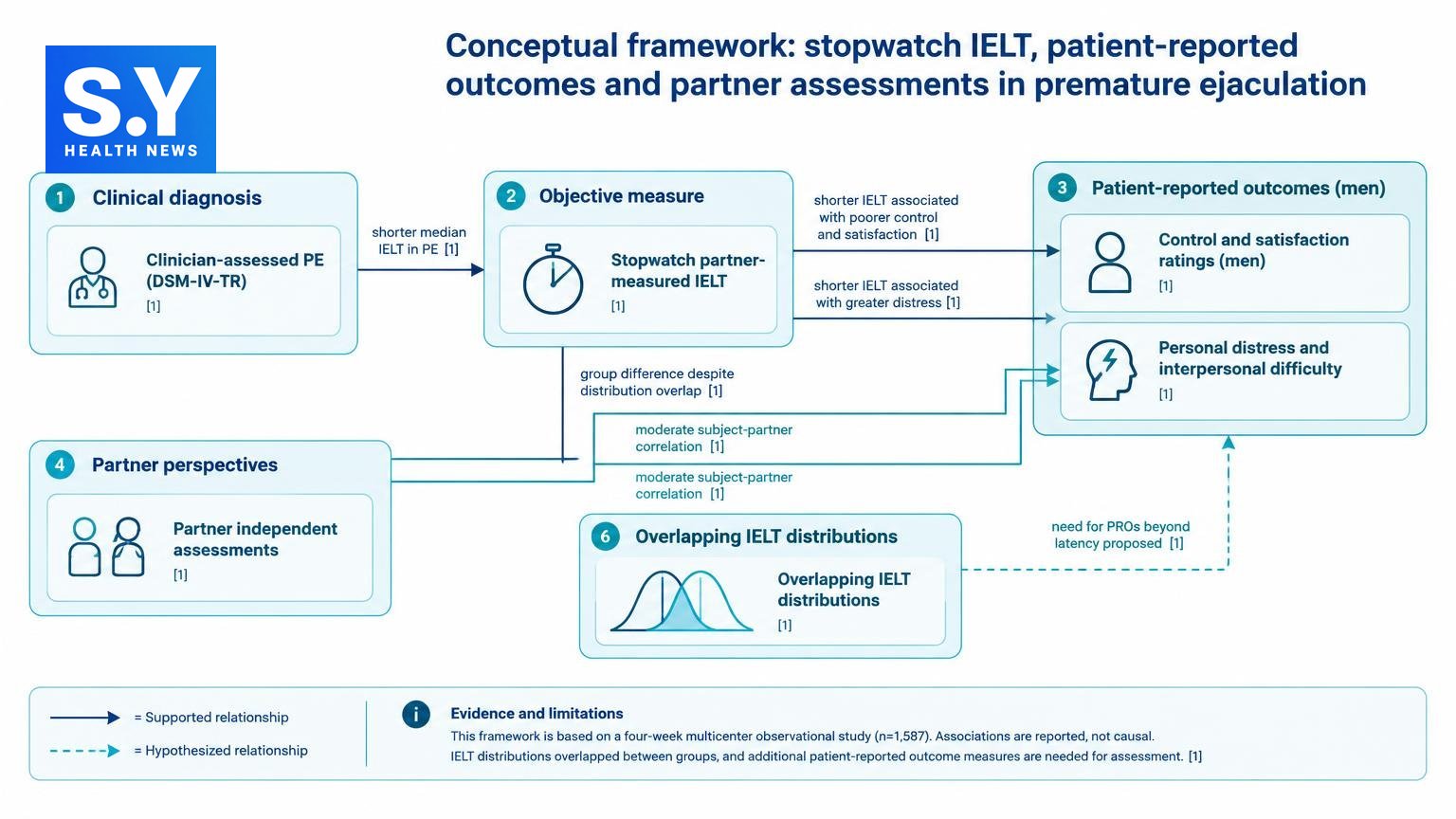
The authors also reported that shorter IELT was significantly associated with reduced ejaculatory control and sexual satisfaction and with increased distress and interpersonal difficulty. This is an association within an observational dataset, not a demonstration that short latency causes distress. The direction of influence could run either way, and both latency and distress may reflect other unmeasured factors. The partner data add a further dimension: subject and partner assessments showed similar patterns and correlated moderately, with coefficients from 0.36 to 0.57, indicating partial but not complete agreement between the two perspectives.
Interpreting Overlap: Statistical Difference Versus Diagnostic Separation
The most consequential finding for clinical reasoning is not the significant P value but the overlap in IELT distributions. A statistically significant difference between group medians means the groups differ on average; it does not mean a single latency value cleanly sorts individuals into PE and non-PE. The reported ranges make this concrete: some men in the PE group recorded latencies far above the group median, and some men without PE recorded very short latencies. A threshold applied to one intercourse event, or even to an average, will therefore misclassify some men in both directions.
The authors drew the appropriate inference: because the distributions overlap, additional patient-reported outcome measures are needed to characterize PE. In practical terms, latency is best treated as one informative dimension among several, alongside the man's sense of control, his and his partner's satisfaction, and the degree of distress or relationship difficulty. This is consistent with the broader consensus framing of ejaculatory disorders as conditions affecting quality of life and relationships, not merely as timing deficits.
Interpersonal Difficulty and Partner Perspectives
The distress and interpersonal difficulty figures are worth reading carefully. Personal distress was far more common than interpersonal difficulty in the PE group, at 64% versus 31% for the highest response categories. That gap suggests these are related but distinguishable constructs: a man may feel considerable personal distress about rapid ejaculation without reporting that it has created difficulty between him and his partner. Assessment that asks only about relationship strain could therefore underestimate the burden a man carries.
The moderate correlations between subject and partner assessments, from 0.36 to 0.57, reinforce that partners contribute independent information rather than duplicating the man's report. Moderate agreement means the two perspectives usually point in the same direction but can differ meaningfully in magnitude. Clinically, this supports asking partners about their experience when appropriate, while recognizing that partner reports are not a gold standard against which the man's report should be judged.
| Measure / finding | Result | Population / follow-up | Limitations |
|---|---|---|---|
| Of 1,587 total participants, 207 were diagnosed with PE and 1,380 were in the non-PE group. | 207 PE; 1,380 non-PE participants | Men aged ≥18 with female partners in monogamous relationships; n=1,587 | Group assignment based on clinician DSM-IV-TR diagnosis. |
| median IELT | 1.8 vs 7.3 minutes | Men with PE (n=207) vs non-PE (n=1380); 4-week observational period | Group medians; wide ranges indicate substantial overlap between groups. |
| proportion rating control very poor/poor | 72% vs 5% percent | PE (n=207) vs non-PE (n=1380) men | Self-reported rating; group comparison. |
| proportion rating distress/interpersonal difficulty quite a bit/extremely | distress 64% vs 4%; interpersonal difficulty 31% vs 1% percent | PE (n=207) vs non-PE (n=1380) men | Self-reported; group comparison. |
| proportion rating satisfaction very poor/poor | 31% vs 1% percent | PE (n=207) vs non-PE (n=1380) men | Self-reported; group comparison. |
| correlation | 0.36-0.57 correlation coefficient | Men and their female partners | Moderate correlations indicate partial, not complete, agreement between partners. |
| IELT distributions overlapped between PE and non-PE groups, indicating that latency alone may be insufficient and additional patient-reported outcome measures are needed to characterize PE. | PE and non-PE groups | Distribution overlap quantifies diagnostic ambiguity; supports multidimensional assessment. |
Limitations and What Remains Uncertain
Several limitations constrain how far these results can be generalized. The design was observational and cross-sectional in its comparisons, so it cannot establish causal relationships between latency and distress. Recruitment was restricted to men aged 18 or older in monogamous relationships of at least six months with female partners willing to participate, which excludes unpartnered men, non-monogamous relationships, and couples in which the partner declined involvement. Men who seek care or volunteer for research may differ from men in the broader community, and the authors themselves noted the scarcity of community-based data on PE.
The diagnostic standard was DSM-IV-TR, applied by clinicians. Later definitions and consensus processes may classify men differently, so the group boundaries in this study should not be assumed to match current diagnostic practice. Stopwatch timing by a partner, while reducing recall bias, is itself an intervention in the couple's sexual encounter and may not reflect typical behavior. The outcome scales are brief and anchored to ordinal categories, and the report summarizes selected response thresholds rather than full distributions.
Finally, the study reported associations and group differences, not predictive performance. It does not provide a validated latency cutoff, sensitivity and specificity estimates for a diagnostic threshold, or evidence that any assessment strategy improves outcomes. Those questions would require different designs. The moderate partner correlations likewise do not establish which informant is more accurate, only that the perspectives are related without being interchangeable.
Research and Clinical Outlook
Consensus work under the Fifth International Consultation on Sexual Medicine aims to synthesize evidence on the etiology, epidemiology, evaluation and management of premature and delayed ejaculation and to offer recommendations on definition, classification and treatment. The scope of that effort includes lifelong and acquired PE, penile hypersensitivity, IELT, psychotherapy, SSRIs and dapoxetine, reflecting how many domains a complete account of PE must span. Such consensus documents organize evidence but are not themselves primary experimental studies, so their recommendations should be read alongside the underlying trials and observational data.
For future research, the overlap finding points toward studies that model latency and patient-reported outcomes jointly rather than testing latency in isolation. Useful designs would examine whether combining IELT with control, distress and partner ratings improves classification compared with latency alone, and whether such combinations perform consistently across relationship contexts and diagnostic definitions. The current evidence supports a multidimensional description of PE; it does not yet specify how those dimensions should be weighted in practice.
Key Takeaways
- In a four-week multicenter observational study of 1,587 men and their female partners, median stopwatch-measured IELT was 1.8 minutes in the PE group and 7.3 minutes in the non-PE group, a significant difference.
- Men with PE much more often rated control and satisfaction as very poor or poor and reported high personal distress and interpersonal difficulty than men without PE.
- The IELT distributions of the two groups overlapped, so a single latency value does not reliably separate men with and without PE; additional patient-reported measures are needed.
- Personal distress was more common than interpersonal difficulty among men with PE, indicating these are related but distinct constructs worth asking about separately.
- Partner and subject assessments correlated moderately, from 0.36 to 0.57, so partner perspectives add information without replacing the man's own report.
- Shorter IELT was associated with poorer control and satisfaction and greater distress, but the observational design cannot establish causation.
Questions and Answers
What is intravaginal ejaculatory latency time (IELT) and how was it measured in this study?
IELT is the time from vaginal penetration to ejaculation. In this study it was measured with a stopwatch held by the female partner and recorded for each sexual intercourse experience over a four-week observational period, while clinicians made PE diagnoses using DSM-IV-TR criteria. Partner-held timing reduces reliance on self-estimate but may alter the encounter being measured.
How large was the difference in latency between men with and without premature ejaculation?
Median IELT was 1.8 minutes in the PE group, with a range of 0 to 41 minutes, compared with 7.3 minutes in the non-PE group, with a range of 0 to 53 minutes. The difference was statistically significant at P<0.0001, based on 207 men with PE and 1,380 without.
Why does overlap in IELT distributions matter for diagnosis?
Overlap means that although the groups differ on average, individual latency values do not cleanly separate men with PE from those without. Some men with PE recorded longer latencies and some without PE recorded very short ones. The authors concluded that latency alone is insufficient and that additional patient-reported outcome measures are needed to characterize PE.
How strong is the evidence that shorter latency is linked to distress and poorer satisfaction?
The study reported statistically significant associations: shorter IELT was linked to reduced ejaculatory control and satisfaction and to increased personal distress and interpersonal difficulty. However, this was an observational study, so the relationships are associations rather than causal effects. The evidence supports a multidimensional description of PE but does not establish which factor drives which.
Do partners report the same experiences as men with premature ejaculation?
Subject and partner assessments showed similar patterns but correlated only moderately, with coefficients from 0.36 to 0.57. This means partners usually point in the same direction as men but can differ meaningfully in magnitude. Partner reports add independent information and are not simply a confirmation of the man's view.
Who was included in this study, and what are the main limitations?
Participants were men aged 18 or older and their female partners in monogamous relationships of at least six months, recruited across multiple centers over four weeks. The design was observational, so causality cannot be inferred. Unpartnered men, non-monogamous couples and partners who declined participation were excluded, and DSM-IV-TR diagnostic criteria may not match current definitions, limiting generalizability.
Conceptual framework: Conceptual framework of variables examined in a four-week multicenter observational study of men with and without clinician-diagnosed premature ejaculation and their female partners. Arrows show reported associations, including moderate subject-partner correlations and the overlap of IELT distributions, which the authors interpreted as a need for additional patient-reported outcome measures. Relations are associational, not causal, and the framework is not a tested model.
Academic References & Evidence
- Patrick, D. L.; Althof, S. E.; Pryor, J. L.; Rosen, R.; Rowland, D. L.; Ho, K. F.; McNulty, P.; Rothman, M.; Jamieson, C.. Premature ejaculation: An observational study of men and their partners. Journal of Sexual Medicine. 2005 2(3):358-367 DOI: 10.1111/j.1743-6109.2005.20353.x.
- Contemporary consensus and emerging directions in premature and delayed ejaculation: recommendations from the 5th International Consultation on Sexual Medicine.. Sexual medicine reviews PMID: 42855438.
SANYUN Science Center explains published research on men's reproductive and sexual health, connecting scientific evidence with everyday questions while making sources and limitations clear.
Disclaimer: This article is for scientific education and research communication only. It does not provide medical advice, diagnosis, or individualized treatment recommendations, and does not endorse any medication, supplement, device, penile enlargement procedure, or other intervention. Decisions about sexual and reproductive health should be made in consultation with a qualified healthcare professional. Do not delay seeking professional care because of information in this article.
Original Content & Copyright Notice
- This article is prepared for SANYUN Science Center, drawing on published research and publicly available academic literature on men’s sexual and reproductive health. Its editorial explanations and presentation are developed for this platform.
- Copyright in the original editorial content, selection, and arrangement is reserved by SANYUN Science Center to the extent protected by applicable law. Referenced research, quotations, and third-party materials remain subject to the rights of their respective owners. This notice does not claim ownership of scientific facts or third-party research.
- Except where permitted by applicable law or an applicable license, prior written permission is required to reproduce, republish, translate, adapt, redistribute, or commercially reuse protected content. Attribution alone does not grant permission for such reuse.
- For permitted quotation or authorized reuse, clearly identify the source and retain a link to the original article.
- Source: SANYUN Science Center
- Original URL: Retain the original article URL on science.san-yun.com.
- Copyright Holder: SANYUN Science Center, for its own protected editorial content.
- Quotation, excerpts, or authorized reuse must not distort the scientific meaning, omit material limitations or disclaimers, or imply unverified medical claims, product efficacy, or endorsement by SANYUN Science Center.



