




Category: Premature Ejaculation
Core Research Direction: Evidence-based definition, classification, and management of lifelong versus acquired premature ejaculation, including the 2025–2026 ICSM consensus recommendations and the limited precision of the underlying evidence
Search Intent: How is premature ejaculation defined and subtyped (lifelong versus acquired), and what does the latest international consensus say about its evaluation and treatment?
Platform: SANYUN Science Center
Evidence reviewed through: 2026-11-06
Executive Summary
The Fifth International Consultation on Sexual Medicine (ICSM) has issued consensus recommendations on the definition, classification, evaluation and management of premature ejaculation (PE) and delayed ejaculation (DE). The review describes ejaculatory disorders as common conditions with a substantial impact on men's quality of life and their relationships, and it sets out to provide evidence-based recommendations for both conditions.[1]
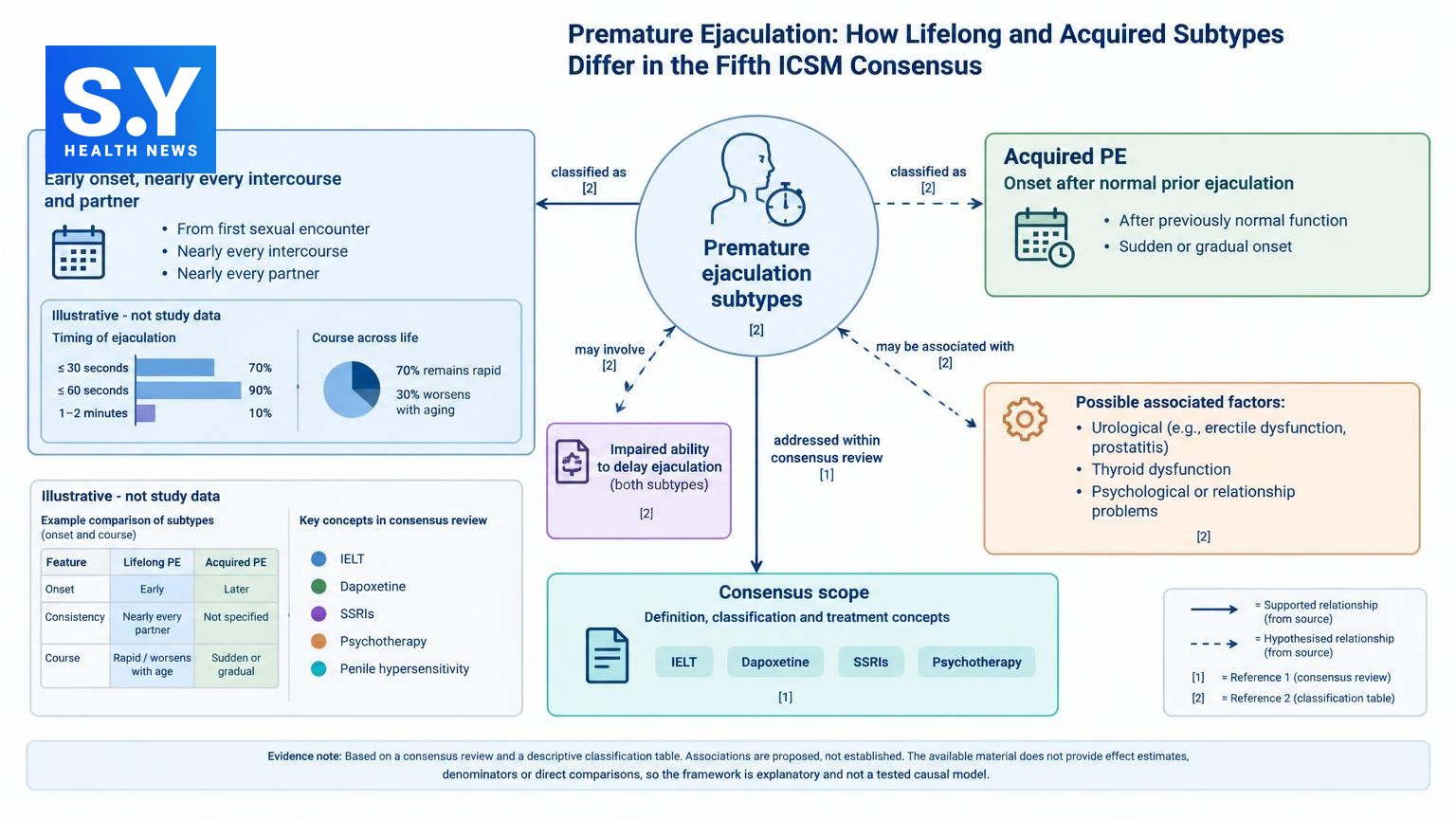
A central organising idea is subtyping. Lifelong PE is described as ejaculation occurring too early at nearly every intercourse, from about the first sexual encounter onward, and with nearly every partner. Acquired PE begins at some point in life after previously normal ejaculation experiences, with either sudden or gradual onset, and may be associated with urological dysfunction, thyroid dysfunction, or psychological and relationship problems.[2]
The supporting material is largely descriptive. The classification criteria are reported without a stated denominator, measurement method or primary study design, and the ICSM paper is a consensus review rather than a new experiment or a systematic review with pooled estimates. This review therefore interprets published recommendations and identifies where precision is limited.
Why This Matters
Ejaculatory disorders are not trivial complaints. The ICSM review characterises PE and DE as common conditions that substantially affect men's quality of life and their relationships, which makes accurate definition and classification clinically relevant rather than academic. How a clinician labels the problem shapes what is explored next: a lifelong pattern present from early sexual experience raises different questions from a change in function that appears later in life.
Subtyping also matters for communication. Men and their partners often describe the problem in terms of timing, control or distress, while classification frameworks rely on onset and consistency across partners and occasions. Recognising the difference between lifelong and acquired patterns helps align a man's account with the clinical categories used in the consensus literature.
Biological and Clinical Mechanism
The ICSM review considers several mechanistic and clinical concepts, reflected in its keywords: intravaginal ejaculatory latency time (IELT), penile hypersensitivity, selective serotonin reuptake inhibitors (SSRIs), dapoxetine and psychotherapy. These concepts span measurement of ejaculatory timing, proposed peripheral sensitivity, pharmacological modulation of ejaculation and psychological intervention. The review's stated aim is to synthesise findings and issue recommendations rather than to test a single mechanism.
The lifelong/acquired distinction is the main conceptual framework in the classification material. It separates a pattern present from early sexual life from one that emerges later, and it links the acquired form to possible urological, thyroid, psychological and relationship contributors. These contributors are framed as possibilities, not proven causes, and the accessible material provides no effect estimates for them.
Delay of ejaculation is described as possibly diminished or lacking in both subtypes, which suggests that impaired voluntary control may be a shared feature rather than a distinguishing one. That statement is framed as a possibility rather than a measured outcome, so it should not be read as a validated discriminator between lifelong and acquired PE.
What the Evidence Shows
The classification table reports descriptive timing figures for lifelong PE. In the majority of lifelong PE cases, ejaculation is reported within 30 seconds (70%), within 60 seconds (90%), or between 1 and 2 minutes (10%). These percentages are best read as overlapping cumulative thresholds rather than as a partition of cases: the 30-second and 60-second figures describe nested proportions, while the 10% figure refers to a later window. The excerpt does not give the denominator, source study or measurement method behind these proportions.
The same material describes lifelong PE as remaining rapid across life in 70% of cases or becoming aggravated with aging in 30%. Again, no denominator, study design or citation is supplied in the excerpt. These figures function as descriptive clinical teaching points rather than as verified population estimates, and they should not be treated as precise epidemiological values.
For acquired PE, the accessible material is qualitative. It describes onset after a period of normal ejaculation, either sudden or gradual, and lists possible associations with urological dysfunction such as erectile dysfunction or prostatitis, thyroid dysfunction, and psychological or relationship problems. No effect estimates, prevalence figures or comparative statistics appear in the excerpt.
The ICSM review is described as synthesising findings on the etiology, epidemiology, evaluation and management of PE and DE, with the stated aim of presenting evidence-based recommendations for definition, classification and treatment. Its keyword list names lifelong and acquired PE, IELT, dapoxetine, SSRIs, psychotherapy and penile hypersensitivity, indicating the scope of concepts considered. The abstract excerpt does not report the detailed recommendations or treatment effect sizes.
| Feature | Lifelong PE | Acquired PE | Interpretation |
|---|---|---|---|
| Onset | Ejaculation too early from about the first sexual encounter onward | Becomes too early at some point in life, after normal prior experiences | Onset timing is the main discriminating feature |
| Consistency and partners | Nearly every intercourse and with nearly every partner | Not characterised this way in the accessible material | Lifelong PE is framed as pervasive across partners |
| Temporal course | Remains rapid across life in 70% or becomes aggravated with aging in 30% | Sudden or gradual onset | Course descriptions differ; lifelong figures lack a stated denominator |
| Possible associated factors | Not listed as a defining feature in the accessible material | Urological dysfunction (e.g., erectile dysfunction, prostatitis), thyroid dysfunction, psychological or relationship problems | Associated factors are framed as possibilities, not proven causes |
| Timing of ejaculation | Majority reported within 30 seconds (70%), within 60 seconds (90%), or between 1 and 2 minutes (10%) | Not quantified in the accessible material | Timing figures are descriptive and methodologically opaque |
| Ability to delay | May be diminished or lacking | May be diminished or lacking | A possible shared feature rather than a discriminator |
Interpretation and Limitations
The most important limitation is that the available material does not allow direct estimation of treatment effects. The ICSM publication is a consensus review whose stated aim is to present evidence-based recommendations; the abstract excerpt provides no outcome data, no confidence intervals and no direct comparisons of dapoxetine, SSRIs, psychotherapy or penile hypersensitivity. Mention of these concepts should not be read as proof that any particular approach works for a given person.
The classification table is also methodologically thin. It distinguishes lifelong and acquired PE, but it does not specify the population, the measurement method or the provenance of the reported percentages. The figures for timing and course therefore function as descriptive clinical teaching points, not as verified epidemiological estimates.
Association is not causation for the acquired-PE factors. Urological dysfunction, thyroid dysfunction, and psychological or relationship problems are described as possibly associated with acquired PE. The accessible material does not establish direction of effect, shared mechanisms or causality, and it does not report effect sizes.
A further caution concerns what the consensus review does and does not claim. It presents recommendations for definition, classification and treatment, but it is not a systematic review with pooled estimates, and it is not a new trial. Where the underlying evidence is uncertain, recommendations may reflect expert consensus as much as high-certainty data.
Research Outlook
The ICSM review identifies the main conceptual territory for future work: sharper definition and classification, better characterisation of etiology and epidemiology, and evaluation of treatment options including SSRIs, dapoxetine and psychotherapy. The keyword emphasis on IELT and penile hypersensitivity suggests ongoing interest in measurable timing endpoints and in peripheral mechanisms of ejaculatory control.
For the lifelong/acquired distinction to become more than a teaching framework, studies would need to report clear denominators, standardised timing measurements and consistent definitions of onset. The accessible material does not report such data, so the distinction is best treated as a clinically useful, hypothesis-generating classification rather than a fully validated taxonomy.
Key Takeaways
- The ICSM consensus review classifies PE alongside delayed ejaculation as common ejaculatory disorders with substantial effects on quality of life and relationships.
- Lifelong PE is described as early ejaculation from about the first sexual encounter onward, at nearly every intercourse and with nearly every partner.
- Acquired PE begins after previously normal ejaculation, with sudden or gradual onset, and may be associated with urological, thyroid, psychological or relationship problems.
- Reported timing figures for lifelong PE (within 30 seconds in 70%, within 60 seconds in 90%, between 1 and 2 minutes in 10%) lack a stated denominator in the accessible source and are best read as overlapping cumulative thresholds.
- The consensus review names IELT, penile hypersensitivity, dapoxetine, SSRIs and psychotherapy as key concepts, but its abstract excerpt provides no comparative efficacy data.
- Impaired ability to delay ejaculation may be present in both subtypes, so it does not by itself separate lifelong from acquired PE.
Questions and Answers
How do lifelong and acquired premature ejaculation differ in onset and course?
Lifelong PE is described as ejaculation occurring too early at nearly every intercourse, from about the first sexual encounter onward, and with nearly every partner. Acquired PE begins at some point in life after previously normal ejaculation, either suddenly or gradually, and may be associated with urological, thyroid, psychological or relationship problems. The distinction rests on onset and prior normal function rather than on severity alone.
What does the Fifth ICSM consensus say about premature ejaculation definition and classification?
The Fifth International Consultation on Sexual Medicine review aims to present evidence-based recommendations for the definition, classification and treatment of premature and delayed ejaculation. It synthesises findings on etiology, epidemiology, evaluation and management, and its keywords include lifelong and acquired PE, IELT, dapoxetine, SSRIs, psychotherapy and penile hypersensitivity. The abstract excerpt does not report the detailed recommendations themselves.
How strong is the evidence behind the premature ejaculation classification criteria?
The evidence available here is largely descriptive. The classification table reports timing and course figures without a stated denominator, source study or measurement method, and the ICSM paper is a consensus review rather than a systematic review with pooled estimates or a new trial. The lifelong/acquired distinction is clinically useful, but it should be treated as a framework supported by expert synthesis rather than high-certainty primary data.
Does premature ejaculation affect quality of life and relationships?
Yes, according to the ICSM consensus review, which characterises ejaculatory disorders including premature and delayed ejaculation as common conditions with a substantial impact on men's quality of life and their relationships. The abstract excerpt does not quantify the size of that impact or report prevalence figures, so the statement should be understood as a consensus-level clinical observation rather than a measured effect estimate.
What are the limitations of the evidence on acquired premature ejaculation?
The accessible material describes acquired PE in qualitative terms only. Possible associations with urological dysfunction, thyroid dysfunction, and psychological or relationship problems are framed as possibilities, not proven causes, and no effect estimates or prevalence figures are reported. Direction of effect and shared mechanisms remain unknown, so associations should not be read as causal explanations.
Are dapoxetine, SSRIs and psychotherapy effective for premature ejaculation?
The ICSM consensus review lists dapoxetine, SSRIs, psychotherapy, penile hypersensitivity and IELT as key concepts, showing they fall within the scope of its recommendations. However, the accessible abstract excerpt provides no comparative efficacy data, response rates or effect sizes. Readers should not infer that any specific treatment is proven effective for an individual from this keyword-level information alone.
Conceptual framework: Conceptual framework of premature ejaculation subtyping based on a consensus review and a descriptive classification table. Lifelong and acquired PE are distinguished mainly by onset and prior normal ejaculation; associations with urological, thyroid, psychological or relationship factors are proposed, not established. The framework is explanatory, not a tested causal model.
Academic References & Evidence
- Contemporary consensus and emerging directions in premature and delayed ejaculation: recommendations from the 5th International Consultation on Sexual Medicine.. Sexual medicine reviews PMID: 42855438.
- Table 1..
SANYUN Science Center explains published research on men's reproductive and sexual health, connecting scientific evidence with everyday questions while making sources and limitations clear.
Disclaimer: This article is for scientific education and research communication only. It does not provide medical advice, diagnosis, or individualized treatment recommendations, and does not endorse any medication, supplement, device, penile enlargement procedure, or other intervention. Decisions about sexual and reproductive health should be made in consultation with a qualified healthcare professional. Do not delay seeking professional care because of information in this article.
Original Content & Copyright Notice
- This article is prepared for SANYUN Science Center, drawing on published research and publicly available academic literature on men’s sexual and reproductive health. Its editorial explanations and presentation are developed for this platform.
- Copyright in the original editorial content, selection, and arrangement is reserved by SANYUN Science Center to the extent protected by applicable law. Referenced research, quotations, and third-party materials remain subject to the rights of their respective owners. This notice does not claim ownership of scientific facts or third-party research.
- Except where permitted by applicable law or an applicable license, prior written permission is required to reproduce, republish, translate, adapt, redistribute, or commercially reuse protected content. Attribution alone does not grant permission for such reuse.
- For permitted quotation or authorized reuse, clearly identify the source and retain a link to the original article.
- Source: SANYUN Science Center
- Original URL: Retain the original article URL on science.san-yun.com.
- Copyright Holder: SANYUN Science Center, for its own protected editorial content.
- Quotation, excerpts, or authorized reuse must not distort the scientific meaning, omit material limitations or disclaimers, or imply unverified medical claims, product efficacy, or endorsement by SANYUN Science Center.



