




Category: Premature Ejaculation
Core Research Direction: Long-term and consensus-based management of premature ejaculation: what sex therapy and current international consensus recommendations can and cannot achieve for lifelong and acquired PE
Search Intent: How effective is treatment for premature ejaculation in the long term, and what does contemporary international consensus recommend for defining and managing it?
Platform: SANYUN Science Center
Evidence reviewed through: 2026-11-12
Executive Summary
Premature ejaculation (PE) is treated as a common ejaculatory disorder with meaningful effects on quality of life and relationships, and current international consensus work addresses its definition, classification, evaluation and management. The evidence base available for this review, however, is thin in specific ways that matter for anyone making treatment decisions or reading clinical claims.[1]
The clearest long-term outcome data come from a single prospective follow-up of couples treated with sex therapy for a range of sexual dysfunctions. That cohort shows an uneven picture: long-term outcome was often poor for PE, even though treatment-related improvements in couples' general relationships were usually sustained. Recurrence was common, and coping strategies reportedly helped many people recover from relapses.[2]
For contemporary practice, the Fifth International Consultation on Sexual Medicine provides consensus guidance spanning lifelong and acquired PE, intravaginal ejaculatory latency time (IELT), penile hypersensitivity, dapoxetine, selective serotonin reuptake inhibitors (SSRIs) and psychotherapy. The review synthesizes etiology, epidemiology, evaluation and management, and aims to deliver evidence-based recommendations on definition, classification and treatment.
What this literature cannot yet deliver is a robust, comparative, long-term account of which PE treatments work, for whom, and for how long. The gap is not a reason for therapeutic nihilism; it is a reason to be precise about what is established, what is consensus-based, and what remains an open question.
Why This Matters
Ejaculatory disorders are not trivial complaints. Consensus authors describe PE and delayed ejaculation (DE) as common conditions with a substantial impact on men's quality of life and their relationships. That framing matters because it shifts the clinical question from a narrow timing measure to a broader one: whether a man and his partner experience distress, avoidance, reduced confidence or relationship strain.
It also matters because the treatment most likely to be offered first — behavioural and psychological work, often described as sex therapy or psychotherapy — has long-term outcome data that are decades old and, for PE specifically, discouraging. In the follow-up cohort, outcome was excellent for vaginismus and good for erectile dysfunction but often poor for PE, and especially poor for female impaired sexual interest.
That pattern should be read carefully. A poor long-term result for PE in a mixed-dysfunction cohort does not prove that sex therapy fails for PE, nor that it fails for everyone. It does suggest that durable remission is not the norm in that sample, and that the field's historical confidence in sex therapy as a stand-alone solution for PE was not well supported by long-term data even at the time.
The Clinical Mechanism: Why PE Is Not Just a Timing Problem
Premature ejaculation is commonly divided into lifelong and acquired forms, a distinction the consensus review explicitly indexes alongside IELT, penile hypersensitivity, dapoxetine, SSRIs and psychotherapy. The classification is clinically useful because the two forms raise different questions: lifelong PE invites attention to constitutional or neurobiological factors, while acquired PE invites attention to change over time — new anxiety, relationship shifts, pelvic or urological problems, or other medical contributors.
IELT, the intravaginal ejaculatory latency time, is the most widely used objective anchor for defining and measuring PE. It is valuable for research comparability, but it captures only one dimension of a complaint that also includes perceived control, distress and partner experience. The consensus review's inclusion of IELT among its topics reflects that measurement role rather than any claim that a single stopwatch number defines the condition.
Penile hypersensitivity appears in the review's indexed topics as a proposed explanatory construct. It is plausible that differences in sensory thresholds contribute to some cases, but the available packet does not provide evidence establishing hypersensitivity as a cause of PE or as a validated treatment target. It should be treated as a hypothesis under discussion rather than an established mechanism.
The mechanism picture here is therefore conceptual rather than biochemical: lifelong versus acquired classification, latency measurement, a proposed sensory factor, and psychological and pharmacological intervention approaches. None of that amounts to a demonstrated causal pathway, and this review does not claim one.
What the Evidence Shows
The strongest specific long-term numbers in the available packet come from the prospective follow-up of couples who had entered sex therapy one to six years earlier for a variety of sexual dysfunctions. Successful follow-up, mostly by interview, was possible with at least one partner in 75% of cases among the 140 couples. That is a follow-up feasibility figure, not an efficacy figure, and should not be read as a success rate for treatment.
Within that cohort, recurrence of sexual difficulties was common. Importantly, coping strategies were identified that often helped people overcome relapses. This is a more nuanced finding than a simple success-or-failure verdict: some couples regained ground after setbacks, which suggests that relapse management, not just initial response, is part of what long-term care involves.
Outcome varied by dysfunction in an ordinal, qualitative pattern rather than a set of comparable rates: excellent for vaginismus, good for erectile dysfunction, often poor for premature ejaculation and especially for female impaired sexual interest. The available text does not report PE-specific subgroup sizes or outcome percentages, so the magnitude of the PE problem in this cohort cannot be quantified from what is available.
General relationship improvements resulting from treatment were usually sustained at long-term follow-up. This is a meaningful finding in its own right: even where the specific sexual complaint did not resolve, couples often retained relational gains. The available text does not describe how relationship improvement was measured or how large the effect was.
The authors' own conclusion was balanced: the results support continued use of sex therapy for sexual dysfunction, while also emphasizing the need for new therapeutic approaches for problems with poor outcome, especially female loss of sexual interest. Notably, PE is named as a poor-outcome problem in the results but not singled out in that concluding sentence.
| Source and design | Population and timing | Reported finding | What it does not establish |
|---|---|---|---|
| Prospective long-term follow-up of couples after sex therapy | 140 couples treated for various sexual dysfunctions; assessed 1–6 years after entering therapy | Follow-up achieved with at least one partner in 75% of cases, mostly by interview | Treatment efficacy; 75% is a follow-up rate, not a success rate |
| Prospective long-term follow-up of couples after sex therapy | Same cohort; 1–6 years after therapy | Recurrence of sexual difficulties was common; coping strategies often helped overcome relapses | Quantitative relapse rates; whether coping strategies were taught or self-generated |
| Prospective long-term follow-up of couples after sex therapy | Same cohort; outcome by dysfunction type | Excellent for vaginismus, good for erectile dysfunction, often poor for premature ejaculation and especially female impaired sexual interest | PE-specific subgroup sizes, rates or effect sizes; comparative efficacy between therapies |
| Prospective long-term follow-up of couples after sex therapy | Same cohort; relationship outcomes | Treatment-related improvements in couples' general relationships were usually sustained | Measurement method and magnitude of relationship improvement |
| Authors' interpretation of the follow-up cohort | Mixed sexual dysfunctions | Supports continued use of sex therapy; emphasizes need for new approaches for poor-outcome problems | That sex therapy is ineffective overall; that any newer approach has proven superiority |
| Fifth International Consultation on Sexual Medicine consensus review | Men with premature or delayed ejaculation | Synthesizes etiology, epidemiology, evaluation and management; aims to give evidence-based recommendations on definition, classification and treatment | Specific effect estimates or head-to-head trial results, which are not provided in the available text |
| Fifth International Consultation on Sexual Medicine consensus review | Topic scope | Indexed topics include acquired and lifelong PE, IELT, penile hypersensitivity, dapoxetine, SSRIs and psychotherapy | The content of specific recommendations or the strength of evidence behind each topic |
Interpretation and Limitations
Several limitations constrain how far this evidence can be pushed. The long-term follow-up is a single cohort published in 1986, drawn from couples seeking therapy for a mix of dysfunctions; it is not a randomised comparison of PE treatments, and it cannot separate the effect of therapy from natural fluctuation, relationship factors or passage of time. Follow-up was mostly by interview, which introduces recall and interviewer effects.
The PE-specific signal is qualitative. Saying outcome was "often poor" for PE is not the same as reporting a failure rate, and the packet gives no subgroup denominator. Readers should resist converting an ordinal description into a percentage. Likewise, the finding that relationship improvements were usually sustained is a general cohort statement, not a PE-specific outcome.
The contemporary consensus source is a narrative synthesis, not an empirical trial. Its stated aim is to present evidence-based recommendations on definition, classification and treatment under the guidance of the Fifth International Consultation on Sexual Medicine. Consensus documents are valuable for standardising practice and framing the state of the field, but the strength of any individual recommendation depends on the underlying studies, which are not detailed in the available text.
There is also a temporal mismatch worth naming plainly. The long-term outcome data are from the mid-1980s; the consensus work is contemporary. This review is therefore an updated evidence review (2026) that juxtaposes older longitudinal findings with current consensus framing — it does not describe a new study, and it should not be read as one.
Finally, the packet does not allow comparison of specific interventions. Dapoxetine, SSRIs and psychotherapy appear as indexed topics, meaning the consensus review addresses them, but the available material contains no effect sizes, response rates or head-to-head comparisons. Any claim that one of these is superior for lifelong versus acquired PE would be unsupported by what is available here.
Clinical Relevance: What Consensus Can and Cannot Do
For clinicians, the practical value of the consensus review is largely organisational and definitional. It supports a structured approach: classify PE as lifelong or acquired, use IELT as a measurement anchor, consider proposed contributors such as penile hypersensitivity without treating them as established, and draw on both psychological and pharmacological options including psychotherapy, dapoxetine and SSRIs.
What consensus cannot do is guarantee long-term outcomes. The most direct long-term data available here suggest that sex therapy alone often produced poor durable results for PE, while relational gains were more often sustained. That combination argues for expectation-setting: patients should not be told that a course of therapy will reliably resolve PE, and partners should not be told the relationship benefits are contingent on symptom cure.
The recurrence finding adds a further clinical implication. Because relapses were common but coping strategies often helped, follow-up care that anticipates setbacks and builds self-management may be more realistic than a discharge-after-response model. The available text does not specify which coping strategies were used or whether they were formally taught.
Distinguishing lifelong from acquired PE also shapes investigation. Acquired PE, by definition, represents a change from prior function; that temporal shift is where clinicians would ordinarily look for contributing factors. The consensus review indexes the distinction but the available packet does not supply aetiological detail, so this remains a framework for clinical reasoning rather than a specified algorithm.
Research Outlook
The clearest research gap is long-term, PE-specific outcome data for contemporary treatments. The 1986 cohort suggests durable response was often limited, but it cannot tell us whether modern combined approaches — psychological work plus pharmacological options such as dapoxetine or SSRIs — perform better over years rather than weeks. That question requires prospective designs with PE-specific samples, validated outcome measures beyond IELT, and partner-reported outcomes.
A second gap concerns mechanism. Penile hypersensitivity is indexed as a topic but not established as a causal pathway in the available material. Research that tests whether sensory factors predict treatment response, rather than assuming them, would clarify whether this construct deserves a place in clinical decision-making.
A third gap concerns relapse and maintenance. The follow-up data indicate recurrence was common and coping mattered, yet the literature available here does not describe structured relapse-prevention programmes for PE. Testing maintenance strategies, including booster sessions and partner-inclusive care, would address a problem the older data clearly identified but did not solve.
Consensus processes such as the Fifth International Consultation on Sexual Medicine are well placed to flag these gaps, and the review's aim explicitly includes recommendations for definition, classification and treatment. Translating that aim into measurable recommendations with stated evidence certainty would make future consensus more useful to both clinicians and researchers.
Key Takeaways
- Premature ejaculation is a common ejaculatory disorder with substantial impact on quality of life and relationships, according to consensus framing.
- In a prospective follow-up of 140 couples assessed 1–6 years after sex therapy, follow-up was achieved with at least one partner in 75% of cases, mostly by interview — a feasibility figure, not an efficacy rate.
- Long-term outcome in that cohort was often poor for premature ejaculation, while treatment-related improvements in couples' general relationships were usually sustained.
- Recurrence of sexual difficulties was common, but identified coping strategies often helped people overcome relapses, pointing to maintenance and relapse prevention as clinically relevant.
- The Fifth International Consultation on Sexual Medicine addresses definition, classification, evaluation and management of lifelong and acquired PE, with indexed topics including IELT, penile hypersensitivity, dapoxetine, SSRIs and psychotherapy.
- No head-to-head long-term comparisons of PE treatments are available in this evidence base; the consensus review provides guidance, not proof of comparative or durable efficacy.
Questions and Answers
What is premature ejaculation and how is lifelong PE distinguished from acquired PE?
Premature ejaculation is a common ejaculatory disorder that affects quality of life and relationships. Contemporary consensus classifies it into lifelong and acquired forms, with intravaginal ejaculatory latency time (IELT) as a key measurement anchor. Lifelong PE is present from early sexual experience, while acquired PE represents a change from prior function; the distinction guides how clinicians think about contributing factors.
What did the long-term follow-up of couples after sex therapy find about premature ejaculation outcomes?
In 140 couples assessed one to six years after sex therapy, outcome was excellent for vaginismus and good for erectile dysfunction but often poor for premature ejaculation. Recurrence was common, though coping strategies often helped overcome relapses, and general relationship improvements were usually sustained. Follow-up success with at least one partner was 75% of cases, mostly by interview.
How strong is the evidence that sex therapy works long term for premature ejaculation?
It is limited. The main long-term evidence comes from a single 1986 prospective cohort of couples treated for mixed sexual dysfunctions, not a randomised PE trial. PE-specific subgroup sizes and outcome rates are not reported, and follow-up relied mostly on interview. It suggests durable response was often poor for PE, but it cannot quantify a failure rate or compare therapies.
What do current international consensus recommendations say about managing lifelong and acquired PE?
The Fifth International Consultation on Sexual Medicine aims to give evidence-based recommendations on definition, classification and treatment of PE and delayed ejaculation, synthesizing etiology, epidemiology, evaluation and management. Indexed topics include lifelong and acquired PE, IELT, penile hypersensitivity, dapoxetine, SSRIs and psychotherapy. The available text does not detail the specific strength of each recommendation.
What are the limitations of applying this premature ejaculation evidence to individual patients?
The long-term data are old, come from a mixed-dysfunction cohort, and lack PE-specific rates; the consensus review is a narrative synthesis whose underlying studies are not detailed in available material. There are no head-to-head long-term comparisons of dapoxetine, SSRIs or psychotherapy. Findings describe group patterns and should not be used to predict an individual's response or to promise cure.
Why does relapse matter in the long-term management of premature ejaculation?
Because recurrence of sexual difficulties was common in long-term follow-up, yet identified coping strategies often helped people overcome relapses. This suggests that management should include maintenance and relapse-prevention planning rather than discharge after an initial response. The available text does not specify which coping strategies were effective or whether they were formally taught.
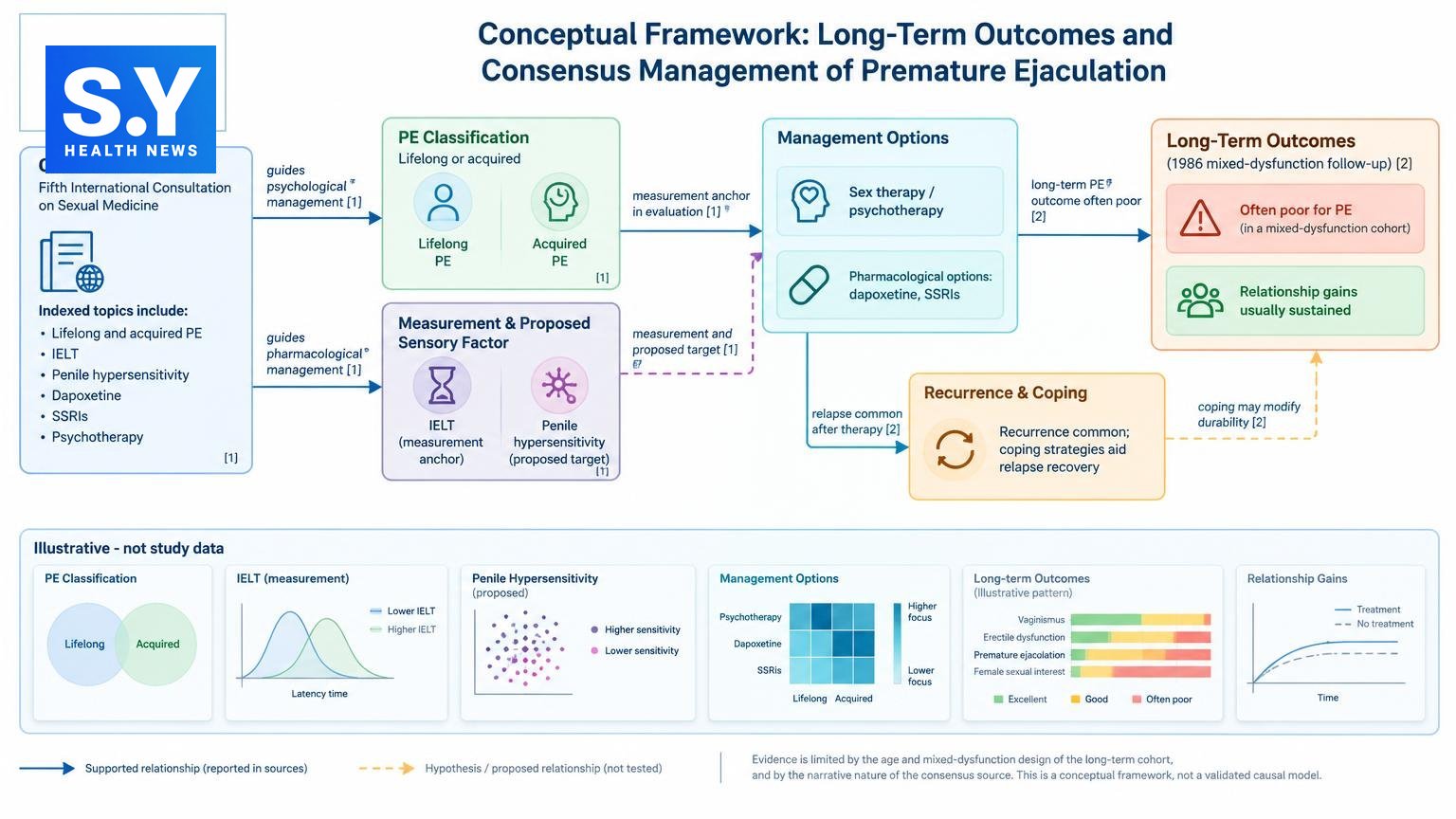
Conceptual framework: Conceptual framework of variables discussed in this review of long-term management of premature ejaculation. The figure links PE classification (lifelong versus acquired), measurement and proposed sensory constructs, psychological and pharmacological management options, and long-term outcomes from a 1986 mixed-dysfunction follow-up cohort alongside contemporary consensus topics. Relations shown as supported reflect associations reported in the cited sources; the relapse-coping and sensory-target links are proposed, not tested causal pathways. The framework is not a validated causal model or a treatment algorithm.
Academic References & Evidence
- Contemporary consensus and emerging directions in premature and delayed ejaculation: recommendations from the 5th International Consultation on Sexual Medicine.. Sexual medicine reviews PMID: 42855438.
- Hawton, K.; Catalan, J.; Martin, P.; Fagg, J.. Long-term outcome of sex therapy. Behaviour Research and Therapy. 1986 24(6):665-675 DOI: 10.1016/0005-7967(86)90062-8.
SANYUN Science Center explains published research on men's reproductive and sexual health, connecting scientific evidence with everyday questions while making sources and limitations clear.
Disclaimer: This article is for scientific education and research communication only. It does not provide medical advice, diagnosis, or individualized treatment recommendations, and does not endorse any medication, supplement, device, penile enlargement procedure, or other intervention. Decisions about sexual and reproductive health should be made in consultation with a qualified healthcare professional. Do not delay seeking professional care because of information in this article.
Original Content & Copyright Notice
- This article is prepared for SANYUN Science Center, drawing on published research and publicly available academic literature on men’s sexual and reproductive health. Its editorial explanations and presentation are developed for this platform.
- Copyright in the original editorial content, selection, and arrangement is reserved by SANYUN Science Center to the extent protected by applicable law. Referenced research, quotations, and third-party materials remain subject to the rights of their respective owners. This notice does not claim ownership of scientific facts or third-party research.
- Except where permitted by applicable law or an applicable license, prior written permission is required to reproduce, republish, translate, adapt, redistribute, or commercially reuse protected content. Attribution alone does not grant permission for such reuse.
- For permitted quotation or authorized reuse, clearly identify the source and retain a link to the original article.
- Source: SANYUN Science Center
- Original URL: Retain the original article URL on science.san-yun.com.
- Copyright Holder: SANYUN Science Center, for its own protected editorial content.
- Quotation, excerpts, or authorized reuse must not distort the scientific meaning, omit material limitations or disclaimers, or imply unverified medical claims, product efficacy, or endorsement by SANYUN Science Center.



