




Category: Premature Ejaculation
Core Research Direction: What population-based and clinic-based evidence exists on the prevalence, classification (lifelong/acquired/variable/subjective) and quality-of-life burden of premature ejaculation, and what do current consensus reviews identify as its etiology, evaluation and management — including how much of this is established versus uncertain?
Search Intent: How common is premature ejaculation really, how is it classified, and what does current consensus say about its causes and treatment — and how strong is that evidence?
Platform: SANYUN Science Center
Evidence reviewed through: 2026-11-05
Executive Summary
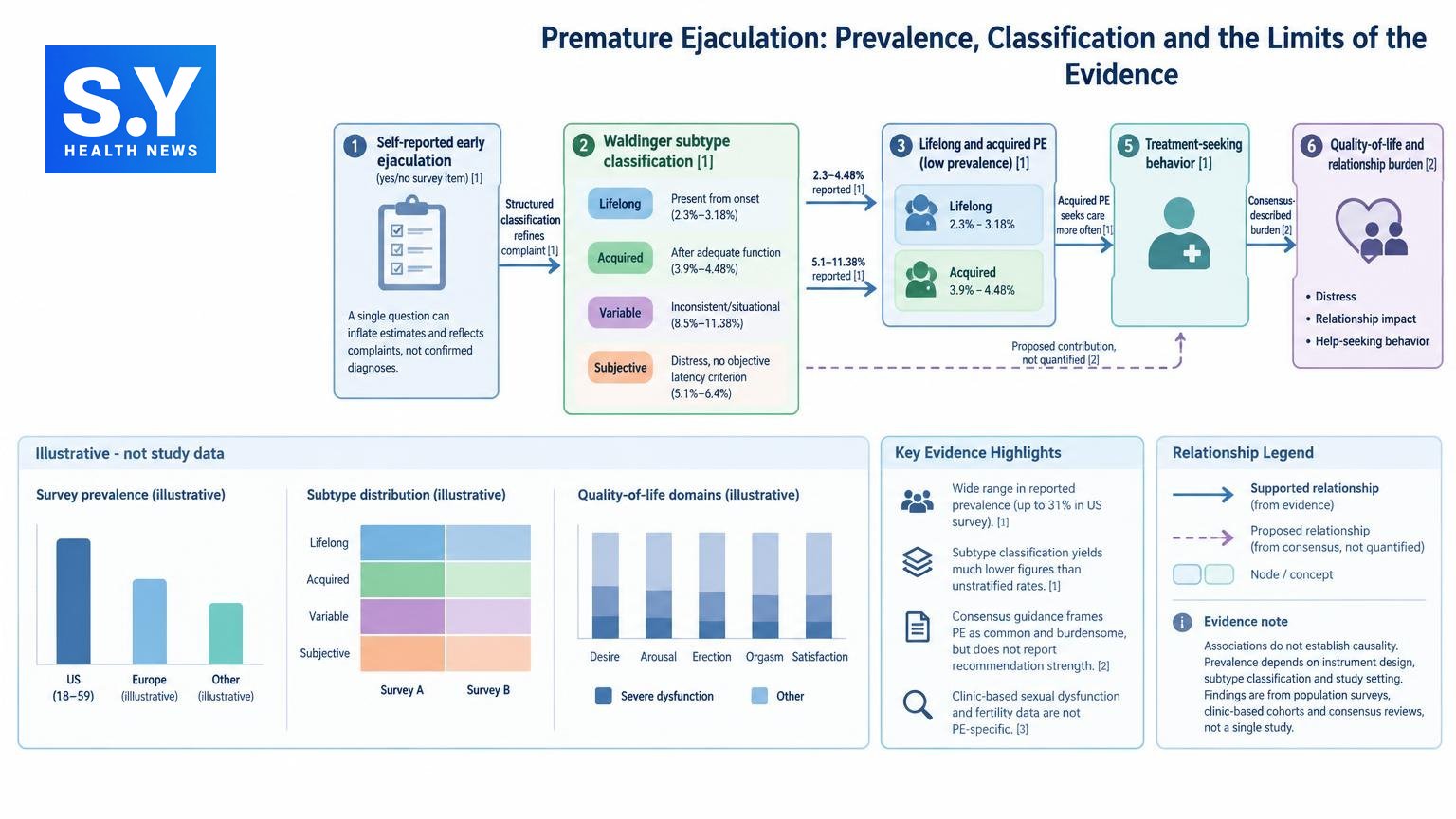
Reported premature ejaculation (PE) prevalence spans a very wide range depending on how the question is asked. The US National Health and Social Life Survey reported rates as high as 31% among men aged 18-59 years, with bands of 30% at 18-29, 32% at 30-39, 28% at 40-49 and 55% at 50-59. Guideline authors regard it as unlikely that true prevalence reaches 20-30%, noting relatively few men seek help and that a single yes/no question may inflate estimates.[1]
Two cross-sectional surveys from different continents reported overall rates of 19.8% and 25.8%. When complaints were stratified using the Waldinger classification, lifelong PE was 2.3% and 3.18%, acquired PE 3.9% and 4.48%, variable PE 8.5% and 11.38%, and subjective PE 5.1% and 6.4%. In both surveys, men with acquired PE were more likely to seek treatment than men with lifelong PE.
- Survey prevalence depends heavily on instrument design; single-question estimates are not clinical diagnoses.
- Strict subtype classification yields much lower figures than unstratified complaint rates.
- Consensus guidance positions ejaculatory disorders as common, distressing and relationship-relevant, while the strength of individual recommendations is not transparent in the available summary.[2]
- Clinic-based quality-of-life data, including infertility cohorts, measure broad sexual dysfunction rather than ejaculatory latency, so they cannot be read as PE-specific findings.[3]
Why This Matters
Ejaculatory disorders, premature and delayed, are described in consensus reviews as common conditions with a substantial impact on men's quality of life and their relationships. That framing matters because the burden is not limited to the timing of ejaculation; it extends to distress, partner dynamics and help-seeking behavior. The management question is therefore not only how many men meet a threshold but who is bothered enough to seek care and what can credibly be offered.
The wide discrepancy between survey rates and help-seeking behavior is itself informative. If roughly one in three men genuinely had a clinically meaningful disorder, clinics would see far more of it. The alternative interpretation, favored by guideline authors, is that many men answer yes to a general question about ejaculating too early without meeting a diagnostic threshold for a persistent, distressing condition. Separating complaint from disorder is central to sensible practice.
Biological or Clinical Mechanism and Classification
The supplied sources do not detail a specific neurobiological pathway. They do, however, establish a classification framework. The Waldinger subtypes divide PE into lifelong (present from early sexual activity), acquired (developing after a period of adequate function), variable (inconsistent, situational) and subjective (distress about latency that is not objectively short). These subtypes behave differently in practice: acquired PE carried higher treatment-seeking in the two surveys, which suggests that a change from a previous baseline is a strong motivator for consultation.
The consensus review keywords reference intravaginal ejaculatory latency time (IELT), penile hypersensitivity and selective serotonin reuptake inhibitors, indicating that timing measurement and serotonergic treatment are central to how the field operationalizes the condition. The supplied abstract does not quantify treatment effects, so these terms are best read as the review's scope markers rather than evidence of efficacy.
| Construct or variable | Source-grounded definition | Interpretation |
|---|---|---|
| Overall survey prevalence | Share of men answering affirmatively to a premature ejaculation question; US National Health and Social Life Survey reported up to 31% among men aged 18-59 years | Reflects complaints, not confirmed diagnoses; susceptible to question design |
| Lifelong PE | PE present from the onset of sexual life in the Waldinger classification | Reported at 2.3% and 3.18% in two cross-sectional surveys |
| Acquired PE | PE developing after a period of previously adequate ejaculatory function | Reported at 3.9% and 4.48%; associated with higher treatment-seeking than lifelong PE |
| Variable PE | Inconsistent or situational early ejaculation | Reported at 8.5% and 11.38%; the largest subtype in both surveys |
| Subjective PE | Distress about perceived early ejaculation without objective latency criterion | Reported at 5.1% and 6.4% |
| Sexual dysfunction in infertile men | Composite ASEX measure covering desire, arousal, erection, orgasm and satisfaction; severe score defined as 19 or above | Not a PE measure; 24.8% had severe sexual dysfunction in a Henan clinic sample of 319 men |
| Fertility quality of life | Validated FertiQoL score across emotional, mind-body, relational, social and treatment domains | 69.9% of the Henan sample scored below the poor-quality-of-life cutoff; association with severe sexual dysfunction was adjusted odds ratio 4.342 |
What the Evidence Shows
Population-level estimates are the most discrepant part of the literature. The US National Health and Social Life Survey yields the highest figures cited, with a peak band of 55% among men aged 50-59. Guideline authors caution that this is unlikely to represent true prevalence, pointing to low help-seeking and to the single dichotomous yes/no item. European studies are described as reporting significantly lower rates, though the magnitude of that difference is not quantified in the supplied text.
The more informative estimates come from surveys that applied subtype definitions. Overall rates of 19.8% and 25.8% conceal a structure in which lifelong and acquired PE together account for a modest minority, variable PE is the largest single category, and subjective PE occupies an intermediate position. This structure implies that many affirmative responses reflect situational or perception-based concerns rather than a persistent disorder. It also implies that prevalence figures reported without subtype breakdown are difficult to compare across studies.
On quality of life, the strongest quantitative data in the packet come from a different population than general PE. A cross-sectional survey of 319 infertile men in Henan, China, recruited from fertility clinics between December 2024 and January 2025, found that 69.9% had poor fertility quality of life and 24.8% had severe sexual dysfunction on the Arizona Sexual Experience Scale. Severe sexual dysfunction remained independently associated with poor fertility quality of life after adjustment, with an adjusted odds ratio of 4.342 (95% CI 2.366-7.967).
That study does not measure premature ejaculation. Its sexual dysfunction construct spans erectile difficulty, reduced libido and orgasm difficulty, and orgasm rather than ejaculatory latency was the domain assessed. Domain-level dysfunction in the full sample ranged narrowly from 21.6% to 23.5%, which indicates broadly distributed complaints rather than a specific ejaculatory profile. Citing it as PE prevalence would be a category error.
Consensus guidance contributes framing rather than numbers in the available material. The Fifth International Consultation on Sexual Medicine review aims to present evidence-based recommendations for definition, classification and treatment of premature and delayed ejaculation, synthesizing etiology, epidemiology, evaluation and management. The supplied abstract confirms scope and a stated aim; it does not report recommendation grades, effect sizes or the primary studies underpinning each statement.
Interpretation and Limitations
Three limitations dominate interpretation. First, measurement heterogeneity: a single yes/no item and a structured subtype interview are not measuring the same construct, and the guideline authors explicitly attribute discrepant rates to such methodological differences alongside age and sociocultural variation. Second, selection: clinic-based cohorts enrich for men already seeking care, and the Henan authors acknowledge that quota and purposive sampling from tertiary fertility clinics limits external validity. Third, design: cross-sectional data cannot establish temporal order or causation.
The Henan findings deserve particular caution in a PE context. The authors state plainly that all reported associations are correlational and that temporal sequence and causal direction cannot be determined from their data. The adjusted association between severe sexual dysfunction and poor fertility quality of life is statistically robust within that model, but statistical significance in a single clinic sample should not be translated into a clinical prediction rule or a causal mechanism.
The consensus review, as represented here, is a narrative synthesis. Its authority derives from expert consultation, not from a reproducible systematic search described in the supplied text. That does not make its recommendations unreliable, but it means readers should not treat the existence of a consensus statement as proof that every recommendation rests on high-certainty trial evidence. Where the packet is silent on treatment effect sizes, the honest position is that management exists and is debated, not that specific agents have demonstrated particular magnitudes of benefit.
Research Outlook
The clearest methodological priority is standardization. Studies that report a single overall prevalence figure without subtype breakdown cannot be pooled meaningfully with studies that apply lifelong, acquired, variable and subjective categories. Future surveys would benefit from consistent instruments, explicit latency criteria where relevant, and reporting of help-seeking alongside prevalence, since the gap between the two carries diagnostic information.
A second priority is separating ejaculatory-specific burden from general sexual and fertility distress. The Henan study shows that sexual dysfunction and fertility quality of life are associated, but it does not isolate ejaculation. Dedicated studies using ejaculatory latency measures in infertility and general populations would clarify whether the associations observed for broad sexual dysfunction extend specifically to PE.
Finally, the consensus process itself would be more useful to readers if recommendation strength were reported transparently alongside the underlying evidence base. The stated aim of providing evidence-based recommendations for definition, classification and treatment is a reasonable one; the next step is making the certainty behind each recommendation visible in accessible summaries.
Key Takeaways
- Premature ejaculation prevalence estimates range widely, up to 31% in the US National Health and Social Life Survey, but guideline authors doubt true prevalence reaches 20-30%.
- Applying subtype classification yields much lower figures: lifelong 2.3% and 3.18%, acquired 3.9% and 4.48%, variable 8.5% and 11.38%, subjective 5.1% and 6.4%.
- Acquired PE prompts treatment-seeking more often than lifelong PE in the available cross-sectional surveys.
- Consensus guidance frames ejaculatory disorders as common and burdensome and addresses definition, classification and treatment, but the supplied summary does not report recommendation strength or effect sizes.
- Clinic-based sexual dysfunction and fertility quality-of-life data are associative and cross-sectional; they should not be presented as PE prevalence or causation.
Questions and Answers
How common is premature ejaculation in population surveys?
Estimates vary widely. The US National Health and Social Life Survey reported up to 31% among men aged 18-59 years, while two cross-continental surveys reported 19.8% and 25.8%. Guideline authors consider it unlikely that true prevalence reaches 20-30%, because few men seek help and a single yes/no question may overstate the condition.
What are the lifelong, acquired, variable and subjective premature ejaculation subtypes?
Lifelong PE is present from the start of sexual activity; acquired PE develops after a period of adequate function; variable PE is inconsistent or situational; subjective PE is distress about perceived early ejaculation without objectively short latency. In two surveys, rates were 2.3% and 3.18% for lifelong, 3.9% and 4.48% for acquired, 8.5% and 11.38% for variable, and 5.1% and 6.4% for subjective.
Does premature ejaculation affect quality of life and relationships?
Consensus reviews describe ejaculatory disorders, including premature and delayed ejaculation, as common conditions with substantial impact on men's quality of life and relationships. Quantitative quality-of-life data in the available sources come from infertile men and measure broad sexual dysfunction rather than ejaculatory latency, so they support concern about burden but not PE-specific effect sizes.
How strong is the evidence behind current consensus recommendations on premature ejaculation?
The Fifth International Consultation on Sexual Medicine review is a narrative synthesis aiming to provide evidence-based recommendations on definition, classification and treatment. The available summary states this aim and scope but does not report recommendation grades, effect sizes or the underlying trial evidence, so the certainty behind individual recommendations cannot be judged from it.
Do the Chinese infertility clinic findings apply to premature ejaculation generally?
Probably not directly. The Henan study of 319 infertile men measured broad sexual dysfunction on the ASEX, including desire, erection and orgasm, not ejaculatory latency. Its finding that severe sexual dysfunction was associated with poor fertility quality of life (adjusted odds ratio 4.342) is cross-sectional, clinic-based and cannot establish causation or PE prevalence.
Why do premature ejaculation prevalence figures differ so much between studies?
Guideline authors attribute discrepancies to methodology, age distribution and sociocultural context. A single dichotomous yes/no question about ejaculating too early may capture transient complaints, whereas structured subtype interviews identify persistent patterns. European studies report significantly lower rates than the US survey, and the guideline explicitly describes reported prevalence as highly discrepant.
Conceptual framework: Conceptual framework. Self-reported early ejaculation on a single survey item is refined by Waldinger subtype classification into lifelong, acquired, variable and subjective categories, which carry markedly different prevalence. Treatment-seeking and quality-of-life burden are shown as related constructs; the link from variable and subjective PE to burden is proposed rather than quantified. Based on guideline epidemiology and a consensus review; relationships are conceptual, not a tested causal model.
Academic References & Evidence
- Epidemiology and Prevalence of Sexual Dysfunction and Disorders of Male Reproductive Health – EAU Guidelines on Sexual and Reproductive Health – Uroweb.
- Contemporary consensus and emerging directions in premature and delayed ejaculation: recommendations from the 5th International Consultation on Sexual Medicine.. Sexual medicine reviews PMID: 42855438.
- Zhongxin Wang; Xuan Su; Ruonan Li; Yifei Wang; Nurul Akmal Jamaludin; Hana Chen. Prevalence of sexual dysfunction and its association with fertility quality of life among infertile men in Henan, China. Reproductive Fertility (Reprod Fertil). 2026 7(2):RAF250195 DOI: 10.1530/RAF-25-0195. PMID: 42284120.
SANYUN Science Center explains published research on men's reproductive and sexual health, connecting scientific evidence with everyday questions while making sources and limitations clear.
Disclaimer: This article is for scientific education and research communication only. It does not provide medical advice, diagnosis, or individualized treatment recommendations, and does not endorse any medication, supplement, device, penile enlargement procedure, or other intervention. Decisions about sexual and reproductive health should be made in consultation with a qualified healthcare professional. Do not delay seeking professional care because of information in this article.
Original Content & Copyright Notice
- This article is prepared for SANYUN Science Center, drawing on published research and publicly available academic literature on men’s sexual and reproductive health. Its editorial explanations and presentation are developed for this platform.
- Copyright in the original editorial content, selection, and arrangement is reserved by SANYUN Science Center to the extent protected by applicable law. Referenced research, quotations, and third-party materials remain subject to the rights of their respective owners. This notice does not claim ownership of scientific facts or third-party research.
- Except where permitted by applicable law or an applicable license, prior written permission is required to reproduce, republish, translate, adapt, redistribute, or commercially reuse protected content. Attribution alone does not grant permission for such reuse.
- For permitted quotation or authorized reuse, clearly identify the source and retain a link to the original article.
- Source: SANYUN Science Center
- Original URL: Retain the original article URL on science.san-yun.com.
- Copyright Holder: SANYUN Science Center, for its own protected editorial content.
- Quotation, excerpts, or authorized reuse must not distort the scientific meaning, omit material limitations or disclaimers, or imply unverified medical claims, product efficacy, or endorsement by SANYUN Science Center.



