




Category: Premature Ejaculation
Core Research Direction: How well diagnostic instruments and self-reported ejaculation latency distinguish men with premature ejaculation from controls, and how contemporary consensus frames the definition, classification, and management of premature and delayed ejaculation.
Search Intent: How well do ejaculatory function questionnaires and self-reported ejaculation latency time differentiate men with premature ejaculation from controls, and what does the latest international consensus recommend for defining and managing ejaculatory disorders?
Platform: SANYUN Science Center
Evidence reviewed through: 2026-11-11
Executive Summary
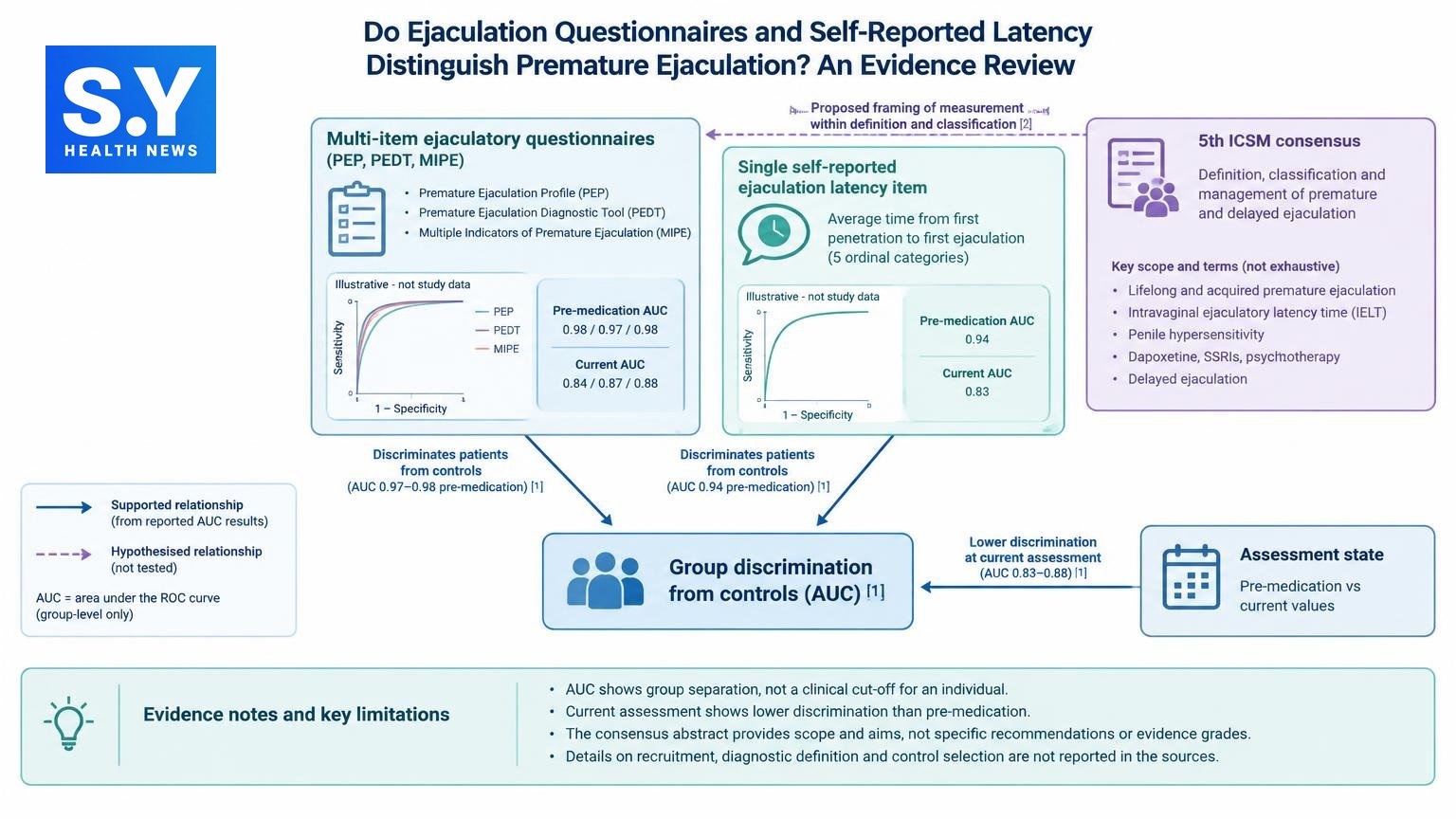
This review brings together two complementary strands of published evidence. The first is a diagnostic-accuracy analysis that compared three ejaculatory function questionnaires, plus a single self-reported latency item, against a control group. Using patients' pre-medication values, discrimination between groups was strong: the area under the receiver operating characteristic curve was 0.98 for the Premature Ejaculation Profile (PEP), 0.97 for the Premature Ejaculation Diagnostic Tool (PEDT), 0.98 for Multiple Indicators of Premature Ejaculation (MIPE), and 0.94 for self-reported ejaculation latency time.[1]
Using patients' current values, discrimination was lower but still substantial: 0.84 for the PEP, 0.87 for the PEDT, 0.88 for the MIPE, and 0.83 for self-reported latency. The analysis drew on 135 patients at pre-medication assessment, 148 patients at current assessment, and 892 controls. These are group-level statistics; they do not by themselves establish clinical cut-offs for diagnosing an individual man.
The second strand is a consensus review developed under the Fifth International Consultation on Sexual Medicine. It describes premature ejaculation and delayed ejaculation as common conditions with a substantial impact on quality of life and relationships, and states its aim as presenting evidence-based recommendations for their definition, classification and treatment. The abstract supplied here sets out scope and aims but does not disclose the individual recommendations or their evidence grades.[2]
Why Measurement Matters in Premature Ejaculation Care
Ejaculatory complaints are a frequent reason men seek sexual medicine care, yet the terms used in everyday conversation are often loose. A man may describe rapid ejaculation without reference to measured latency, distress or partner context, while a clinician may anchor on a time the patient never actually recorded. The consensus review characterises ejaculatory disorders, including premature and delayed ejaculation, as common conditions with a substantial impact on men's quality of life and their relationships, which places the question of measurement inside clinical care rather than outside it.
The practical stakes are straightforward. If brief questionnaires and a single latency question separate men with premature ejaculation from controls as well as the reported ROC statistics suggest, structured self-report has genuine triage value. If that separation weakens once patients are assessed at a different point, the same instruments cannot be treated as fixed diagnostic gates. Reading both findings together is the purpose of this review.
What the Instruments Actually Capture
The diagnostic analysis compared three multi-item questionnaires and one single latency question. The PEP, PEDT and MIPE each combine several items about the ejaculatory experience. The latency measure was a single item, drawn from the MIPE, which asked men to average the time between first penetration, vaginally or anally, and first ejaculation. Responses were recorded in five ordinal categories ranging from "I usually do not ejaculate" to "Less than 1 min." That design detail matters: the latency measure is a retrospective, broad-category self-report, not a stopwatch record or an event-level diary.
The statistic used to compare the measures was the area under the ROC curve. In this analysis, 1.00 indicates perfect differentiation between groups and 0.50 indicates chance-level differentiation. AUC therefore answers a group-separation question: how consistently a randomly chosen patient scores as more affected than a randomly chosen control. It does not answer the clinical question of which score or cut-off should trigger a diagnosis for a particular man.
What the Evidence Shows
Before medication, all four measures separated patients from controls strongly. The AUC was 0.98 for the PEP, 0.97 for the PEDT, 0.98 for the MIPE, and 0.94 for the self-reported latency item. The multi-item questionnaires had a marginal numerical edge over the single latency question, but all four sat in a range conventionally described as excellent discrimination.
| Measure | Pre-medication AUC | Current-value AUC | 95% CI at current values |
|---|---|---|---|
| Premature Ejaculation Profile (PEP) | 0.98 | 0.84 | 0.80 to 0.89 |
| Premature Ejaculation Diagnostic Tool (PEDT) | 0.97 | 0.87 | 0.84 to 0.91 |
| Multiple Indicators of Premature Ejaculation (MIPE) | 0.98 | 0.88 | 0.85 to 0.91 |
| Self-reported ejaculation latency time | 0.94 | 0.83 | 0.79 to 0.86 |
When patients' current values were analysed, discrimination fell to 0.84 for the PEP, 0.87 for the PEDT, 0.88 for the MIPE, and 0.83 for self-reported latency. The direction of change was consistent across all four measures: the same patient group, assessed at a different point, was harder to separate from controls. The source table does not explain why. Treatment exposure, regression toward the mean, shifts in how symptoms are reported, or differences in which patients contributed current data are all plausible contributors that the available excerpt cannot adjudicate.
The sample structure deserves attention. The pre-medication analysis drew on 135 patients, the current-value analysis on 148 patients, and both were compared against 892 controls. The control group is substantially larger than either patient group, which is common in diagnostic-accuracy work but means the confidence intervals around patient-derived estimates deserve as much weight as the point estimates. The reported intervals at current assessment remain relatively narrow, from 0.79 to 0.91 across the four measures, consistent with the large control sample.
How Consensus Frames Premature and Delayed Ejaculation
The Fifth International Consultation on Sexual Medicine review positions ejaculatory disorders as a linked pair rather than a single condition. Its stated aim is to present evidence-based recommendations for the definition, classification and treatment of premature and delayed ejaculation, and its scope covers etiology, epidemiology, evaluation and management. The keyword list signals the constructs in play: lifelong and acquired premature ejaculation, intravaginal ejaculatory latency time (IELT), penile hypersensitivity, dapoxetine, selective serotonin reuptake inhibitors (SSRIs), psychotherapy, and delayed ejaculation.
Two implications follow. First, the lifelong versus acquired distinction appears as a classification axis rather than a footnote; the two presentations may differ in onset, course and management emphasis. Second, the inclusion of IELT as a named construct confirms that measured or estimated latency remains central to how the field defines premature ejaculation, even though the diagnostic-accuracy data show that a single latency item is not a stand-alone substitute for multidimensional assessment.
Penile hypersensitivity appears in the keyword list as a topic under discussion, not as an established cause. That distinction matters for readers who encounter the word "hypersensitivity" in consumer-facing material. The consensus review includes it within scope, but the supplied abstract provides no finding that establishes it as a mechanism of premature ejaculation, and no effect size is reported. Keyword scope should not be read as a causal claim or a treatment recommendation.
Interpretation and Limitations
The AUC values are best read as evidence that structured self-report carries real signal. A value of 0.94 for a single ordinal latency question is notable: it suggests that men's own estimate of penetration-to-ejaculation time, even in coarse categories, tracks the clinical distinction reasonably well at group level. That does not mean a single question should replace a full evaluation. AUC summarises ranking performance across an entire sample; a clinician still needs a threshold, and the source does not supply one.
The drop from pre-medication to current values is the finding most likely to be misread. It does not show that the instruments are unreliable; it shows that discrimination depends on the clinical state of the sample being tested. Once patients' symptoms change, the boundary between patient and control becomes less sharp. The source table gives no information on treatment status at the current assessment, so a causal interpretation of the change is not possible from this excerpt.
- Group discrimination is not individual diagnosis: high AUC values describe separation across samples, not a validated cut-off for one man.
- Self-reported latency in this analysis used five broad ordinal categories and retrospective recall, not stopwatch-measured IELT or a prospective diary.
- The source table does not report recruitment methods, the operational definition of premature ejaculation used, or how controls were selected.
- The consensus abstract lists scope and aims but does not disclose specific recommendations or their evidence grades.
A second limitation concerns the consensus material itself. Its stated aim is to present evidence-based recommendations, but the supplied abstract gives scope rather than content. Readers should not treat the appearance of dapoxetine, SSRIs or psychotherapy in a keyword list as evidence that any particular treatment is recommended, superior, or appropriate for a given patient. Those are topics within the review's remit, and the details sit behind the abstract.
Open Questions on Classification and Measurement
Several questions follow naturally from these two sources. How do questionnaire scores and latency reports perform when premature ejaculation is defined using the lifelong versus acquired distinction that the consensus review foregrounds? Do the instruments retain their discrimination when the comparator group includes men with delayed ejaculation rather than only unaffected controls? And does a brief latency item add incremental value beyond multi-item questionnaires in a clinical pathway, or does it mainly serve as a screening prompt?
The consensus review's inclusion of delayed ejaculation alongside premature ejaculation also invites a symmetry check. If the same instruments are used to characterise delayed ejaculation, do they perform comparably, or were they built around a premature-ejaculation-centric construct of "too short" latency? The abstract does not answer this, and the diagnostic analysis reported here concerns premature ejaculation only.
Key Takeaways
- Three questionnaires and one self-reported latency item each discriminated men with premature ejaculation from controls with AUC values between 0.94 and 0.98 at pre-medication assessment.
- At current assessment, AUC values were lower but still substantial, ranging from 0.83 to 0.88 across the same measures.
- AUC is a group-level discrimination statistic; 1.00 means perfect separation and 0.50 means chance, and neither figure supplies a clinical cut-off.
- The Fifth International Consultation on Sexual Medicine review frames premature and delayed ejaculation as common, quality-of-life-relevant conditions and aims to give evidence-based guidance on definition, classification and treatment; the abstract does not disclose those recommendations.
- Lifelong versus acquired premature ejaculation, IELT, penile hypersensitivity, dapoxetine, SSRIs and psychotherapy appear as review topics, not as established comparative findings in the supplied material.
Questions and Answers
What is the difference between a multi-item ejaculation questionnaire and a single self-reported latency question?
A questionnaire such as the PEP, PEDT or MIPE combines several items about ejaculatory control, timing and distress into a composite score. The latency measure in this analysis was a single MIPE item asking men to average penetration-to-ejaculation time across five broad ordinal categories, from "I usually do not ejaculate" to "Less than 1 min." It relies on retrospective recall rather than a stopwatch or diary.
How well did premature ejaculation diagnostic questionnaires distinguish patients from controls?
Using patients' pre-medication values, the AUC was 0.98 for the PEP, 0.97 for the PEDT, 0.98 for the MIPE and 0.94 for self-reported latency, indicating strong group-level separation. These are discrimination statistics across a sample of 135 pre-medication patients and 892 controls, not validated individual diagnostic cut-offs.
Why were questionnaire scores less able to separate patients from controls at current assessment?
When patients' current values were analysed, AUC values fell to 0.84 for the PEP, 0.87 for the PEDT, 0.88 for the MIPE and 0.83 for self-reported latency. Discrimination depends on the clinical state of the sample, and once symptoms change the patient-control boundary becomes less sharp. The source table does not specify treatment status at the current assessment, so the reason cannot be determined from this material.
Do high AUC values for ejaculatory function questionnaires establish a clinical cut-off for diagnosing premature ejaculation?
No. In this analysis, AUC ranges from 0.50, meaning chance-level differentiation, to 1.00, meaning perfect differentiation, so values of 0.94 to 0.98 indicate near-perfect separation across the samples studied. AUC describes ranking performance across groups and does not establish which score should define premature ejaculation in an individual man.
What does the 5th International Consultation on Sexual Medicine say about defining and managing premature and delayed ejaculation?
The review describes premature and delayed ejaculation as common conditions with substantial impact on quality of life and relationships, and its stated aim is to present evidence-based recommendations for their definition, classification and treatment, drawing on evidence about etiology, epidemiology, evaluation and management. The supplied abstract sets out scope and aims but does not disclose the individual recommendations or their evidence grades.
Does the consensus review establish penile hypersensitivity as a cause of premature ejaculation?
No. Penile hypersensitivity appears in the review's keyword list as a topic within scope, alongside lifelong and acquired premature ejaculation, intravaginal ejaculatory latency time, dapoxetine, SSRIs and psychotherapy. The supplied abstract reports no finding establishing hypersensitivity as a cause, and no effect size is given. Keyword scope should not be read as a causal claim or treatment recommendation.
Conceptual framework: Conceptual framework. Two self-report routes, multi-item questionnaires (PEP, PEDT, MIPE) and a single ordinal latency item, each discriminated men with premature ejaculation from controls in ROC analysis; discrimination was lower at current than pre-medication assessment. The 5th ICSM consensus frames definition, classification and management of premature and delayed ejaculation. Solid arrows reflect reported AUC results; the proposed link from consensus framing to measurement is not tested. AUC is group-level only.
Academic References & Evidence
- Table 3. Ability of ejaculatory function instruments and self-reported ejaculation latency time to differentiate between patients and controls..
- Contemporary consensus and emerging directions in premature and delayed ejaculation: recommendations from the 5th International Consultation on Sexual Medicine.. Sexual medicine reviews PMID: 42855438.
SANYUN Science Center explains published research on men's reproductive and sexual health, connecting scientific evidence with everyday questions while making sources and limitations clear.
Disclaimer: This article is for scientific education and research communication only. It does not provide medical advice, diagnosis, or individualized treatment recommendations, and does not endorse any medication, supplement, device, penile enlargement procedure, or other intervention. Decisions about sexual and reproductive health should be made in consultation with a qualified healthcare professional. Do not delay seeking professional care because of information in this article.
Original Content & Copyright Notice
- This article is prepared for SANYUN Science Center, drawing on published research and publicly available academic literature on men’s sexual and reproductive health. Its editorial explanations and presentation are developed for this platform.
- Copyright in the original editorial content, selection, and arrangement is reserved by SANYUN Science Center to the extent protected by applicable law. Referenced research, quotations, and third-party materials remain subject to the rights of their respective owners. This notice does not claim ownership of scientific facts or third-party research.
- Except where permitted by applicable law or an applicable license, prior written permission is required to reproduce, republish, translate, adapt, redistribute, or commercially reuse protected content. Attribution alone does not grant permission for such reuse.
- For permitted quotation or authorized reuse, clearly identify the source and retain a link to the original article.
- Source: SANYUN Science Center
- Original URL: Retain the original article URL on science.san-yun.com.
- Copyright Holder: SANYUN Science Center, for its own protected editorial content.
- Quotation, excerpts, or authorized reuse must not distort the scientific meaning, omit material limitations or disclaimers, or imply unverified medical claims, product efficacy, or endorsement by SANYUN Science Center.



