




Category: Premature Ejaculation
Core Research Direction: Diagnostic performance of patient-reported ejaculatory function instruments (PEP, PEDT, MIPE) and self-reported ejaculation latency time for differentiating men with premature ejaculation from controls, contextualized within contemporary consensus recommendations on PE definition, classification and management.
Search Intent: How well do patient-reported questionnaires and self-reported ejaculation latency time actually distinguish men with premature ejaculation from controls, and what does current expert consensus say about defining and managing the condition?
Platform: SANYUN Science Center
Evidence reviewed through: 2026-11-02
Executive Summary
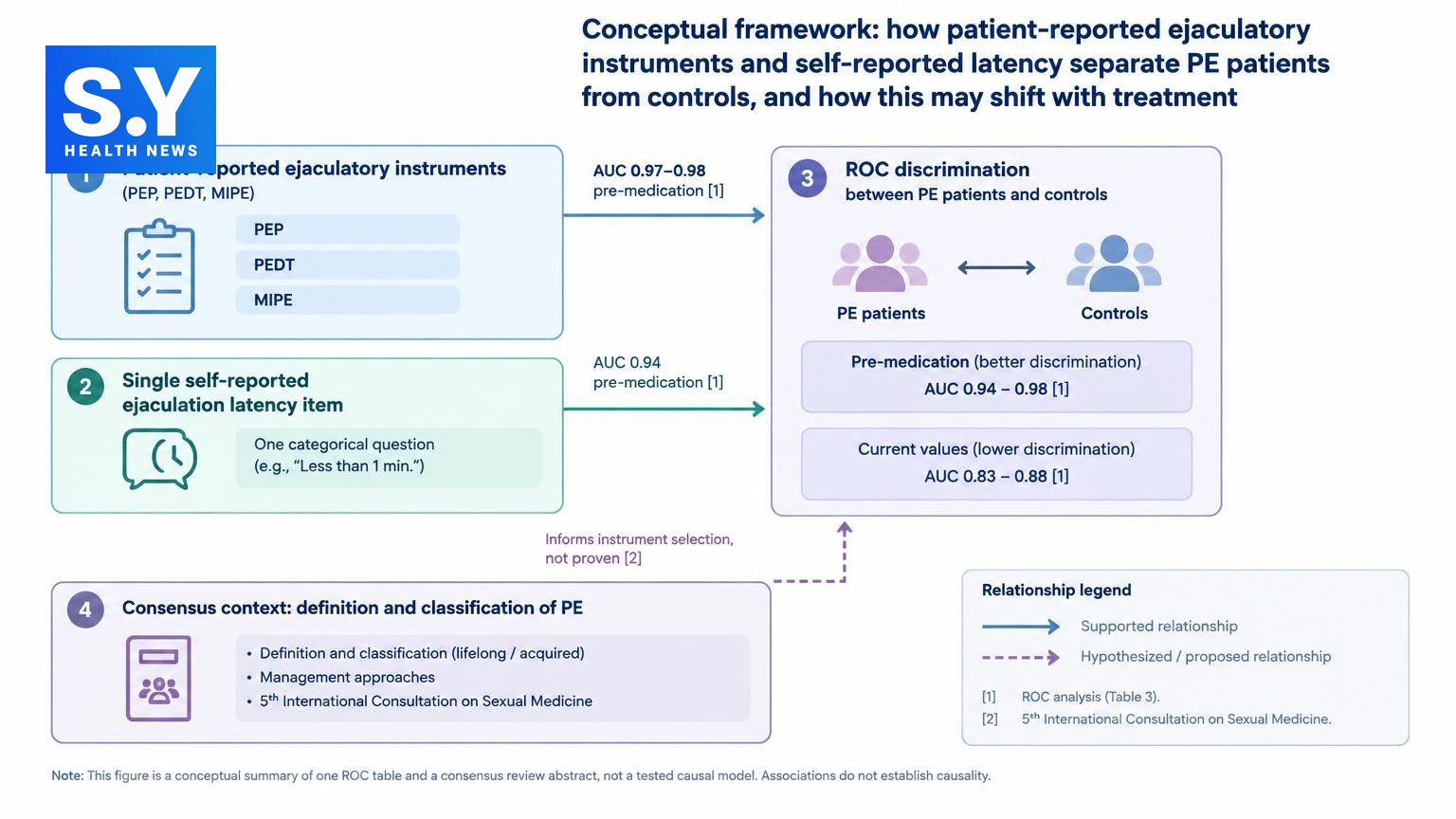
A published receiver operating characteristic (ROC) analysis compared three patient-reported ejaculatory function instruments — the Premature Ejaculation Profile (PEP), the Premature Ejaculation Diagnostic Tool (PEDT) and Multiple Indicators of Premature Ejaculation (MIPE) — plus a single self-reported ejaculation latency item against control men. Using pre-medication patient values, areas under the curve (AUC) were 0.98 for PEP, 0.97 for PEDT, 0.98 for MIPE and 0.94 for self-reported latency, where 1.00 indicates perfect group separation and 0.50 indicates chance-level discrimination.[1]
When current (on-treatment) patient values were used, discrimination against the same controls weakened: AUC 0.84 for PEP, 0.87 for PEDT, 0.88 for MIPE and 0.83 for self-reported latency. The analysis compared 135 patients assessed pre-medication and 148 patients assessed on current values with 892 controls. These are diagnostic-discrimination statistics from a single table, not a head-to-head clinical trial, and the supplied material does not describe the diagnostic reference standard or recruitment. Contemporary consensus recommendations from the Fifth International Consultation on Sexual Medicine frame PE and delayed ejaculation as common conditions affecting quality of life and relationships, and address definition, classification and management, but the supplied abstract gives no recommendation strength or effect sizes.[2]
Why Measurement of Premature Ejaculation Matters
Premature ejaculation is clinically awkward to define precisely because it combines a timing dimension with distress and control. The consensus review underpinning current recommendations describes ejaculatory disorders, including premature and delayed ejaculation, as common conditions with a substantial impact on men's quality of life and their relationships. That framing explains why measurement matters: a condition defined partly by subjective distress and partner-related impact cannot be captured by stopwatch timing alone.
The index analysis tested two families of measurement. One was multi-item patient-reported questionnaires (PEP, PEDT, MIPE), which combine timing, control, distress and related items. The other was a single self-reported latency item embedded within MIPE, asking on average how much time elapses between penetration and ejaculation, scored from 'I usually do not ejaculate' to 'Less than 1 min.' The comparison is therefore not only instrument versus instrument but also multidimensional questionnaire versus a one-question proxy for latency.
What the Discrimination Analysis Measured
The reported metric is the area under the ROC curve, computed from an analysis of diagnostic efficacy of the different measures. An AUC of 1.00 indicates perfect differentiation between groups, whereas 0.50 indicates chance-level differentiation. ROC analysis summarizes how well a continuous or ordinal score separates two known groups across possible thresholds; importantly, it does not by itself establish a threshold for clinical diagnosis, nor does it demonstrate agreement with an independent reference standard.
| Measure | Patient Values Analyzed | AUC (95% CI) | Sample Context |
|---|---|---|---|
| PEP | Pre-medication | 0.98 (0.97–0.99) | Patients pre-medication n = 135; controls n = 892 |
| PEDT | Pre-medication | 0.97 (0.96–0.98) | Patients pre-medication n = 135; controls n = 892 |
| MIPE | Pre-medication | 0.98 (0.97–0.98) | Patients pre-medication n = 135; controls n = 892 |
| Self-reported ejaculation latency time | Pre-medication | 0.94 (0.92–0.96) | Patients pre-medication n = 135; controls n = 892 |
| PEP | Current values | 0.84 (0.80–0.89) | Patients current values n = 148; controls n = 892 |
| PEDT | Current values | 0.87 (0.84–0.91) | Patients current values n = 148; controls n = 892 |
| MIPE | Current values | 0.88 (0.85–0.91) | Patients current values n = 148; controls n = 892 |
| Self-reported ejaculation latency time | Current values | 0.83 (0.79–0.86) | Patients current values n = 148; controls n = 892 |
What the Evidence Shows
Before medication, the three questionnaires and the single latency item all discriminated patients from controls with AUCs above 0.90. PEP and MIPE each reached 0.98, PEDT 0.97 and self-reported latency 0.94. The overlapping confidence intervals for PEP, PEDT and MIPE mean the supplied data do not permit a claim that any one questionnaire outperforms another. The self-reported latency item's confidence interval is somewhat lower but also overlaps with the questionnaires, at least at the lower bound. What the table supports is that all four measures carried substantial discriminative information in this sample, not that they are interchangeable or clinically equivalent.
The current-value analysis is the more clinically interesting result. Once patients were assessed on treatment, AUCs fell to 0.84 for PEP, 0.87 for PEDT, 0.88 for MIPE and 0.83 for self-reported latency. This is expected behavior for a diagnostic-discrimination statistic: the control group remains unchanged, while the patient group's scores move toward the control range as symptoms improve. A falling AUC therefore does not mean the instrument became unreliable; it means the instrument is tracking clinical change, which blurs the separation between treated patients and controls. The supplied material does not report statistical tests of the pre-medication versus current differences, so the size of this shift should be read descriptively rather than as a formally tested treatment effect.
The single self-reported latency item deserves separate attention. Its pre-medication AUC of 0.94 came from one categorical question rather than measured intravaginal ejaculatory latency time. It should not be equated with stopwatch-measured IELT, which appears among the consensus review's indexed topics but is not reported with numerical results in the supplied text. Self-report is subject to recall and interpretation; the categorical response options limit precision; and the benchmark comparisons in the table concern group separation rather than agreement with a clinician's diagnosis. The practical implication is that a brief latency question carried considerable signal in this dataset, but it is not established as a substitute for a fuller instrument or for clinical assessment.
Interpretation and Limitations
Several limitations constrain interpretation. First, the evidence is drawn from a single table of ROC results. The supplied material does not describe how patients were recruited, how the reference diagnosis was established, whether assessors were blinded to questionnaire scores, or whether controls were screened to exclude sexual dysfunction. Each of these can inflate apparent discrimination in a case-control design, particularly when cases are drawn from specialist clinics and controls from the general population. Second, ROC analysis in a two-group comparison does not directly answer the question a clinician asks at the point of care — whether a particular score in an individual patient indicates PE — because that requires threshold-specific sensitivity, specificity and predictive values, which the table does not provide.
Third, the patient and control groups differ in size and apparent provenance: 135 pre-medication patients, 148 current-value patients and 892 controls. Unequal groups are not a flaw in themselves, but they mean that the AUC is not a prevalence-calibrated estimate of diagnostic yield in a typical clinic. Fourth, the pre-medication and current-value patient groups are described as distinct sample sizes, implying that the comparison across conditions is not a within-person longitudinal analysis in the supplied text. Fifth, the difference in AUC between the questionnaires is small and statistically untested; ordering them by point estimate would overstate precision.
The consensus document adds context rather than confirmation. It is a review synthesizing findings on etiology, epidemiology, evaluation and management, and it aims to present evidence-based recommendations for definition, classification and treatment developed under the Fifth International Consultation on Sexual Medicine. Its indexed keywords include lifelong and acquired premature ejaculation, intravaginal ejaculatory latency time, penile hypersensitivity, dapoxetine, SSRIs and psychotherapy. That signals the scope of contemporary discussion, including subtyping and multiple treatment modalities, but it does not show that any instrument has been endorsed as a diagnostic gold standard, nor does it provide numerical recommendation strengths in the supplied abstract. The two sources therefore answer different questions: one estimates discrimination in a research sample, the other frames how experts currently organize the condition.
A further limitation is the absence of an explicit reference standard in the supplied text. ROC curves require a binary truth classification; if patients were classified by clinical interview that itself incorporated one of the questionnaires, the resulting AUC would be circularly inflated. The table cannot resolve this. Similarly, the controls' ejaculatory function is not characterized. In a condition defined by distress and relationship impact, controls with undisclosed mild symptoms would bias discrimination downward, whereas highly selected healthy controls would bias it upward. Neither direction can be assessed from the supplied material.
Clinical and Research Outlook
The pattern of results suggests two productive research directions. The first is a proper diagnostic accuracy study with a pre-specified reference standard, consecutive recruitment, blinded scoring and reporting of sensitivity and specificity at clinically relevant thresholds. The second is longitudinal within-person work using the same instruments before and during treatment, which would convert the observed difference between pre-medication and current-value AUCs into an interpretable measure of responsiveness. The supplied table hints that instruments track change — the drop from roughly 0.97–0.98 to 0.83–0.88 is substantial in descriptive terms — but the current evidence cannot distinguish a treatment response from differences between the two patient samples.
On the consensus side, the 5th ICSM recommendations indicate that definition and classification remain active topics, with lifelong and acquired forms distinguished and IELT retained as a key construct alongside symptom and distress dimensions. None of this resolves the measurement question. A single self-reported latency item performed well in one dataset, but whether it performs well across settings, languages and subtypes is unknown. Until threshold-based and longitudinal data are available, clinicians and researchers should treat these AUCs as evidence that the instruments capture real group differences, not as evidence that one questionnaire can replace clinical evaluation or that any score is diagnostic on its own.
Key Takeaways
- In pre-medication ROC analysis, PEP, PEDT, MIPE and a single self-reported latency item all separated patients from controls with AUCs from 0.94 to 0.98.
- Using current on-treatment patient values, AUCs were lower (0.83–0.88), consistent with instruments tracking clinical change, though formal testing of that change is not reported in the supplied material.
- The self-reported latency measure is a categorical item, not stopwatch-measured IELT, and should not be equated with measured latency or with a clinical diagnosis.
- The comparison involved 135 pre-medication patients, 148 current-value patients and 892 controls; recruitment, reference standard and blinding are not described in the supplied text.
- The 5th ICSM consensus document provides recommendations on definition, classification and treatment of premature and delayed ejaculation but, in the supplied abstract, no specific numerical recommendation strength for any instrument.
Questions and Answers
What do PEP, PEDT and MIPE stand for in premature ejaculation research?
PEP is the Premature Ejaculation Profile, PEDT is the Premature Ejaculation Diagnostic Tool, and MIPE is Multiple Indicators of Premature Ejaculation. All three are patient-reported instruments that combine timing, control and distress-related items. In the reviewed ROC analysis, pre-medication AUCs were 0.98 for PEP, 0.97 for PEDT and 0.98 for MIPE, indicating strong group discrimination in that sample; the supplied data do not establish which instrument is best.
How well did self-reported ejaculation latency time distinguish premature ejaculation patients from controls?
A single MIPE latency item asking the average time between penetration and ejaculation achieved an AUC of 0.94 (95% CI 0.92–0.96) for pre-medication patients versus controls, and 0.83 (95% CI 0.79–0.86) for current values. This indicates strong group discrimination before treatment, but the item is a categorical self-report rather than measured intravaginal ejaculatory latency time, and it is not a stand-alone diagnostic test.
Why were premature ejaculation questionnaire AUCs lower when current patient values were used?
AUC reflects separation between treated patients and unchanged controls. When patients were assessed on current treatment values, their scores moved toward the control range, lowering AUCs to 0.84 for PEP, 0.87 for PEDT, 0.88 for MIPE and 0.83 for self-reported latency. This is consistent with instruments tracking clinical improvement, but the supplied table does not report a formal statistical test of the pre-medication versus current difference.
What are the main limitations of the premature ejaculation diagnostic accuracy evidence?
The evidence comes from a single ROC table. The supplied material does not describe patient recruitment, the diagnostic reference standard, assessor blinding or how controls were screened. ROC AUCs also do not provide threshold-specific sensitivity and specificity, so they cannot establish a diagnostic cutoff. Sample sizes were 135 pre-medication patients, 148 current-value patients and 892 controls, so the estimates are not calibrated to typical clinic prevalence.
What do the 5th ICSM consensus recommendations say about premature ejaculation?
The 5th International Consultation on Sexual Medicine review aims to present evidence-based recommendations for the definition, classification and treatment of premature and delayed ejaculation. It describes ejaculatory disorders as common conditions affecting quality of life and relationships, and its indexed topics include lifelong and acquired premature ejaculation, intravaginal ejaculatory latency time, dapoxetine, SSRIs and psychotherapy. The supplied abstract does not provide recommendation strengths or numerical effect estimates.
Can a questionnaire or latency question replace clinical assessment for premature ejaculation?
No. The reviewed AUCs show that these instruments detect group-level differences between patients and controls, but AUC is not a diagnostic threshold, and the supplied text does not report sensitivity, specificity or predictive values. The single latency item is a categorical self-report, not measured intravaginal ejaculatory latency time. These tools can support structured assessment and track change, but the evidence does not establish any of them as a substitute for clinical evaluation.
Conceptual framework: Conceptual framework. PEP, PEDT, MIPE and a single self-reported latency item are shown as measurement approaches linked to ROC discrimination between patients and controls. The framework distinguishes pre-medication discrimination (AUC 0.94–0.98) from current-value discrimination (AUC 0.83–0.88), and notes consensus context only as a proposed influence on instrument selection. It is a conceptual summary of one ROC table and a consensus review abstract, not a tested causal model.
Academic References & Evidence
- Table 3. Ability of ejaculatory function instruments and self-reported ejaculation latency time to differentiate between patients and controls..
- Contemporary consensus and emerging directions in premature and delayed ejaculation: recommendations from the 5th International Consultation on Sexual Medicine.. Sexual medicine reviews PMID: 42855438.
SANYUN Science Center explains published research on men's reproductive and sexual health, connecting scientific evidence with everyday questions while making sources and limitations clear.
Disclaimer: This article is for scientific education and research communication only. It does not provide medical advice, diagnosis, or individualized treatment recommendations, and does not endorse any medication, supplement, device, penile enlargement procedure, or other intervention. Decisions about sexual and reproductive health should be made in consultation with a qualified healthcare professional. Do not delay seeking professional care because of information in this article.
Original Content & Copyright Notice
- This article is prepared for SANYUN Science Center, drawing on published research and publicly available academic literature on men’s sexual and reproductive health. Its editorial explanations and presentation are developed for this platform.
- Copyright in the original editorial content, selection, and arrangement is reserved by SANYUN Science Center to the extent protected by applicable law. Referenced research, quotations, and third-party materials remain subject to the rights of their respective owners. This notice does not claim ownership of scientific facts or third-party research.
- Except where permitted by applicable law or an applicable license, prior written permission is required to reproduce, republish, translate, adapt, redistribute, or commercially reuse protected content. Attribution alone does not grant permission for such reuse.
- For permitted quotation or authorized reuse, clearly identify the source and retain a link to the original article.
- Source: SANYUN Science Center
- Original URL: Retain the original article URL on science.san-yun.com.
- Copyright Holder: SANYUN Science Center, for its own protected editorial content.
- Quotation, excerpts, or authorized reuse must not distort the scientific meaning, omit material limitations or disclaimers, or imply unverified medical claims, product efficacy, or endorsement by SANYUN Science Center.



