




Category: Premature Ejaculation
Core Research Direction: Long-term outcomes of psychological/sex therapy for premature ejaculation relative to other sexual dysfunctions, and how contemporary consensus frames PE definition, classification, and treatment
Search Intent: Does sex therapy produce durable long-term improvement in premature ejaculation, and how does current expert consensus define and manage PE?
Platform: SANYUN Science Center
Evidence reviewed through: 2026-11-04
Executive Summary
Premature ejaculation (PE) is a common ejaculatory disorder with a substantial impact on men's quality of life and their relationships, a position reflected in the most recent international consensus review of premature and delayed ejaculation. That review aimed to present evidence-based recommendations for the definition, classification and treatment of PE and delayed ejaculation under the guidance of the Fifth International Consultation on Sexual Medicine.[1]
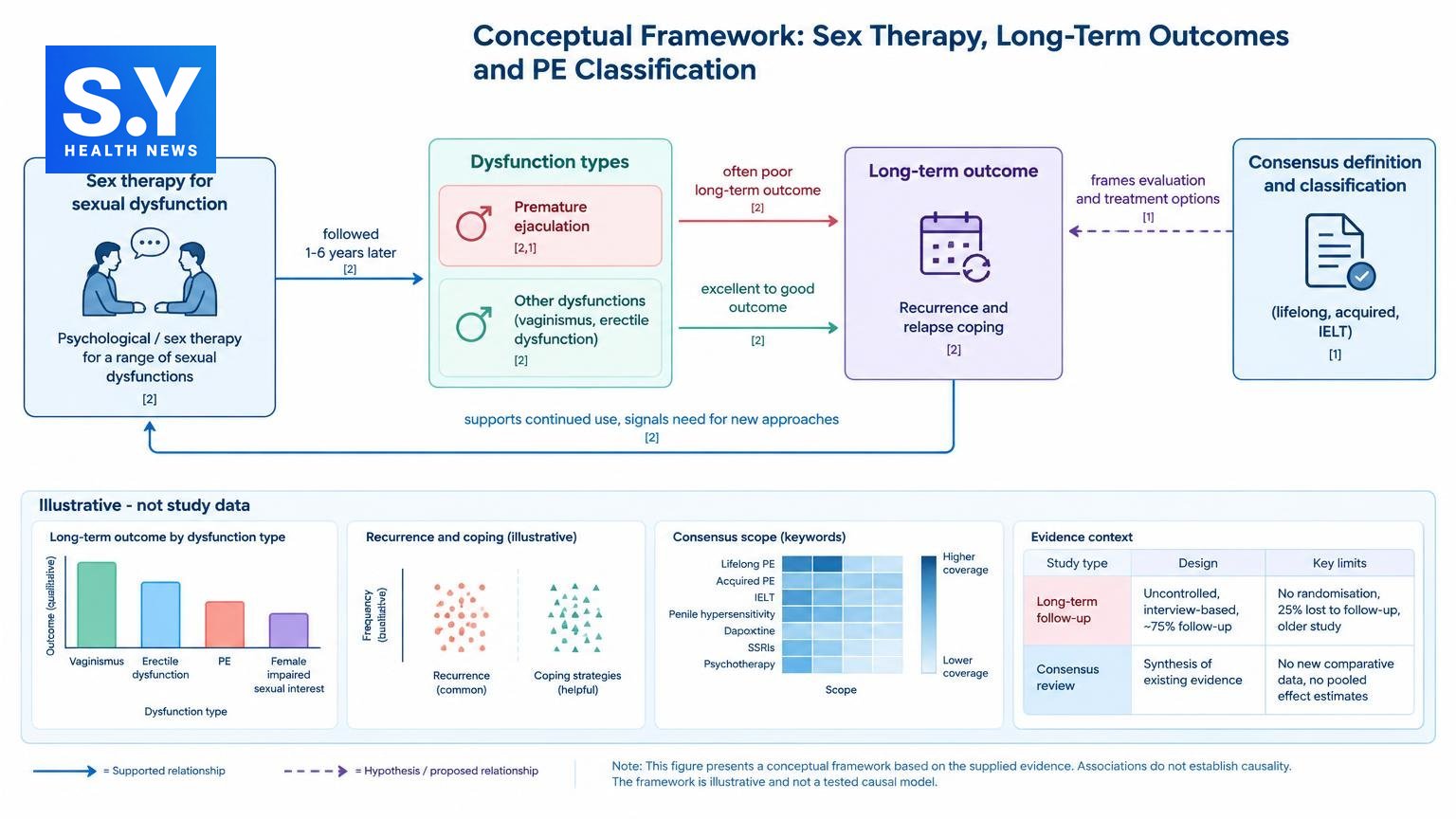
The long-term durability of psychological and sex therapy for PE rests on comparatively thin evidence. The clearest long-term dataset is a prospective follow-up of 140 couples who had entered sex therapy 1 to 6 years earlier for a variety of sexual dysfunctions, with successful follow-up of at least one partner in 75% of cases, mostly by interview. In that cohort, long-term outcome was reported as excellent for vaginismus and good for erectile dysfunction, but often poor for PE.[2]
Recurrence of sexual difficulties was common in that follow-up, although coping strategies were identified that often helped couples overcome relapses, and improvements in couples' general relationships resulting from treatment were usually sustained. The authors concluded that results supported continued use of sex therapy while emphasising the need for new therapeutic approaches for problems with poor outcome.
Why This Matters
PE is not a trivial complaint. The consensus review characterises ejaculation disorders, including PE and delayed ejaculation, as common conditions with a substantial impact on men's quality of life and their relationships. That framing matters because treatment decisions are not only about latency time; they involve distress, partner experience and confidence.
For clinicians and patients, the practical question is whether the benefits of therapy persist after the treatment episodes end. The available long-term evidence suggests that persistence cannot be assumed uniformly across sexual dysfunctions. Among the dysfunctions studied, PE was one of the poorer long-term performers, alongside female impaired sexual interest.
How the Evidence Was Generated
The two sources used here answer different questions. The long-term outcome study was a prospective investigation of couples who had entered sex therapy for a variety of sexual dysfunctions, followed 1 to 6 years after entering therapy. Follow-up success was achieved with at least one partner in 75% of cases and was mostly conducted by interview.
The consensus document is a review that aimed to present evidence-based recommendations for definition, classification and treatment of PE and delayed ejaculation under the guidance of the Fifth International Consultation on Sexual Medicine. Its stated scope was to synthesise findings on etiology, epidemiology, evaluation and management. Neither source constitutes a randomised controlled trial of sex therapy for PE.
What the Long-Term Follow-Up Found
| Sexual dysfunction | Long-term outcome after sex therapy | Evidence context |
|---|---|---|
| Vaginismus | Reported as excellent | Follow-up 1 to 6 years after entering therapy; descriptive comparison |
| Erectile dysfunction | Reported as good | Same follow-up; descriptive comparison |
| Premature ejaculation | Reported as often poor | Same follow-up; uncontrolled design |
| Female impaired sexual interest | Reported as especially poor | Same follow-up; uncontrolled design |
| Recurrence across dysfunctions | Common, with coping strategies often helping to overcome relapses | Interview-based follow-up |
| Couples' general relationship | Improvements usually sustained | Treatment-related gains in relationship functioning |
The pattern is consistent with the authors' own conclusion that results support continued use of sex therapy for sexual dysfunction while emphasising the need for new therapeutic approaches for problems with poor outcome. In other words, the finding is not that sex therapy fails generally, but that its long-term benefit appears uneven across conditions.
How Contemporary Consensus Frames PE
The consensus review aimed to present evidence-based recommendations for the definition, classification and treatment of PE and delayed ejaculation under the guidance of the Fifth International Consultation on Sexual Medicine. The supplied material reports the review's aims and scope rather than its specific diagnostic thresholds, so the precise criteria it endorses cannot be reconstructed here.
The review's keywords indicate coverage of lifelong and acquired PE, intravaginal ejaculatory latency time, penile hypersensitivity, dapoxetine, selective serotonin reuptake inhibitors and psychotherapy. These keywords signal the topics in scope; they are not efficacy claims. Readers should not infer from the keyword list that any one of these approaches is superior.
The practical implication is that contemporary consensus treats PE as a heterogeneous condition deserving structured evaluation and a range of management options rather than a single modality. The distinction between lifelong and acquired forms is part of that vocabulary, as is attention to latency time as one descriptor among several.
Interpretation and Limitations
The long-term follow-up has important design limits. It was uncontrolled, outcomes were mostly gathered by interview, and 25% of couples had no successful follow-up. Outcomes were compared descriptively across dysfunction types, not through randomised allocation, and the study is decades old. Its finding of often poor long-term outcome for PE should therefore be treated as a signal that motivates better treatments, not as proof that current therapy is ineffective.
The consensus document has a different limitation: as a review, it synthesises existing evidence rather than generating new comparative data. The supplied text reports its scope and aims, not pooled effect estimates. Interim interpretation should therefore separate what consensus recommends from what long-term outcomes actually demonstrate.
Statistical significance is not at issue here because the long-term source reports descriptive outcomes rather than comparative statistics in the supplied material. The clinical meaning is what matters: a pattern of recurrence and uneven durability across dysfunctions suggests that booster sessions, relapse-prevention planning and combined approaches deserve consideration, though the sources do not test those specific strategies.
Research Outlook
The clearest research gap is controlled, long-term evaluation of psychological and sex therapy for PE specifically, including durability beyond one year and comparison with pharmacological and combined strategies. The consensus review's coverage of dapoxetine, selective serotonin reuptake inhibitors and psychotherapy indicates that such comparative questions are within the field's current scope, but the supplied material does not report their results.
A second gap concerns relapse. Recurrence was common in the long-term follow-up, and coping strategies often helped couples overcome relapses, but the study did not determine which strategies were most effective or for whom. Future work could test structured relapse-prevention programmes rather than assuming that initial treatment response will persist.
Key Takeaways
- The main long-term follow-up of sex therapy found outcomes often poor for premature ejaculation, in contrast with excellent reported outcomes for vaginismus and good outcomes for erectile dysfunction.
- Recurrence of sexual difficulties was common, though coping strategies often helped couples overcome relapses; broader relationship improvements were usually sustained.
- Contemporary consensus frames PE as a common condition with substantial quality-of-life and relationship impact and aims to guide definition, classification and treatment.
- The evidence base remains limited: the long-term study was uncontrolled and interview-based, and the consensus document is a review rather than new comparative data.
Questions and Answers
How is premature ejaculation defined and classified in current consensus?
The most recent international consensus review aimed to present evidence-based recommendations for the definition, classification and treatment of PE and delayed ejaculation, and its keywords include lifelong and acquired PE plus intravaginal ejaculatory latency time. The supplied material does not report the specific diagnostic thresholds, so exact criteria should be checked in the full document.
Does sex therapy for premature ejaculation produce lasting improvement?
Long-term evidence is discouraging but limited. In a prospective follow-up of 140 couples treated 1 to 6 years earlier, outcomes were often poor for premature ejaculation, recurrence was common, and coping strategies sometimes helped. The study was uncontrolled and interview-based, so it signals a need for better approaches rather than proving that therapy never works.
How strong is the evidence on long-term outcomes of sex therapy for sexual dysfunctions?
Moderate at best. The key dataset is an uncontrolled prospective follow-up with 75% successful follow-up, mostly by interview, and descriptive comparisons across dysfunctions. It is also decades old. It supports the general use of sex therapy but cannot establish how current, structured programmes perform for premature ejaculation specifically.
Which sexual dysfunctions respond best to sex therapy in long-term follow-up?
In the long-term follow-up, outcomes were reported as excellent for vaginismus and good for erectile dysfunction, while premature ejaculation and especially female impaired sexual interest often fared poorly. These are descriptive comparisons from an uncontrolled cohort, not head-to-head trial results, so they should guide hypothesis generation rather than definitive clinical ranking.
What are the limitations of evidence linking sex therapy to premature ejaculation outcomes?
The long-term study was uncontrolled, mostly interview-based, and lost 25% of couples to follow-up; comparisons across dysfunctions were descriptive. The consensus review synthesises existing evidence rather than generating new comparative data, and the supplied material does not report pooled effect estimates. Neither source provides randomised long-term data specific to premature ejaculation.
What should patients understand about relapse after sex therapy for premature ejaculation?
Relapse appears common rather than exceptional. In the long-term follow-up, recurrence of sexual difficulties was frequent, although coping strategies often helped couples overcome relapses, and improvements in the general relationship were usually sustained. This suggests planning for setbacks and discussing relapse-prevention strategies with a clinician rather than expecting a single course of therapy to be permanently sufficient.
Conceptual framework: Conceptual framework. A prospective follow-up of couples 1 to 6 years after sex therapy reported often poor long-term outcomes for premature ejaculation versus excellent or good outcomes for vaginismus and erectile dysfunction; recurrence was common. Contemporary consensus framing of PE definition and classification is shown as contextual, not as tested causal mediation. The framework is illustrative and not a tested causal model.
Academic References & Evidence
- Contemporary consensus and emerging directions in premature and delayed ejaculation: recommendations from the 5th International Consultation on Sexual Medicine.. Sexual medicine reviews PMID: 42855438.
- Hawton, K.; Catalan, J.; Martin, P.; Fagg, J.. Long-term outcome of sex therapy. Behaviour Research and Therapy. 1986 24(6):665-675 DOI: 10.1016/0005-7967(86)90062-8.
SANYUN Science Center explains published research on men's reproductive and sexual health, connecting scientific evidence with everyday questions while making sources and limitations clear.
Disclaimer: This article is for scientific education and research communication only. It does not provide medical advice, diagnosis, or individualized treatment recommendations, and does not endorse any medication, supplement, device, penile enlargement procedure, or other intervention. Decisions about sexual and reproductive health should be made in consultation with a qualified healthcare professional. Do not delay seeking professional care because of information in this article.
Original Content & Copyright Notice
- This article is prepared for SANYUN Science Center, drawing on published research and publicly available academic literature on men’s sexual and reproductive health. Its editorial explanations and presentation are developed for this platform.
- Copyright in the original editorial content, selection, and arrangement is reserved by SANYUN Science Center to the extent protected by applicable law. Referenced research, quotations, and third-party materials remain subject to the rights of their respective owners. This notice does not claim ownership of scientific facts or third-party research.
- Except where permitted by applicable law or an applicable license, prior written permission is required to reproduce, republish, translate, adapt, redistribute, or commercially reuse protected content. Attribution alone does not grant permission for such reuse.
- For permitted quotation or authorized reuse, clearly identify the source and retain a link to the original article.
- Source: SANYUN Science Center
- Original URL: Retain the original article URL on science.san-yun.com.
- Copyright Holder: SANYUN Science Center, for its own protected editorial content.
- Quotation, excerpts, or authorized reuse must not distort the scientific meaning, omit material limitations or disclaimers, or imply unverified medical claims, product efficacy, or endorsement by SANYUN Science Center.



