




Category: Premature Ejaculation
Core Research Direction: Characterizing premature ejaculation in men and their partners using stopwatch-measured intravaginal ejaculatory latency time alongside patient-reported outcomes of control, satisfaction, distress, and interpersonal difficulty, and situating these findings within contemporary consensus on definition, subtyping, and management of premature ejaculation.
Search Intent: How do stopwatch-measured intravaginal ejaculatory latency time and patient- and partner-reported outcomes differ between men diagnosed with premature ejaculation and men without it, and how does contemporary consensus frame the definition and treatment of the condition?
Platform: SANYUN Science Center
Evidence reviewed through: 2026-11-16
Executive Summary
Premature ejaculation is the most common male sexual complaint, and contemporary consensus classifies it into lifelong, acquired, variable and subjective subtypes. Definitions now combine a timing criterion, distress and a sense of impaired control rather than relying on ejaculation latency alone. This review examines a large observational study that measured intravaginal ejaculatory latency time with a partner-held stopwatch while independently collecting patient-reported outcomes from men and their female partners, and situates its findings within the 5th International Consultation on Sexual Medicine framework.[1][2][3]
In that study, 207 of 1,587 men were diagnosed with premature ejaculation using DSM-IV-TR criteria and 1,380 were assigned to a non-premature-ejaculation group. Median stopwatch-measured latency was 1.8 minutes in the diagnosed group versus 7.3 minutes in the comparison group, and men with premature ejaculation reported markedly poorer control, lower satisfaction and more distress and interpersonal difficulty. The authors emphasized that latency distributions overlapped substantially, which is why additional patient-reported measures are needed to characterize the condition.
Why This Matters
Ejaculatory disorders are common and carry a substantial impact on men's quality of life and their relationships, so how they are defined and measured has practical consequences for who is offered care and how improvement is judged. A definition built only on a stopwatch reading would misclassify men whose latency sits in an overlapping range but who nonetheless experience distressing loss of control, and it would miss the partner's perspective entirely.
The measurement question is not academic. If timing and subjective experience diverge, then trials, clinical assessment and couple counseling need instruments that capture both. The observational study reviewed here was designed to address exactly that gap, since community-based data describing premature ejaculation and its outcomes were limited at the time.
How the Condition Is Defined and Subtyped
Consensus definitions of premature ejaculation and delayed ejaculation incorporate three elements: time, distress and control. That triad is a meaningful shift from latency-only definitions, because it formally accepts that a man's appraisal of control and his associated distress are part of the condition rather than secondary consequences.
The 5th International Consultation on Sexual Medicine document was developed as a review synthesizing evidence on etiology, epidemiology, evaluation and management, and it states an aim of providing evidence-based recommendations for definition, classification and treatment under the guidance of that consultation. A separate summary of the same consensus reports that it used a modified Delphi process and the GRADE system to formulate those recommendations.
Classification recognizes lifelong, acquired, variable and subjective subtypes. This subtyping matters for interpretation of any latency dataset, because a cohort defined by a single diagnostic threshold may mix men whose difficulty has been present since sexual debut with men whose difficulty emerged later in life, and those groups can differ in expected natural history and in response to treatment. The consensus also lists penile hypersensitivity and selective serotonin reuptake inhibitors, dapoxetine and psychotherapy among its topics, indicating the breadth of proposed mechanisms and management options considered.
Study Design and Measurement Approach
The key primary study was a 4-week, multicenter, observational investigation of men aged 18 years or older and their female partners in monogamous relationships lasting at least 6 months. Screening, baseline and follow-up visits were scheduled at 2-week intervals. Clinicians diagnosed premature ejaculation using DSM-IV-TR criteria, which were the prevailing diagnostic standard at the time of the study rather than the later consensus definitions described above.
Latency was measured with a stopwatch held by the partner and recorded for each sexual intercourse experience, a design choice that reduces recall bias relative to retrospective estimates. Men and their partners then independently rated control over ejaculation and satisfaction with sexual intercourse on a 0 to 4 scale anchored from very poor to very good, personal distress and interpersonal difficulty on a 0 to 4 scale anchored from not at all to extremely, and severity of premature ejaculation on a 0 to 3 scale anchored from none to severe.
Two features of this design deserve emphasis. First, it is observational and groups were formed by clinical diagnosis rather than randomization, so comparisons describe associations and not causal effects of premature ejaculation on satisfaction or distress. Second, the patient-reported outcome instruments were single-item ratings, which are practical for a large multicenter study but trade granularity for feasibility.
What the Evidence Shows
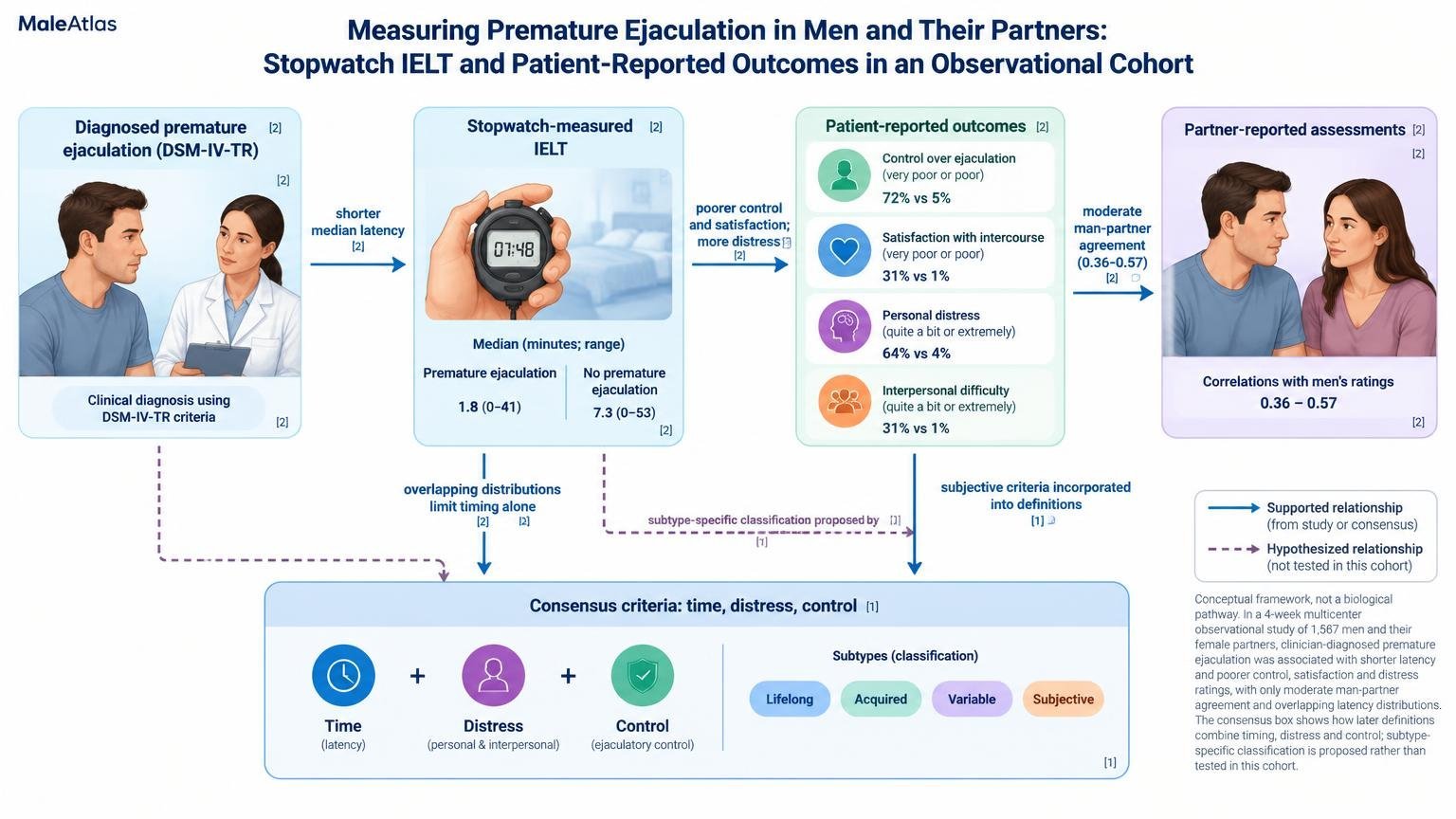
Of the total study population of 1,587, clinicians diagnosed 207 men with premature ejaculation and assigned 1,380 to the non-premature-ejaculation group. Median stopwatch-measured latency was 1.8 minutes in the diagnosed group, with a range of 0 to 41 minutes, compared with 7.3 minutes in the comparison group, with a range of 0 to 53 minutes. This difference was statistically significant at a threshold of P less than 0.0001.
Patient-reported outcomes separated the groups more sharply than the group medians alone might suggest. Ratings of very poor or poor control over ejaculation were given by 72 percent of men with premature ejaculation versus 5 percent of comparison men, and very poor or poor satisfaction with sexual intercourse by 31 percent versus 1 percent. Personal distress rated as quite a bit or extremely was reported by 64 percent versus 4 percent, and interpersonal difficulty at those levels by 31 percent versus 1 percent. All of these comparisons were significant at P less than 0.0001.
Men's and partners' assessments showed similar patterns and correlated moderately, with coefficients of 0.36 to 0.57. That degree of agreement is informative in both directions: partners largely track the man's experience, yet the moderate magnitude means partner reports are not interchangeable with the man's own ratings and should not be substituted for them in assessment or research.
Shorter stopwatch-measured latency was significantly associated with reduced ejaculatory control and sexual satisfaction and with increased distress and interpersonal difficulty. Crucially, the authors also reported overlap in latency distributions between the two groups and concluded that this overlap indicates a need for additional patient-reported outcome measures to characterize the condition.
| Measure | Men with premature ejaculation | Men without premature ejaculation | Reported significance |
|---|---|---|---|
| Median stopwatch-measured IELT (minutes; range) | 1.8 (0-41) | 7.3 (0-53) | P < 0.0001 |
| Rated control over ejaculation very poor or poor (percent) | 72 | 5 | P < 0.0001 |
| Rated satisfaction with intercourse very poor or poor (percent) | 31 | 1 | P < 0.0001 |
| Rated personal distress quite a bit or extremely (percent) | 64 | 4 | P < 0.0001 |
| Rated interpersonal difficulty quite a bit or extremely (percent) | 31 | 1 | P < 0.0001 |
| Agreement between men's and partners' assessments (correlation coefficient) | 0.36-0.57 | Not applicable | Not reported |
Interpretation and Limitations
The central lesson is definitional. A group median of 1.8 minutes versus 7.3 minutes shows clear separation at the population level, but overlapping ranges running from zero into the tens of minutes mean that any single latency cut-off will misclassify some individuals. Statistical significance in a sample of 1,587 does not by itself establish a clinically usable threshold, and the authors' own conclusion points toward combining timing with subjective measures rather than replacing one with the other.
Several limitations constrain inference. The study was observational and participants were men in established monogamous heterosexual relationships with female partners, so findings may not generalize to casual partnerships, unpartnered men, same-sex relationships or other relationship structures. Diagnosis used DSM-IV-TR criteria current at the time rather than contemporary consensus definitions incorporating distress and control.
Measurement carries its own caveats. A partner-held stopwatch may introduce burden or reactivity during intercourse, though it remains a pragmatic way to reduce recall error. Patient-reported outcomes were single-item ratings, and the association between shorter latency and worse control, lower satisfaction and greater distress is cross-sectional, so direction and causation cannot be established from these data.
The consensus literature also has evidentiary limits in the material available here. The retrieved abstract-level text of the 5th International Consultation describes a synthesis with stated recommendations, and the supplementary summary notes a modified Delphi process and GRADE grading, but the supplied materials do not provide recommendation-by-recommendation strength ratings or comparative efficacy estimates for specific treatments. Claims about which therapy works best should therefore be treated as outside what this evidence base can settle.
Clinical Relevance and Research Outlook
For clinical assessment, the findings support a two-strand approach: obtain a timing estimate where feasible, and pair it with structured questions about control, satisfaction, distress and interpersonal difficulty, ideally inviting the partner's perspective without treating it as a substitute. The moderate man-partner correlations justify including partners in evaluation while keeping the man's own report central.
Contemporary consensus describes management options including selective serotonin reuptake inhibitors, topical anesthetics and psychotherapy, and classifies premature ejaculation into lifelong, acquired, variable and subjective subtypes. Because subtype membership was not analyzed in the observational cohort described here, matching treatment strategy to subtype remains an inference from consensus rather than a finding of that study.
The consensus authors state that understanding pathophysiological mechanisms and adopting individualized treatment may improve prognosis, and they call for more evidence-based treatment research, particularly for delayed ejaculation, which is less studied and has limited treatment options. These are forward-looking recommendations rather than demonstrated outcomes, and they should be read as a research agenda.
A practical research priority follows directly from the overlap finding: studies that model latency continuously alongside validated multi-item patient-reported outcomes, stratify by subtype, and include partners as separate respondents would clarify where thresholds add value and where they distort. Until then, the safest reading of the evidence is that premature ejaculation is a multidimensional complaint in which timing is one informative variable among several.
Key Takeaways
- In a 4-week multicenter observational study of 1,587 men and their partners, median stopwatch-measured latency was 1.8 minutes in men diagnosed with premature ejaculation and 7.3 minutes in men without the diagnosis.
- Poor or very poor control was reported by 72 percent versus 5 percent, poor satisfaction by 31 percent versus 1 percent, high personal distress by 64 percent versus 4 percent, and high interpersonal difficulty by 31 percent versus 1 percent.
- Latency distributions overlapped between groups, and the authors concluded that patient-reported outcomes are needed alongside timing to characterize premature ejaculation.
- Men's and partners' ratings correlated moderately at 0.36 to 0.57, so partner perspectives are informative but not interchangeable with the man's own report.
- Contemporary consensus definitions incorporate time, distress and control, and classify premature ejaculation into lifelong, acquired, variable and subjective subtypes with treatment options including SSRIs, topical anesthetics and psychotherapy.
- The observational design, single-item outcome scales, DSM-IV-TR-era diagnoses and restricted relationship population limit causal and generalizability claims.
Questions and Answers
How is intravaginal ejaculatory latency time measured in premature ejaculation research?
In the reviewed study, a partner held a stopwatch and recorded intravaginal ejaculatory latency time for each sexual intercourse experience across a 4-week observation period. This prospective approach reduces reliance on retrospective recall, but it may add burden or alter behavior during intercourse, and it captures timing only, not the distress or loss of control that consensus definitions also require.
What did the observational study find about ejaculatory control and satisfaction in men with premature ejaculation?
Among 1,587 men, 72 percent of those diagnosed with premature ejaculation rated control over ejaculation as very poor or poor versus 5 percent of men without the diagnosis, and 31 percent versus 1 percent rated satisfaction with intercourse as very poor or poor. Both differences were statistically significant, but the design was observational, so these are associations rather than causal effects.
How strong is the evidence linking shorter ejaculation latency to distress and relationship difficulty?
The link is consistent within this large cohort: shorter stopwatch-measured latency was significantly associated with reduced control and satisfaction and with greater personal distress and interpersonal difficulty, with 64 percent versus 4 percent reporting high distress. However, the analysis was cross-sectional and observational, using single-item ratings, so it establishes association and not causation or a diagnostic threshold.
Do female partners rate premature ejaculation similarly to affected men?
Partners' assessments followed similar patterns to men's but correlated only moderately, with coefficients of 0.36 to 0.57. This suggests partners meaningfully track the man's experience without being interchangeable reporters. Clinically and in research, the partner view can add useful context, but it should complement rather than replace the man's own ratings of control, satisfaction and distress.
What are the main limitations of the stopwatch IELT study of premature ejaculation?
The study was observational, so groups were defined by clinical diagnosis rather than randomization. Participants were men aged 18 or older in monogamous heterosexual relationships of at least 6 months, limiting generalizability. Diagnosis used DSM-IV-TR criteria rather than current consensus definitions, and outcomes were single-item ratings. Latency ranges also overlapped substantially between groups, weakening any single cut-off.
How does current consensus define and subtype premature ejaculation?
Consensus definitions incorporate time, distress and control rather than latency alone, and classify premature ejaculation into lifelong, acquired, variable and subjective subtypes. The 5th International Consultation on Sexual Medicine developed recommendations on definition, classification and treatment using a modified Delphi process and GRADE grading. Management options discussed include SSRIs, topical anesthetics and psychotherapy, though the materials available here do not provide comparative efficacy estimates.
Conceptual framework: Conceptual framework, not a biological pathway. In a 4-week multicenter observational study of 1,587 men and their female partners, clinician-diagnosed premature ejaculation was associated with shorter stopwatch-measured latency and poorer control, satisfaction and distress ratings, with only moderate man-partner agreement and overlapping latency distributions. The consensus box shows how later definitions combine timing, distress and control; subtype-specific classification is proposed rather than tested in this cohort.
Academic References & Evidence
- 2026 ICSM专家共识:早泄和延迟射精的当代共识与新兴方向. Sex Med Rev. 2026 14(4)
- Patrick, D. L.; Althof, S. E.; Pryor, J. L.; Rosen, R.; Rowland, D. L.; Ho, K. F.; Jamieson, C.. Premature ejaculation: An observational study of men and their partners. Journal of Sexual Medicine. 2005 2(3):358-367 DOI: 10.1111/j.1743-6109.2005.20353.x.
- Contemporary consensus and emerging directions in premature and delayed ejaculation: recommendations from the 5th International Consultation on Sexual Medicine.. Sexual medicine reviews PMID: 42855438.
SANYUN Science Center explains published research on men's reproductive and sexual health, connecting scientific evidence with everyday questions while making sources and limitations clear.
Disclaimer: This article is for scientific education and research communication only. It does not provide medical advice, diagnosis, or individualized treatment recommendations, and does not endorse any medication, supplement, device, penile enlargement procedure, or other intervention. Decisions about sexual and reproductive health should be made in consultation with a qualified healthcare professional. Do not delay seeking professional care because of information in this article.
Original Content & Copyright Notice
- This article is prepared for SANYUN Science Center, drawing on published research and publicly available academic literature on men’s sexual and reproductive health. Its editorial explanations and presentation are developed for this platform.
- Copyright in the original editorial content, selection, and arrangement is reserved by SANYUN Science Center to the extent protected by applicable law. Referenced research, quotations, and third-party materials remain subject to the rights of their respective owners. This notice does not claim ownership of scientific facts or third-party research.
- Except where permitted by applicable law or an applicable license, prior written permission is required to reproduce, republish, translate, adapt, redistribute, or commercially reuse protected content. Attribution alone does not grant permission for such reuse.
- For permitted quotation or authorized reuse, clearly identify the source and retain a link to the original article.
- Source: SANYUN Science Center
- Original URL: Retain the original article URL on science.san-yun.com.
- Copyright Holder: SANYUN Science Center, for its own protected editorial content.
- Quotation, excerpts, or authorized reuse must not distort the scientific meaning, omit material limitations or disclaimers, or imply unverified medical claims, product efficacy, or endorsement by SANYUN Science Center.



