




Category: Premature Ejaculation
Core Research Direction: Comparative efficacy and mechanisms of topical local anesthetics and non-oral (glans hyaluronic acid injection) versus oral dapoxetine for intravaginal ejaculation latency time (IELT) in men with premature ejaculation, with attention to sham-control, blinding, follow-up duration, and reported adverse effects
Search Intent: How do topical anesthetics and glans hyaluronic acid injection compare with oral dapoxetine for prolonging intravaginal ejaculation latency time in men with premature ejaculation, and how strong is the trial evidence behind these comparisons?
Platform: SANYUN Science Center
Evidence reviewed through: 2026-11-10
Executive Summary
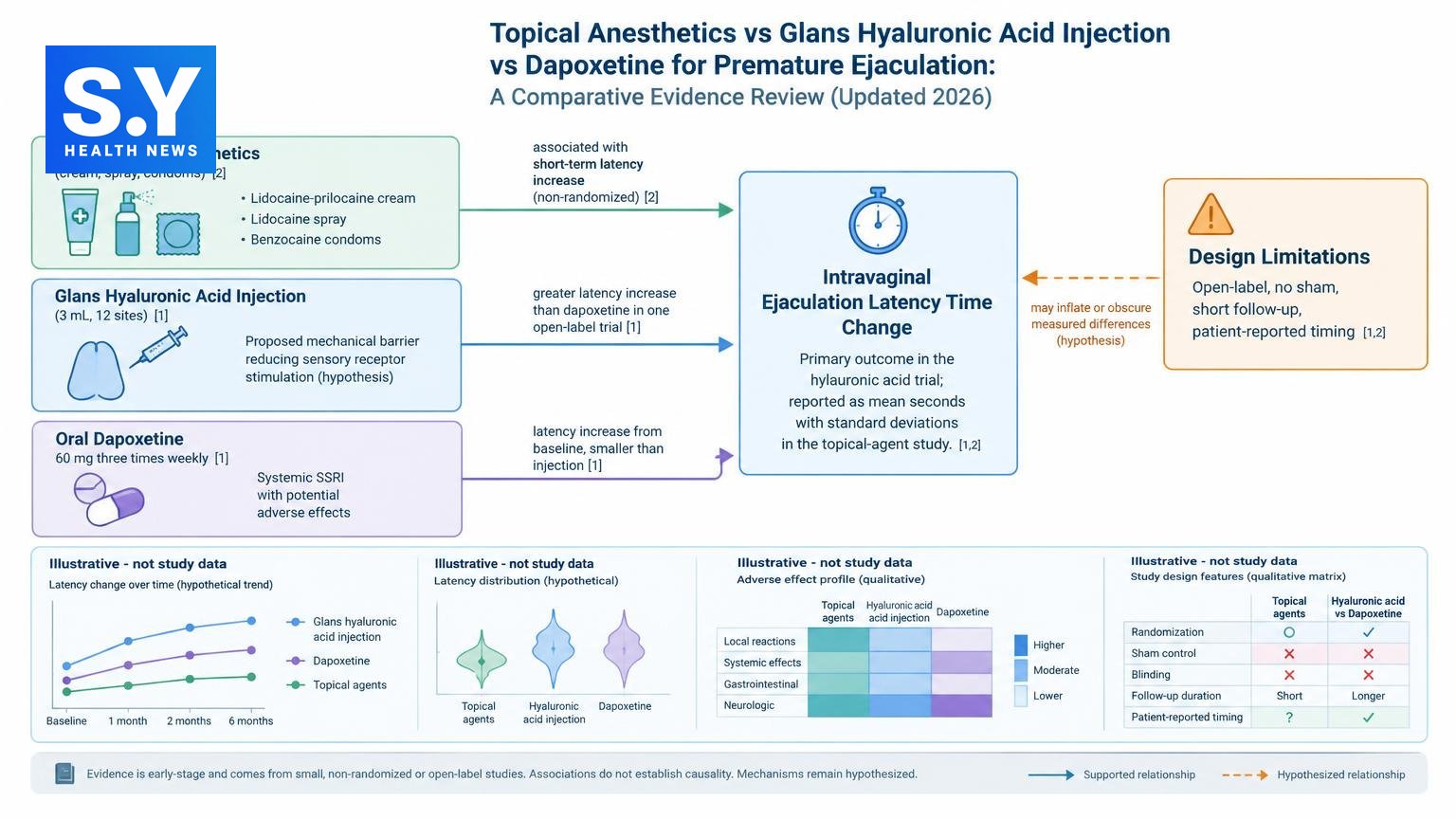
A small open-label randomized trial reported that a single 3-mL glans hyaluronic acid injection produced longer intravaginal ejaculation latency time than oral dapoxetine 60 mg three times weekly over six months in 60 men with lifelong premature ejaculation refractory to behavioral therapy. A separate prospective single-center study reported short-term latency increases with topical lidocaine-prilocaine cream, lidocaine spray and benzocaine condoms over two months in 273 men. This review examines both datasets alongside consensus framing on definition and treatment.[1][2][3]
The evidence is early-stage. The hyaluronic acid comparison was open-label, had no sham injection, used patient-reported stopwatch timing and followed patients for six months. The topical-agent study did not describe randomization or a sham arm, and its findings appeared in a preprint abstract. No replicated head-to-head data across all three approaches exist in the reviewed material.
Why This Matters
Premature ejaculation is a common condition with substantial impact on men's quality of life and relationships, according to the Fifth International Consultation on Sexual Medicine consensus review. Treatment options include on-demand oral selective serotonin reuptake inhibitors such as dapoxetine, topical anesthetics intended to reduce glans hypersensitivity, and newer procedural options such as glans hyaluronic acid injection.
The rationale for local and procedural approaches is partly practical. Dapoxetine is established as an on-demand SSRI, but repeated dosing, systemic adverse events and symptom recurrence after discontinuation may limit its use. A longer-lasting local option would be attractive if its benefits survived rigorous control.
The central question for readers is not simply which option produced the longest latency in one study, but how much of any apparent advantage survives blinding, sham control and longer follow-up. Neither dataset supplies those features, so the evidence supports cautious short-term signal claims rather than treatment-ranking claims.
Definitions and Measurement Context
Intravaginal ejaculation latency time, the interval from vaginal penetration to ejaculation, is the most commonly used efficacy outcome in premature ejaculation trials. It was the prespecified primary outcome in the hyaluronic acid versus dapoxetine trial at six months. How latency is measured matters: the hyaluronic acid trial relied on patient-reported stopwatch measurements, a limitation the authors acknowledged.
The topical-agent study reported mean latency with standard deviations but the abstract does not specify the timing method. Interpretation should therefore treat both datasets as providing group-level average changes, not individually verified latency.
| Variable | Definition in the reviewed studies | Interpretation |
|---|---|---|
| Intravaginal ejaculation latency time | Primary outcome in the hyaluronic acid trial at six months; reported as mean seconds with standard deviations in the topical-agent study | Central efficacy measure, but largely patient-reported in both datasets; group means do not describe individual outcomes |
| Topical local agents | Lidocaine-prilocaine cream, lidocaine spray and benzocaine condoms in three non-randomized groups over two months | Within-group latency gains reported, but absence of randomization, sham control or blinding limits attribution |
| Glans hyaluronic acid injection | Single 3-mL deep dermal injection at 12 sites in the glans | Proposed mechanical barrier reducing sensory receptor stimulation; mechanism not directly demonstrated |
| Oral dapoxetine | 60 mg three times weekly for six months in the randomized comparison | Active comparator with systemic adverse events reported |
| Sham control and blinding | Absent in the hyaluronic acid trial (open-label); no sham arm described in the topical study | Open-label subjective outcomes and absent sham injection can inflate apparent procedural advantage |
| Follow-up duration | Two months for topical agents; six months for hyaluronic acid versus dapoxetine | Short horizons cannot establish durability or post-discontinuation trajectories |
Proposed Biological and Clinical Mechanisms
Topical anesthetics are used to reduce glans hypersensitivity, a rationale grounded in the idea that dampened sensory input delays the ejaculatory reflex. This is a mechanistic rationale rather than a demonstrated mediator; the topical-agent study did not measure hypersensitivity directly.
For glans hyaluronic acid, the trialists proposed that the injected deposit creates a mechanical barrier that decreases stimulation of sensory receptors, thereby reducing penile hypersensitivity. This is an author hypothesis; the trial did not demonstrate the barrier or receptor-level effect.
Dapoxetine acts through serotonin reuptake inhibition, a systemic pharmacologic route distinct from local mechanical or anesthetic approaches. The contrast between systemic and local strategies is the conceptual core of the comparison, even though the trial cannot isolate which component drove the between-group difference.
What the Evidence Shows: Topical Local Agents
In the prospective single-center study, 273 men with lifelong premature ejaculation were enrolled between November 2020 and December 2022. Participants were allocated by treatment into lidocaine-prilocaine cream (n=59), lidocaine spray (n=126) and benzocaine condom (n=88) groups.
Baseline latency was approximately 30 seconds in all groups: 32.5±17.7 seconds with the cream, 29.8±17.9 seconds with the spray and 30.1±13.9 seconds with condoms. Two months after treatment, mean latency rose to 104.5±135.81 seconds, 144.1±179.8 seconds and 75.1±50.4 seconds, respectively. All three groups improved significantly from baseline, and the authors reported that spray and cream increased latency significantly more than condoms.
The very large standard deviations, for example 179.8 seconds around a mean of 144.1 seconds in the spray group, indicate highly heterogeneous individual responses. Group means describe averages, not what a given man should expect. The investigators concluded that local treatments appear effective in the short term and called for long-term efficacy studies.
What the Evidence Shows: Glans Hyaluronic Acid Versus Dapoxetine
The randomized trial enrolled 60 adult men with lifelong premature ejaculation unresponsive to behavioral therapy. Participants were randomized to dapoxetine 60 mg three times weekly for six months or a single 3-mL glans hyaluronic acid injection at 12 sites. Each arm contained 30 men, with mean ages of 37 and 39 years, comparable baseline characteristics and complete six-month follow-up.
The prespecified primary outcome was change in latency at six months. From baselines of 46.83 seconds (hyaluronic acid) and 43.27 seconds (dapoxetine), mean latency at six months was 246.30 seconds versus 145.63 seconds (P<.001). Separation was also reported at one month (284.93 vs 158.87 seconds) and three months (268.70 vs 150.80 seconds), both P<.001.
Secondary outcomes moved in the same direction. At six months, hyaluronic acid recipients had higher mean scores on the International Index of Erectile Function-5 (18.53 vs 14.87; P<.001), the Index of Premature Ejaculation (21.10 vs 16.80; P=.006) and quality of life (44.63 vs 37.47; P<.001). Satisfaction was reported by 70.0% versus 43.3% (P=.037).
A notable feature is that mean latency was numerically higher at one month than at six months in the injection arm, a pattern that could reflect within-person variability or measurement noise across visits rather than a clear time trend.
Adverse Effects Reported
In the dapoxetine arm, nausea and dizziness each occurred in 10.0% of recipients, and headache and dry mouth in 6.7% each. In the hyaluronic acid arm, injection-site pain occurred in 23.3%, bullae in 16.7% and ecchymosis in 13.3%; all resolved spontaneously within 10 to 15 days.
The trial reported no de novo erectile dysfunction, persistent penile deformity, ischemic complications, significant hypoesthesia or delayed orgasm in the hyaluronic acid group. With 30 men per arm, however, uncommon or delayed harms cannot be excluded; rare events require far larger cohorts or registries.
Adverse-event profiles differ qualitatively: systemic drug effects with dapoxetine versus local, generally self-limited injection-site effects with hyaluronic acid. Neither profile is trivial, and the trade-off involves personal priorities rather than a single superiority ranking.
Interpretation and Limitations
The largest interpretive problem in the hyaluronic acid trial is the absence of a sham injection and its open-label design. A man who receives a procedural injection and knows it may report longer latency and greater satisfaction for reasons unrelated to the mechanical barrier. The trial was also small, with 60 men, and short, at six months, with latency based on patient-reported stopwatch timing. Complete follow-up is a strength against attrition but does not offset these design limits.
The topical-agent study has different but equally consequential limits. Group assignment appears treatment-based rather than randomized, no sham or placebo arm is described, the analysis is a preprint abstract, and follow-up was two months; the abstract also does not identify the latency measurement method.
The two datasets are not directly comparable. Populations differ (refractory lifelong premature ejaculation versus a general lifelong clinic sample), comparators differ (oral drug versus other local products), and outcomes were collected under different designs. Cross-study subtraction of group means would be misleading.
Statistical significance in a small open-label trial is not the same as clinical importance. P values describe the probability of the observed difference under a null hypothesis rather than the size or durability of benefit. Effect sizes and confidence intervals were not available in the source material reviewed.
Research Outlook
What the field needs is not another small superiority claim but trials with features that make procedural and topical comparisons trustworthy: randomization of local agents, sham injection or sham device controls where feasible, blinded outcome assessment, prespecified clinically meaningful latency thresholds, longer follow-up beyond six months and standardized measurement.
Mechanistic work is also needed to test the glans-barrier hypothesis directly and to clarify whether any benefit persists after the injected material is resorbed. The consensus literature on definition, classification and treatment can anchor such trials in agreed outcome constructs.
Finally, sequential or combination strategies using topical agents, oral drugs and procedural options in different clinical situations remain essentially untested in controlled designs. Comparative effectiveness questions should be posed prospectively rather than inferred from separate small studies.
Key Takeaways
- Topical lidocaine-prilocaine cream, lidocaine spray and benzocaine condoms were each associated with significant two-month latency gains in a non-randomized, unblinded single-center study of 273 men with lifelong premature ejaculation.
- In a 60-man randomized trial, a single 3-mL glans hyaluronic acid injection produced significantly longer latency than dapoxetine 60 mg three times weekly at one, three and six months.
- Both trials lack the controls that would make a treatment ranking robust: the hyaluronic acid trial had no sham injection and was open-label; the topical-agent study does not describe randomization or a sham arm.
- Reported harms differed by route: systemic drug effects with dapoxetine and self-limited injection-site reactions with hyaluronic acid, all framed within a small sample.
- Long-term durability, post-discontinuation trajectories and real-world generalizability remain unestablished, as the topical-agent investigators themselves noted in calling for long-term studies.
Questions and Answers
How does glans hyaluronic acid injection compare with oral dapoxetine for premature ejaculation in the randomized trial?
In 60 men with lifelong premature ejaculation refractory to behavioral therapy, mean intravaginal ejaculation latency time at six months was 246.30 seconds with a single 3-mL glans injection versus 145.63 seconds with dapoxetine 60 mg three times weekly (P<.001), with separation also at one and three months. Satisfaction was 70.0% versus 43.3%. The open-label design and absence of a sham injection qualify these results.
Do topical lidocaine, lidocaine-prilocaine cream or benzocaine condoms prolong intravaginal ejaculation latency time in premature ejaculation?
A prospective single-center study of 273 men found significant latency increases after two months with each local agent: lidocaine-prilocaine cream, lidocaine spray and benzocaine condoms, with means of 104.5, 144.1 and 75.1 seconds from baselines near 30 seconds. The groups were not randomized and no sham arm was described, so the gains should be read as short-term signals rather than proven effects.
What adverse effects were reported with glans hyaluronic acid injection and with dapoxetine?
Dapoxetine-related effects included nausea and dizziness in 10.0% each and headache and dry mouth in 6.7% each. Injection-related effects included pain in 23.3%, bullae in 16.7% and ecchymosis in 13.3%, all resolving within 10 to 15 days. No erectile dysfunction, deformity or ischemic complications were reported, but 30 men per arm cannot exclude uncommon harms.
How strong is the trial evidence comparing topical anesthetics and hyaluronic acid injection with dapoxetine for premature ejaculation?
It is early-stage rather than definitive. The hyaluronic acid comparison comes from one small open-label randomized trial of 60 men without sham injection or blinding, using patient-reported stopwatch timing over six months. The topical-agent study is a single-center non-randomized preprint with two-month follow-up. No replicated head-to-head data across all three approaches exists in the reviewed material.
Why can't these studies show that one premature ejaculation treatment is truly better than another?
Because design features allow alternative explanations. The hyaluronic acid trial was open-label without a sham injection, so expectation could inflate subjective outcomes; the topical-agent groups were not randomized and lacked a sham arm. Both had short follow-up and modest samples, and their populations and comparators differed, so cross-study treatment rankings would overreach the evidence.
What is intravaginal ejaculation latency time and why is it used to measure premature ejaculation treatments?
Intravaginal ejaculation latency time is the interval from vaginal penetration to ejaculation and is the most widely used efficacy outcome in premature ejaculation trials. The hyaluronic acid versus dapoxetine trial used change in latency at six months as its primary outcome. Group averages are useful but often patient-reported, and they do not describe individual outcomes.
Conceptual framework: Conceptual framework: local and systemic strategies for premature ejaculation mapped to latency outcomes in the reviewed studies, with design limitations shown as a proposed modifier of measured differences.
Academic References & Evidence
- Torad H; Rammah AM; Elahwany A. Glans Hyaluronic Acid Injection Outperforms Dapoxetine for Premature Ejaculation. International Urology and Nephrology. 2026 DOI: 10.1007/s11255-026-05274-2.
- Efficacy of Local Agents Used in Premature Ejaculation Treatment. (preprint)
- Contemporary consensus and emerging directions in premature and delayed ejaculation: recommendations from the 5th International Consultation on Sexual Medicine.. Sexual medicine reviews PMID: 42855438.
SANYUN Science Center explains published research on men's reproductive and sexual health, connecting scientific evidence with everyday questions while making sources and limitations clear.
Disclaimer: This article is for scientific education and research communication only. It does not provide medical advice, diagnosis, or individualized treatment recommendations, and does not endorse any medication, supplement, device, penile enlargement procedure, or other intervention. Decisions about sexual and reproductive health should be made in consultation with a qualified healthcare professional. Do not delay seeking professional care because of information in this article.
Original Content & Copyright Notice
- This article is prepared for SANYUN Science Center, drawing on published research and publicly available academic literature on men’s sexual and reproductive health. Its editorial explanations and presentation are developed for this platform.
- Copyright in the original editorial content, selection, and arrangement is reserved by SANYUN Science Center to the extent protected by applicable law. Referenced research, quotations, and third-party materials remain subject to the rights of their respective owners. This notice does not claim ownership of scientific facts or third-party research.
- Except where permitted by applicable law or an applicable license, prior written permission is required to reproduce, republish, translate, adapt, redistribute, or commercially reuse protected content. Attribution alone does not grant permission for such reuse.
- For permitted quotation or authorized reuse, clearly identify the source and retain a link to the original article.
- Source: SANYUN Science Center
- Original URL: Retain the original article URL on science.san-yun.com.
- Copyright Holder: SANYUN Science Center, for its own protected editorial content.
- Quotation, excerpts, or authorized reuse must not distort the scientific meaning, omit material limitations or disclaimers, or imply unverified medical claims, product efficacy, or endorsement by SANYUN Science Center.



