




Category: Premature Ejaculation
Core Research Direction: Comparative evidence on treatments for premature ejaculation (dapoxetine, other SSRIs, physiotherapy, and other options): what randomized trials, a systematic review/meta-analysis, and consensus/guideline syntheses actually show about IELT gains, tolerability, and remaining uncertainty.
Search Intent: How effective and safe are the main treatment options for premature ejaculation, and how confident can we be in the comparisons between drug and non-drug approaches?
Platform: SANYUN Science Center
Evidence reviewed through: 2026-11-24
Executive Summary
A 2026 systematic review and meta-analysis of six clinical trials, including 416 participants, concluded that on-demand dapoxetine 30 mg was significantly more effective than physiotherapy for prolonging intravaginal ejaculation latency time (IELT) in men with lifelong premature ejaculation. The pooled difference was statistically significant, but the absolute difference was small and heterogeneity between trials was high. The same review described physiotherapy as a safe alternative for men who cannot tolerate medication and suggested, qualitatively, that combined approaches produced the largest IELT improvements.[1]
Evidence comparing drug treatments is thinner and less consistent. A 148-patient cross-comparison trial reported longer IELT with nightly paroxetine 20 mg than with on-demand dapoxetine 30 mg, alongside more adverse reactions in the paroxetine-first group. A smaller randomized trial found similar IELT gains with dapoxetine 30 mg and daily sertraline 50 mg after one month, but significantly more fatigue, somnolence and dry mouth with sertraline. Most of these drug comparisons are abstract-level, single trials with short durations and atypical comparators.[2]
Guideline synthesis has moved in parallel. A recent amendment to the disorders of ejaculation guideline revised its statement on non-pharmacological therapies to reflect new evidence that some may be effective, added an expert-opinion statement on phosphodiesterase type 5 inhibitors, and supported new statements on clomipramine and glans hyaluronic acid injection only within informed consent and clinician involvement. The panel recommends shared decision-making as the central principle across all treatment options.[3]
Why This Matters
Premature ejaculation is often framed as a timing problem, but the outcomes that matter clinically combine latency, perceived control, distress, relationship satisfaction and treatment persistence. Trials in this evidence base measured several of these domains, including the Premature Ejaculation Profile and Clinical Global Impression of Change, which helps move interpretation beyond a single stopwatch value. The review notes that premature ejaculation commonly appears between ages 25 and 55, though it is not limited to that range.
Treatment choice also involves tolerability and adherence. The physiotherapy review notes that selective serotonin reuptake inhibitors can increase IELT and improve control and satisfaction, yet long-term adherence is limited by nausea, dizziness and reported discontinuation rates of 70.6% to 89.6% after the first year. That range comes from background literature cited within the review rather than a new trial, but it illustrates why a statistically larger latency gain may not translate into a better long-term option.
Biological and Clinical Mechanism
Dapoxetine is described as a short-acting selective serotonin reuptake inhibitor developed for on-demand premature ejaculation treatment, with fast absorption and a short half-life relative to daily SSRIs. Its clinical rationale is that serotonin reuptake inhibition delays ejaculation, while on-demand dosing limits cumulative exposure. The physiotherapy review notes that dapoxetine is widely approved in Europe but not in the United States, so regional availability shapes treatment comparisons.
Physiotherapy is proposed to work through pelvic floor muscle strengthening, biofeedback, electrostimulation, acupuncture or yoga, targeting muscular control and breathing rather than neurotransmitter reuptake. The review frames weak or hypertonic pelvic floor muscles as potentially contributing to ejaculatory disorder, but this is a rationale for intervention rather than a proven mediating pathway in the pooled trials. The included physiotherapy modalities varied widely, from yoga and acupuncture to biofeedback and pelvic floor training.
Phosphodiesterase type 5 inhibitor mechanisms are explicitly hypothetical in the review literature here: reduced central sympathetic output, modulation of contractile responses in the vas deferens, seminal vesicles, prostate and urethra, peripheral analgesia, and longer erectile duration increasing confidence in ejaculatory control. These proposed pathways should not be read as established causal explanations for a premature ejaculation treatment effect, and the guideline amendment addresses their use only as expert opinion.
What the Evidence Shows
The physiotherapy meta-analysis is the most structured comparison in this evidence base. Six trials published between 2014 and 2024, including 416 participants, compared physiotherapy with pharmacological treatment using IELT as the primary outcome. The pooled effect was statistically significant (P = .03) in favor of dapoxetine 30 mg, with a reported mean difference of −0.80 s (95% confidence interval −1.53 to −0.06) and high heterogeneity (I² = 83%). The abstract calls this a mean difference while the discussion describes a standardized mean difference, an inconsistency that matters when interpreting effect size.
Individual trials inside that review illustrate the range. In one study, dapoxetine 30 mg raised average IELT from 37.2 s at baseline to 168.2 ± 36.6 s at 6 weeks, and 60 mg produced 193.2 ± 43.8 s. In another, after 4 weeks, dapoxetine 60 mg reached 127.52 s, dapoxetine 30 mg reached 103.21 s and acupuncture reached 87.21 s, while the sham acupuncture group did not exceed 63.43 s. These are small studies and should be read as directionally supportive, not definitive.
The review also reported that moderate physical activity increased IELT from 39.3 s to 188.6 s, whereas minimal activity moved only from 33.8 s to 50.3 s, and dapoxetine increased IELT from 36.8 s to 181.7 s. Combined physiotherapy plus dapoxetine appeared to produce the largest gains in the qualitative synthesis, but the meta-analysis itself pooled physiotherapy against dapoxetine rather than testing combination therapy formally. The review cautions that scarcity and heterogeneity of studies limit definitive conclusions.
Drug-to-drug trials are heterogeneous and small. In the 148-patient cross-comparison study, mean IELT improved in both arms, but paroxetine-treated men had significantly longer IELT than dapoxetine-treated men (P<0.001), with adverse reactions in 20.8% versus 9.7% and none serious. The reported absolute means (4.43 min and 7.12 min) do not align with the percentage increases stated in the same sentence, which limits how precisely the effect can be interpreted. The trial also reported greater patient preference for paroxetine after withdrawal (61.9% versus 26.8%), which the authors partly attributed to dapoxetine's higher price.
A separate 117-patient trial randomized outpatients 2:1 to on-demand dapoxetine 30 mg or daily sertraline 50 mg for one month, with 95 followed up. IELT rose from 0.87 ± 0.31 to 2.84 ± 0.68 min with dapoxetine and from 0.84 ± 0.28 to 2.71 ± 0.92 min with sertraline. Dizziness, nausea, headache and diarrhea were slightly but not significantly higher with sertraline, while fatigue, somnolence and dry mouth were significantly more frequent. Rates of excellent or effective Clinical Global Impression of Change were 36.5% with dapoxetine and 37.5% with sertraline.
Other comparisons are harder to interpret. One trial randomized 116 men to dapoxetine 30 mg on demand or tamsulosin 20 mg daily and found similar IELT gains (0.86 to 4.32 min versus 0.88 to 4.17 min) and similar Clinical Global Impression of Change response, with lower adverse-event incidence in the dapoxetine group (3.33% versus 30.36%). Tamsulosin is not a standard premature ejaculation comparator, so this result does not establish equivalence with guideline-concordant treatments.
Two trials of traditional medicines add further context but do not resolve the comparison question. A three-arm trial randomized 180 men with premature ejaculation to Yimusake tablets alone, dapoxetine 30 mg on demand alone, or the combination for 8 weeks; 154 had complete data. Mean IELT at 8 weeks was highest in the combination group (2.08 ± 0.68 min), followed by dapoxetine alone (1.76 ± 0.52 min) and Yimusake alone (1.47 ± 0.44 min), with significant differences among groups. Adverse reactions were reported in 3.6%, 9.6% and 10.9% respectively, with no severe events.
A separate 60-patient randomized trial compared Qiaoshao Formula with on-demand dapoxetine over 4 weeks in men with lifelong premature ejaculation and a specified traditional medicine syndrome. In the Qiaoshao group, median IELT rose from 1.5 min to 3 min after treatment (P<0.05), and the authors reported no significant adverse events in either group. This is a within-group report in a small, syndrome-specific population, so it does not establish comparative efficacy against dapoxetine.
| Comparison | Design and sample | Main reported result | Tolerability signal | Key limitation |
|---|---|---|---|---|
| Dapoxetine 30 mg vs physiotherapy | Meta-analysis of 6 trials, 416 participants | Pooled difference favored dapoxetine: −0.80 s (95% CI −1.53 to −0.06), P = .03 | Physiotherapy described as safe, with no significant side effects in qualitative review | High heterogeneity (I² = 83%); small trials; mean vs standardized mean difference ambiguity |
| Paroxetine 20 mg nightly vs dapoxetine 30 mg on demand | Randomized cross-comparison, 148 men, 6-week periods | Paroxetine produced significantly longer IELT than dapoxetine (P<0.001) | Adverse reactions 20.8% vs 9.7%; none serious; preference favored paroxetine 61.9% vs 26.8% | Abstract only; reported means and percentage increases are inconsistent |
| Dapoxetine 30 mg on demand vs sertraline 50 mg daily | Randomized 2:1, 117 enrolled, 95 followed, 1 month | IELT rose to 2.84 ± 0.68 min vs 2.71 ± 0.92 min | Fatigue, somnolence and dry mouth significantly more frequent with sertraline | Unequal allocation; incomplete follow-up; small sample |
| Dapoxetine 30 mg vs tamsulosin 20 mg daily | Randomized, 116 men, 4 weeks | IELT 0.86 to 4.32 min vs 0.88 to 4.17 min; no significant between-group difference | Adverse reactions 3.33% vs 30.36% | Tamsulosin is not a standard premature ejaculation comparator |
| Yimusake alone vs dapoxetine alone vs combination | Three-arm randomized trial, 180 enrolled, 154 analyzed, 8 weeks | Mean IELT 1.47 vs 1.76 vs 2.08 min at 8 weeks | Adverse reactions 3.6%, 9.6% and 10.9%; no severe events | Open-label comparisons; herbal product context; abstract only |
| Qiaoshao Formula vs dapoxetine | Randomized, 60 patients with lifelong premature ejaculation, 4 weeks | Median IELT in Qiaoshao group rose from 1.5 to 3 min | No significant adverse events reported in either group | Within-group reporting; small, syndrome-specific trial |
Interpretation and Limitations
The central statistical finding is that dapoxetine 30 mg outperformed physiotherapy for IELT in pooled analysis, but the clinical meaning is more modest than the word "significantly" suggests. A pooled difference near one second, whatever its statistical significance, is small in absolute terms; the wide confidence interval and I² of 83% indicate that trial results varied substantially. The review itself cautions that scarcity and heterogeneity of studies limit definitive conclusions.
The review contains an internal inconsistency in sample size: it states six studies with 416 participants in the abstract, while the results section reports a total sample of 466 men across the same six studies. There is also ambiguity between mean difference and standardized mean difference. These are reporting problems rather than evidence of fraud, but they reduce confidence in the precision of the pooled estimate.
Most drug comparisons in this evidence base are abstract-level, single trials with small samples, short durations and inconsistent comparators. The paroxetine-versus-dapoxetine finding is interesting but cannot establish paroxetine as generally superior, because the design was a cross-comparison and the numerical reporting is internally inconsistent. The sertraline comparison suggests broadly similar IELT gains with a different side-effect profile, not equivalence across all outcomes. The tamsulosin comparison uses an atypical comparator that is not a standard premature ejaculation treatment.
Evidence about non-drug approaches has shifted but remains soft. The guideline amendment revised statements on non-pharmacological therapies based on new evidence that some may be effective, yet that is a consensus judgment over mixed trials rather than proof of a single best modality. Physiotherapy interventions in the meta-analysis ranged from yoga and acupuncture to biofeedback and pelvic floor training, so pooling them may obscure clinically important differences. Blinding of participants, therapists and assessors received the lowest quality scores in the included trials.
Long-term tolerability and adherence are understudied relative to short-term latency. The reported first-year SSRI discontinuation range of 70.6% to 89.6% comes from background literature cited in the physiotherapy review, and it reminds readers that withdrawal due to side effects, cost or low perceived benefit can outweigh an initial latency gain. Cost and partner-related distress were also mentioned as reasons for discontinuation.
Research Outlook
The most useful next step is adequately powered head-to-head trials with standardized stopwatch IELT, validated control and distress measures, longer follow-up and blinded outcome assessment. Physiotherapy trials face inherent blinding problems, and the review acknowledged that blinding received the lowest quality scores. Combination therapy appeared most promising in qualitative synthesis, but it needs formal randomized testing rather than inference from small three-arm studies.
Guideline development is also moving. The amendment searched literature from January 2020 to December 2024, identified 727 abstracts and included 89 studies, with 25 used to assess outcomes for statement updates. Newer statements on phosphodiesterase type 5 inhibitors, clomipramine and glans hyaluronic acid injection signal active re-evaluation, but the panel's emphasis on informed consent and trained clinicians reflects how thin some of that evidence remains.
Key Takeaways
- On-demand dapoxetine 30 mg had a statistically significant pooled IELT advantage over physiotherapy (mean difference −0.80 s, 95% CI −1.53 to −0.06), but heterogeneity was high and the absolute difference small.
- Nightly paroxetine 20 mg produced longer IELT than on-demand dapoxetine 30 mg in one 148-patient cross-comparison trial, with more adverse reactions (20.8% vs 9.7%), but reporting inconsistencies limit confidence.
- Dapoxetine and sertraline produced broadly similar IELT gains in a small month-long trial, while sertraline was associated with significantly more fatigue, somnolence and dry mouth.
- Physiotherapy appears safe and may suit men who cannot tolerate medication; combined physiotherapy plus dapoxetine looked most promising in qualitative review, not in the pooled meta-analysis.
- Guideline bodies now describe some non-drug therapies as possibly effective and stress shared decision-making, while newer options such as clomipramine and glans hyaluronic acid injection carry explicit consent and supervision caveats.
Questions and Answers
What did the 2026 meta-analysis find when comparing physiotherapy with dapoxetine for premature ejaculation?
Six trials including 416 participants found a statistically significant pooled difference favoring dapoxetine 30 mg over physiotherapy for IELT, reported as −0.80 s (95% CI −1.53 to −0.06), with high heterogeneity (I² = 83%). The review concluded dapoxetine was more effective for IELT in lifelong premature ejaculation, while physiotherapy may be safe and useful for men intolerant to medication.
Is paroxetine more effective than dapoxetine for premature ejaculation?
One 148-patient cross-comparison trial reported significantly longer IELT with nightly paroxetine 20 mg than on-demand dapoxetine 30 mg, and more adverse reactions (20.8% vs 9.7%). However, it is a single trial reported at abstract level, with inconsistent numerical reporting and a cross-comparison design. It does not establish paroxetine as generally superior.
How do dapoxetine and sertraline compare for IELT and side effects in premature ejaculation trials?
In a small randomized trial of 117 outpatients followed for one month, IELT gains were similar with dapoxetine 30 mg on demand and sertraline 50 mg daily, but fatigue, somnolence and dry mouth were significantly more frequent with sertraline. Dizziness, nausea, headache and diarrhea were slightly but not significantly higher with sertraline. The study was small and incompletely followed up.
Can physiotherapy replace medication for premature ejaculation?
The review suggests physiotherapy is a safe and beneficial option, especially for men who cannot tolerate drug side effects, but pooled data favored dapoxetine for IELT. Physiotherapy modalities varied widely, blinding was difficult, and trials were small. Combination therapy looked most promising in qualitative review, but this has not been confirmed in a large randomized comparison.
What do current guidelines say about comparing premature ejaculation treatments?
A recent amendment to the disorders of ejaculation guideline revised non-pharmacological statements because some therapies may be effective, added expert opinion on PDE5 inhibitors, and supported clomipramine and glans hyaluronic acid injection use only with informed consent and clinician involvement. It recommends shared decision-making as the central principle rather than ranking one treatment above all others.
What is intravaginal ejaculation latency time (IELT) and why is it used in premature ejaculation research?
IELT is the time from vaginal penetration to intravaginal ejaculation, measured by stopwatch or self-report. It is the standard primary outcome in treatment trials because it provides a quantifiable measure of ejaculatory timing. However, IELT alone does not capture perceived control, distress or relationship satisfaction, which is why trials increasingly add validated questionnaires such as the Premature Ejaculation Profile.
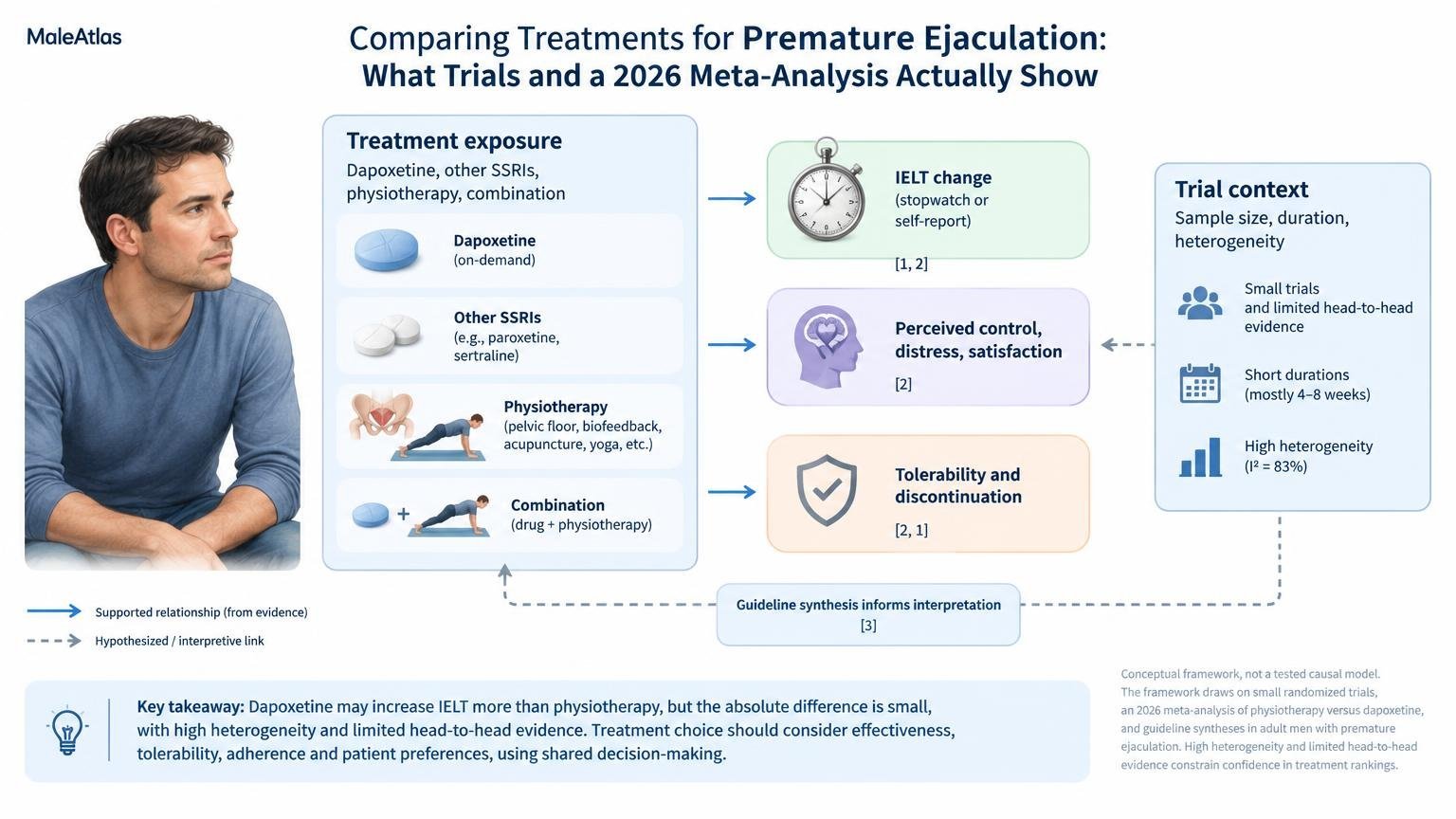
Conceptual framework: Conceptual framework, not a tested causal model. The framework draws on small randomized trials, a 2026 meta-analysis of physiotherapy versus dapoxetine, and guideline syntheses in adult men with premature ejaculation. Supported links reflect reported associations; trial-context links are interpretive. High heterogeneity and limited head-to-head evidence constrain confidence in treatment rankings.
Academic References & Evidence
- Esther M Medrano-Sánchez; Ana López-del-Castillo; Maud Boisseau; Juan C Fernández-Domínguez; Esther Díaz-Mohedo. Effectiveness of physiotherapy in male premature… : The Journal of Sexual Medicine. The Journal of Sexual Medicine. 2026 23(5) DOI: 10.1093/jsxmed/qdag096.
- 10. Shugan Jieyu Capsules combined with conventional therapy for type III B prostatitis complicated by sexual dysfunction.. Chinese journal of integrative medicine. 2016 22(12):889-893
- Disorders of Ejaculation: AUA/SMSNA Guideline (2027) | Journal of Urology. Journal of Urology DOI: 10.1097/JU.0000000000005378.
SANYUN Science Center explains published research on men's reproductive and sexual health, connecting scientific evidence with everyday questions while making sources and limitations clear.
Disclaimer: This article is for scientific education and research communication only. It does not provide medical advice, diagnosis, or individualized treatment recommendations, and does not endorse any medication, supplement, device, penile enlargement procedure, or other intervention. Decisions about sexual and reproductive health should be made in consultation with a qualified healthcare professional. Do not delay seeking professional care because of information in this article.
Original Content & Copyright Notice
- This article is prepared for SANYUN Science Center, drawing on published research and publicly available academic literature on men’s sexual and reproductive health. Its editorial explanations and presentation are developed for this platform.
- Copyright in the original editorial content, selection, and arrangement is reserved by SANYUN Science Center to the extent protected by applicable law. Referenced research, quotations, and third-party materials remain subject to the rights of their respective owners. This notice does not claim ownership of scientific facts or third-party research.
- Except where permitted by applicable law or an applicable license, prior written permission is required to reproduce, republish, translate, adapt, redistribute, or commercially reuse protected content. Attribution alone does not grant permission for such reuse.
- For permitted quotation or authorized reuse, clearly identify the source and retain a link to the original article.
- Source: SANYUN Science Center
- Original URL: Retain the original article URL on science.san-yun.com.
- Copyright Holder: SANYUN Science Center, for its own protected editorial content.
- Quotation, excerpts, or authorized reuse must not distort the scientific meaning, omit material limitations or disclaimers, or imply unverified medical claims, product efficacy, or endorsement by SANYUN Science Center.



