




Category: Premature Ejaculation
Core Research Direction: Premature ejaculation as a couple-level condition: whether treating only the man improves secondary sexual dysfunction in his female partner, and how consensus guidance frames PE evaluation and management
Search Intent: When premature ejaculation in men is treated, does the sexual dysfunction it has caused in their female partners also improve, and what does current consensus recommend for defining and treating PE?
Platform: SANYUN Science Center
Evidence reviewed through: 2026-11-05
Executive Summary
Premature ejaculation (PE) is commonly described as one of the frequent sexual disorders in men, yet its effects are rarely studied at the level of the couple. A recently published pilot study set out to test a specific and clinically important question: if PE in a man contributes to sexual dysfunction in his female partner, does treating only the man improve her function as well? The authors framed PE explicitly as a possible problem for the couple rather than for the man alone.[1]
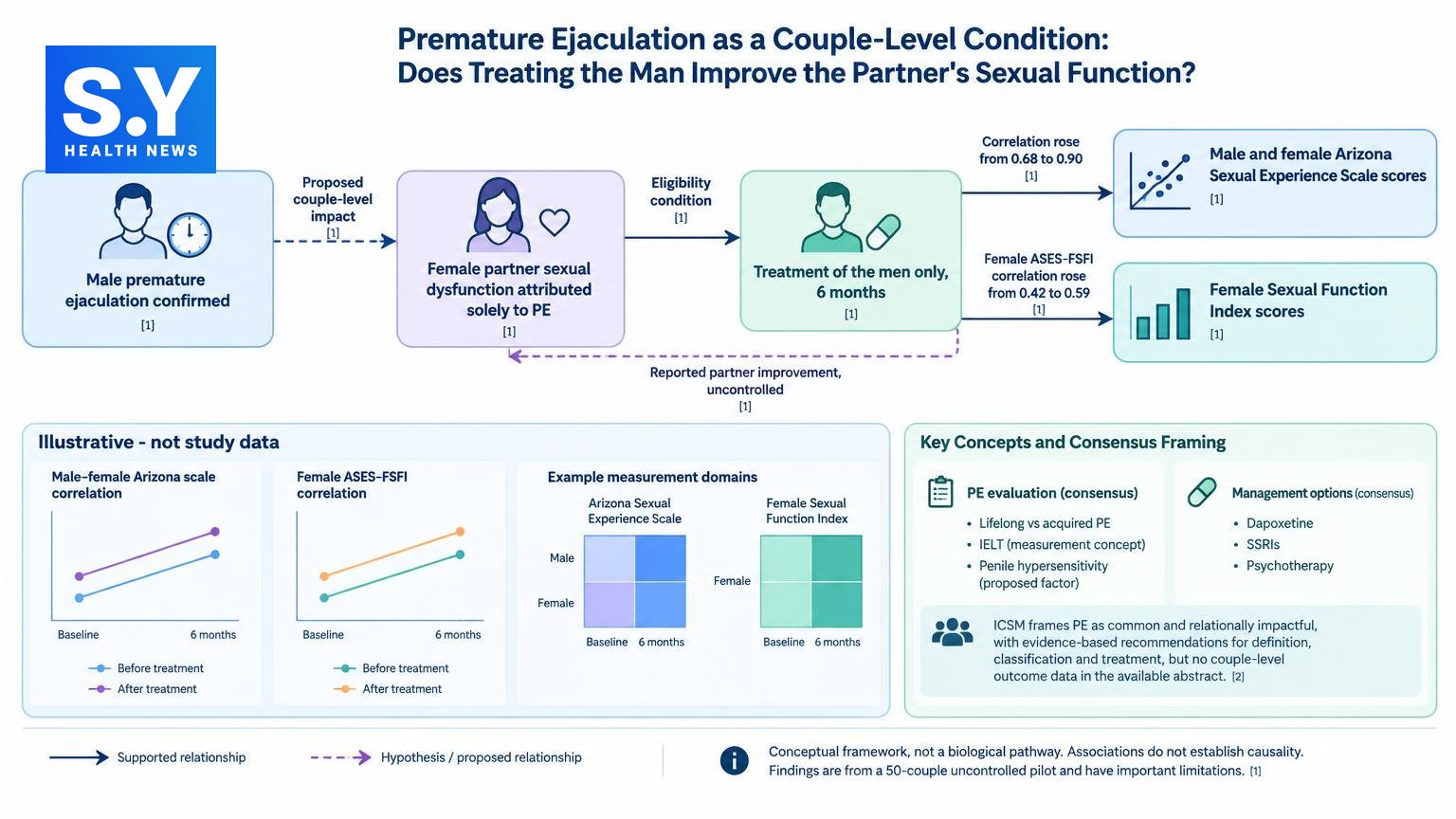
The study enrolled 50 of 95 screened couples in which PE was confirmed in the man and sexual dysfunction in the woman was judged to result solely from his PE. Over six months of treating the men, the correlation between male and female scores on the Arizona Sexual Experience Scale rose from 0.68 at baseline to 0.90, and the correlation between the female Arizona scale and the Female Sexual Function Index rose from 0.42 to 0.59. The authors interpreted these movements as evidence that treating the man's PE was accompanied by improvement in the partner's sexual dysfunction.
These are preliminary, uncontrolled, correlational findings. The supplied report does not include a comparison group, effect sizes for within-person change, or the statistics and p-values behind its significance testing, and the treatment used is not specified. The parallel consensus literature, as represented by the Fifth International Consultation on Sexual Medicine, emphasizes the relational impact of ejaculatory disorders and the need for structured definition, classification and management, but the available abstract does not describe couple-level outcome trials either.[2]
Why This Matters
Ejaculatory disorders, including PE and delayed ejaculation, are described in the consensus review as common conditions with a substantial impact on men's quality of life and their relationships. That relational framing matters clinically: if a man's PE is treated in isolation and the partner's distress or dysfunction is never assessed, a meaningful part of the presenting problem may be left unaddressed.
The couple-level hypothesis also cuts the other way. Partners are not passive recipients of a man's symptom; their sexual response, expectations and prior experiences can shape how PE is experienced and how treatment is evaluated. The pilot authors themselves describe the couple-level effect of PE treatment as little explored, which means clinicians are currently reasoning from a thin evidence base when they promise or predict partner improvement.
For readers of men's health evidence, this is a case study in the difference between a plausible and important hypothesis and a demonstrated treatment effect. The direction of the pilot's findings is encouraging, but the design cannot separate treatment effects from regression to the mean, natural fluctuation, relationship changes over six months, or the nonspecific effects of being assessed and followed.
Biological and Clinical Mechanism
The rationale for expecting partner improvement rests less on a single biological pathway than on a behavioural and interpersonal one. PE changes the timing and predictability of intercourse, which can reduce a partner's opportunity for arousal and orgasm and can generate frustration, avoidance or performance pressure. If the man's ejaculatory control improves, the couple's sexual repertoire and confidence may shift, plausibly improving the partner's sexual experience.
The consensus scope adds conventional clinical anchors: the distinction between lifelong and acquired PE, intravaginal ejaculatory latency time (IELT) as a measurement concept, and penile hypersensitivity as one proposed contributing factor. The listed management concepts include dapoxetine, selective serotonin reuptake inhibitors and psychotherapy, but the supplied abstract does not establish the efficacy of any of these options, nor does it specify how they might influence partner outcomes.
One subtlety in the pilot design is that the female dysfunction was required to stem only from the man's PE. This inclusion rule sharpens the causal question but also narrows the population: in routine practice, female sexual dysfunction is often multifactorial, involving hormonal, relational, psychological and medical factors that a male-focused intervention would not be expected to resolve. The study therefore tests a cleaner hypothesis than most clinics encounter.
What the Evidence Shows
The pilot screened 95 couples and included 50 who met criteria based on diagnostic tools. In the men, PE was confirmed; in the women, sexual dysfunction attributable solely to the man's PE was confirmed. The authors then measured both partners at baseline and after six months of treating the men, using the Arizona Sexual Experience Scale in both sexes and the Female Sexual Function Index in the women.
The reported correlations are the core of the result. Male and female Arizona Sexual Experience Scale scores correlated at R = 0.68 before treatment and R = 0.90 after six months. Female Arizona scale scores and Female Sexual Function Index scores correlated at R = 0.42 before treatment and R = 0.59 after treatment. The authors state that all data were confirmed by the Mann-Whitney test.
| Variable | Reported value | Population and time point | Interpretation and caution |
|---|---|---|---|
| Couples included after screening | 50 of 95 screened | Couples with confirmed male PE and female dysfunction attributed solely to PE | Selected sample; reasons for exclusion of the other couples are not detailed in the supplied text |
| Correlation between male and female ASES scores | R = 0.68 before treatment; R = 0.90 after 6 months | Included couples; baseline and 6 months of treating the men | Correlation strength, not agreement, change over time, or causality |
| Correlation between female ASES and FSFI scores | R = 0.42 before treatment; R = 0.59 after treatment | Female partners; baseline and after treatment | Moderate correlations; no change scores or effect sizes reported in supplied text |
| Additional significance testing | Mann-Whitney test reported, statistics not given | Included couples | Statistical significance cannot be independently assessed from the supplied text |
| Authors' interpretation of partner outcome | Positive effect of treating men's PE on partners' sexual dysfunction | Female partners; 6 months | Uncontrolled pre-post observation; treat as preliminary |
The authors conclude that their results point to the little-explored fact that PE is not only a problem for men but can form a subsequent sexual problem for the couple, and that treating the man's PE had a positive effect on the partner's resulting sexual dysfunction. Both statements are the authors' interpretation of an uncontrolled pilot and should be read as hypothesis-generating rather than as established treatment effects.
The consensus review occupies a different evidentiary level. It synthesizes findings on etiology, epidemiology, evaluation and management and aims to provide evidence-based recommendations for the definition, classification and treatment of PE and delayed ejaculation under the auspices of the Fifth International Consultation on Sexual Medicine. The available abstract does not report its search methods, evidence grading or recommendation strength, and it does not supply couple-level outcome data.
Interpretation and Limitations
The central limitation is the absence of a control or comparison group in the supplied description. Without one, an increase in correlation and an inferred improvement in partners cannot be attributed specifically to the men's PE treatment. Scores can change because symptoms fluctuate, because couples adapt over time, because both partners are being monitored, or because the relationship itself changes during six months of clinical contact.
A second limitation concerns what correlations can mean. A correlation of 0.90 between male and female symptom scores indicates that the two measures moved together closely in this sample; it does not prove that the man's treatment caused the woman's improvement, nor does it quantify how much either partner improved. The supplied text reports no mean scores, no change scores, no effect sizes and no p-values, even though a Mann-Whitney test is mentioned.
Third, the recruitment rule limits generalizability. Requiring that the woman's sexual dysfunction stem solely from the man's PE creates a homogenous, purposively selected group; couples in which female dysfunction has additional causes were apparently not the target population. The sample of 50 couples is also a pilot-scale number, and the 45 screened couples who were not included are not characterized in the supplied text.
Finally, the report does not specify which treatments the men received, their adherence, or whether partners received any intervention of their own. Without that information, the finding cannot be linked to a particular drug, behavioural programme or combined approach, and it would be inappropriate to infer that any specific PE therapy reliably improves partner function.
Research Outlook
The obvious next step is a controlled design: couples randomized to active PE treatment versus delay or alternative management, with partner-reported outcomes measured as primary endpoints and blinded assessors where feasible. Such a study would need to prespecify change scores and effect sizes rather than relying on correlation coefficients, and to report the treatment actually delivered.
A second direction is broader inclusion. Since routine female sexual dysfunction is usually multifactorial, future work could stratify couples by whether the partner's dysfunction is judged to be PE-attributable or mixed, and test whether couple-focused care adds benefit over treating the man alone. The consensus agenda already distinguishes lifelong from acquired PE and lists IELT, hypersensitivity, pharmacological and psychotherapeutic concepts, which provides a framework for stratifying both male and couple-level outcomes.
Until such data exist, the practical message is cautious. The pilot supports taking the partner's sexual health into the clinical conversation and considering couple-level assessment when PE is diagnosed, while making clear to patients that improvement in the partner is a plausible but not yet proven consequence of treating the man.
Key Takeaways
- A pilot study of 50 couples found that treating men's PE was accompanied by improvement in female partners' sexual dysfunction, with male-female Arizona scale correlations rising from 0.68 to 0.90 over six months.
- The design was uncontrolled and correlational, and the supplied report lacks change scores, effect sizes, p-values and treatment details, so the findings are preliminary.
- Inclusion required female dysfunction attributable solely to the man's PE, a deliberately narrow population that limits generalization to multifactorial female sexual dysfunction.
- The Fifth International Consultation on Sexual Medicine frames PE as common and relationally impactful and aims to provide evidence-based recommendations on definition, classification and treatment, but the supplied abstract gives no couple-level outcome evidence.
- Clinically, partner sexual health deserves assessment alongside PE, but improvement in the partner should not be presented as a proven effect of treating the man.
Questions and Answers
What is premature ejaculation and how is it assessed at the couple level?
Premature ejaculation is one of the common sexual disorders in men, and consensus discussions distinguish lifelong from acquired forms and use intravaginal ejaculatory latency time as a measurement concept. A couple-level assessment asks whether the partner also has sexual dysfunction and whether it is attributable to the man's PE. In the reviewed pilot, inclusion required confirmed PE in the man and female dysfunction judged to stem solely from it.
Does treating premature ejaculation in men improve sexual function in their female partners?
A pilot study of 50 couples reported that the correlation between male and female Arizona Sexual Experience Scale scores rose from 0.68 before treatment to 0.90 after six months, and the authors described a positive effect on partners' sexual dysfunction. However, the study was uncontrolled and correlational, with no comparison group, change scores or effect sizes reported in the supplied text, so improvement in partners is plausible but not proven.
How strong is the evidence that treating male PE resolves female partner sexual dysfunction?
The evidence available in this packet is weak. It comes from a single pilot study of 50 couples analyzed before and after treatment without a control arm, and the supplied report gives correlations rather than effect sizes or p-values despite mentioning a Mann-Whitney test. That makes the finding hypothesis-generating. The consensus review addresses definition, classification and management but provides no couple-level outcome data in the available abstract.
Which couples were included in the premature ejaculation couple study?
Of 95 screened couples, 50 were included. In the men, PE was confirmed; in the women, sexual dysfunction was confirmed and judged to result solely from the man's PE. Couples in which female dysfunction had other causes were apparently not the target group, which means the results may not apply to the more common situation of multifactorial female sexual dysfunction.
What are the main limitations and risks of interpreting this couple-level PE study?
The main limitation is the uncontrolled pre-post design, which cannot separate treatment effects from regression to the mean, symptom fluctuation or relationship change over six months. Correlations show that scores moved together, not that the man's treatment caused the partner's improvement. The report also lacks treatment details, mean scores and p-values. Clinicians should avoid promising partners improvement based on this pilot.
What should patients understand about treating premature ejaculation when a partner is affected?
Patients should understand that PE is a common male sexual disorder that can affect the couple, and that the consensus literature calls for structured definition, classification and management. Treating the man may plausibly help the relationship and the partner, and the pilot is encouraging, but improvement in a partner has not been proven in controlled trials. The partner's sexual health deserves separate assessment rather than being assumed to follow.
Conceptual framework: Conceptual framework, not a biological pathway. In a 50-couple uncontrolled pilot, female dysfunction was attributed solely to male PE; over six months of treating the men, male-female Arizona scale correlation rose from 0.68 to 0.90 and female ASES-FSFI correlation from 0.42 to 0.59. Arrows to the partner outcome are proposed, not proven causal effects.
Academic References & Evidence
- R. Sajdlová; J. Lenz; D. Kestlerová; Š. Papadaki; V. Větvička; L. Fiala. The impact of premature ejaculation treatment on a couple’s…. Prakt. Lék.. 2025 105(1):27-32
- Contemporary consensus and emerging directions in premature and delayed ejaculation: recommendations from the 5th International Consultation on Sexual Medicine.. Sexual medicine reviews PMID: 42855438.
SANYUN Science Center explains published research on men's reproductive and sexual health, connecting scientific evidence with everyday questions while making sources and limitations clear.
Disclaimer: This article is for scientific education and research communication only. It does not provide medical advice, diagnosis, or individualized treatment recommendations, and does not endorse any medication, supplement, device, penile enlargement procedure, or other intervention. Decisions about sexual and reproductive health should be made in consultation with a qualified healthcare professional. Do not delay seeking professional care because of information in this article.
Original Content & Copyright Notice
- This article is prepared for SANYUN Science Center, drawing on published research and publicly available academic literature on men’s sexual and reproductive health. Its editorial explanations and presentation are developed for this platform.
- Copyright in the original editorial content, selection, and arrangement is reserved by SANYUN Science Center to the extent protected by applicable law. Referenced research, quotations, and third-party materials remain subject to the rights of their respective owners. This notice does not claim ownership of scientific facts or third-party research.
- Except where permitted by applicable law or an applicable license, prior written permission is required to reproduce, republish, translate, adapt, redistribute, or commercially reuse protected content. Attribution alone does not grant permission for such reuse.
- For permitted quotation or authorized reuse, clearly identify the source and retain a link to the original article.
- Source: SANYUN Science Center
- Original URL: Retain the original article URL on science.san-yun.com.
- Copyright Holder: SANYUN Science Center, for its own protected editorial content.
- Quotation, excerpts, or authorized reuse must not distort the scientific meaning, omit material limitations or disclaimers, or imply unverified medical claims, product efficacy, or endorsement by SANYUN Science Center.



