




Category: Premature Ejaculation
Core Research Direction: How healthcare practitioners set treatment goals, define success and decide when to end treatment for men with premature ejaculation, and how these clinician priorities compare with patients' latency-focused expectations
Search Intent: When treating premature ejaculation, do doctors and therapists prioritize the same outcomes as patients, and how do they judge whether treatment has worked or can be stopped?
Platform: SANYUN Science Center
Evidence reviewed through: 2026-11-22
Executive Summary
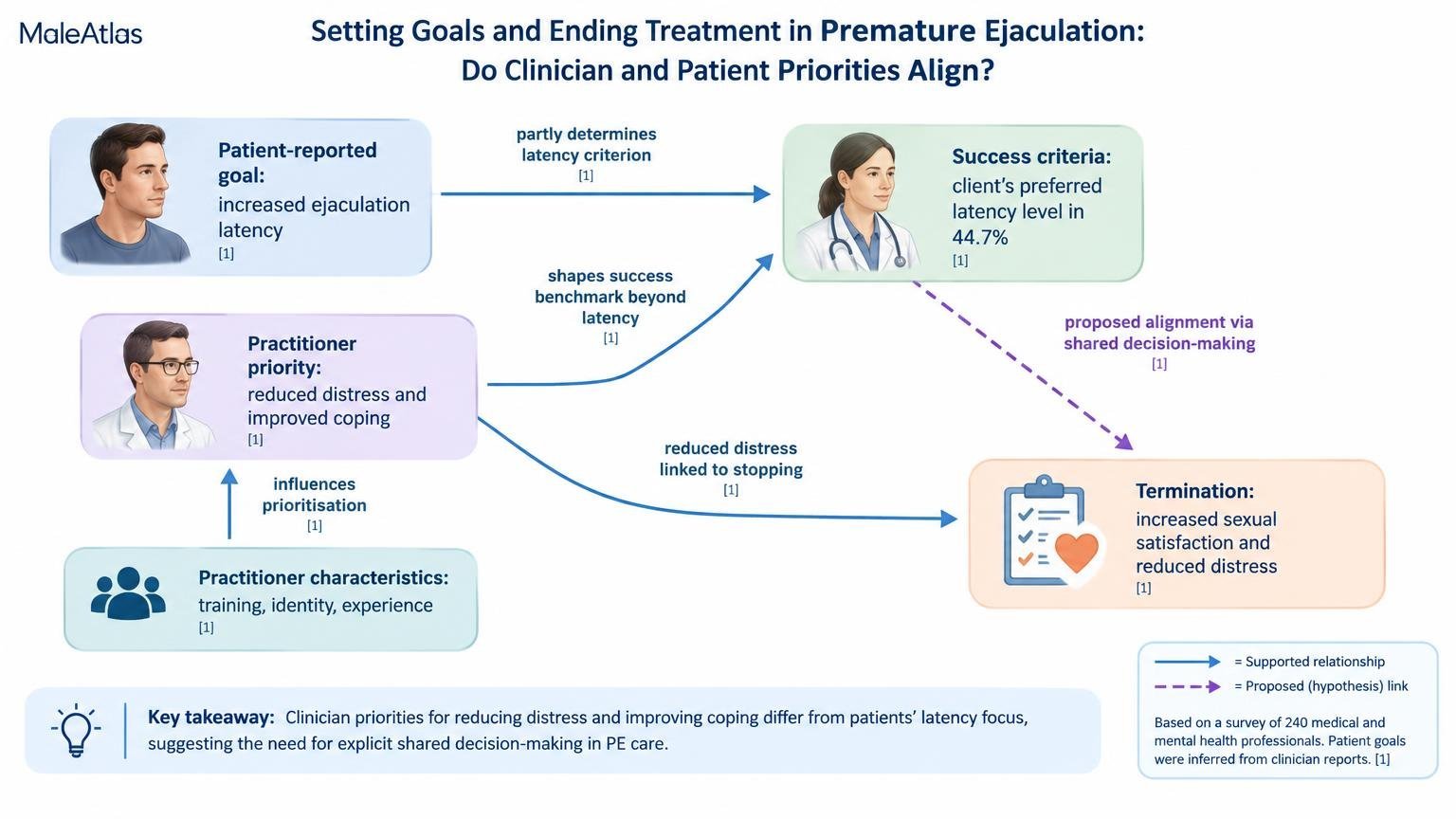
How clinicians decide that premature ejaculation (PE) treatment has worked, and when it should stop, has received little direct study. A survey of 240 medical and mental health professionals addressed this gap by asking practitioners about their treatment objectives, their criteria for success and their reasons for ending care. According to practitioner reports, patients' primary goal was increased ejaculation latency, whereas practitioners themselves most strongly prioritised reducing distress and improving coping.[1]
The findings suggest a structured mismatch rather than a simple disagreement. Only 44.7% of practitioners defined latency success according to the client's preferred level, meaning most applied another benchmark. Beyond latency, reduced stress and improved coping drew the highest success ratings, and 76.9% of practitioners reported moderate-to-high success in treating men with PE. Termination was most often linked to increased sexual satisfaction and reduced distress. Training, professional identity and treatment experience influenced all three decision areas.
These are practitioner self-reports, not observed patient outcomes, and patient goals were inferred rather than measured directly. The authors' recommendation of explicit shared decision-making is therefore a reasoned proposal, not a tested intervention. The survey nonetheless reframes a practical question: success in PE may need to be defined at more than one level, and stopping treatment may reasonably follow satisfaction and distress criteria rather than a latency threshold alone.
Why Treatment Goals Matter in Premature Ejaculation
Ejaculatory disorders, including PE, are common and substantially affect men's quality of life and relationships, according to a consensus review prepared under the Fifth International Consultation on Sexual Medicine. That review aimed to present evidence-based recommendations for the definition, classification and treatment of PE and delayed ejaculation, and it addresses concepts such as lifelong and acquired PE, intravaginal ejaculatory latency time (IELT), dapoxetine, selective serotonin reuptake inhibitors, psychotherapy and penile hypersensitivity.[2]
Because PE is defined partly by time to ejaculation but experienced as distress and relationship difficulty, any treatment plan faces a definitional fork. A clinician can anchor success in the symptom (latency), in the consequences (distress, coping, satisfaction), or in both. The survey is useful because it shows where practitioners actually place that anchor, and where they believe patients place it.
What the Survey Asked and How It Was Designed
Before this survey, the criteria practitioners use to set goals and judge whether PE treatment was successful, met its goals, or should end had not been studied in men seeking treatment. The study therefore set out to describe practitioner priorities for treatment goals, success assessment and termination decisions, and to examine whether practitioner characteristics influenced those decisions.
A total of 240 medical and mental health professionals completed an online or in-person survey on treatment objectives and termination criteria in PE care. The design is descriptive and observational: it captures what clinicians say they do, not what happens in recorded consultations or measured patient outcomes. Sampling method, response rate and the exact item wording are not detailed in the available text, which limits how precisely the percentages should be read.
The Divergence Between Latency and Distress
The central result is a difference in emphasis. According to practitioner reports, patients' primary treatment goal was increased ejaculation latency, while practitioners themselves most strongly prioritised reducing distress and improving coping. This is a report about clinicians' beliefs regarding patients, not a direct measurement of patient preferences, a distinction that matters because clinicians may systematically misjudge what patients value.
The latency question produced a revealing split. Regarding ejaculation latency, 44.7% of practitioners defined success according to the client's preferred level. The complement implies that most practitioners used some other reference point, whether a clinical threshold, a comparative norm or their own judgement. The survey text does not specify those alternatives, so the figure should be read as evidence of heterogeneity in success criteria rather than as a validated cut-off.
Beyond latency, reduced stress and improved coping received the highest success ratings, and 76.9% of practitioners reported moderate-to-high success in treating men with PE. That high self-reported success rate is notable alongside the modest share who deferred to the client's latency target; it suggests clinicians largely judge their work through a broader psychosocial lens. Self-reported success without objective outcome measurement cannot distinguish effective care from generous self-assessment.
| Decision area | What practitioners reported | Reported basis or proportion | Interpretation |
|---|---|---|---|
| Patient's primary goal | Increased ejaculation latency | As reported by practitioners | Inferred from clinician reports, not measured in patients |
| Practitioners' own top priority | Reducing distress and improving coping | Highest-rated priority | Biopsychosocial framing of PE care |
| Latency success criterion | Client's preferred level used by part of the sample | 44.7% of practitioners | Most used a criterion other than the client's target |
| Other success ratings | Reduced stress and improved coping | Highest success rating beyond latency | Outcome judged on function and coping, not time alone |
| Self-rated treatment success | Moderate-to-high success | 76.9% of practitioners | Self-report without objective outcome measurement |
| Termination trigger | Increased sexual satisfaction and reduced distress | Most often linked reasons | Stopping tied to wellbeing rather than a latency number |
How Practitioners Decide Treatment Has Succeeded
Success appears to be judged on several planes at once. Reduced stress and improved coping drew the strongest success ratings beyond latency, which places emotional and behavioural change near the centre of the outcome model. Yet latency was not irrelevant: it generated its own success criterion, and for a minority of practitioners that criterion was the client's preferred level. The overall picture is a layered judgement in which symptom change and psychosocial change are weighed together, with uncertain relative weights.
That layering has a clinical logic. A man whose IELT rises modestly but who no longer avoids sex, argues with his partner or feels inadequate has arguably gained something real. Conversely, a longer latency that leaves anxiety intact may not register as success to the patient. The survey cannot settle which weighting is better, but it makes the weighting visible and therefore negotiable.
Deciding When Treatment Should End
Treatment termination was most often linked to increased sexual satisfaction and reduced distress. This is a consequential finding because it locates the stopping rule in wellbeing rather than in a latency target. It also implies that ending treatment is not the same as declaring the latency problem solved; a man may stop care with a latency he still considers short but with distress and relationship strain sufficiently reduced.
The survey does not report the specific proportions behind this termination finding, so its strength relative to other reasons cannot be quantified from the available text. Nor does it describe structured stopping protocols, relapse criteria or follow-up schedules. Termination therefore remains a judgement informed by satisfaction and distress, not a standardised endpoint, and the decision may vary widely between clinicians.
Why Practitioners Differ: Training, Identity and Experience
Practitioner training, professional identity and PE treatment experience influenced goals, success assessment and termination decisions. This is an association-level finding from a survey; the direction and magnitude of each influence are not given in the source text. It is nonetheless consistent with the idea that medical and mental health professionals approach PE from different conceptual starting points, which would produce different default goals even when treating similar patients.
The clinical implication is not that one professional group is correct. It is that the goal-setting conversation may need to be made explicit precisely because the clinician's default is shaped by background. A clinician who frames success psychosocially and a patient who frames it as time to ejaculation can both be reasonable and still leave the consultation with different expectations unless the difference is named.
Interpretation and Limitations
The most important limitation is perspective. Patient goals were inferred from practitioner reports rather than measured directly, so the headline divergence between latency and distress reflects what clinicians believe about patients. Practitioner beliefs can be accurate, but they can also reflect recall bias, stereotyping or the way survey items were framed. A parallel patient survey would be needed to test whether the gap is real.
Second, all outcomes are self-reported. The 76.9% moderate-to-high success figure describes clinicians' impressions, not verified clinical improvement, and no objective outcome measurement is described. Third, the design is cross-sectional and descriptive, with sampling method and response rate unstated; the 240 respondents may not represent medical and mental health professionals broadly. Fourth, the study examines reported priorities and criteria, not the effect of any particular goal-setting or termination strategy on patient outcomes.
Finally, the recommendation for explicit shared decision-making is an interpretive proposal drawn from a practitioner survey. It has intuitive appeal and aligns with person-centred care, but it has not been tested here as an intervention, and the survey cannot show that aligning goals improves retention, satisfaction or clinical outcome. The consensus review likewise aimed to present evidence-based recommendations for definition, classification and treatment, but the supplied text does not detail those recommendations, so it cannot be used to adjudicate the survey's findings.
Research Outlook
The natural next step is to measure patient priorities directly and compare them with clinician priorities in the same clinical population, rather than inferring one from the other. Studies could also test whether a structured shared-decision conversation about goals changes satisfaction, distress or premature discontinuation. Linking goal type to measured outcomes such as IELT and validated patient-reported measures would clarify whether psychosocial and latency endpoints move together or diverge.
Termination deserves its own prospective study. The survey identifies satisfaction and distress as the usual triggers for stopping, but not how durable that stopping is, how often symptoms return, or whether men who stop with residual latency concerns later re-present. Consensus work on definition and classification provides the conceptual vocabulary, including IELT and the lifelong versus acquired distinction, but applied evidence on stopping rules in routine care remains thin.
Key Takeaways
- A survey of 240 medical and mental health professionals examined how practitioners set goals, judge success and decide when PE treatment should end, an area previously unstudied in men seeking care.
- According to practitioner reports, patients mainly wanted increased ejaculation latency, while practitioners most strongly prioritised reducing distress and improving coping.
- Only 44.7% of practitioners defined latency success by the client's preferred level, and reduced stress and improved coping received the highest success ratings beyond latency.
- Termination was most often linked to increased sexual satisfaction and reduced distress, suggesting wellbeing-based rather than latency-based stopping rules.
- Patient goals were inferred from clinician reports, outcomes were self-reported, and the shared decision-making recommendation is a proposal rather than a tested strategy.
Questions and Answers
What are the treatment goals for premature ejaculation according to practitioners?
In a survey of 240 medical and mental health professionals, practitioners most strongly prioritised reducing distress and improving coping. By their report, patients' primary goal was increased ejaculation latency. Reduced stress and improved coping also received the highest success ratings beyond latency. These are clinician-reported priorities, not directly measured patient preferences, so the patient side of the comparison remains inferred.
How do doctors define successful premature ejaculation treatment?
Success appears multidimensional. For ejaculation latency, 44.7% of practitioners defined success according to the client's preferred level, implying most used another benchmark. Beyond latency, reduced stress and improved coping drew the highest success ratings, and 76.9% of practitioners reported moderate-to-high success overall. These are self-reported impressions without described objective outcome measurement, so they should not be read as verified clinical effectiveness.
When should premature ejaculation treatment be stopped?
In the survey, treatment termination was most often linked to increased sexual satisfaction and reduced distress rather than to a latency target. This suggests practitioners tend to stop when wellbeing and relationship strain improve. However, the source text does not report specific proportions, structured stopping protocols or relapse criteria, so termination remains a clinical judgement informed by satisfaction and distress rather than a standardised endpoint.
How strong is the evidence that clinician and patient goals in premature ejaculation differ?
The evidence is suggestive but indirect. The divergence comes from practitioner reports about what patients want, not from patients themselves, and the study is a descriptive cross-sectional survey of 240 professionals with unstated sampling and response rate. It documents clinician beliefs and criteria, not measured patient preferences or the effect of aligning goals on outcomes. Direct patient-preference research would be needed to confirm the gap.
Does professional background affect premature ejaculation treatment decisions?
Yes, according to the survey. Practitioner training, professional identity and PE treatment experience influenced goals, success assessment and termination decisions. The source gives the direction of influence only loosely and does not report effect sizes, so this is an association-level finding. It suggests that medical and mental health professionals may bring different default goals to the same patient, which is one rationale for making goals explicit in consultation.
What does intravaginal ejaculatory latency time mean in premature ejaculation care?
Intravaginal ejaculatory latency time, or IELT, is the time from vaginal penetration to ejaculation and is a recognised measurement concept in premature ejaculation. A consensus review under the Fifth International Consultation on Sexual Medicine addresses IELT alongside lifelong and acquired PE classifications, dapoxetine, SSRIs, psychotherapy and penile hypersensitivity. The available text lists these topics but does not detail the review's specific recommendations on them.
Conceptual framework: Conceptual framework of practitioner and patient priorities in premature ejaculation care, based on a survey of 240 medical and mental health professionals. Arrows marked as supported reflect reported associations; the proposed shared-decision link between latency goals and termination is a hypothesis, not a tested causal model. Patient goals were inferred from clinician reports.
Academic References & Evidence
- Mirnics Mirnics; Kirana Kirana; Rowland Rowland. Health Care Practitioners' Treatment Objectives and Criteria for Ending Treatment in Men with Premature Ejaculation..
- Contemporary consensus and emerging directions in premature and delayed ejaculation: recommendations from the 5th International Consultation on Sexual Medicine.. Sexual medicine reviews PMID: 42855438.
SANYUN Science Center explains published research on men's reproductive and sexual health, connecting scientific evidence with everyday questions while making sources and limitations clear.
Disclaimer: This article is for scientific education and research communication only. It does not provide medical advice, diagnosis, or individualized treatment recommendations, and does not endorse any medication, supplement, device, penile enlargement procedure, or other intervention. Decisions about sexual and reproductive health should be made in consultation with a qualified healthcare professional. Do not delay seeking professional care because of information in this article.
Original Content & Copyright Notice
- This article is prepared for SANYUN Science Center, drawing on published research and publicly available academic literature on men’s sexual and reproductive health. Its editorial explanations and presentation are developed for this platform.
- Copyright in the original editorial content, selection, and arrangement is reserved by SANYUN Science Center to the extent protected by applicable law. Referenced research, quotations, and third-party materials remain subject to the rights of their respective owners. This notice does not claim ownership of scientific facts or third-party research.
- Except where permitted by applicable law or an applicable license, prior written permission is required to reproduce, republish, translate, adapt, redistribute, or commercially reuse protected content. Attribution alone does not grant permission for such reuse.
- For permitted quotation or authorized reuse, clearly identify the source and retain a link to the original article.
- Source: SANYUN Science Center
- Original URL: Retain the original article URL on science.san-yun.com.
- Copyright Holder: SANYUN Science Center, for its own protected editorial content.
- Quotation, excerpts, or authorized reuse must not distort the scientific meaning, omit material limitations or disclaimers, or imply unverified medical claims, product efficacy, or endorsement by SANYUN Science Center.



