




Category: Premature Ejaculation
Core Research Direction: Couple-level and dyadic effects of premature ejaculation and its treatment: whether treating the man's PE also improves the female partner's sexual function, and how consensus guidance and couple-oriented CBT trials frame evaluation and management.
Search Intent: When a man is treated for premature ejaculation, does his partner's sexual function and the couple's sexual relationship also improve, and what does current consensus recommend for assessment and treatment?
Platform: SANYUN Science Center
Evidence reviewed through: 2026-11-14
Executive Summary
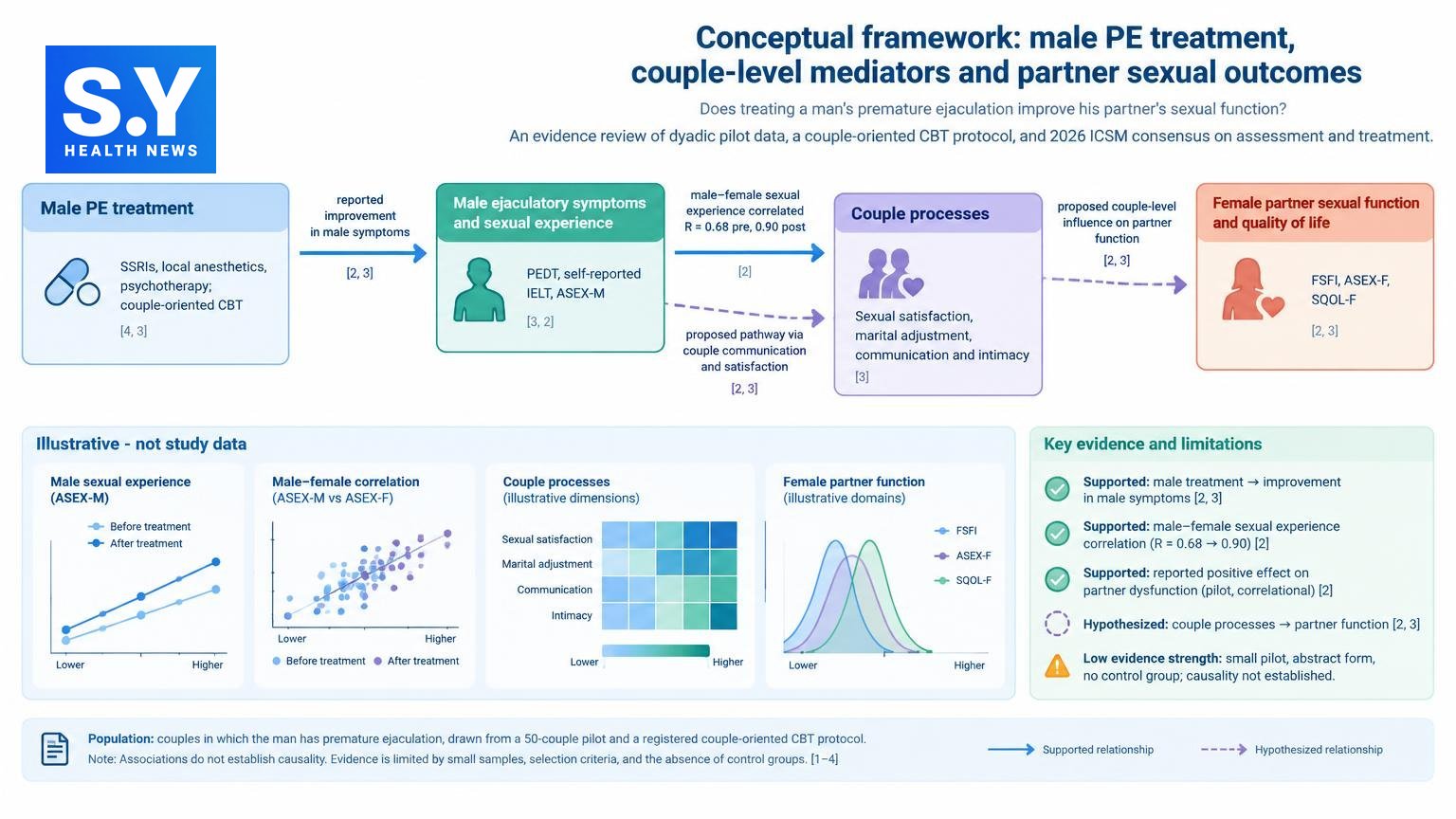
Premature ejaculation (PE) is conventionally assessed and treated as an individual male complaint, yet contemporary consensus describes ejaculatory disorders as common conditions with substantial impact on men's quality of life and their relationships. A small 2025 pilot study in couples reframes PE as a potential problem for the couple as a whole, reporting that when only the man was treated, correlations between male and female sexual-experience scores rose from R = 0.68 before treatment to R = 0.90 after 6 months of treatment, and the authors describe a positive effect of the man's treatment on the female partner's sexual dysfunction.[1][2]
These findings are hypothesis-generating, not confirmatory. The pilot included 50 couples selected from 95 screened, was reported only in abstract form in the retrieved record, and reported correlations rather than controlled between-group effects. A registered couple-oriented cognitive-behavioral protocol aims to evaluate men's PE symptoms alongside couples' sexual satisfaction, marital adjustment and wives' sexual function, but with 4 couples plus 1 pilot, no classical control group, and recruitment not yet begun, it cannot yet answer the dyadic question. The 2026 consensus guidance supplies the definitional and treatment frame but does not itself test partner outcomes.[3][4]
Why Dyadic Framing Matters
The Fifth International Consultation on Sexual Medicine (ICSM) review states that disorders of ejaculation, including PE and delayed ejaculation, are common conditions with a substantial impact on men's quality of life and their relationships. That wording places the relationship inside the clinical problem rather than outside it: if the partner's sexual experience is part of what is affected, it is also a plausible part of what should be measured when treatment is evaluated.
The consensus summary describes PE as the most common male sexual complaint and divides it into lifelong, acquired, variable and subjective subtypes. This subtyping matters for dyadic research because lifelong and acquired PE may have different trajectories, different degrees of partner accommodation, and potentially different responsiveness to couple-based versus individual treatment. None of the retrieved sources stratifies partner outcomes by subtype, which is one reason the dyadic evidence base remains thin.
Definitions also shape who enters a dyadic study. The consensus definitions of PE incorporate time, distress and control criteria, so a couple is eligible for research only when the man's ejaculatory latency, his sense of control and associated distress meet a threshold. A partner's sexual dysfunction may exist independently of that threshold, which complicates attribution — an issue central to interpreting the pilot data below.
Conceptual Mechanism: How a Male Symptom Could Reach a Female Outcome
The retrieved sources do not establish a mechanism, but they permit a conceptual sketch. If PE is experienced as a couple-level problem, the pathway most consistent with the pilot framing runs from the man's ejaculatory control and associated distress to the couple's sexual repertoire, timing of intercourse, and the partner's opportunity for arousal and satisfaction. Treating the man could plausibly alter that pathway by lengthening intercourse, reducing performance anxiety, or improving communication — but these are proposed links, not measured mediators in any retrieved study.
The registered couple-oriented protocol makes a different mechanistic assumption: that an individual CBT package should be improved into a couple-oriented package based on qualitative findings about women's lived experiences, actively involving wives and addressing women's sexual needs and expectations. Its planned content combines cognitive techniques, behavioral techniques such as stop-start exercises, and couple-oriented techniques targeting intimacy and communication, delivered across 10 weekly sessions of 60 to 90 minutes in a planned 10-week intervention with a 1.5-month follow-up.
The consensus treatment list — SSRIs, local anesthetics and psychotherapy — is symptom-directed at the man. Whether any of these modalities produces measurable, durable change in a partner's sexual function has not been established in the retrieved evidence; the pilot examined treated men without specifying a dyadic psychotherapy component in the abstract, and the couple-oriented trial has not reported outcomes.
What the Evidence Shows
| Study or source | Design and population | Key reported or planned observation | Interpretation and limits |
|---|---|---|---|
| Couple pilot (2025) | Pilot study; 50 couples included of 95 screened; men with confirmed PE and women with sexual dysfunction attributed to PE | Male–female ASEX correlation R = 0.68 before treatment and R = 0.90 after 6 months of treatment; authors report a positive effect of treating the man on the partner's sexual dysfunction | Couple-level association; pilot design, abstract-only record, no documented control group, no effect sizes; cannot establish causation |
| Couple pilot (2025) | Same 50 couples | Female ASEX and FSFI correlation R = 0.42 before treatment and R = 0.59 after treatment; all data confirmed with the Mann-Whitney test | Two female instruments converged more closely after treatment; sample-level correlation, not an individual-level guarantee of improvement |
| Couple-oriented CBT protocol | Single-case design with multiple baselines; 4 couples plus 1 pilot; each couple serves as own control; no classical control group; not yet recruiting as of 2026-10-16 | Planned outcomes: men's PE symptoms (PEDT and self-reported IELT), men's sexual quality of life, couples' sexual satisfaction, marital adjustment, and wives' sexual function and quality of life | Protocol only; no results; very small sample and no randomization limit causal inference and generalizability |
| Fifth ICSM consensus (2026) | Evidence-based consensus review using a modified Delphi process and GRADE, per the consensus summary | PE and delayed ejaculation are common and substantially affect men's quality of life and relationships; definitions use time, distress and control; treatment includes SSRIs, local anesthetics and psychotherapy | Provides definitional and management frame; does not report partner outcomes; recommendations are consensus rather than new trial data |
The closest thing to a direct test of the dyadic question is the pilot's observation that the correlation between male and female Arizona Sexual Experience Scale scores strengthened from R = 0.68 before treatment to R = 0.90 after 6 months of treatment. Read plainly, this says male and female sexual experience moved into closer alignment over the treatment period. It does not, by itself, establish that the man's treatment caused the partner's improvement: correlations can strengthen because variance in one measure shrinks, because couples were selected for linked dysfunction at baseline, or because shared time and attention changed both partners.
A second correlation adds internal consistency to the female measurement: female Arizona Sexual Experience Scale scores correlated with the Female Sexual Function Index at R = 0.42 before treatment and R = 0.59 after treatment. The authors state that these relationships were confirmed by the Mann-Whitney test. This supports the plausibility that the female instruments were tracking a related construct, but it does not supply a controlled estimate of how much a partner improves, how often, or whether improvement persists after treatment stops.
The protocol adds an important design idea rather than an answer. By listing PE symptoms, men's sexual quality of life, couples' sexual satisfaction, marital adjustment, and wives' sexual function and quality of life as primary outcomes, it treats the couple as the unit of evaluation. Its planned use of the Premature Ejaculation Diagnostic Tool and self-reported intravaginal ejaculatory latency time means the male symptom anchor will be both questionnaire-based and couple-reported, which is methodologically sensible for a dyadic study. Because recruitment had not begun at registration, no outcome data exist.
Interpretation and Limitations
Evidence strength for the central claim — that treating the man's PE improves the female partner's sexual function — is low. It rests on one small pilot reported in abstract form, with selection of couples in whom the woman's dysfunction was attributed solely to the man's PE, a design choice that inflates the apparent coupling of outcomes. The absence of a documented control group means regression to the mean, natural fluctuation, placebo response, and the nonspecific effects of entering treatment cannot be separated from specific treatment effects.
Statistical and clinical meaning should be kept distinct here. The correlation changes are described as statistically confirmed, but no minimal clinically important difference, responder rate, or effect size for the partner is reported in the retrieved record. A couple may show closer alignment of scores without either partner crossing a threshold that matters to them. Conversely, a partner could improve substantially while correlations remain modest. The pilot cannot adjudicate between these possibilities.
The pilot's own authors frame the result cautiously, describing a little-explored fact that PE may form a subsequent sexual problem for the couple as a whole, and presenting the findings as pointing to a positive effect. That language is appropriately tentative and should be preserved: it is a hypothesis about dyadic entanglement, not a demonstrated causal chain, and the retrieved record does not describe how treatment was assigned or how partners were assessed.
Applicability is limited by selection. The pilot enrolled couples in which the woman's sexual dysfunction was attributed only to the man's PE, excluding couples with mixed or partner-predominant etiology. The protocol is narrower still, enrolling couples aged 25 and older with at least two years of marital life, confirmed PE by interview and PEDT, no major psychiatric or personality disorders, no major marital conflict, and no PE-affecting medication in the past three months. Findings from such samples should not be generalized to couples with co-occurring erectile dysfunction, relationship crisis, or shorter relationships.
Finally, the consensus guidance that frames assessment and management is a review of evidence and recommendations, not a trial. It organizes definitions and treatment options, and states that understanding pathophysiology and individualized treatment may improve outcomes, while calling for more evidence-based treatment research. It does not quantify partner benefit, so it cannot fill the gap left by the pilot.
Clinical Relevance: Assessment and Management Framing
For clinicians, the dyadic framing changes the assessment conversation more than the prescription. If PE affects relationships, then asking about the partner's sexual experience, the couple's satisfaction and the meaning of the symptom to both people is consistent with the consensus emphasis on distress and control rather than latency alone. This is an assessment stance supported by the consensus definitions and the pilot framing, not a claim that couple assessment has proven superiority over individual assessment.
Management options named in the consensus summary include SSRIs, local anesthetics and psychotherapy, and the consensus links understanding of pathophysiology with individualized treatment as a route that may improve outcomes. The registered couple-oriented package illustrates one way psychotherapy could be structured dyadically — cognitive work on dysfunctional sexual beliefs, behavioral stop-start and squeeze techniques, anxiety management, communication and intimacy exercises, and attention to the partner's needs — but its efficacy is unproven until the planned study reports.
A practical implication is that partner outcomes should be measured, not assumed. The pilot's instruments — the Arizona Sexual Experience Scale for both partners and the Female Sexual Function Index for women — are feasible in a couple-level evaluation, and the protocol's inclusion of couples' sexual satisfaction and marital adjustment alongside male symptom measures shows what a dyadic outcome set can look like. Whether improvement in one partner tracks improvement in the other remains an empirical question for adequately controlled studies.
Research Outlook
The field needs three things the current record lacks. First, controlled dyadic trials that randomize couples rather than men, with partners as prespecified outcome informants and blinded or independent assessment where feasible. Second, reporting that separates statistical association from clinically meaningful partner-level change, including responder definitions agreed in advance. Third, stratification by PE subtype and by baseline partner function, since the consensus distinguishes lifelong, acquired, variable and subjective PE and dyadic effects may not be uniform across them.
The registered couple-oriented CBT protocol is one step in that direction, but its planned single-case design with 4 couples plus 1 pilot, multiple baselines and no classical control group means it will generate hypotheses and feasibility data rather than definitive efficacy estimates. Its four-phase structure — qualitative exploration, package development, feasibility assessment, then single-case efficacy evaluation — is a sensible sequence for a complex dyadic intervention, and its mixed-methods logic could clarify which partner experiences drive change.
The consensus review also flags an evidence gap beyond PE: more evidence-based treatment research is needed, especially for delayed ejaculation. For the dyadic question specifically, the gap is not merely more studies but better-matched designs — couples as the unit, partner outcomes as primary, and follow-up long enough to test whether gains persist after treatment ends, which the planned 1.5-month follow-up may begin to address but not resolve.
Key Takeaways
- A 2025 pilot in 50 couples (of 95 screened) reported that male–female sexual-experience correlations rose from R = 0.68 before treatment to R = 0.90 after 6 months when only the man was treated, and its authors describe a positive effect on the partner's sexual dysfunction — hypothesis-generating, not confirmatory.
- The pilot's female instruments correlated at R = 0.42 before and R = 0.59 after treatment, and the authors report confirmation by the Mann-Whitney test; no partner-level responder rates or effect sizes appear in the retrieved record.
- A registered couple-oriented CBT protocol plans to measure men's PE symptoms, couples' sexual satisfaction and marital adjustment, and wives' sexual function, but has 4 couples plus 1 pilot, no classical control group, and had not begun recruiting — so it currently provides design, not results.
- The 2026 ICSM consensus defines PE using time, distress and control, describes lifelong, acquired, variable and subjective subtypes, and lists SSRIs, local anesthetics and psychotherapy as treatment options without quantifying partner benefit.
- Until controlled dyadic trials report, clinicians should treat partner improvement as plausible but unproven, and couples should expect that assessment may include both partners' sexual experience rather than the man's latency alone.
Questions and Answers
What is premature ejaculation, and how does the 2026 consensus define its subtypes?
Premature ejaculation is described by the consensus summary as the most common male sexual complaint, classified into lifelong, acquired, variable and subjective subtypes. Its definition incorporates time, distress and control criteria rather than a latency threshold alone. The Fifth ICSM review frames ejaculatory disorders as common conditions that substantially affect men's quality of life and relationships, which is why dyadic assessment has gained attention.
Does treating a man's premature ejaculation improve his female partner's sexual function?
A small 2025 pilot suggests it may. In 50 couples, male–female sexual-experience correlations rose from R = 0.68 before treatment to R = 0.90 after 6 months of treating only the man, and the authors describe a positive effect on the partner's sexual dysfunction. However, this is a pilot without a documented control group, reported in abstract form, so causation and the size of any partner benefit remain unproven.
How strong is the evidence that premature ejaculation treatment helps the couple rather than only the man?
Evidence strength is low. It rests on one pilot of 50 couples selected because the woman's dysfunction was attributed solely to the man's PE, with correlational outcomes, no documented control group and no reported partner-level effect sizes. A registered couple-oriented CBT trial exists but has no results and a very small planned sample. The consensus review frames the problem dyadically but provides no partner-outcome estimates.
What does the couple-oriented CBT protocol for premature ejaculation plan to measure, and in whom?
It plans to enroll couples in which the husband's PE is confirmed by interview and the PEDT, aged 25 and older with at least two years of marital life. Planned primary outcomes include men's PE symptoms via PEDT and self-reported IELT, men's sexual quality of life, couples' sexual satisfaction, marital adjustment, and wives' sexual function and quality of life, assessed across baseline, a 10-week intervention and a 1.5-month follow-up.
What are the main limitations of the premature ejaculation couple studies reviewed here?
The pilot is small, abstract-only, selects couples with partner dysfunction attributed solely to PE, and reports correlations rather than controlled effects, so regression to the mean and nonspecific treatment effects cannot be excluded. The CBT protocol has 4 couples plus 1 pilot, no classical control group and no randomization, and had not begun recruiting. The consensus review offers recommendations, not new partner-outcome data.
What treatment options does the 2026 consensus list for premature ejaculation?
The consensus summary lists SSRIs, local anesthetics and psychotherapy as treatment options for PE. It also states that understanding pathophysiology and individualizing treatment may improve outcomes, and calls for more evidence-based treatment research, especially for delayed ejaculation. The retrieved consensus does not quantify how much any option improves a partner's sexual function, so couple-level benefit should be discussed as plausible but unproven.
Conceptual framework: Conceptual framework. Population: couples in which the man has premature ejaculation, drawn from a 50-couple pilot and a registered couple-oriented CBT protocol. Supported edges reflect reported correlations and pilot interpretations; dashed-style proposed edges reflect hypotheses about couple communication and satisfaction that were not directly tested. Not a tested causal model.
Academic References & Evidence
- Contemporary consensus and emerging directions in premature and delayed ejaculation: recommendations from the 5th International Consultation on Sexual Medicine.. Sexual medicine reviews PMID: 42855438.
- R. Sajdlová; J. Lenz; D. Kestlerová; Š. Papadaki; V. Větvička; L. Fiala. The impact of premature ejaculation treatment on a couple’s…. Prakt. Lék.. 2025 105(1):27-32
- zahra khaksari. Exploring the Lived Experiences of Women with Husbands Suffering from Premature Ejaculation: Improvement, Feasibility, and Efficacy of an Individual Cognitive-Behavioral Treatment Package into a Couple-Oriented Package Based on the Findings of a Qualitative Study. 2026 (protocol)
- 2026 ICSM专家共识:早泄和延迟射精的当代共识与新兴方向. Sex Med Rev. 2026 14(4)
SANYUN Science Center explains published research on men's reproductive and sexual health, connecting scientific evidence with everyday questions while making sources and limitations clear.
Disclaimer: This article is for scientific education and research communication only. It does not provide medical advice, diagnosis, or individualized treatment recommendations, and does not endorse any medication, supplement, device, penile enlargement procedure, or other intervention. Decisions about sexual and reproductive health should be made in consultation with a qualified healthcare professional. Do not delay seeking professional care because of information in this article.
Original Content & Copyright Notice
- This article is prepared for SANYUN Science Center, drawing on published research and publicly available academic literature on men’s sexual and reproductive health. Its editorial explanations and presentation are developed for this platform.
- Copyright in the original editorial content, selection, and arrangement is reserved by SANYUN Science Center to the extent protected by applicable law. Referenced research, quotations, and third-party materials remain subject to the rights of their respective owners. This notice does not claim ownership of scientific facts or third-party research.
- Except where permitted by applicable law or an applicable license, prior written permission is required to reproduce, republish, translate, adapt, redistribute, or commercially reuse protected content. Attribution alone does not grant permission for such reuse.
- For permitted quotation or authorized reuse, clearly identify the source and retain a link to the original article.
- Source: SANYUN Science Center
- Original URL: Retain the original article URL on science.san-yun.com.
- Copyright Holder: SANYUN Science Center, for its own protected editorial content.
- Quotation, excerpts, or authorized reuse must not distort the scientific meaning, omit material limitations or disclaimers, or imply unverified medical claims, product efficacy, or endorsement by SANYUN Science Center.



