




Category: Premature Ejaculation
Core Research Direction: Premature ejaculation in young adult men: epidemiology, persistence, and evolving evidence-based management, including guideline updates on non-pharmacological and pharmacological therapies, with attention to what observational and consensus evidence can and cannot establish.
Search Intent: How common is premature ejaculation in young men, how often does it persist, and what do current evidence-based guidelines support for its treatment?
Platform: SANYUN Science Center
Evidence reviewed through: 2026-11-21
Executive Summary
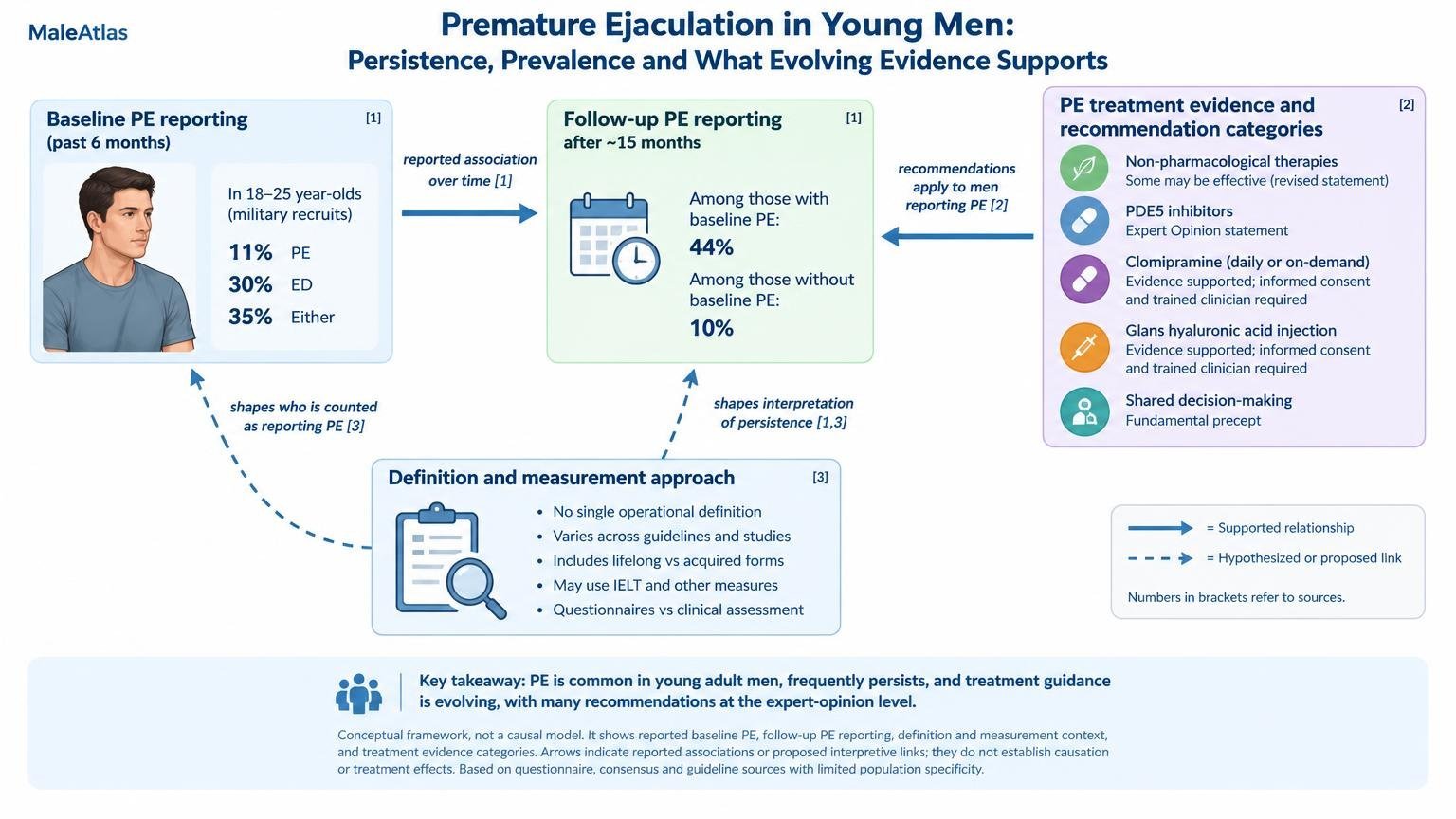
Premature ejaculation (PE) is often framed as a condition of older men, yet a Swiss prospective cohort of 3700 sexually active military recruits aged 18–25 found that 11% reported PE within the past 6 months at baseline, and 30% reported erectile dysfunction (ED); 35% reported at least one of the two. At follow-up a mean of 15 months later, PE was reported by 44% of men who had reported it at baseline and by 10% of those who had not. These figures describe questionnaire-reported symptoms in a specific young, sexually active, military sample rather than clinically diagnosed disorder, and the supplied summary does not report how PE was defined or what the multivariate model adjusted for.[1]
Treatment guidance has also moved. The AUA/SMSNA Disorders of Ejaculation guideline amendment searched MEDLINE and Embase for studies published between January 1, 2020 and December 19, 2024, identified 727 abstracts of which 89 met inclusion criteria, and assessed outcomes on 25 studies to inform statement updates. It revised its statement on non-pharmacological PE therapies to reflect new evidence that some may be effective, added a new Expert Opinion statement on PDE5 inhibitors for PE, and added statements on daily or on-demand clomipramine and glans hyaluronic acid injection with explicit caveats about informed consent and trained-clinician use. The Panel set shared decision-making as the fundamental precept.[2]
The Fifth International Consultation on Sexual Medicine (ICSM) review describes PE and delayed ejaculation as common conditions with substantial impact on quality of life and relationships, and aims to provide evidence-based recommendations for definition, classification and treatment. Its keywords indicate coverage of lifelong PE, penile hypersensitivity, psychotherapy and selective serotonin reuptake inhibitors (SSRIs). However, the supplied text contains no efficacy estimates, so it supports framing rather than comparative claims. The central conclusion of this review is therefore narrow: PE is common enough in young adult men to warrant attention, it frequently persists over about a year, and the treatment evidence base is evolving but still contains statements graded at expert-opinion level.[3]
Why This Matters in Young Adult Men
Sexual dysfunction research has historically concentrated on middle-aged and older men. The Swiss cohort is notable because it recruited 18–25-year-old recruits and followed them prospectively, allowing the investigators to examine factors associated with emergence or persistence rather than a single cross-sectional snapshot. The baseline prevalence figures — 11% for PE, 30% for ED and 35% for either — suggest that a substantial minority of young, sexually active men report at least one sexual difficulty. The follow-up proportions (44% of those with baseline PE and 10% of those without) indicate that PE is neither universally transient nor universally persistent in this sample.
Broader surveys in young men reinforce that sexual difficulties are not confined to older ages, though they focus mainly on ED rather than PE. A nationwide internet-based cross-sectional survey conducted in Japan in 2023 analyzed 6228 men aged 20–79 and defined ED as Erection Hardness Score ≤2. In men aged 20–29, ED prevalence was 25.5% among unmarried men and 17.8% among married men, an adjusted prevalence difference of 7.3% (p<0.05). After adjustment for marital status and comorbidities, ED prevalence followed a U-shaped age pattern, lowest around age 40.[4]
A separate summary of a study in 361 healthy, sexually active Malaysian men aged 18–39 reported that about 33% had some degree of erectile difficulty and about 4% severe symptoms, with associations reported for lower income, lower sexual desire and certain sexual orientation groups. A peer-reviewed perspective article on the reported rise of ED in young men lists performance anxiety and premature ejaculation among its keywords, but the supplied text contains only title and bibliographic fields. These sources sketch a consistent message — young adulthood is a vulnerable period for male sexual health — but they do not measure PE prevalence directly or explain why persistence varies.[5][6]
Definitions, Measurement and the Persistence Question
PE is defined and classified in guideline and consensus documents, but the supplied sources do not converge on a single operational definition. The ICSM review aims to present recommendations for the definition, classification and treatment of PE and delayed ejaculation, and its keywords distinguish lifelong from acquired forms and list intravaginal ejaculatory latency time (IELT) among its concepts. The AUA/SMSNA amendment likewise addresses evaluation and diagnosis alongside treatment. The Swiss cohort summary, by contrast, reports only whether respondents reported PE within the past 6 months; the exact question wording, the latency threshold used and whether distress or partner bother was required are not stated in the supplied text.
This measurement gap matters for interpreting the follow-up figures. A man who reported PE at both baseline and follow-up may have had persistent lifelong PE, relapsing acquired PE, or simply the same self-reported symptom on two occasions. The 44% figure describes the proportion reporting PE at follow-up among those who reported it at baseline, and the 10% figure describes the proportion reporting it at follow-up among those who did not. Framing these as persistence and new-onset respectively is a convenient reading, but the two-questionnaire design cannot establish clinical diagnostic stability, and no clinician assessment is described in the supplied summary.
The Japanese survey illustrates a related point for ED: even when a validated instrument such as the Erection Hardness Score is used, an internet-based, self-selected sample and a cross-sectional design limit causal inference and can distort apparent age trends. The authors themselves frame the elevated ED prevalence in men in their 20s as persisting independently of marital status and raise psychosocial and lifestyle contributions as a possibility, not a demonstrated cause. The same caution applies when reading PE prevalence: reported percentages describe who answered a questionnaire in a particular way in a particular sample, not the true population burden of clinically significant disorder.
What the Evidence Shows
The clearest quantitative findings in this packet come from the Swiss cohort. In 3700 sexually active recruits aged 18–25, baseline 6-month PE reporting was 11%, baseline ED reporting was 30%, and 35% reported at least one. At a mean of 15 months, PE was reported by 44% of men with baseline PE and 10% without baseline PE; the corresponding ED figures were 51% and 14%. These are proportions of respondents, not incidence rates, and the supplied text does not provide confidence intervals, loss-to-follow-up numbers or the full multivariate model. The directional finding — that baseline symptoms predict later symptoms more often than absence does — is consistent with a meaningful persistence signal, but the size of that signal in clinical terms cannot be derived from the summary alone.
Treatment evidence in the guideline amendment is best read as a map of where recommendations stand rather than a ranking of therapies. The revision of the non-pharmacological statement reflects new evidence that some such therapies may be effective; the supplied text does not name which therapies or report effect sizes. The PDE5 inhibitor statement is explicitly labeled Expert Opinion, which places it below trial-based recommendations in evidence hierarchy. The clomipramine and glans hyaluronic acid injection statements are supported by evidence according to the amendment, but the Panel attaches informed-consent and trained-clinician caveats, signaling that these are not routine first-line options for every patient.
| Measure or recommendation | Source type | Reported content | Interpretation |
|---|---|---|---|
| Baseline PE reporting, men aged 18–25 | Prospective cohort, questionnaire | 11% within past 6 months | Symptom reporting in a military recruit sample; clinical diagnosis not stated |
| PE at follow-up by baseline status | Prospective cohort, mean 15 months | 44% with baseline PE; 10% without | Suggests persistence and some new reporting; not an incidence rate |
| Non-pharmacological PE therapies | Guideline amendment | Statement revised; some therapies may be effective | Direction positive but specific therapies and effect sizes not in supplied text |
| PDE5 inhibitors for PE | Guideline amendment, Expert Opinion | New Expert Opinion statement on potential use | Lowest formal evidence grade among guideline statements described |
| Clomipramine and glans hyaluronic acid injection | Guideline amendment | Evidence supported two new statements; informed consent and trained clinician required | Conditional recommendations carrying procedural caveats |
| Shared decision-making | Guideline amendment | Fundamental precept regardless of treatment | Applies across all PE management options |
Reading the Guideline Amendment Carefully
The AUA/SMSNA amendment is a useful case study in how guideline language encodes evidence strength. Its methods section reports a defined search window (January 1, 2020 to December 19, 2024), 727 abstracts screened, 89 meeting inclusion criteria, and 25 studies undergoing data extraction and quality assessment in 2025. These numbers describe the evidence review process; they do not by themselves indicate that any particular therapy works. Readers should notice that the amendment distinguishes between revised statements, new Expert Opinion statements and statements supported by evidence with caveats. Those categories carry different weights when applied to an individual patient.
The amendment's title and publication details also require care. The source is labeled as a 2027 guideline amendment in the Journal of Urology, while the search window ends in December 2024 and the evidence assessment occurred in 2025. Guideline publication dates often reflect administrative and editorial timelines rather than the date of the most recent evidence. This article treats the amendment as the most current guideline source in the packet, but readers should not infer that it incorporates evidence published after its search window. The as-of date for this review is November 21, 2026, and no newer guideline source is supplied.
The ICSM review adds a complementary taxonomy. Its stated aim is to present evidence-based recommendations for definition, classification and treatment of PE and delayed ejaculation. Its keywords identify lifelong PE, penile hypersensitivity, psychotherapy and SSRIs as topics, which suggests the review covers both psychological and pharmacological approaches. But the supplied abstract does not report effect estimates, and a keyword list is not evidence of efficacy. Readers should treat the ICSM document as a framework for classification and a signpost to the types of therapy discussed, not as a source of comparative outcome data.
Interpretation and Limitations
Several limitations qualify the picture. First, the Swiss cohort is a military recruit sample, which may differ from the general population of young men in health, stress, relationship status and willingness to report sexual symptoms. Second, PE and ED were assessed by questionnaire, and the supplied summary does not state the PE definition, the recall period beyond the past 6 months at baseline, or whether distress was required. Third, the follow-up figures do not distinguish persistent from relapsing symptoms and cannot establish incidence because the baseline sample already included affected men.
The ED-focused surveys in this packet add context but not PE-specific estimates. The Japanese survey is internet-based and cross-sectional, with a self-selected sample, and the subgroup denominators for men aged 20–29 are not given in the supplied text. The Malaysian study is available only as a secondary hospital blog summary, so the original instruments, recruitment methods and analytic approach cannot be verified here. The perspective article on young men's ED is a commentary whose supplied text contains only title and bibliographic fields, so its arguments cannot be evaluated in detail. The Taiwanese survey reported in a news article involved 200 men and is a consumer survey, not a clinical prevalence study; it reports that nearly 90% of men with erectile symptoms had not consulted a physician, but the denominators per symptom are not stated.[7]
The treatment sources carry their own constraints. The guideline amendment reports that some non-pharmacological therapies may be effective but does not, in the supplied text, name them or quantify benefit. The PDE5 inhibitor statement is Expert Opinion, and the clomipramine and glans hyaluronic acid injection statements, though evidence-supported, come with explicit procedural cautions. The ICSM review is a consensus document whose abstract does not report outcome data. None of these sources supports personalized treatment instructions, and none establishes that a particular therapy will work for an individual young man.
Research Outlook
The most pressing evidence gap is longitudinal, PE-specific research in general young adult populations, using agreed definitions and validated patient-reported measures together with clinician assessment. The Swiss cohort shows that such research is feasible and that persistence is measurable over about a year, but its military setting and questionnaire-only design leave open how findings translate to civilian men. Studies that distinguish lifelong from acquired PE, record IELT alongside patient-reported distress, and include partner perspectives would address the definitional and measurement limitations described here.
On the treatment side, the guideline amendment's identification of new evidence for non-pharmacological therapies, PDE5 inhibitors and other options sets a research agenda: clearer comparisons between psychological, behavioral and pharmacological approaches, with outcomes that reflect both ejaculatory latency and patient-reported bother. The amendment's emphasis on shared decision-making and its caveats around clomipramine and glans hyaluronic acid injection also point to the need for research on how patients weigh benefits, risks and procedural requirements. Until such evidence accumulates, the appropriate interpretation of the current literature is that several options have some support, at differing levels of certainty, and that no single approach is established as universally superior.
Key Takeaways
- In a Swiss cohort of 3700 sexually active men aged 18–25, 11% reported PE and 30% reported ED within the past 6 months at baseline; 35% reported at least one of the two.
- At a mean of 15 months, PE was reported by 44% of men with baseline PE and 10% of those without; these are questionnaire-reported proportions, not clinical incidence rates.
- The AUA/SMSNA guideline amendment revised its non-pharmacological PE statement, added an Expert Opinion statement on PDE5 inhibitors, and added evidence-supported statements on clomipramine and glans hyaluronic acid injection with informed-consent and trained-clinician caveats.
- The 5th ICSM consensus review frames PE as common and impactful and covers definition, classification and treatment, but the supplied text provides no efficacy estimates.
- Shared decision-making is the guideline Panel's fundamental precept for managing ejaculatory disorders regardless of treatment chosen.
Questions and Answers
How common is premature ejaculation in young men aged 18 to 25?
In a Swiss prospective cohort of 3700 sexually active military recruits aged 18–25, 11% reported premature ejaculation within the past 6 months at baseline, and 30% reported erectile dysfunction; 35% reported at least one of the two. These are questionnaire-reported symptoms in a specific military recruit sample, not clinically diagnosed disorder, and the summary does not state the PE definition used.
Does premature ejaculation in young men usually persist over time?
It often persists but not universally. At follow-up a mean of 15 months later, PE was reported by 44% of men who had baseline PE and by 10% of those who did not. This suggests meaningful persistence alongside some new reporting, but the two-questionnaire design cannot distinguish persistent from relapsing lifelong or acquired PE, and no clinician assessment is described.
What does the AUA/SMSNA guideline amendment recommend for premature ejaculation treatment?
The amendment revised its non-pharmacological PE statement to reflect new evidence that some such therapies may be effective, added an Expert Opinion statement on PDE5 inhibitors, and added evidence-supported statements on daily or on-demand clomipramine and glans hyaluronic acid injection with informed-consent and trained-clinician caveats. It sets shared decision-making as the fundamental precept. Specific therapies and effect sizes are not detailed in the supplied text.
How strong is the evidence behind current premature ejaculation treatment recommendations?
It varies by statement. The guideline amendment searched 727 abstracts and assessed 25 studies, revising the non-pharmacological statement and adding an Expert Opinion statement on PDE5 inhibitors, which sits at a lower evidence level. The clomipramine and glans hyaluronic acid injection statements are evidence-supported but carry procedural caveats. The ICSM review is a consensus document whose supplied text provides no efficacy estimates, so recommendation strength should not be conflated with proven effectiveness for every patient.
Do premature ejaculation findings from military recruits apply to all young men?
Not necessarily. The Swiss cohort comprised sexually active military recruits aged 18–25, a group that may differ from the general population in health, stress and relationship status. Assessment relied on questionnaires, and the PE definition and distress criteria are not stated in the supplied summary. The findings indicate that PE is common and often persistent in this sample; they do not establish prevalence or persistence in civilian or clinical populations.
Why do definitions and measurement matter when reading premature ejaculation research?
Different studies define PE differently — for example, lifelong versus acquired, with or without a latency threshold and distress requirement. The ICSM review addresses definition and classification, and lists intravaginal ejaculatory latency time among its concepts. The Swiss cohort reports only whether men reported PE in the past 6 months. Without consistent definitions and validated measures, reported percentages and persistence figures cannot be directly compared across studies.
Conceptual framework: Conceptual framework, not a causal model. It shows reported baseline PE, follow-up PE reporting, definition and measurement context, and guideline treatment evidence categories. Arrows indicate reported associations or proposed interpretive links; they do not establish causation or treatment effects. Based on questionnaire, consensus and guideline sources with limited population specificity.
Academic References & Evidence
- Sexual Dysfunction Is Common in Young Men.
- Disorders of Ejaculation: AUA/SMSNA Guideline (2027) | Journal of Urology. Journal of Urology. 2027 DOI: 10.1097/JU.0000000000005378.
- Contemporary consensus and emerging directions in premature and delayed ejaculation: recommendations from the 5th International Consultation on Sexual Medicine.. Sexual medicine reviews PMID: 42855438.
- Akira Tsujimura. U-Shaped Age Pattern of Erectile Dysfunction with Elevated Prevalence in Men in Their 20s Independent of Marital Status: Results from a National Survey in Japan. World J Mens Health. 2026 DOI: 10.5534/wjmh.260157.
- Prevalence of erectile dysfunction among healthy and sexually active Malaysian men aged 18 to 39 years. Sexual Medicine
- Laura N. Oscar; Karen Zhang; Run Wang. Erectile dysfunction in the young and restless: rethinking the rise of erectile dysfunction in young men: Perspective on “Erectile dysfunction prevalence in the United States: report from the 2021 National Survey of Sexual Wellbeing”. Journal of Sexual Medicine. 2026 23(2)
- 勃起功能障礙年輕化!最新調查曝9成男性有症狀未就醫,醫:「晨勃減少」恐是心血管警訊 – 良醫健康網. 2026
SANYUN Science Center explains published research on men's reproductive and sexual health, connecting scientific evidence with everyday questions while making sources and limitations clear.
Disclaimer: This article is for scientific education and research communication only. It does not provide medical advice, diagnosis, or individualized treatment recommendations, and does not endorse any medication, supplement, device, penile enlargement procedure, or other intervention. Decisions about sexual and reproductive health should be made in consultation with a qualified healthcare professional. Do not delay seeking professional care because of information in this article.
Original Content & Copyright Notice
- This article is prepared for SANYUN Science Center, drawing on published research and publicly available academic literature on men’s sexual and reproductive health. Its editorial explanations and presentation are developed for this platform.
- Copyright in the original editorial content, selection, and arrangement is reserved by SANYUN Science Center to the extent protected by applicable law. Referenced research, quotations, and third-party materials remain subject to the rights of their respective owners. This notice does not claim ownership of scientific facts or third-party research.
- Except where permitted by applicable law or an applicable license, prior written permission is required to reproduce, republish, translate, adapt, redistribute, or commercially reuse protected content. Attribution alone does not grant permission for such reuse.
- For permitted quotation or authorized reuse, clearly identify the source and retain a link to the original article.
- Source: SANYUN Science Center
- Original URL: Retain the original article URL on science.san-yun.com.
- Copyright Holder: SANYUN Science Center, for its own protected editorial content.
- Quotation, excerpts, or authorized reuse must not distort the scientific meaning, omit material limitations or disclaimers, or imply unverified medical claims, product efficacy, or endorsement by SANYUN Science Center.



