




Category: Latest Research
Core Research Direction: Short-term effect of testicular platelet-rich fibrin (PRF) injection, with or without laser acupuncture, on sperm parameters and hormone levels in men with non-obstructive azoospermia (NOA)
Search Intent: In men with non-obstructive azoospermia, does adding laser acupuncture to PRF injection improve sperm parameters or sperm retrieval in the short term?
Platform: SANYUN Science Center
Evidence reviewed through: 2026-11-15
Executive Summary
A randomized clinical trial published in the Journal of Lasers in Medical Sciences in February 2026 tested two regenerative-style approaches in men with non-obstructive azoospermia (NOA), a condition the authors describe as having limited treatment options. The trial asked whether injecting platelet-rich fibrin (PRF) into the testis, with or without added laser acupuncture (laser needling), could improve testicular function and sperm retrieval.[1]
Forty men with NOA were randomized to PRF plus laser needling or PRF alone. Semen parameters, hormone levels and testicular volume were measured at baseline, immediately after the intervention, and at one and three months. The investigators reported no statistically significant between-group differences in sperm concentration, motility, morphology or DNA fragmentation rates. Semen volume rose within groups after the intervention, but the change did not differ significantly between groups. No serious complications were reported.
The authors concluded that PRF injection, with or without laser acupuncture, did not significantly improve sperm parameters in NOA patients in the short term, and called for larger cohorts, longer follow-up and more precise patient selection. This is a small, short-term trial; it does not show that either approach works, and it also cannot rule out modest effects that a study of this size would miss.
Why This Matters
Non-obstructive azoospermia means absent sperm in the ejaculate because of impaired sperm production inside the testis, rather than a blockage in the reproductive tract. It is one of the harder problems in male fertility care, and the treatment menu is narrow. For that reason, any proposed testicular regenerative therapy attracts attention, and men understandably ask whether it can help them avoid more invasive procedures or improve the odds of finding sperm for assisted reproduction.
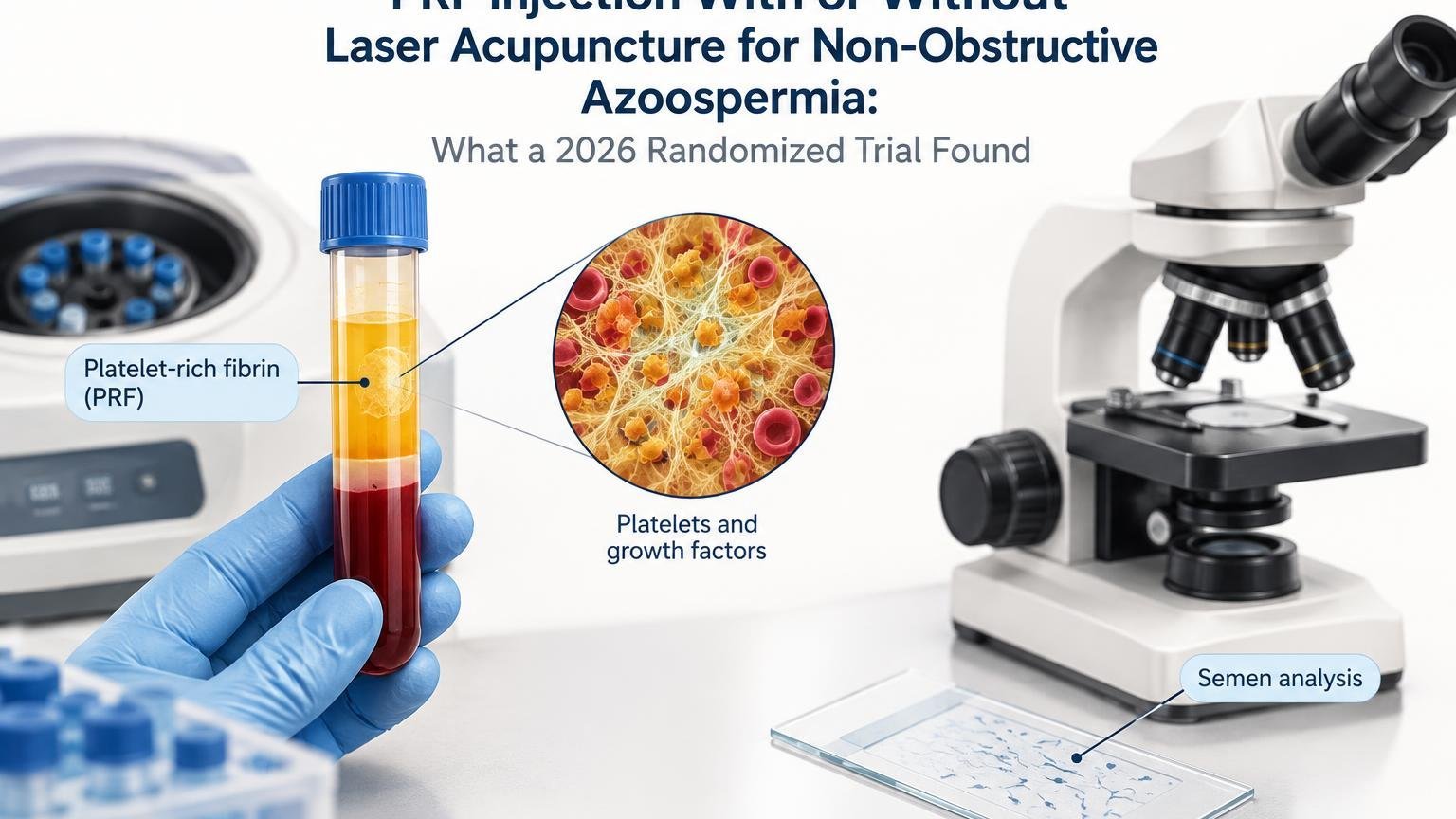
PRF is a blood-derived material rich in platelets and growth factors, and it has an established history in other areas of regenerative medicine, including dental and soft-tissue applications. The biological rationale for injecting it into testicular tissue is that locally delivered growth factors might support the cells and structures involved in sperm production. Laser acupuncture, sometimes called laser needling, applies low-level light rather than needles; the trial grouped it with PRF as a possible add-on to support testicular function. Neither mechanism has been established as effective in NOA, which is why a randomized comparison was worth doing.[2]
How the Trial Was Designed
The study was a two-arm randomized clinical trial. Forty men with NOA were divided into a PRF-plus-laser group and a PRF-alone group, so the comparison isolates the contribution of laser needling rather than testing PRF against a placebo. Outcomes covered the main domains a clinician would want to know about: semen volume, sperm concentration, motility, morphology and DNA fragmentation, plus the hormones FSH, LH and testosterone, and testicular volume. Measurements were scheduled at baseline, immediately post-intervention, and at one and three months.
That design has a clear strength and a clear weakness. The strength is randomization and a head-to-head comparison of two active strategies, which reduces some sources of bias compared with uncontrolled case series. The weakness is that the abstract does not describe an untreated, sham or placebo-only arm. Without such a comparator, any within-group change over time, including the rise in semen volume, cannot be confidently attributed to the intervention rather than to natural variation, regression to the mean, or other care received during the study.
What the Evidence Shows
| Outcome assessed | What was reported | How to interpret it |
|---|---|---|
| Sperm concentration, motility, morphology, DNA fragmentation | No significant between-group differences between PRF plus laser and PRF alone | Adding laser needling did not measurably change these parameters in this cohort over the short term |
| Semen volume | Increased within groups after intervention (P=0.039); not significant between groups (P>0.05) | A within-group change without a between-group difference is weak evidence of a treatment effect |
| Hormones (FSH, LH, testosterone) and testicular volume | Assessed at baseline, immediately post-intervention, and one and three months | The abstract does not report these results, so no conclusion about hormonal or volume effects can be drawn here |
| Safety | No serious complications reported | Reassuring but limited by a small sample and an undescribed monitoring method |
The headline result is a null finding for the between-group comparison. In plain terms, men who received PRF plus laser needling did not have significantly better sperm concentration, motility, morphology or DNA fragmentation than men who received PRF alone. Because both groups received PRF, the trial does not directly answer whether PRF itself changes sperm production compared with no active treatment.
The semen volume finding deserves careful reading. A P value of 0.039 for a change within groups indicates that volume changed over the study period in a way unlikely to be explained by chance alone under the statistical model used. But the between-group comparison was not significant (P>0.05), and the abstract does not report effect sizes or confidence intervals. A within-group signal of this kind is a hypothesis-generating observation, not evidence that injection or laser increased semen volume.
Safety reporting was similarly brief: the authors state that no serious complications were reported. That is useful but not a thorough safety profile. The abstract does not describe how complications were defined, how men were monitored after testicular injection, or how many men completed follow-up. For an invasive procedure, those details matter for judging tolerability as well as efficacy.
Interpretation and Limitations
The most important limitation is sample size. With 40 men split across two arms, the trial has limited statistical power to detect modest differences in sperm parameters, which are themselves variable measurements. A non-significant result in a small trial means the data are compatible with no effect and also with a small-to-moderate effect that the study could not reliably detect. That is why the absence of a significant difference should not be read as proof that laser acupuncture is useless, nor as proof that PRF works.
The short time horizon is a second constraint. Azoospermia reflects impaired spermatogenesis, and the spermatogenic cycle in humans takes roughly a few months from start to mature sperm release. A three-month window may capture only part of any biological response, and the trial's own authors called for extended follow-up. The reported outcomes stop at three months, so longer-term effects on sperm production, hormone profiles or testicular tissue remain unknown.
A third issue is patient selection and reporting. The authors explicitly recommend more precise patient selection, which implies that NOA is a heterogeneous label: men differ in the degree of spermatogenic failure, testicular histology and hormonal profile. A treatment might plausibly help a narrow subgroup while showing no average effect across a mixed group. The abstract does not report subgroup analyses, so this remains a hypothesis rather than a finding.
Readers should also note what the abstract omits. The hormone results and testicular volume measurements were collected but not summarized in the available text, and no effect estimates, confidence intervals or per-protocol details are given. Without those, the trial cannot tell us whether FSH, LH or testosterone changed meaningfully, or whether testicular volume responded. Those gaps limit any claim about testicular function beyond semen analysis.
Research Outlook
The authors' own prescription is larger cohorts, longer follow-up and more precise patient selection. To that could be added a design that includes an untreated, sham or placebo comparator, so that PRF itself can be evaluated rather than only the incremental value of laser needling. Blinding would also strengthen future work, particularly for subjective measures such as semen volume and morphology assessment.
A practical near-term question is whether testicular PRF has any effect at all on sperm retrieval outcomes in NOA, since retrieval success is the outcome that matters most for men considering assisted reproduction. The present trial assessed sperm parameters and hormone levels but the abstract does not report retrieval rates. Future studies that report retrieval outcomes, histology and longer sperm-production trajectories would be more clinically informative than semen analysis alone.
For now, the evidence does not support PRF injection with or without laser acupuncture as an established treatment for NOA. It is a plausible but unproven approach tested in a small, short randomized trial with a null primary comparison. Men considering such options should discuss them with a fertility specialist, including the invasive nature of testicular injection, the limited evidence base and the availability of established pathways such as surgical sperm retrieval.
Key Takeaways
- A 2026 randomized trial of 40 men with non-obstructive azoospermia compared PRF injection plus laser acupuncture with PRF injection alone and found no significant between-group differences in sperm concentration, motility, morphology or DNA fragmentation.
- Semen volume increased within groups after intervention (P=0.039), but the between-group change was not significant (P>0.05), so this is not evidence that either intervention increased volume.
- The authors concluded that PRF injection, with or without laser acupuncture, did not significantly improve sperm parameters in the short term and called for larger studies with longer follow-up and better patient selection.
- No serious complications were reported, but the small sample and limited monitoring description mean safety conclusions remain provisional.
- Hormone and testicular volume results were measured but not summarized in the available abstract, leaving questions about testicular function unanswered.
Questions and Answers
What is platelet-rich fibrin (PRF) injection being studied for in non-obstructive azoospermia?
PRF is a blood-derived material rich in platelets and growth factors used in regenerative medicine. In non-obstructive azoospermia, the hypothesis is that injecting it into testicular tissue might support sperm production and improve sperm retrieval. The 2026 trial tested PRF with or without laser acupuncture, but it did not demonstrate a significant improvement in sperm parameters in the short term.
Did adding laser acupuncture to PRF injection improve sperm parameters in the 2026 randomized trial?
No. Among 40 men with non-obstructive azoospermia, those receiving PRF plus laser needling did not differ significantly from those receiving PRF alone in sperm concentration, motility, morphology or DNA fragmentation. Semen volume rose within groups, but the between-group change was not significant. The authors concluded that neither approach significantly improved sperm parameters in the short term.
How strong is the evidence that PRF injection helps men with non-obstructive azoospermia?
The evidence is limited. The trial randomized only 40 men, followed them for up to three months, and did not report a significant between-group benefit. Its abstract also lacks effect sizes and confidence intervals. A small, short null trial cannot prove absence of benefit, but it does not support PRF, with or without laser acupuncture, as an established treatment for non-obstructive azoospermia.
Does the PRF and laser acupuncture trial apply to all men with male infertility?
No. The trial enrolled men with non-obstructive azoospermia specifically, meaning impaired sperm production rather than a reproductive tract blockage. Results should not be generalized to men with obstructive azoospermia or other fertility diagnoses. The authors also noted that non-obstructive azoospermia is heterogeneous and called for more precise patient selection in future research.
What are the main limitations and safety unknowns of testicular PRF injection research?
Key limitations include the small 40-man sample, short three-month follow-up, absence of a described untreated or sham comparator, and lack of reported hormone or testicular volume results. No serious complications were reported, but the abstract does not describe how complications were defined or how men were monitored after an invasive testicular injection. Safety conclusions therefore remain provisional.
What should men with non-obstructive azoospermia take away from this PRF trial?
Treat PRF with or without laser acupuncture as an unproven experimental approach, not an established treatment. The trial found no significant short-term improvement in sperm parameters, and longer-term or subgroup effects remain unknown. Men interested in such options should ask a fertility specialist about the evidence, the invasive nature of testicular injection, and established pathways such as surgical sperm retrieval.
Sources and References
- Razzaghi, M. R.; Nicknama, R.; Zare, S.; Seifipoor , M.; Mazloumfard , M.; Sheibani , F.; Rahnamay Farnood, P.. Evaluation of the Effect of Platelet-Rich Fibrin (PRF) Protocol and Laser Acupuncture in the Treatment of Infertile Men with Non-Obstructive Azoospermia: A Randomized Clinical Trial: PRF with laser acupuncture for non-obstructive azoospermia: RCT. Journal of Lasers in Medical Sciences. 2026 17:e52024
- Lasers and Platelet-Rich Fibrin.
SANYUN Science Center explains published research on men's reproductive and sexual health, connecting scientific evidence with everyday questions while making sources and limitations clear.
Disclaimer: This article is for scientific education and research communication only. It does not provide medical advice, diagnosis, or individualized treatment recommendations, and does not endorse any medication, supplement, device, penile enlargement procedure, or other intervention. Decisions about sexual and reproductive health should be made in consultation with a qualified healthcare professional. Do not delay seeking professional care because of information in this article.
Original Content & Copyright Notice
- This article is prepared for SANYUN Science Center, drawing on published research and publicly available academic literature on men’s sexual and reproductive health. Its editorial explanations and presentation are developed for this platform.
- Copyright in the original editorial content, selection, and arrangement is reserved by SANYUN Science Center to the extent protected by applicable law. Referenced research, quotations, and third-party materials remain subject to the rights of their respective owners. This notice does not claim ownership of scientific facts or third-party research.
- Except where permitted by applicable law or an applicable license, prior written permission is required to reproduce, republish, translate, adapt, redistribute, or commercially reuse protected content. Attribution alone does not grant permission for such reuse.
- For permitted quotation or authorized reuse, clearly identify the source and retain a link to the original article.
- Source: SANYUN Science Center
- Original URL: Retain the original article URL on science.san-yun.com.
- Copyright Holder: SANYUN Science Center, for its own protected editorial content.
- Quotation, excerpts, or authorized reuse must not distort the scientific meaning, omit material limitations or disclaimers, or imply unverified medical claims, product efficacy, or endorsement by SANYUN Science Center.



