




Category: Reproductive Care
Core Research Direction: Occupational prolonged standing and male reproductive outcomes: synthesizing evidence on semen quality among male anesthesia technicians and comparable occupational groups
Search Intent: Does prolonged standing at work (>5–6 hours/day) relate to poorer semen quality in men, and what mechanisms and limits does the evidence show?
Platform: SANYUN Science Center
Evidence reviewed through: 2026-11-10
Executive Summary
A 2026 scoping review examined whether prolonged standing at work is associated with infertility-related outcomes in male anesthesia technicians and comparable occupational groups. The review synthesized evidence from five observational studies published between 2019 and 2025, mostly from China with one from Turkey. Its central observation was that standing exceeding 5–6 hours per day was consistently associated with impaired semen quality — reduced sperm motility and concentration, more abnormal sperm morphology and elevated sperm DNA fragmentation index — with occupational heat and chemical agents identified as additional contributing factors.[1]
The evidence is best read as hypothesis-generating rather than confirmatory. Only five observational studies met the inclusion criteria, all observational in design, and the review explicitly acknowledges heat and chemical co-exposures as confounders. The proposed mechanism — impaired venous circulation and increased scrotal temperature disrupting spermatogenesis, with oxidative stress as a downstream pathway — is biologically plausible but was not directly tested within the review.
Why This Matters
Male infertility accounts for nearly half of infertility cases worldwide and has increasingly been recognized as an occupational health concern, particularly among male anesthesia technicians who face prolonged standing during surgical procedures, extended working hours, operating room heat and potential chemical exposure. The review's framing positions these workers as a potentially high-risk group precisely because their daily work combines several exposures that could plausibly affect fertility at the same time.
The practical importance is that prolonged standing is a modifiable exposure. Unlike genetic factors or age, the number of hours spent standing can be adjusted through scheduling, anti-fatigue matting, sit-stand task rotation and workplace ergonomics. If even part of the observed association is causal, such interventions could plausibly reduce a modifiable contributor to poor semen quality in standing-intensive jobs. The review's conclusion calls for exactly these measures — ergonomic interventions, occupational risk management and reproductive health monitoring in healthcare settings — while acknowledging that the evidence base does not yet prove that changing standing time will change reproductive outcomes.
Biological and Clinical Mechanism
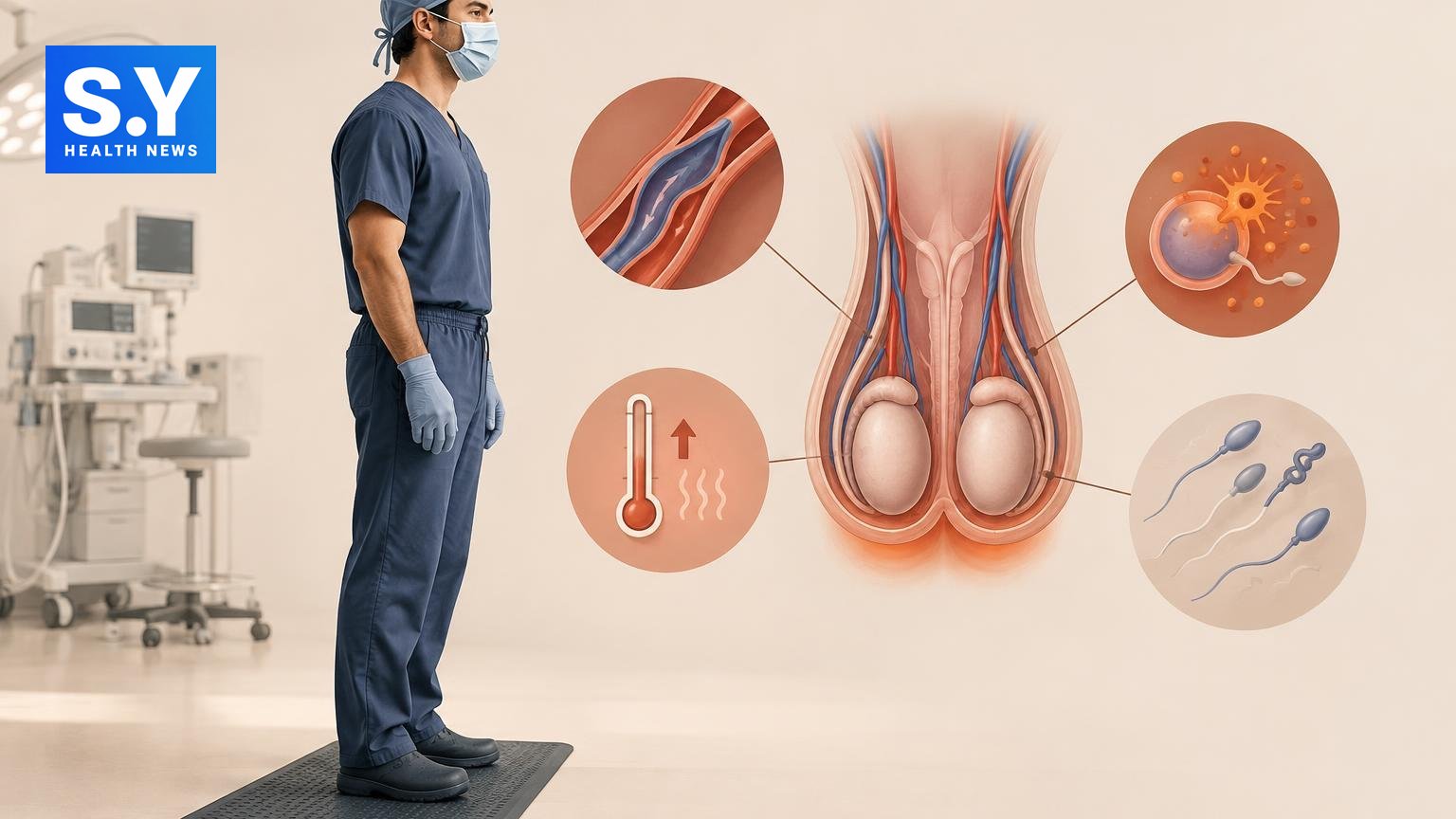
The review outlines a multi-step biological rationale. The starting premise is that prolonged static standing may impair venous circulation in the pelvis and lower limbs, and that this circulatory stagnation could raise scrotal temperature. Because spermatogenesis is temperature-sensitive — the testes sit outside the body cavity in part to maintain a temperature below core body temperature — any sustained elevation of scrotal temperature could disrupt the germ-cell maturation process and degrade semen quality. The review states this as a 'may' hypothesis, not an established causal chain.
A second proposed pathway is oxidative stress. The review identifies oxidative stress as a key biological mechanism underlying sperm dysfunction, and several included studies reported a dose–response relationship between exposure duration and the severity of semen impairment. In this framework, prolonged standing and its associated local temperature and circulatory changes could increase reactive oxygen species in the reproductive tract, which in turn could damage sperm membranes and DNA. That would help explain why DNA fragmentation index — a marker of sperm DNA damage — appeared elevated in some studies, rather than only the conventional measures of concentration and motility.
The mechanistic story becomes more complicated because the occupational setting itself is mixed. Anesthesia technicians are described as simultaneously exposed to prolonged standing, extended working hours, operating room heat and potential chemical agents such as anesthetic gases and disinfectants. Heat and chemical agents could plausibly contribute to the same oxidative and thermal pathways. This means that even a correct description of the association cannot cleanly assign it to standing alone; the mechanism may be a combined load from several co-occurring exposures.
What the Evidence Shows
The review's scoping process searched PubMed, Cochrane Library and Google Scholar for articles published between 2019 and 2025, following a recognized scoping-review framework, the PCC population–concept–context structure and PRISMA reporting. Quality appraisal used the Mixed Methods Appraisal Tool. Five studies met the inclusion criteria, comprising retrospective cohort, cross-sectional and longitudinal observational designs, predominantly conducted in China, with one study from Turkey.
| Outcome domain | Reported direction at >5–6 hours standing/day | Key co-exposures noted | Evidence basis |
|---|---|---|---|
| Sperm motility | Reduced | Occupational heat, chemical agents | Five observational studies, mostly China, one Turkey |
| Sperm concentration | Reduced | Occupational heat, chemical agents | Five observational studies, mostly China, one Turkey |
| Sperm morphology | Increased abnormal forms | Occupational heat, chemical agents | Five observational studies, mostly China, one Turkey |
| Sperm DNA fragmentation index (DFI) | Elevated | Occupational heat, chemical agents | Five observational studies, mostly China, one Turkey |
| Dose–response pattern | Reported by several studies between exposure duration and impairment severity | Not specified separately | Observational dose–response reports within included studies |
The findings across the five studies pointed in a consistent direction. Prolonged standing exceeding 5–6 hours per day was associated with reduced sperm motility and concentration, increased abnormal sperm morphology and an elevated sperm DNA fragmentation index. Several studies reported a dose–response pattern, with more standing time tracking more severe semen impairment. The persistence of a similar signal across different study designs and occupational groups is the strongest point in favor of the hypothesis.
At the same time, the review's own framing cautions against reading the findings as a proven threshold. 'Exceeding 5–6 hours per day' describes the pattern observed across studies; it was not a prospectively validated cutoff derived from a single controlled trial. The included study designs cannot rule out that men who stand longer differ in other ways that also affect fertility, such as age, smoking, body weight, varicocele history or workload intensity. The review's quality appraisal results are not detailed in the available summary, so the reader cannot independently judge how well each study handled these issues.
Interpretation and Limitations
The most important limitation is the size and nature of the evidence base. Five observational studies is a small base for a conclusion about a common occupational exposure. Geographic concentration matters too: four of the five included studies were from China and one from Turkey, so generalization to other populations, healthcare systems, work cultures and chemical-exposure profiles is uncertain. A scoping review maps what exists; it does not pool data or quantitatively estimate an effect size, and the supplied summary does not provide meta-analytic estimates.
Confounding is central to interpretation. Occupational standing in operating rooms rarely occurs alone. Heat and chemical agents were explicitly identified as additional contributing factors, meaning the observed semen changes could partly reflect thermal or chemical exposure rather than standing itself. Extended working hours could add sleep disruption and fatigue, which are also plausible influences on reproductive health. Without adjustment or stratification for these factors, the association between standing and semen quality is real as a statistical observation but not established as a causal relationship.
Statistical language also needs care. An 'association' in observational studies means the variables move together more than expected by chance, not that one causes the other. The reported dose–response pattern strengthens the case for causality in principle, but such patterns can also arise from confounding if longer standing correlates with other cumulative workplace exposures. The review itself uses cautious wording — 'suggests', 'may increase' — which is appropriate for the current evidence stage.
Clinical relevance must be stated modestly. The findings do not support diagnosing individual infertility from job title or standing hours, nor do they quantify how much any one man's risk might change. Semen quality fluctuates and has many determinants. What the evidence supports is a plausible occupational contribution worth considering in a broader fertility evaluation and worth addressing through workplace design — not a substitute for standard clinical assessment.
Research Outlook
Progress will depend on study designs that can separate standing from its occupational companions. Longitudinal cohorts with repeated semen analyses, objective measurement of standing time via wearables, and concurrent measurement of scrotal temperature, ambient operating-room heat and chemical exposure would help disentangle the pathways. Studies in healthcare settings outside China and Turkey, and studies that include non-healthcare standing occupations for comparison, would improve generalizability.
Intervention research is the natural next step. The review's conclusion calls for ergonomic interventions, occupational risk management and reproductive health monitoring. Testing whether reduced standing time or sit-stand rotation improves semen parameters would move the field from association toward actionable evidence. Until such studies exist, the appropriate stance is informed precaution: recognize the plausible risk, reduce avoidable standing where practical, and monitor reproductive health in high-exposure occupations without overstating what is known.
Key Takeaways
- A 2026 scoping review of five observational studies found that standing more than 5–6 hours per day was consistently associated with poorer semen quality, including reduced sperm motility and concentration, more abnormal morphology and higher sperm DNA fragmentation.
- The proposed mechanisms are impaired venous circulation, increased scrotal temperature and oxidative stress, but these are hypotheses supported by plausible biology rather than direct demonstration within the review.
- Occupational heat exposure and chemical agents were identified as additional contributing factors, so the observed semen changes cannot be attributed to standing alone.
- The evidence base is small, geographically concentrated and entirely observational; it supports concern and further research, not a confirmed causal threshold or individualized risk estimate.
- Reasonable next steps include ergonomic adjustment of standing-intensive work and reproductive health monitoring in high-exposure roles, while awaiting longitudinal and intervention studies.
Questions and Answers
Does prolonged standing at work affect semen quality in men?
A 2026 scoping review found that standing more than 5–6 hours per day was consistently associated with reduced sperm motility and concentration, more abnormal sperm morphology and elevated sperm DNA fragmentation across five observational studies. However, the review describes an association, not proven causation, and heat and chemical co-exposures may contribute. The evidence is preliminary but directionally consistent.
Why might standing for long hours lower sperm quality biologically?
The proposed mechanism is that prolonged static standing may impair venous circulation and raise scrotal temperature, disrupting temperature-sensitive spermatogenesis. Oxidative stress is identified as a downstream pathway that could damage sperm DNA. These are biologically plausible hypotheses outlined in the review, not mechanisms directly demonstrated by the included studies.
How strong is the evidence linking occupational standing to male infertility?
The evidence is preliminary. The review included only five observational studies, mostly from China with one from Turkey, and no controlled trials. Observational designs cannot establish causation, and the review acknowledges confounding by heat and chemical exposure. The consistent direction and reported dose–response pattern are suggestive, but the small, geographically limited evidence base means conclusions remain tentative.
Are male anesthesia technicians at higher risk of fertility problems from standing?
The review flags male anesthesia technicians as a potentially high-risk occupational group because their work combines prolonged standing with operating-room heat, extended hours and potential chemical exposure. That framing is a hypothesis based on five observational studies, not a confirmed risk estimate. Individual risk cannot be inferred from job title alone, and standard fertility evaluation remains appropriate.
What are the main limitations of research on standing and semen quality?
Key limitations include a small evidence base of five observational studies, geographic concentration in China and Turkey, and confounding by heat, chemicals and long working hours that co-occur with standing. The review is a scoping synthesis without pooled effect estimates, and quality appraisal results are not detailed in the available summary. Causation and a validated standing threshold remain unproven.
What should men in standing-intensive jobs understand about this research?
The research suggests a plausible occupational contribution to poorer semen quality at standing durations above 5–6 hours per day, but it does not prove that standing causes infertility or predict any individual's outcome. Practical understanding means treating it as a reason to reduce avoidable standing where feasible, discuss fertility concerns with a clinician, and support workplace ergonomic review rather than drawing personal diagnostic conclusions.
Sources and References
SANYUN Science Center explains published research on men's reproductive and sexual health, connecting scientific evidence with everyday questions while making sources and limitations clear.
Disclaimer: This article is for scientific education and research communication only. It does not provide medical advice, diagnosis, or individualized treatment recommendations, and does not endorse any medication, supplement, device, penile enlargement procedure, or other intervention. Decisions about sexual and reproductive health should be made in consultation with a qualified healthcare professional. Do not delay seeking professional care because of information in this article.
Original Content & Copyright Notice
- This article is prepared for SANYUN Science Center, drawing on published research and publicly available academic literature on men’s sexual and reproductive health. Its editorial explanations and presentation are developed for this platform.
- Copyright in the original editorial content, selection, and arrangement is reserved by SANYUN Science Center to the extent protected by applicable law. Referenced research, quotations, and third-party materials remain subject to the rights of their respective owners. This notice does not claim ownership of scientific facts or third-party research.
- Except where permitted by applicable law or an applicable license, prior written permission is required to reproduce, republish, translate, adapt, redistribute, or commercially reuse protected content. Attribution alone does not grant permission for such reuse.
- For permitted quotation or authorized reuse, clearly identify the source and retain a link to the original article.
- Source: SANYUN Science Center
- Original URL: Retain the original article URL on science.san-yun.com.
- Copyright Holder: SANYUN Science Center, for its own protected editorial content.
- Quotation, excerpts, or authorized reuse must not distort the scientific meaning, omit material limitations or disclaimers, or imply unverified medical claims, product efficacy, or endorsement by SANYUN Science Center.



