




Category: Reproductive Care
Core Research Direction: Occupational prolonged standing (over 5–6 hours/day) and male reproductive outcomes, synthesized in a scoping review of observational studies, with proposed mechanisms of scrotal heat and oxidative stress among male anesthesia technicians and comparable occupational groups.
Search Intent: Is prolonged standing at work associated with poorer semen quality in men, and how strong is that evidence?
Platform: SANYUN Science Center
Evidence reviewed through: 2026-11-05
Executive Summary
A scoping review published in 2026 set out to map the evidence linking prolonged standing at work to male infertility-related outcomes, with male anesthesia technicians named as a group of particular interest. Male infertility is described in the review as accounting for nearly half of infertility cases worldwide and as an increasingly recognized occupational health concern; anesthesia technicians are cited as facing prolonged standing during procedures, extended working hours, operating room heat and potential chemical exposure.[1]
Five studies met the inclusion criteria: retrospective cohort, cross-sectional and longitudinal observational designs, mostly conducted in China with one from Turkey. Their findings were described as consistent: standing more than 5–6 hours per day was associated with impaired semen quality — reduced sperm motility and concentration, more abnormal sperm morphology and an elevated sperm DNA fragmentation index — with occupational heat and chemical agents acting as additional contributing factors. Several studies reportedly showed a dose–response pattern between exposure duration and severity of impairment.
The review proposes impaired venous circulation and raised scrotal temperature as a route to disrupted spermatogenesis, with oxidative stress identified as a key biological mechanism. These are mechanistic hypotheses rather than measurements made within the review itself. The core limitations are the small evidence base of five observational studies, geographic concentration, and confounding by heat and chemical co-exposures, which means the findings support an association and a rationale for prevention — not a causal claim or a personal risk estimate.
Why This Matters
Occupational causes of poor semen quality are attractive targets because, unlike age or genetics, they can be modified. If a work schedule or workstation design contributes to reproductive risk, then ergonomic change, rotation of tasks, cooling and protective measures, and reproductive health monitoring become plausible harm-reduction steps rather than abstract advice. The review explicitly calls for ergonomic interventions, occupational risk management and reproductive health monitoring in healthcare settings, and flags male anesthesia technicians as a potentially high-risk occupational group.
The topic also matters epidemiologically. Male infertility is framed in the review as accounting for nearly half of infertility cases worldwide, which places male factors alongside female factors rather than as an afterthought. Occupational exposures that are common, such as long periods of static standing in operating rooms, warehouses, kitchens, retail and manufacturing, would affect large numbers of men if the association were causal and meaningful in magnitude.
A note on framing: this is an evidence review of published observational work, not a new study and not a systematic review with meta-analysis. The review mapped and synthesized existing literature; it did not generate new semen analyses or follow men prospectively.
The Proposed Biological Mechanism: Heat, Blood Flow and Oxidative Stress
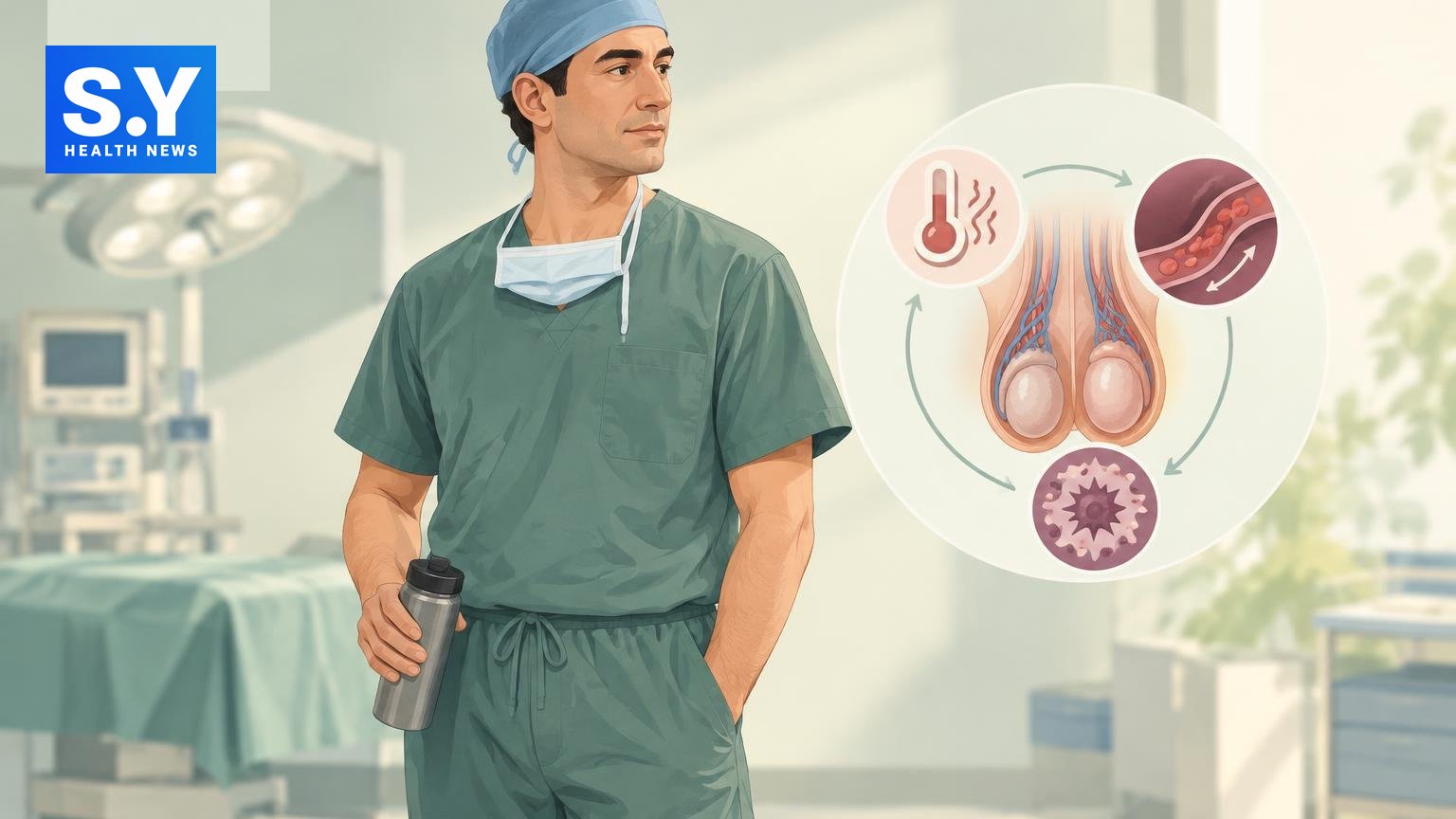
Spermatogenesis is temperature-sensitive, and the scrotum normally sits a few degrees below core body temperature. The review's mechanistic proposal is that prolonged static standing may impair venous circulation and increase scrotal temperature, which could in turn disrupt spermatogenesis and compromise semen quality. The wording is deliberately tentative: the review states this as a possibility, not as something it measured.
Two linked pathways are described. First, a thermal pathway: sustained heat exposure in the workplace — operating room heat is named alongside extended working hours — could add to the thermal load on the testes. Second, a biochemical pathway: oxidative stress was identified as a key biological mechanism underlying sperm dysfunction in the included studies. Oxidative stress is a plausible bridge between heat, cellular stress and sperm DNA damage, and it fits the reported elevation in sperm DNA fragmentation index.
Mechanistic plausibility is not the same as demonstrated mechanism. The review did not report direct scrotal temperature measurements, venous flow studies or oxidative stress biomarkers in the men studied; these pathways are inferred from observational associations and from general reproductive biology. A further complication is that the named occupational group faces several exposures at once — standing, long shifts, heat and potential chemical agents — so separating the contribution of posture from the contribution of heat or chemicals is difficult in the designs available.
What the Evidence Shows
The review followed the Tricco et al. framework and searched PubMed, Cochrane Library and Google Scholar for articles published between 2019 and 2025. Inclusion was restricted to original research articles in English or Indonesian that examined occupational standing duration, static posture or related physical workload alongside male reproductive outcomes; study selection used the Population–Concept–Context framework and a PRISMA flow diagram. Data extraction and quality appraisal used the Mixed Methods Appraisal Tool.
Only five studies qualified: retrospective cohort, cross-sectional and longitudinal observational designs, predominantly from China and one from Turkey. The reported direction of effect was uniform — greater standing exposure was associated with worse semen parameters — and several studies suggested a dose–response relationship between exposure duration and severity of impairment. That internal consistency across different designs is the strongest feature of the evidence base.
| Dimension | What the review reports | How to read it |
|---|---|---|
| Exposure threshold | Standing exceeding 5–6 hours per day was associated with impaired semen quality | A descriptive threshold across included studies, not a validated clinical cutoff |
| Semen outcomes | Reduced sperm motility and concentration, increased abnormal sperm morphology, elevated sperm DNA fragmentation index | Directionally consistent findings; effect sizes and units are not reported in the available text |
| Co-exposures | Occupational heat exposure and chemical agents described as additional contributing factors | Confounding is likely; posture effects cannot be cleanly isolated |
| Dose–response | Several studies indicated a relationship between exposure duration and severity of semen impairment | Supports a biological gradient, but reported without quantification here |
| Mechanism | Impaired venous circulation, increased scrotal temperature and oxidative stress proposed | Hypothesis-level; not directly measured in the review |
| Evidence base | Five observational studies, mostly China, one Turkey; 2019–2025 search window | Small, geographically concentrated, observational only |
Interpretation and Limitations
The most important interpretive point is that all five included studies were observational. Observational designs can show that standing-heavy jobs and poorer semen parameters travel together, but they cannot show that standing caused the difference. Men who stand for long shifts may also differ in age, body composition, smoking, sleep, shift work, protective equipment use and other job demands — factors the available summary does not quantify or adjust for in detail.
Confounding by co-exposure is a specific concern rather than a generic caveat. The review itself lists occupational heat and chemical agents as additional contributing factors in the same occupational group, so a man working in a hot operating room with chemical exposures may accumulate several reproductive hazards simultaneously. A dose–response pattern is reassuring for biological plausibility, but it does not remove confounding if the co-exposures also rise with shift length.
Generalisability is limited in three ways. Five studies is a small evidence base; the geographic concentration in China with one study from Turkey means findings may not transfer directly to other work cultures, climates, protective standards or healthcare systems. The search covered articles published from 2019 to 2025 and was restricted to English or Indonesian language originals, so relevant older or other-language work may have been excluded. Quality appraisal used the Mixed Methods Appraisal Tool, but per-study ratings are not detailed in the available text, so readers cannot judge how much weight each study deserves.
The review's conclusion is correspondingly measured: available evidence suggests an association between prolonged standing and adverse male reproductive outcomes and that it may increase the risk of infertility. That is an association-level statement about populations, not a prediction about any individual man, and it does not establish that reducing standing hours will improve semen parameters. The recommendations for ergonomics, risk management and reproductive health monitoring are the authors' interpretation of the evidence rather than tested interventions.
Research Outlook
The clearest gap is design. Prospective cohorts that measure standing exposure objectively — through wearables or shift records — while measuring scrotal temperature, oxidative stress markers and repeated semen analyses would help separate posture from heat and chemicals. Studies that follow men after workplace changes, such as sit–stand rotation or cooling interventions, would begin to address whether modification changes outcomes, which observational data cannot answer.
A second gap is scope. Replication outside China and Turkey, in diverse healthcare and industrial settings, would test generalisability. A third is reporting: standardized semen analysis methods, quantified effect estimates, adjustment for confounders and transparent per-study quality ratings would let readers weigh the evidence rather than rely on a narrative summary. Until such work exists, the review's value lies in mapping a plausible occupational signal and setting a research agenda for male reproductive health in standing-heavy jobs.
Key Takeaways
- A 2026 scoping review of five observational studies reported consistent associations between standing more than 5–6 hours per day at work and poorer semen quality, including lower sperm motility and concentration, more abnormal morphology and higher sperm DNA fragmentation.
- The proposed mechanism — impaired venous circulation, raised scrotal temperature and oxidative stress disrupting spermatogenesis — is biologically plausible but was not directly measured in the review.
- Occupational heat and chemical agents are named as additional contributing factors, so the effect of standing posture alone cannot be isolated from other workplace exposures.
- Male anesthesia technicians are flagged as a potentially high-risk group, and the authors call for ergonomic interventions, occupational risk management and reproductive health monitoring in healthcare settings.
- The evidence supports an association, not causation or a personal risk estimate; the small, geographically narrow and observational evidence base limits how far the findings can be generalized.
Questions and Answers
How might prolonged standing at work affect sperm quality biologically?
The review proposes that prolonged static standing may impair venous circulation and raise scrotal temperature, which could disrupt spermatogenesis and compromise semen quality. Oxidative stress is identified as a key mechanism underlying sperm dysfunction, fitting the reported rise in sperm DNA fragmentation. These are proposed pathways inferred from observational data, not direct measurements in the review.
What did the 2026 scoping review find about standing hours and semen parameters?
Across five included observational studies, standing more than 5–6 hours per day was associated with reduced sperm motility and concentration, increased abnormal sperm morphology and elevated sperm DNA fragmentation index. Several studies indicated a dose–response relationship between exposure duration and severity. Effect sizes and units are not reported in the available summary, and heat and chemical co-exposures were additional contributing factors.
How strong is the evidence that prolonged standing harms male fertility?
Moderate at best. The evidence base is five observational studies (retrospective cohort, cross-sectional and longitudinal), mostly from China with one from Turkey, appraised with the Mixed Methods Appraisal Tool. Consistency and a possible dose–response pattern are supportive, but observational designs cannot establish causation, and confounding by workplace heat and chemical exposure remains plausible.
Does this research apply to male anesthesia technicians specifically?
The review names male anesthesia technicians as a potentially high-risk occupational group because they face prolonged standing during procedures, extended working hours, operating room heat and potential chemical exposure. However, the five included studies covered occupational groups rather than technicians alone, so the technician-specific risk is an inference from the review's framing rather than a directly measured finding.
What are the main limitations of the prolonged standing and semen quality evidence?
Key limits are the small evidence base of five observational studies, geographic concentration in China and Turkey, a 2019–2025 search window restricted to English or Indonesian articles, and confounding by heat and chemical co-exposures. Per-study quality ratings are not detailed in the available text. The findings support an association and prevention rationale, not a causal claim or individual risk prediction.
What should men in standing-heavy jobs understand from this review?
The review suggests an association between long daily standing and poorer semen quality in populations, and flags healthcare and comparable occupational groups for ergonomic intervention and reproductive health monitoring. It does not show that standing causes infertility in an individual or that changing posture will improve semen parameters. Anyone concerned about fertility or workplace exposures should discuss it with a qualified clinician.
Sources and References
SANYUN Science Center explains published research on men's reproductive and sexual health, connecting scientific evidence with everyday questions while making sources and limitations clear.
Disclaimer: This article is for scientific education and research communication only. It does not provide medical advice, diagnosis, or individualized treatment recommendations, and does not endorse any medication, supplement, device, penile enlargement procedure, or other intervention. Decisions about sexual and reproductive health should be made in consultation with a qualified healthcare professional. Do not delay seeking professional care because of information in this article.
Original Content & Copyright Notice
- This article is prepared for SANYUN Science Center, drawing on published research and publicly available academic literature on men’s sexual and reproductive health. Its editorial explanations and presentation are developed for this platform.
- Copyright in the original editorial content, selection, and arrangement is reserved by SANYUN Science Center to the extent protected by applicable law. Referenced research, quotations, and third-party materials remain subject to the rights of their respective owners. This notice does not claim ownership of scientific facts or third-party research.
- Except where permitted by applicable law or an applicable license, prior written permission is required to reproduce, republish, translate, adapt, redistribute, or commercially reuse protected content. Attribution alone does not grant permission for such reuse.
- For permitted quotation or authorized reuse, clearly identify the source and retain a link to the original article.
- Source: SANYUN Science Center
- Original URL: Retain the original article URL on science.san-yun.com.
- Copyright Holder: SANYUN Science Center, for its own protected editorial content.
- Quotation, excerpts, or authorized reuse must not distort the scientific meaning, omit material limitations or disclaimers, or imply unverified medical claims, product efficacy, or endorsement by SANYUN Science Center.



