




Category: Clinical Insights
Core Research Direction: Validation and clinical utility of PROMIS Sexual Interest and Satisfaction (single-item) measures for assessing sexual outcomes in men after radical prostatectomy, and psychometric performance of PROMIS Sexual Function and Satisfaction measures in men with congenital bleeding disorders
Search Intent: Can brief PROMIS sexual interest and satisfaction measures validly capture how men's sexual wellbeing changes after radical prostatectomy, and what do these and related PROMIS SexFS measures reveal about sexual function in men with chronic hematologic conditions?
Platform: SANYUN Science Center
Evidence reviewed through: 2026-11-12
Executive Summary
Sexual outcomes after radical prostatectomy have historically been framed around erectile function. A US validation cohort of 1,604 men who underwent robotic radical prostatectomy between May 2014 and January 2016 examined whether two single-item PROMIS measures — Global Satisfaction With Sex Life and Interest in Sexual Activity — could add a broader, patient-centered perspective. Convergent and discriminant validity was supported, and both measures showed a statistically significant decline from baseline to 3 months, followed by a significant increase from 3 months to 24 months. Interest scores at 24 months exceeded baseline scores (P < .001), while satisfaction followed a similar but not identically described trajectory (P < .002).[1][2]
In a different population, a 2026 cross-sectional multicenter psychometric evaluation tested the Dutch PROMIS Sexual Function and Satisfaction (SexFS) measures in 231 adults with congenital bleeding disorders, 54% of whom were male and whose mean age was 44 years. More than 78% of measures met the reliability criterion, internal consistency and feasibility were sufficient, and known-group validity was supported. Compared with Dutch general-population reference data, patients reported somewhat greater orgasm pleasure (d = 0.23) and more interest in sexual activity (d = 0.19); males also reported better erectile function (d = 0.26), while females reported more vaginal discomfort with sexual activity (d = 0.48). These are small-to-moderate standardized differences in a cross-sectional comparison, not evidence of treatment effects.[3]
Together, the two studies suggest that brief PROMIS sexual measures can capture dimensions of sexual wellbeing that erectile-function scales alone may miss, and that they can perform adequately in at least two distinct chronic-condition populations. The evidence is not, however, a single unified validation program. The prostatectomy study is a large but geographically and surgically narrow cohort with a 2019 publication date; the bleeding-disorder study is cross-sectional, Dutch-language and single-country. Neither provides the kind of randomized or interventional evidence that would establish these measures as definitive endpoints, and the clinical meaning of the observed T-score changes remains incompletely characterized.
Why This Matters
Erectile function is the dominant patient-reported outcome in prostate cancer survivorship research, yet sexual wellbeing is broader than the ability to achieve or maintain an erection. Interest, desire, satisfaction, orgasm and relational context all contribute. The PROMIS Sexual Interest and Satisfaction items were designed as brief, generic measures that could be administered with low patient burden, making them attractive for large registries and routine survivorship care. The prostatectomy cohort was motivated by a specific gap: although erectile function had been extensively studied, the PROMIS single-item measures had not been validated in prostate cancer, and their relationship to erectile function and their responsiveness to treatment had not been well described.
The clinical stakes are substantial. If interest and satisfaction follow a different trajectory than erectile function after surgery — for example, if interest rebounds even when functional losses persist — then counseling that focuses only on erectile recovery may miss what patients actually value. The prostatectomy investigators concluded that patients remain interested in sex despite functional losses and can recover satisfaction, which they framed as insight into attainable, patient-centered survivorship goals for sexual recovery after radical prostatectomy. That conclusion is an interpretation of observational trajectories, not a tested intervention pathway, but it is clinically meaningful because it reframes the goal of survivorship care from restoring a single function to supporting a broader sexual life.
The bleeding-disorder study extends the relevance of PROMIS sexual measures beyond oncology. Sexual function can be negatively affected in individuals with congenital bleeding disorders, and patient-reported outcome measures may provide insight into patients' experiences and help address sexual function and satisfaction in clinical care. Demonstrating that the Dutch PROMIS SexFS measures have sufficient reliability and validity in this population supports their use in research and as a conversation aid in hematology clinics, where sexual health is often underdiscussed.
Biological and Clinical Mechanism
Radical prostatectomy removes the prostate and seminal vesicles and can disturb the neurovascular bundles, cavernous nerves and pelvic floor structures that support erectile function. The resulting erectile dysfunction is the most studied functional consequence. Sexual interest, by contrast, is influenced by hormonal, psychological, relational and aging factors that are not directly removed by surgery. Satisfaction is a further layer: it reflects how a person appraises their sexual life against their expectations, values and circumstances. This layered structure is why a man can report low erectile function yet retain interest in sex and recover a meaningful level of satisfaction over time. The PROMIS items are designed to measure these appraisal-based constructs rather than the underlying vascular or neural mechanism.
In congenital bleeding disorders, the proposed mechanisms are different. Recurrent joint bleeding, chronic pain, fatigue, anxiety about bleeding during sexual activity, and in women heavy menstrual or gynecologic bleeding can all affect sexual function and satisfaction. The study did not test a biological pathway; it examined whether the PROMIS SexFS measures behave well enough to describe these experiences. The small positive standardized differences from general-population references — greater orgasm pleasure, more interest, better erectile function in males — should not be read as a biological advantage. They may reflect response style, age composition, selection into the study, or genuine differences in how adults with bleeding disorders appraise their sexual lives. Cross-sectional comparisons cannot disentangle these explanations.
What the Evidence Shows
The prostatectomy validation was a cohort study nested in the Michigan Urological Surgery Improvement Collaborative. It included 1,604 patients who underwent robotic radical prostatectomy between May 2014 and January 2016. A single item from the PROMIS Global Satisfaction With Sex Life subdomain and a single item from the PROMIS Interest in Sexual Activity subdomain were administered, alongside erectile function assessment. Convergent and discriminant validity was supported. Multilevel models examined change over time. Mean interest T-scores decreased significantly from baseline to 3 months (P = .001), then increased significantly from 3 months to 24 months, with 24-month scores exceeding baseline (P < .001). Mean satisfaction T-scores declined from baseline to 3 months and increased from 3 months to 24 months (P < .002). The source does not report the magnitude of the T-score changes in points, so the statistical significance cannot be directly translated into a clinical meaningfulness threshold.
The trajectory itself is informative. A decline at 3 months is consistent with the early postoperative period, when recovery from surgery, pelvic pain, catheter-related issues and initial erectile dysfunction are prominent. The subsequent rise in both interest and satisfaction suggests adaptation over the first two years. The finding that 24-month interest scores exceeded baseline is notable and somewhat counterintuitive for a procedure associated with functional loss; the authors interpreted it as evidence that patients remain interested in sex despite functional losses. Because this is an observational cohort without a non-surgical comparator, the rise cannot be attributed to surgery, to adaptation, to partner support, to erectile-dysfunction treatment, or to any specific survivorship intervention. It is a description of the cohort's average trajectory.
The congenital bleeding disorders study used a cross-sectional multicenter design. Men with hemophilia and women with hemophilia or von Willebrand disease were invited. Six screener items, 12 PROMIS SexFS measures and disease-specific items on sexual function and satisfaction were completed by 231 patients (mean age 44 years, range 18–81; 54% male). Reliability was evaluated using the standard error of T-scores; internal consistency with item-total correlation; known-group validity with predefined hypotheses; feasibility with floor and ceiling percentages and qualitative relevance assessment. More than 78% of measures met the reliability criterion, internal consistency and feasibility were sufficient, and known-group validity was supported. The authors concluded that the Dutch PROMIS SexFS measures had sufficient reliability and validity for assessing sexual function and satisfaction in this population.
| Construct or outcome | Study and population | Key reported result | Interpretation |
|---|---|---|---|
| PROMIS Interest in Sexual Activity change | Prostatectomy cohort, 1,604 men after robotic radical prostatectomy | Significant decrease baseline to 3 months (P = .001); significant increase 3 months to 24 months, with 24-month scores above baseline (P < .001) | Statistical responsiveness demonstrated; magnitude in T-score points and clinical meaningfulness not reported in the source |
| PROMIS Global Satisfaction With Sex Life change | Prostatectomy cohort, 1,604 men after robotic radical prostatectomy | Decline baseline to 3 months and increase 3 months to 24 months (P < .002) | Satisfaction follows a recovery trajectory; the source does not state whether 24-month scores exceeded baseline |
| Convergent and discriminant validity of single-item PROMIS measures | Prostatectomy cohort | Supported | Measurement validity supported within this surgical cohort; not a head-to-head comparison with legacy instruments |
| PROMIS SexFS reliability | Congenital bleeding disorders, 231 adults (54% male) | >78% of measures met the reliability criterion using standard error of T-scores | Favorable psychometric performance across a broad measure set in a rare-disease population |
| Internal consistency, feasibility and known-group validity | Congenital bleeding disorders | Sufficient internal consistency and feasibility; known-group validity supported | Supports use in research and clinical discussion; cross-sectional design limits inference about change over time |
| Comparison with Dutch general-population reference data | Congenital bleeding disorders vs. reference | Greater orgasm pleasure (d = 0.23), more interest in sexual activity (d = 0.19), better erectile function in males (d = 0.26), more vaginal discomfort in females (d = 0.48) | Small-to-moderate standardized differences; cross-sectional comparison cannot establish cause or direction |
Interpretation and Limitations
Several limitations temper the conclusions. The prostatectomy cohort was drawn from a single collaborative and was restricted to robotic radical prostatectomy, so generalizability to open, laparoscopic or non-US surgical populations is uncertain. The study was observational; the observed trajectories describe average change and cannot establish what would have happened without surgery or with different survivorship care. The source reports P values but not the point estimates of T-score change, minimal important difference thresholds, or the proportion of men who improved, worsened or remained unchanged. Statistical significance at 3 months and 24 months therefore demonstrates that change occurred, not that it was clinically large or uniform.
The interpretation that patients can salvage satisfaction is a hypothesis-generating reading of the data. It is plausible and clinically resonant, but it was not tested against an intervention, a comparator group, or a formal mediation model. Confounding by age, baseline function, partner status, mental health, use of erectile-dysfunction treatments and survivorship support could all influence the trajectory. The single-item format, while attractive for burden reduction, may be less sensitive to change than multi-item or computerized adaptive testing approaches, and the study did not compare the single items against longer PROMIS sexual function measures or legacy instruments in a head-to-head design.
The congenital bleeding disorders study has different but equally important limitations. The cross-sectional design means reliability, internal consistency and known-group validity can be assessed, but responsiveness to change over time was not evaluated. The sample of 231 adults with a mean age of 44 years is substantial for a rare-disease psychometric study but limits subgroup analyses, particularly for specific bleeding-disorder diagnoses and for sex-specific measures. The measures were Dutch-language, so cultural and linguistic transfer to other settings is not established by this study alone. The comparisons with general-population reference data used independent-samples t-tests and produced small-to-moderate standardized differences; these are average group differences, not clinical classifications for individual patients.
A broader limitation concerns the evidence base as a whole. The two studies address different populations, use different PROMIS item sets and different analytic strategies, and do not share a common validation framework. They should not be combined into a single effect estimate or presented as a coordinated multicenter validation program. The prostatectomy study is dated 2019 and the bleeding-disorder study is dated 2026; neither supersedes the other, and the gap in time highlights how slowly psychometric evidence accumulates for brief sexual measures in male-dominated chronic conditions.
Research Outlook
Several research directions follow directly from these findings. First, the clinical meaningfulness of PROMIS interest and satisfaction T-score changes after prostatectomy should be established using anchor-based methods and distribution-based thresholds, reported transparently across subgroups defined by age, baseline function and treatment use. Second, longitudinal designs with repeated measurement beyond 24 months and with non-surgical or active-surveillance comparators would help separate surgical effects from aging and adaptation. Third, head-to-head comparisons between the single-item measures and longer PROMIS sexual function forms, including computerized adaptive testing, would clarify whether brevity costs sensitivity.
For congenital bleeding disorders, the priority is longitudinal psychometric evaluation: responsiveness, test–retest reliability and minimal important change have not yet been reported in this population. Larger and more diagnostically diverse samples would support subgroup analyses, and translation and cross-cultural validation beyond Dutch would broaden applicability. Qualitative work on relevance, which the study began, could inform how sexual health discussions are structured in hematology clinics. Finally, implementation research is needed to determine whether routine collection of these brief measures changes clinical conversations, referral patterns or patient-reported outcomes — questions that psychometric validation alone cannot answer.
Key Takeaways
- In 1,604 men after robotic radical prostatectomy, single-item PROMIS measures of sexual interest and satisfaction showed supported convergent and discriminant validity and detected a significant decline at 3 months followed by significant improvement through 24 months.
- Interest scores at 24 months exceeded baseline scores (P < .001), supporting the interpretation that sexual interest can persist or rebound despite functional losses — an observational hypothesis rather than a proven causal pathway.
- In 231 adults with congenital bleeding disorders (mean age 44, 54% male), more than 78% of Dutch PROMIS SexFS measures met the reliability criterion, and internal consistency, feasibility and known-group validity were supported.
- Patients with congenital bleeding disorders reported small-to-moderate standardized differences from general-population references, including greater orgasm pleasure (d = 0.23) and more sexual interest (d = 0.19); these are cross-sectional group comparisons and not evidence of treatment benefit.
- Neither study establishes clinically meaningful change thresholds, and neither is a randomized or interventional trial; both should be read as psychometric and descriptive evidence that supports further longitudinal and implementation research.
Questions and Answers
What do the PROMIS Sexual Interest and Satisfaction single-item measures assess after radical prostatectomy?
They are two brief patient-reported items: one from the PROMIS Global Satisfaction With Sex Life subdomain and one from the PROMIS Interest in Sexual Activity subdomain. In a cohort of 1,604 men after robotic radical prostatectomy, they were administered alongside erectile function assessment to capture sexual interest and appraisal-based satisfaction, dimensions that erectile-function scales alone may not fully reflect. Their convergent and discriminant validity was supported in that cohort.
How did sexual interest and satisfaction change over 24 months after robotic radical prostatectomy?
Mean PROMIS interest T-scores fell significantly from baseline to 3 months (P = .001), then rose significantly from 3 months to 24 months, with 24-month scores exceeding baseline (P < .001). Mean satisfaction T-scores declined from baseline to 3 months and increased from 3 months to 24 months (P < .002). The source does not report the T-score point estimates, so the size and clinical meaningfulness of these changes remain uncertain.
How strong is the evidence validating PROMIS sexual measures in men after prostatectomy?
The evidence comes from a large observational validation cohort of 1,604 men in a single US collaborative, restricted to robotic radical prostatectomy. Convergent and discriminant validity and responsiveness over time were supported. However, the study reports statistical significance without clinical meaningfulness thresholds, has no non-surgical comparator, and is dated 2019. It is useful psychometric evidence, not a randomized trial or a definitive validation across all surgical approaches and populations.
Do PROMIS Sexual Function and Satisfaction measures work in adults with congenital bleeding disorders?
A 2026 cross-sectional multicenter study of 231 adults with congenital bleeding disorders (mean age 44, 54% male) found that more than 78% of Dutch PROMIS SexFS measures met the reliability criterion, with sufficient internal consistency and feasibility and supported known-group validity. The authors concluded the measures had sufficient reliability and validity for this population. Responsiveness over time and minimal important change were not evaluated because the design was cross-sectional.
What were the sexual function findings in adults with congenital bleeding disorders compared with the general population?
Compared with Dutch general-population reference data, patients reported greater orgasm pleasure (d = 0.23) and more interest in sexual activity (d = 0.19). Males reported better erectile function (d = 0.26), while females reported more vaginal discomfort with sexual activity (d = 0.48). These are small-to-moderate standardized differences from a cross-sectional comparison, not evidence of a biological advantage or treatment effect, and they do not describe individual patients.
What are the main limitations of using brief PROMIS sexual measures in survivorship and hematology care?
The prostatectomy evidence is observational, single-collaborative, restricted to robotic surgery, and lacks reported minimal important difference thresholds, so statistical change may not equal clinically meaningful change. The bleeding-disorder evidence is cross-sectional, Dutch-language and single-country, without responsiveness data. Neither study tested whether routine use of these measures improves clinical conversations or outcomes. Single-item brevity may reduce burden but could also reduce sensitivity compared with longer forms.
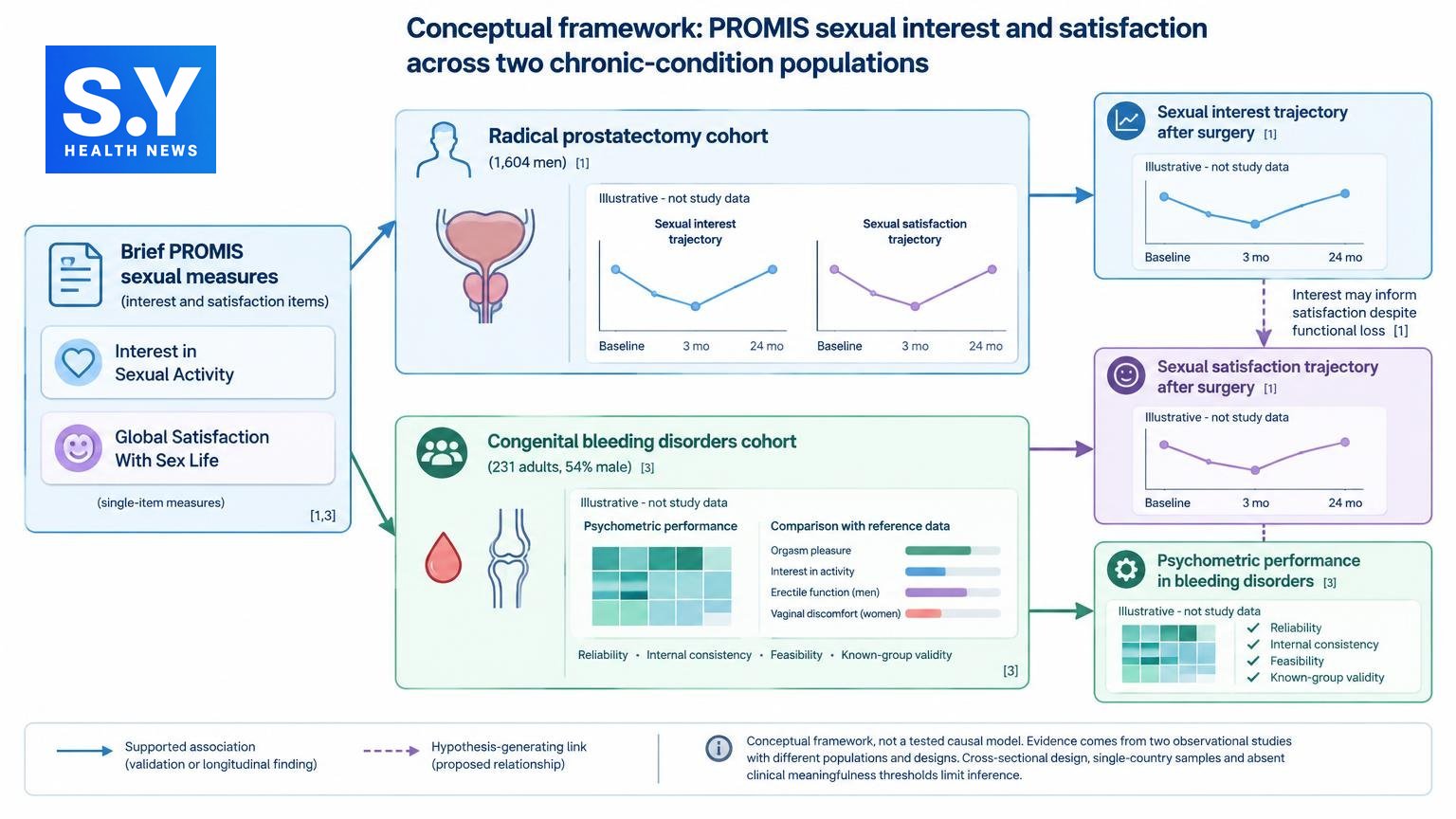
Conceptual framework: Conceptual framework, not a tested causal model. The diagram links brief PROMIS sexual interest and satisfaction measures to two observational study contexts: a 1,604-man robotic radical prostatectomy cohort with 3- and 24-month trajectories, and a 231-adult congenital bleeding disorders psychometric evaluation. Solid arrows denote supported associations or validation findings; the proposed link between interest and satisfaction recovery is hypothesis-generating. Cross-sectional design, single-country samples and absent clinical meaningfulness thresholds limit inference.
Academic References & Evidence
- Agochukwu NQ; Wittmann D; Boileau NR; Dunn RL; Montie JE; Kim T; Miller DC; Peabody J; Carlozzi NE. Validity of the Patient-Reported Outcome Measurement Information System (PROMIS) Sexual Interest and Satisfaction Measures in Men Following Radical Prostatectomy. Journal of clinical oncology. 2019 37(23):2017-2027 PMID: 31232671.
- Validity of the Patient-Reported Outcome Measurement Information System (PROMIS) Sexual Interest and Satisfaction Measures in Men Following Radical Prostatectomy.
- Tessa C M van Gastel. Psychometric properties and outcomes of the PROMIS Sexual Function and Satisfaction measures in individuals with congenital bleeding disorders. Res Pract Thromb Haemost. 2026 10(6):106937 DOI: 10.1016/j.rpth.2026.106937.
SANYUN Science Center explains published research on men's reproductive and sexual health, connecting scientific evidence with everyday questions while making sources and limitations clear.
Disclaimer: This article is for scientific education and research communication only. It does not provide medical advice, diagnosis, or individualized treatment recommendations, and does not endorse any medication, supplement, device, penile enlargement procedure, or other intervention. Decisions about sexual and reproductive health should be made in consultation with a qualified healthcare professional. Do not delay seeking professional care because of information in this article.
Original Content & Copyright Notice
- This article is prepared for SANYUN Science Center, drawing on published research and publicly available academic literature on men’s sexual and reproductive health. Its editorial explanations and presentation are developed for this platform.
- Copyright in the original editorial content, selection, and arrangement is reserved by SANYUN Science Center to the extent protected by applicable law. Referenced research, quotations, and third-party materials remain subject to the rights of their respective owners. This notice does not claim ownership of scientific facts or third-party research.
- Except where permitted by applicable law or an applicable license, prior written permission is required to reproduce, republish, translate, adapt, redistribute, or commercially reuse protected content. Attribution alone does not grant permission for such reuse.
- For permitted quotation or authorized reuse, clearly identify the source and retain a link to the original article.
- Source: SANYUN Science Center
- Original URL: Retain the original article URL on science.san-yun.com.
- Copyright Holder: SANYUN Science Center, for its own protected editorial content.
- Quotation, excerpts, or authorized reuse must not distort the scientific meaning, omit material limitations or disclaimers, or imply unverified medical claims, product efficacy, or endorsement by SANYUN Science Center.



