




Category: Health Academy
Core Research Direction: Prostate cancer screening explainer: who should discuss PSA testing and DRE, what abnormal results mean, and the limits of screening
Search Intent: Who should talk to a doctor about prostate cancer screening, what do PSA and DRE involve, and what does an abnormal result actually mean?
Platform: SANYUN Science Center
Evidence reviewed through: 2026-11-15
Prostate cancer screening is not a single test that produces a yes-or-no answer. It is a conversation followed, in some cases, by a blood test and a physical examination, and then — if something looks concerning — by further tests that are themselves uncertain. The practical questions men ask are straightforward: Should I be screened? What do the tests actually do? And if a result is abnormal, what happens next?[1]
Why This Matters
Prostate cancer is common. Consumer health material from Rochester Regional Health, citing the American Cancer Society, states that about 1 in 8 men in the United States will be diagnosed with prostate cancer during their lifetime, and that roughly 35,000 men die of the disease each year. Those are secondhand figures without a stated year, but they convey the scale: prostate cancer occupies a large share of men's cancer diagnosis and mortality.
It is also a cancer that often causes no symptoms in its early stages, and when symptoms do appear they can resemble benign prostatic hyperplasia or other non-cancerous conditions. That symptom overlap is the argument for discussing screening before symptoms begin — but it is not proof that screening saves lives in every group, which is why the decision is framed around individual risk, benefits and harms rather than a universal mandate.
What PSA Testing and DRE Actually Involve
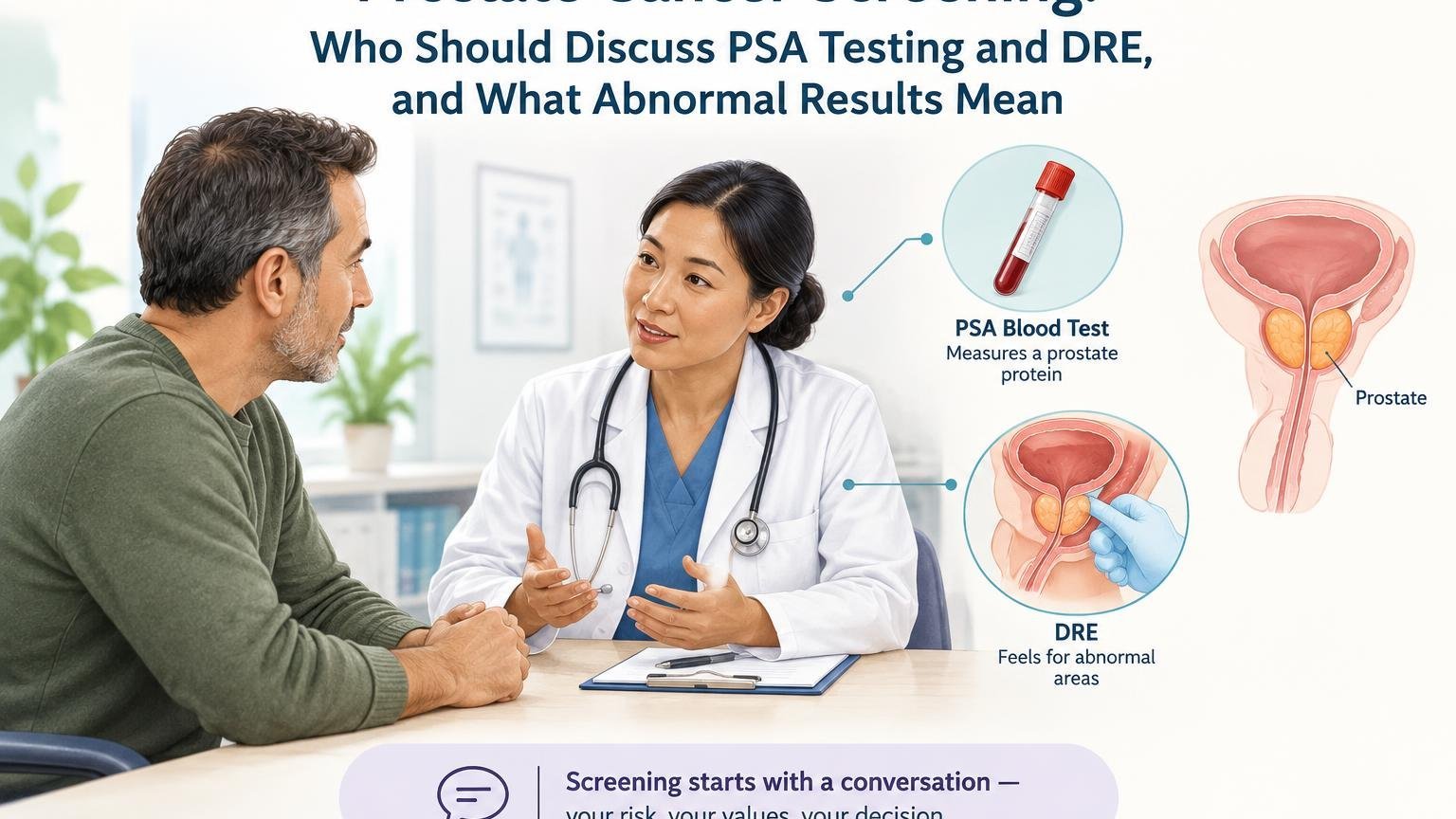
The prostate-specific antigen (PSA) test is a blood test that measures a protein released by the prostate. An elevated PSA can be a sign of cancer, but it can also rise because of benign conditions such as an enlarged prostate or an infection. Because of that ambiguity, clinicians typically monitor PSA levels over time rather than treating a single number as a diagnosis.
A digital rectal exam (DRE) is a physical examination in which a clinician inserts a gloved, lubricated finger into the rectum to feel for abnormal bumps or hard areas in the prostate. It is a quick office procedure, but the source describes only the technique — it offers no data on how often DRE detects cancer that PSA would miss, or how often it produces false alarms. DRE is best understood as one part of an examination, not a stand-alone verdict.
Who Should Discuss Screening, and When
The source advises that most men begin discussing prostate cancer screening with a clinician around age 50. This is institutional guidance rather than a cited trial result, and it does not name the guideline body behind the age. The key word is discuss: a conversation at around 50 is a starting point for weighing personal risk, not an automatic order for a test.
The source lists age, family history and race as risk factors and states that African-American men are twice as likely to be diagnosed with prostate cancer as other men. For people with these higher risks, it recommends starting screening between ages 40 and 45. The twofold figure is not attributed to a specific study in the source, and the earlier starting age is a recommendation rather than an outcome demonstrated in a trial. Men in higher-risk groups should treat these as reasons to have an earlier and more detailed conversation, not as a personal prediction.
At the other end of the age range, the source states that not all men benefit from PSA screening, particularly men over 70 or those with a life expectancy of less than 10 years, who may choose not to be screened or to consider alternative approaches. The underlying trial and guideline evidence is not cited, but the logic is important: a screening test has value only if finding a cancer earlier would plausibly change the person's outcome within their expected lifespan.
What an Abnormal Result Does — and Does Not — Mean
An abnormal screening result is a prompt for further investigation, not a cancer diagnosis. The source states plainly that an abnormal result does not automatically mean cancer and that additional testing is part of a thorough diagnostic process. It also notes that not all prostate cancers require immediate treatment, and that some low-risk cancers can be safely monitored over time by a urologist. The source does not cite the active-surveillance outcome data behind that statement, so the reassurance should be read as a general principle rather than a guarantee for any individual.
Follow-up options listed in the source include repeat PSA blood tests, prostate MRI, non-invasive urinary biomarker tests and prostate biopsy. These are described as a care pathway rather than as compared strategies, and the source gives no figures on how often each step changes management or produces a diagnosis. For a patient, the practical point is that the pathway is usually sequential: a repeat test may clarify a borderline value before a biopsy is considered.
| Screening element | What it involves | What an abnormal finding may mean | Key limitation |
|---|---|---|---|
| PSA blood test | Measures a protein released by the prostate | Can signal cancer, but may also reflect benign enlargement or infection; often monitored over time | No sensitivity or specificity figures given in the source |
| Digital rectal exam (DRE) | Gloved, lubricated finger inserted into the rectum to feel for abnormal bumps or hard areas | A palpable abnormality may prompt further testing | Source describes technique only; no accuracy data |
| Follow-up after abnormal screening | Repeat PSA, prostate MRI, urinary biomarker tests, or biopsy | Further testing is part of diagnosis, not proof of cancer | Options are listed as a pathway; no comparative outcomes reported |
| Age to begin discussion | Around age 50 for most men; ages 40 to 45 for higher-risk groups | Earlier discussion for those with age, family history or race-related risk | Institutional guidance; no cited trial or named guideline body |
| Men over 70 or with life expectancy under 10 years | May choose not to be screened or to consider alternatives | Limited benefit expected when lifespan is shorter | Stated without citing underlying trial evidence |
Interpretation and Limitations
The source is a consumer health explainer from a health system, not a systematic review or a clinical trial. Its numbers — 1 in 8 lifetime diagnoses and about 35,000 annual deaths — are attributed to the American Cancer Society but are reported secondhand, without a year or primary dataset. The age thresholds and the twofold risk figure for African-American men are presented as guidance without cited studies. None of this makes the guidance wrong, but it does mean the article cannot tell you how much screening reduces prostate cancer mortality, how many men must be screened to prevent one death, or how often screening leads to diagnosis and treatment of a cancer that would never have caused harm.
That gap matters because the core trade-off in prostate cancer screening is between earlier detection and overdiagnosis — finding cancers that would never have caused symptoms. The source acknowledges that not all prostate cancers require treatment and that some can be monitored, but it does not quantify how often that occurs. It also does not compare PSA alone with PSA plus DRE, or with newer biomarker or imaging pathways. A patient reading it should come away with a clear picture of the process and a clear sense of what remains unknown.
The source's own quoted urologist frames the decision as one of weighing risks, benefits and limitations and having an open conversation with a provider. That is an expert opinion within patient education, not an outcome from a study, but it aligns with the structure of the evidence: screening decisions are preference-sensitive, and the right choice depends on individual risk and values.
Research Outlook and Practical Questions
Several questions remain open in the source and in the wider field: how much PSA screening reduces death from prostate cancer in different risk groups; how often elevated PSA reflects benign causes; how DRE adds to or duplicates PSA; and which follow-up sequence — repeat PSA, MRI, urinary biomarkers or biopsy — best balances detection and harm. The source describes newer imaging and biopsy techniques as tools that may improve accuracy, but it does not report their diagnostic performance. Men considering screening can prepare for the conversation by asking about their personal risk, what a positive result would lead to, and whether active surveillance would be an option if a low-risk cancer were found.
Key Takeaways
- Most men should discuss prostate cancer screening with a clinician around age 50; higher-risk men — including those with family history or who are African-American — are advised to start the conversation between ages 40 and 45.
- PSA is a blood test for a prostate protein; it can rise with cancer but also with benign enlargement or infection, so clinicians often monitor levels over time.
- DRE is a physical examination of the prostate through the rectum; the source describes the technique but gives no accuracy or benefit data.
- An abnormal screening result is not a cancer diagnosis; follow-up may include repeat PSA, MRI, urinary biomarker tests or biopsy, and some low-risk cancers can be monitored over time.
- Not all men benefit from PSA screening, particularly men over 70 or with a life expectancy under 10 years, who may choose not to be screened.
Questions and Answers
What is the difference between a PSA test and a digital rectal exam for prostate cancer screening?
A PSA test is a blood test that measures a protein released by the prostate; elevated levels can reflect cancer but also benign enlargement or infection. A digital rectal exam is a physical examination in which a clinician inserts a gloved, lubricated finger into the rectum to feel for abnormal bumps or hard areas. The source describes both but provides no accuracy data for either.
At what age should men start discussing prostate cancer screening?
The source advises most men to begin discussing screening with a clinician around age 50. People at higher risk — including those with a family history or who are African-American — are advised to start the conversation between ages 40 and 45. This is institutional guidance without a named guideline body, so individual timing should be discussed with a clinician.
Does an abnormal PSA or DRE result mean I have prostate cancer?
No. The source states that an abnormal result does not automatically mean cancer and that additional testing is part of a thorough diagnostic process. Follow-up may include repeat PSA tests, prostate MRI, urinary biomarker tests or biopsy. It also notes that some low-risk prostate cancers can be safely monitored over time rather than treated immediately.
Why might some men, especially those over 70, choose not to have PSA screening?
The source states that not all men benefit from PSA screening, particularly those over 70 or with a life expectancy of less than 10 years, who may choose not to be screened or to consider alternatives. The underlying trial evidence is not cited, but the reasoning is that earlier detection matters only if it could plausibly change outcomes within a person's expected lifespan.
What are the limitations of the evidence in this prostate cancer screening explainer?
The source is a consumer health article, not a systematic review or trial. Its lifetime diagnosis and annual death figures are secondhand American Cancer Society estimates without a stated year; age thresholds and the twofold risk figure for African-American men are uncited guidance. It does not quantify screening's mortality benefit, overdiagnosis rates, or how DRE compares with PSA.
What should men know about symptoms and prostate cancer screening before deciding?
Early prostate cancer often causes no symptoms, and when symptoms appear they can resemble benign prostatic hyperplasia, so symptoms alone cannot distinguish cancer from benign conditions. The source quotes a urologist advising patients to weigh the risks, benefits and limitations of screening and discuss them openly with their provider. Screening decisions are preference-sensitive and depend on individual risk.
Sources and References
- How Prostate Cancer Screenings Work | Rochester Regional Health. Rochester Regional Health. 2025
SANYUN Science Center explains published research on men's reproductive and sexual health, connecting scientific evidence with everyday questions while making sources and limitations clear.
Disclaimer: This article is for scientific education and research communication only. It does not provide medical advice, diagnosis, or individualized treatment recommendations, and does not endorse any medication, supplement, device, penile enlargement procedure, or other intervention. Decisions about sexual and reproductive health should be made in consultation with a qualified healthcare professional. Do not delay seeking professional care because of information in this article.
Original Content & Copyright Notice
- This article is prepared for SANYUN Science Center, drawing on published research and publicly available academic literature on men’s sexual and reproductive health. Its editorial explanations and presentation are developed for this platform.
- Copyright in the original editorial content, selection, and arrangement is reserved by SANYUN Science Center to the extent protected by applicable law. Referenced research, quotations, and third-party materials remain subject to the rights of their respective owners. This notice does not claim ownership of scientific facts or third-party research.
- Except where permitted by applicable law or an applicable license, prior written permission is required to reproduce, republish, translate, adapt, redistribute, or commercially reuse protected content. Attribution alone does not grant permission for such reuse.
- For permitted quotation or authorized reuse, clearly identify the source and retain a link to the original article.
- Source: SANYUN Science Center
- Original URL: Retain the original article URL on science.san-yun.com.
- Copyright Holder: SANYUN Science Center, for its own protected editorial content.
- Quotation, excerpts, or authorized reuse must not distort the scientific meaning, omit material limitations or disclaimers, or imply unverified medical claims, product efficacy, or endorsement by SANYUN Science Center.



