




Category: Health Academy
Core Research Direction: What a prostate-focused visit involves (DRE and PSA), what each component can and cannot show, and how an abnormal result becomes a follow-up sequence rather than a diagnosis
Search Intent: What actually happens during a prostate exam, what can the results tell me, and what comes next if something is abnormal?
Platform: SANYUN Science Center
Evidence reviewed through: 2026-11-15
Executive Summary
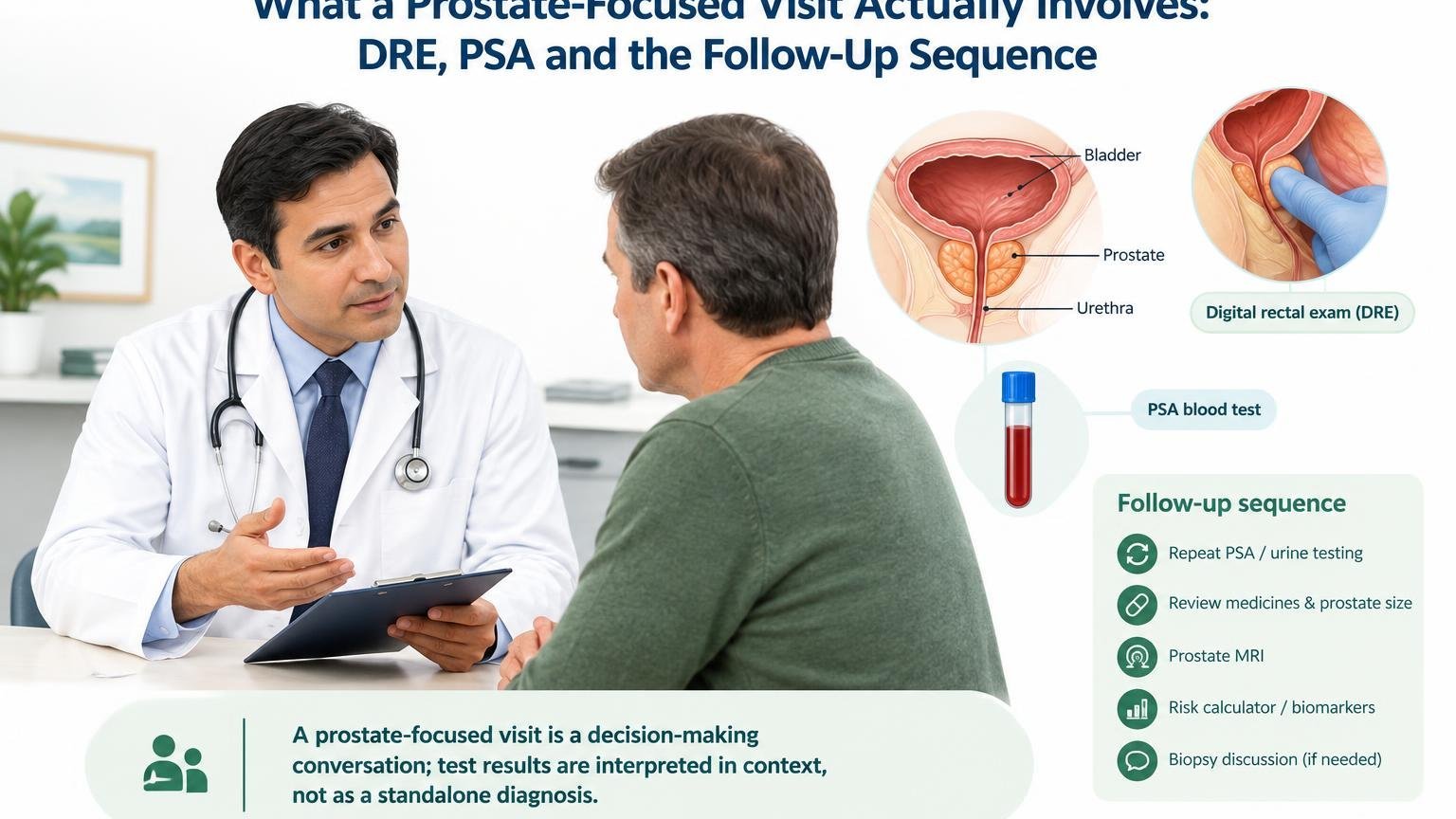
A prostate-focused visit is usually a decision-making appointment, not a single test that produces a yes-or-no answer. It commonly begins with a structured history covering urinary symptoms, pain, infection history, medicines, family history, previous PSA values and the specific reason testing is being considered. The two familiar components are a digital rectal exam (DRE), a brief physical examination of the accessible back surface of the prostate through the rectal wall, and a prostate-specific antigen (PSA) blood test. Neither result diagnoses prostate cancer by itself.[1]
The DRE lets a clinician assess the size, shape and texture of the prostate and notice hard areas, lumps or irregularities that may need investigation, but it cannot feel the entire gland or determine cancer stage. PSA is a protein produced by both cancerous and noncancerous prostate tissue, so a raised value can reflect cancer, benign prostatic hyperplasia or prostatitis, among other explanations. A high PSA does not diagnose cancer, and a lower PSA does not rule it out.[2][3]
Because neither component is definitive, an abnormal exam or PSA should be turned into a sequence rather than a conclusion. That sequence may include repeating the PSA under better conditions, evaluating for infection or urinary retention, reviewing prostate size and medicines, prostate MRI, a risk calculator, additional biomarkers or a biopsy discussion. Which steps apply depends on age, life expectancy, family history, ancestry, prior biopsy or MRI, PSA trend and the patient's preferences. PSA screening itself is preference-sensitive: it can find important cancers but can also trigger additional testing for changes that would never become dangerous.
Why This Matters
The word exam hides a set of different questions. A visit may be about screening in a man without symptoms, about investigating a weak stream or pelvic pain, about following an earlier borderline result, or about monitoring after treatment. Each purpose calls for different parts of the evaluation and different follow-up. When the purpose is not named, an appointment can end with a number but no plan.
Prostate cancer is often described as asymptomatic in its early phase, which is one reason attention falls on testing rather than symptoms alone. At the same time, symptoms such as weak flow or straining are nonspecific and cannot by themselves distinguish benign enlargement, inflammation, infection or cancer. This combination — a condition that may not announce itself, tests that are informative but imperfect, and symptoms that overlap across diagnoses — is why the conversation around the visit matters as much as the tests themselves.[4]
The Two Components and What Each One Does
During a DRE, the clinician inserts a lubricated, gloved finger into the rectum and feels the prostate through the rectal wall. The examination is brief — typically a few minutes, with one source describing a usual range of one to five minutes depending on whether anything unusual is found. It may cause slight discomfort or a pressure sensation and an urge to urinate, but it should not be painful. Most people do not need bowel preparation or fasting for a routine DRE. A clinician should be told beforehand about severe rectal pain, recent rectal surgery, active bleeding or a condition that changes how the examination should be done.
What the DRE adds is tactile information: size, shape, texture, tenderness, firmness and asymmetry. It can identify a hard area or nodule that deserves further investigation. What it cannot do is feel the whole gland or establish stage, and a normal-feeling prostate does not cancel a concerning PSA pattern. Nor does an enlarged prostate automatically mean cancer. The DRE is therefore best understood as one input into a risk assessment rather than a standalone screening strategy.
The PSA test is a blood draw that measures the amount of prostate-specific antigen in the blood. PSA is produced by both cancerous and noncancerous prostate tissue, so it is not a cancer-specific protein; it mainly signals that something is affecting the prostate. Elevated values can occur with cancer, benign prostatic hyperplasia or prostatitis. This is the central interpretive problem: the test is sensitive to prostate activity of many kinds, and its result must be read alongside context rather than in isolation.
| Component | What it can add | What it cannot prove | Interpretive caveat |
|---|---|---|---|
| History and symptom review | Clarifies whether the concern is screening, weak flow, retention, infection, pain, bleeding or treatment follow-up. | Cannot distinguish benign enlargement, inflammation, infection or cancer from symptoms alone. | The purpose of the visit determines which tests are useful. |
| Digital rectal exam (DRE) | Assesses the accessible back surface for size, shape, texture, tenderness, firmness or asymmetry; may detect a hard area or nodule. | Cannot feel the entire gland or determine cancer stage; a normal-feeling prostate does not exclude cancer. | Enlargement does not automatically mean cancer. |
| PSA blood test | Measures prostate-specific antigen and provides a value that can be compared with prior results, age, prostate size and medicines. | A high PSA does not diagnose cancer, and a lower PSA does not rule it out. | PSA is produced by cancerous and noncancerous tissue; infection, benign growth and inflammation can raise it. |
| Follow-up sequence | May include repeat PSA, urine testing, medicine review, MRI, a risk calculator, biomarkers or biopsy discussion. | Not every patient needs every test; no single next step applies to all abnormal results. | Depends on age, life expectancy, family history, ancestry, prior biopsy or MRI, PSA trend and preferences. |
Clinical and Biological Context for Interpretation
The prostate sits below the bladder and surrounds the urethra, which helps explain why enlargement or inflammation can affect urinary flow. A prostate exam is intended to check prostate health and detect abnormalities such as enlargement, inflammation or tumors. But the same anatomy that makes the prostate clinically important also makes simple testing difficult: the gland is not fully reachable by finger, and the blood marker most associated with it is not specific to cancer.
Contextual factors change how a PSA value should be read. Prior PSA values with dates are more informative than a single latest number. Medicines such as finasteride or dutasteride, recent urinary infection, catheterization, urinary retention and prostate procedures can all affect interpretation. Prostate size matters too: a larger gland can produce more PSA, which is why a fixed threshold of 4 is not always the right benchmark. The trend and context are often more useful than an isolated result, and a clinician may reasonably repeat a value before escalating.
The packet contains several numerical statements from an expert interview that deserve cautious handling. The interview states that when PSA is over 4, it is prostate cancer only 30% of the time; that with PSA below 4 and a normal DRE there is an 85% chance of not having prostate cancer; and that a nodule may be felt on examination 15% of the time. These figures are not accompanied by a cited study, population, case definition or time frame, so they should be treated as illustrative clinical commentary rather than established risk estimates. They may not reflect modern biopsy or MRI pathways, and they should not be used to reassure or alarm an individual patient.
What the Evidence Shows — and What It Does Not
The available material is patient education and expert commentary, not comparative trial data. It consistently supports a modest set of conclusions: the DRE is a brief physical examination that can detect some abnormalities but does not visualize the whole gland; PSA is a blood marker that can rise for several reasons and does not by itself establish cancer; and abnormal results should prompt a structured follow-up rather than a diagnosis. The sources also agree that the visit begins with history and that the reason for testing shapes the evaluation.
What the material does not provide is equally important. There are no sensitivity or specificity estimates for DRE or PSA, no overdiagnosis rates, no comparative outcomes for different follow-up pathways, and no verified primary guideline data. One source attributes to the American Cancer Society a recommendation to discuss prostate exams starting at age 50 for average-risk men and at age 45 for higher-risk men, including African American men and those with a family history of prostate cancer. That attribution is secondary within this packet and should be checked against current primary guidance before being applied to an individual.
The 15% nodule figure illustrates the problem well. Even if accurate in some setting, it does not specify the denominator — which men, at what age, with what PSA values, examined by whom — so it cannot be translated into an individual's probability. Similarly, the statement that PSA over 4 reflects cancer 30% of the time is a yield figure whose population and biopsy criteria are unknown. Such numbers are best read as reminders that abnormal does not equal cancer, not as calibrated risk estimates.
Turning an Abnormal Result Into a Sequence
An abnormal DRE or PSA finding is a branch point, not an endpoint. Reasonable next steps may include repeating the PSA under standardized conditions, testing for infection, assessing urinary retention, reviewing prostate size and medicines, or moving to prostate MRI, a risk calculator, additional biomarkers or a biopsy discussion. The right sequence is individualized. Age and life expectancy influence whether finding and treating a cancer would change outcomes; family history, ancestry and prior biopsy or MRI alter pretest probability; PSA trend adds information that a single value lacks.
A useful visit ends with a named plan: which result is being followed, when it should be repeated, what could change the interpretation, and what threshold would trigger MRI, biopsy or specialist referral. That plan is a clinical decision, not passive waiting. It also gives the patient a way to participate — bringing dated prior values, listing medicines and procedures, and stating what decision the visit is meant to support. Clear surveillance is different from simply doing nothing, and the difference should be explicit.
Interpretation and Limitations
Several limitations shape how confidently this explainer can speak. The packet relies on educational web pages and one interview rather than on primary studies or guideline documents. Some statements are the author's framing — for example, calling DRE an essential element of screening — and should not be read as a formal recommendation. The numerical claims in the interview lack cited sources and denominators. The age recommendations are attributed secondhand. And the sources do not quantify the benefits and harms of screening, so the preference-sensitive nature of PSA testing is described qualitatively rather than with absolute risk figures.
A further limitation is that the material describes typical pathways rather than a protocol. Follow-up sequences vary by health system, available imaging, biopsy practice and specialist access. Nothing here should be read as saying that every man needs both tests at every visit, or that a particular sequence is standard of care. The sources explicitly note that not everyone needs both tests at every visit and that not every patient needs every follow-up test. Those decisions belong to a clinical conversation that accounts for the individual's history and preferences.
Research Outlook
The open questions are practical. Which follow-up pathways best balance detection of important cancers against unnecessary testing? How should PSA trend, prostate size and medicine effects be incorporated into decision aids? What role should MRI and biomarkers play before biopsy, and how do those choices affect outcomes that matter to patients? The packet does not answer these questions, but it frames them: the value of a prostate-focused visit depends less on any single number than on whether the testing leads to a coherent, preference-aware plan. Future guidance will need to make that sequence explicit and measurable.
Key Takeaways
- A prostate exam is not one test: it usually combines history, a DRE and possibly a PSA blood test, and neither DRE nor PSA diagnoses cancer by itself.
- A DRE is brief, typically a few minutes, may cause slight discomfort and should not be painful; it assesses the accessible prostate surface but cannot feel the whole gland or determine stage.
- PSA is produced by cancerous and noncancerous prostate tissue, so a raised value can reflect benign enlargement, infection or inflammation as well as cancer; a high PSA does not diagnose cancer and a lower PSA does not rule it out.
- Context matters: prior PSA values with dates, medicines such as finasteride or dutasteride, recent infection or procedures, and prostate size all affect interpretation.
- An abnormal result should start a follow-up sequence — repeat testing, infection or retention evaluation, MRI, risk calculator, biomarkers or biopsy discussion — chosen according to age, history, trend and preferences.
- The interview figures of 30% cancer yield at PSA over 4, 85% cancer-free probability below 4 and a 15% nodule detection rate lack cited populations and should be treated as illustrative, not as personal risk estimates.
Questions and Answers
What is a digital rectal exam and what can it detect during a prostate exam?
A digital rectal exam is a brief physical examination in which a clinician inserts a lubricated, gloved finger into the rectum to feel the accessible back surface of the prostate. It can assess size, shape, texture, tenderness and asymmetry and may identify a hard area or nodule. It cannot feel the entire gland, determine cancer stage, or by itself rule cancer in or out, and an enlarged prostate does not automatically mean cancer.
What does the PSA blood test measure and why is a high PSA not a cancer diagnosis?
The PSA test measures prostate-specific antigen, a protein produced by both cancerous and noncancerous prostate tissue. Because it is not specific to cancer, elevated values can occur with benign prostatic hyperplasia, prostatitis or other prostate activity. A high PSA does not diagnose cancer, and a lower PSA does not rule it out. The result has to be interpreted alongside history, prior values, prostate size, medicines and examination findings.
What typically happens after an abnormal prostate exam or PSA result?
An abnormal result usually leads to a structured sequence rather than an immediate diagnosis. Options include repeating the PSA, evaluating for infection or urinary retention, reviewing prostate size and medicines, prostate MRI, a risk calculator, additional biomarkers or a biopsy discussion. The chosen path depends on age, life expectancy, family history, ancestry, prior biopsy or MRI, PSA trend and the patient's preferences. Not every patient needs every test.
How strong is the evidence behind the PSA and prostate exam figures cited in this explainer?
The evidence base described here is patient education and expert commentary, not comparative trial or guideline data. Figures such as 30% cancer yield when PSA is over 4, an 85% chance of no cancer when PSA is below 4 with a normal exam, and a 15% nodule detection rate are quoted without cited populations, case definitions or time frames. They are illustrative and should not be used as personal risk estimates.
What should I bring to a prostate exam appointment to make the results easier to interpret?
Bring prior PSA values with dates rather than only the latest number, a list of medicines including finasteride or dutasteride, and information about recent urinary infection, catheterization, urinary retention or prostate procedures. Also note symptoms, family history and the specific decision you need from the visit. Trend and context are often more useful than an isolated result, and these details help the clinician interpret it.
Does a normal-feeling prostate on DRE mean cancer has been ruled out?
No. A normal-feeling prostate does not erase a concerning PSA pattern, and the DRE cannot feel the entire gland or determine stage. A DRE is one input into a larger risk assessment rather than a standalone screening strategy. Conversely, an enlarged or firm prostate does not automatically mean cancer. The combination of history, PSA trend, examination findings and other factors guides whether further testing is needed.
Sources and References
- Domenico Savatta. Prostate Exam: What to Expect and What the Results Can Mean. 2026
- David B Samadi. What is a prostate exam? | Urology & Prostate Cancer Physician located in Central Midtown, New York and East Hills, NY | David B Samadi, MD. 2024
- David B. Samadi. Never Had A Prostate Exam? What To Expect During Your First Prostate Exam – Dr. David Samadi | Prostate Cancer 911. 2026
- David Samadi. Celebrity urologist tells the truth about prostate cancer | Prostate Cancer 911.
SANYUN Science Center explains published research on men's reproductive and sexual health, connecting scientific evidence with everyday questions while making sources and limitations clear.
Disclaimer: This article is for scientific education and research communication only. It does not provide medical advice, diagnosis, or individualized treatment recommendations, and does not endorse any medication, supplement, device, penile enlargement procedure, or other intervention. Decisions about sexual and reproductive health should be made in consultation with a qualified healthcare professional. Do not delay seeking professional care because of information in this article.
Original Content & Copyright Notice
- This article is prepared for SANYUN Science Center, drawing on published research and publicly available academic literature on men’s sexual and reproductive health. Its editorial explanations and presentation are developed for this platform.
- Copyright in the original editorial content, selection, and arrangement is reserved by SANYUN Science Center to the extent protected by applicable law. Referenced research, quotations, and third-party materials remain subject to the rights of their respective owners. This notice does not claim ownership of scientific facts or third-party research.
- Except where permitted by applicable law or an applicable license, prior written permission is required to reproduce, republish, translate, adapt, redistribute, or commercially reuse protected content. Attribution alone does not grant permission for such reuse.
- For permitted quotation or authorized reuse, clearly identify the source and retain a link to the original article.
- Source: SANYUN Science Center
- Original URL: Retain the original article URL on science.san-yun.com.
- Copyright Holder: SANYUN Science Center, for its own protected editorial content.
- Quotation, excerpts, or authorized reuse must not distort the scientific meaning, omit material limitations or disclaimers, or imply unverified medical claims, product efficacy, or endorsement by SANYUN Science Center.



