




Category: Latest Research
Core Research Direction: Whether combined penile platelet-rich plasma (PRP) plus low-intensity extracorporeal shock wave therapy (ESWT) produces durable erectile-function benefit beyond ESWT alone at 6 months in men with erectile dysfunction, and what conference-abstract and single-arm evidence can and cannot show
Search Intent: Does adding platelet-rich plasma to shock wave therapy give men with erectile dysfunction better erectile function than shock wave therapy alone, and do any gains last 6 months?
Platform: SANYUN Science Center
Evidence reviewed through: 2026-11-07
Executive Summary
A randomized trial reported at the International Continence Society 2026 meeting compared low-intensity extracorporeal shock wave therapy (ESWT) alone with ESWT combined with intrapenile platelet-rich plasma (PRP) injections in 164 men with erectile dysfunction. Both groups of 82 received treatment twice weekly for 6 weeks; in the combination arm, one weekly session paired ESWT with PRP injection and the other was ESWT alone. The abstract reports that both arms improved, that the combination was statistically superior at day 60, and that some between-group differences in erection scores and penile Doppler measures persisted at 6 months.[1]
The headline result is not proof of superiority. This trial is available here only as a conference abstract: effect sizes, confidence intervals, adverse-event counts and follow-up completeness are not reported. The groups also differed at baseline in mean age (40.1 versus 45.6 years), and a single abstract cannot fully document randomization, blinding or analysis methods. The findings are best read as a signal worth following into full peer review, not as a treatment recommendation.
Why This Matters
Erectile dysfunction is common, and regenerative-style add-ons such as PRP are marketed far ahead of their evidence base. Clinicians and patients therefore need a clear view of what the strongest recent comparative data actually show. A randomized design is a meaningful step up from single-arm case series, because it allows a direct comparison against an active treatment rather than against no treatment.[2]
At the same time, a conference abstract is a compressed snapshot presented before or alongside full peer review. Reviews of meeting abstracts have long shown that a substantial share never reach full publication, and that results can change when they do. Readers should treat the reported 6-month advantage as a preliminary comparative signal rather than a settled clinical benefit.
Biological and Clinical Mechanism
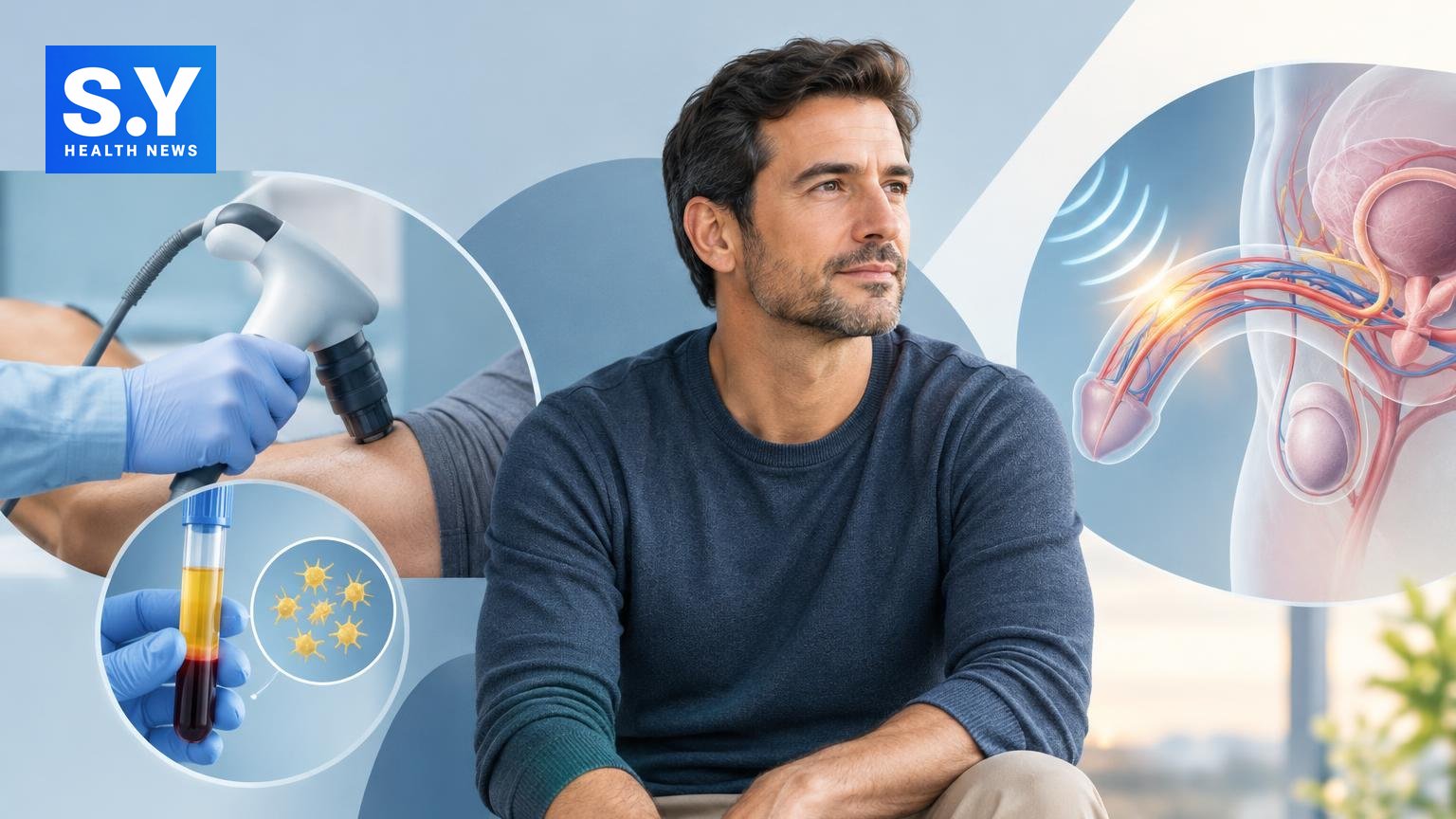
Low-intensity shock waves are thought to stimulate microcirculation and tissue repair through mechanical and cellular signaling. PRP is a concentrate of a man's own platelets, rich in growth factors that are released when platelets are activated. In the combination arm of this trial, PRP was injected into the penis and then activated by ESWT in the same session. The working rationale is that shock waves may both stimulate tissue and trigger growth-factor release from the injected platelets, so that the two treatments reinforce each other.
This rationale is background hypothesis, not an outcome measured here. The abstract reports functional and Doppler endpoints, not tissue-level growth-factor activity, vascular remodeling or nerve recovery. Adjacent work in other conditions — a single-arm pilot of 25 women with interstitial cystitis/bladder pain syndrome receiving low-intensity ESWT plus PRP, and a randomized Peyronie's disease abstract from the same research group — is consistent with a repair-oriented rationale, but neither establishes a mechanism in erectile dysfunction.[3][4]
What the Evidence Shows
The erectile dysfunction trial randomized 164 men into two equal groups. Outcomes were measured at baseline, day 60 and 6 months using the IIEF-5 questionnaire, the Erection Hardness Score (EHS), the Sexual Encounter Profile (SEP), the Global Assessment Question (GAQ) and penile duplex Doppler ultrasound, the vascular measure reported as median with interquartile range. At day 60, both arms improved significantly on IIEF-5, EHS, SEP, GAQ, peak systolic velocity (PSV) and resistive index, and the authors report the combination arm was statistically superior.
Between day 60 and 6 months, both arms drifted slightly downward on questionnaire scores, none of those declines reaching statistical significance within groups. The clearest divergence was vascular: in the ESWT-alone arm, PSV fell significantly from a median of 25.8 cm/s to 21.4 cm/s, whereas the combination arm's PSV change from 28 cm/s to 25.8 cm/s was not significant. Between-group comparison at 6 months reportedly favored the combination arm on SEP, EHS and Doppler measures.
| Measure (timing) | ESWT alone (n = 82) | PRP + ESWT (n = 82) | Reported interpretation |
|---|---|---|---|
| IIEF-5, day 60 to 180 days | Median 20.2 (IQR 15.9–22.6) to 19.6 (13.8–22); p > 0.05 | Median 19.6 (IQR 17–23) to 19.0 (16–22); p > 0.05 | Slight non-significant decline in both arms; no within-group loss of score demonstrated |
| Penile Doppler PSV, day 60 to 180 days | Median 25.8 cm/s (20.2–28.9) to 21.4 cm/s (19–27.5); p < 0.05 | Median 28 cm/s (23.3–34.9) to 25.8 cm/s (23–31.8); p > 0.05 | Only the ESWT-alone arm showed a significant fall in peak systolic velocity |
| GAQ responders, day 60 to 6 months | 55 (67%) to 40 (48.8%) | 68 (82.9%) to 59 (71.9%) | Both arms retained more responders than not, but abstract gives no between-group test for GAQ |
| Between-group comparison at 6 months | Reference arm | Higher SEP, EHS and Doppler scores reported; p < 0.05 | Direction favors combination; effect size and adjustment for baseline differences not reported |
Responder patterns echoed the score data. In the ESWT-alone arm, GAQ improvement was reported by 55 men (67%) at day 60 and 40 (48.8%) at 6 months. In the combination arm, positive GAQ responses were reported by 68 men (82.9%) at day 60 and 59 (71.9%) at 6 months. These are counts within each randomized group, so they show how each arm tracked over time rather than a validated head-to-head responder difference.
Interpretation and Limitations
Three features of the data deserve careful reading. First, both groups improved, which is expected in an open-label regenerative trial where expectancy and regression toward the mean can inflate early gains. Without a sham or no-treatment arm, the abstract cannot separate specific treatment effects from placebo and natural fluctuation. Second, the ESWT-alone arm's statistically significant PSV decline is a within-group change on an ultrasound measure; whether it translates into a meaningful clinical loss of function is not established. Third, the between-group advantage at 6 months is reported as a p-value below 0.05 without effect sizes, so the magnitude of any real difference remains unknown.
Baseline differences complicate attribution. The combination arm was on average about five years older and had a somewhat shorter mean duration of erectile dysfunction, and full baseline comparability of IIEF-5, vascular and comorbidity profiles is not shown in the abstract. Statistical significance also differs from clinical importance: a reported difference on a questionnaire or Doppler measure does not by itself demonstrate that men noticed a meaningful change in sexual function.
Safety reporting is limited to a general statement that both approaches were well tolerated. The abstract does not quantify injection-site pain, bruising, infection or other procedure-related events, and it does not state how many men returned for the 6-month assessment. Missing follow-up matters because responder percentages are only interpretable if most randomized participants were actually assessed.
Adjacent evidence should not be substituted for erectile dysfunction data. The Peyronie's disease trial randomized 70 men and reported durable pain relief in both groups at 180 days, with curvature falling from a median of 15° to 11° and fibrosis area from 30.7 mm² to 15 mm² in the combination arm, but that is a different condition and endpoint set. The single-arm interstitial cystitis pilot enrolled 25 women, reported an 80% efficacy rate and concluded the combination might help, yet its uncontrolled design cannot demonstrate causation and its population is not men with erectile dysfunction.
Research Outlook
The practical next question is what full peer-reviewed reporting will show. A complete paper should provide between-group effect sizes with confidence intervals, the randomization and blinding procedures, adverse-event counts, and a clear accounting of men lost to follow-up. It should also state whether the analysis was pre-specified and whether baseline age differences were adjusted for.
Future studies would benefit from a sham-controlled design, stratification by erectile dysfunction cause and severity, and prespecified thresholds for clinically meaningful change on IIEF-5 and EHS. Because the reported benefits in both conditions appear to soften over months, trials should also test whether repeat courses sustain response — a question the interstitial cystitis authors themselves raised when they suggested treatment may need to be repeated over time.
Key Takeaways
- A 164-man randomized trial abstract reports that adding intrapenile PRP to ESWT produced better day-60 erectile-function outcomes than ESWT alone, with some between-group differences reportedly persisting at 6 months.
- In the ESWT-alone arm, PSV fell significantly from 25.8 cm/s to 21.4 cm/s by 6 months; in the combination arm the change from 28 cm/s to 25.8 cm/s was not significant.
- Both arms drifted slightly downward between day 60 and 6 months on questionnaire scores, without statistically significant within-group losses.
- The evidence is abstract-only, with baseline age differences, no reported effect sizes and no quantified safety or follow-up completeness data, so superiority is suggested rather than established.
Questions and Answers
What is penile platelet-rich plasma combined with shock wave therapy for erectile dysfunction?
It is a regenerative approach in which a man's own concentrated platelets are injected into the penis and low-intensity shock waves are applied to the same area. In the reported trial, one weekly session combined ESWT with PRP injection, with ESWT used to activate the platelets, and a second weekly session was ESWT alone for 6 weeks. The tissue-repair rationale is plausible but remains a hypothesis, not a demonstrated mechanism in erectile dysfunction.
Did adding PRP to shock wave therapy improve erectile function more than shock wave therapy alone?
In the conference abstract, yes at the early time point: both groups of 82 improved by day 60, and the combination group was reported as statistically superior on questionnaire and Doppler measures. At 6 months, between-group comparisons reportedly still favored the combination on SEP, EHS and Doppler measures. However, no effect sizes or confidence intervals are given, so the size of any advantage is unknown.
How strong is the evidence that PRP plus shock wave therapy has 6-month benefits for erectile dysfunction?
Preliminary. It rests on a single randomized trial known here only through a conference abstract, without a published full report, effect sizes, adverse-event counts or follow-up completeness. Durability is suggested by persisting between-group differences at 6 months, but both arms drifted slightly downward from day 60, and questionnaire declines within each arm were not statistically significant. Independent replication is needed.
Do the 6-month results of combined PRP and shock wave therapy apply to all men with erectile dysfunction?
Not necessarily. Participants were men with a mean age of about 40 years in the ESWT-alone arm and 45.6 years in the combination arm, with mean erectile-dysfunction duration of roughly 4 years, treated at one university center. The abstract reports no subgroup analyses by cause or severity, so men with diabetes, prior prostate surgery or severe vascular disease may respond differently. Generalization should wait for fuller data.
What are the main limitations of the evidence on PRP injections plus shock wave therapy for erectile dysfunction?
The main limitations are abstract-only reporting, baseline age differences between arms, unreported effect sizes and confidence intervals, and no quantified safety data beyond a general statement of tolerability. It is also unclear how many men completed the 6-month assessment. These gaps mean the study cannot establish that the combination is superior to ESWT alone in routine practice.
What should readers understand about the status of PRP plus shock wave therapy for erectile dysfunction?
The combination remains investigational. The reported advantage over ESWT alone comes from a single conference abstract with methodological gaps, and PRP also involves penile injections whose procedure-related risks were not detailed. Readers should discuss erectile dysfunction causes and proven options with a clinician, and treat regenerative add-ons as unproven rather than established care.
Sources and References
- Epifanova M; Artemenko S; Kostin A; Epifanov A. Delayed clinical outcomes of combined platelet-rich plasma and shock wave therapy in the treatment of erectile dysfunction.
- International Continence Society. International Continence Society
- Cheng-Yu Long; Chieh-Yu Chang; I-Chieh Sung; Liang-Ying Ke; Hui-Yu Chuang. Matilda – Œuvre. Frontiers in Bioengineering and Biotechnology. 2026 14:1801578 DOI: 10.3389/fbioe.2026.1801578. PMID: 42292523.
- Epifanova M; Artemenko S; Kostin A; Epifanov A. Regenerative potential of PRP and ESWT: a six-month follow-up study in Peyronie’s disease.
SANYUN Science Center explains published research on men's reproductive and sexual health, connecting scientific evidence with everyday questions while making sources and limitations clear.
Disclaimer: This article is for scientific education and research communication only. It does not provide medical advice, diagnosis, or individualized treatment recommendations, and does not endorse any medication, supplement, device, penile enlargement procedure, or other intervention. Decisions about sexual and reproductive health should be made in consultation with a qualified healthcare professional. Do not delay seeking professional care because of information in this article.
Original Content & Copyright Notice
- This article is prepared for SANYUN Science Center, drawing on published research and publicly available academic literature on men’s sexual and reproductive health. Its editorial explanations and presentation are developed for this platform.
- Copyright in the original editorial content, selection, and arrangement is reserved by SANYUN Science Center to the extent protected by applicable law. Referenced research, quotations, and third-party materials remain subject to the rights of their respective owners. This notice does not claim ownership of scientific facts or third-party research.
- Except where permitted by applicable law or an applicable license, prior written permission is required to reproduce, republish, translate, adapt, redistribute, or commercially reuse protected content. Attribution alone does not grant permission for such reuse.
- For permitted quotation or authorized reuse, clearly identify the source and retain a link to the original article.
- Source: SANYUN Science Center
- Original URL: Retain the original article URL on science.san-yun.com.
- Copyright Holder: SANYUN Science Center, for its own protected editorial content.
- Quotation, excerpts, or authorized reuse must not distort the scientific meaning, omit material limitations or disclaimers, or imply unverified medical claims, product efficacy, or endorsement by SANYUN Science Center.



