




Category: Premature Ejaculation
Core Research Direction: Evidence on behavioral and psychological treatments for premature ejaculation: effect sizes reported across 33 pre-post trials, which technique components appear active (pause/stop-start, arousal-regulation) versus uncertain (squeeze, vibrator, masturbation mode) or unsupported (pelvic floor), therapist-supported versus self-treatment delivery, combination with pharmacotherapy, and how PE is defined and subtyped (lifelong/acquired, generalized/situational, objective vs subjective latency)
Search Intent: How well do psycho-behavioral (sex therapy) approaches work for premature ejaculation, which components and delivery formats seem to matter, and what do the underlying trial designs and PE definitions allow us to conclude?
Platform: SANYUN Science Center
Evidence reviewed through: 2026-11-04
Executive Summary
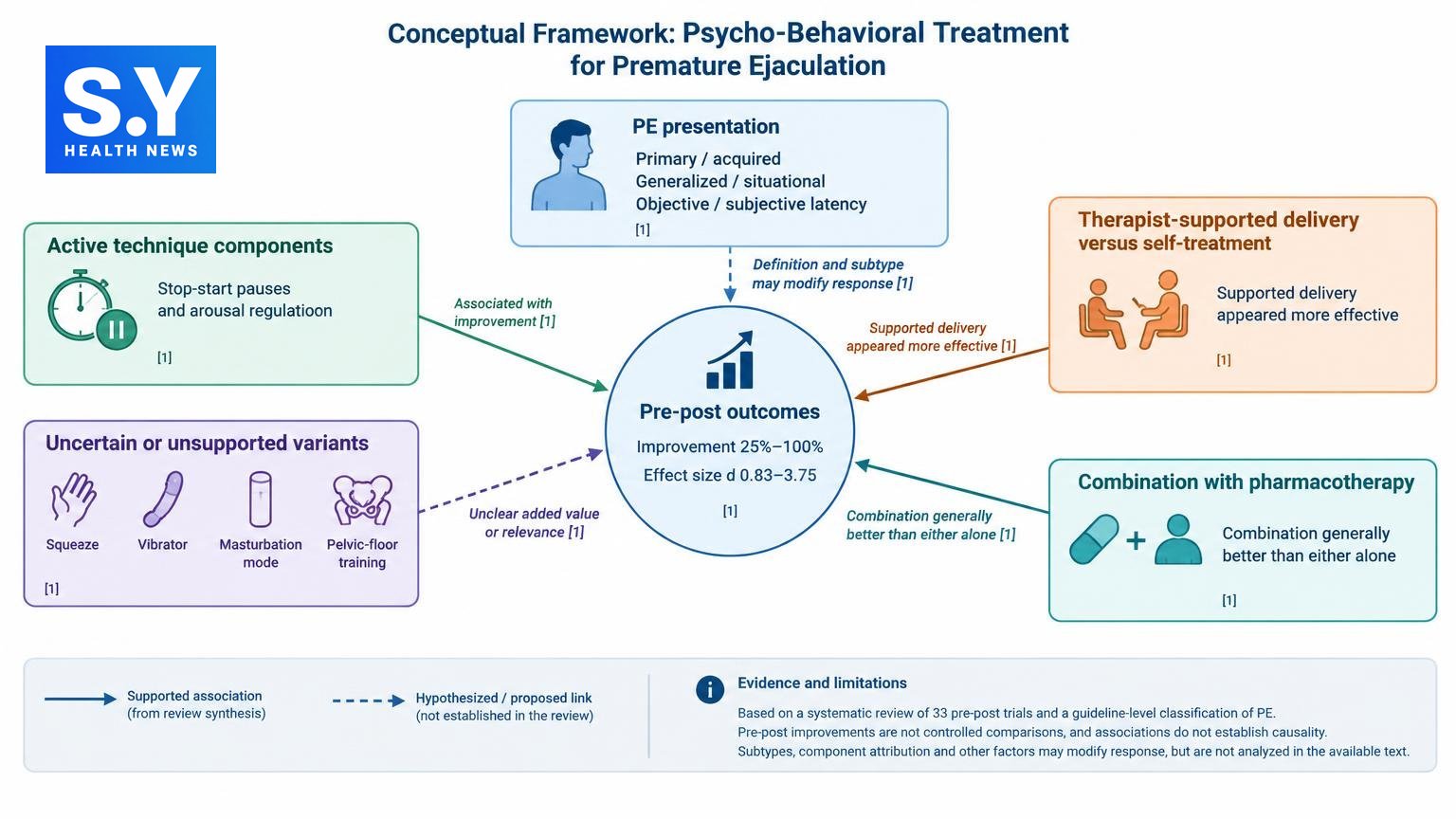
A systematic review of 33 trials reporting pre- and post-treatment measures of psycho-sexological (sex therapy) treatment for premature ejaculation (PE) concludes that several decades of empirical research support the usefulness of these approaches and specifies conditions for their effectiveness. The reported improvement rates ranged from 25% to 100%, with overall effect sizes (d) between 0.83 and 3.75. The review states that effectiveness requires penile stimulation exercises with pauses (stop-start) and/or exercises regulating discrete components of sexual arousal; that squeezing, vibratory devices or a particular masturbation mode have unclear added value; that pelvic-muscle strengthening appears largely irrelevant; that therapist-supported formats outperformed self-treatment; and that combining sex therapy with pharmacotherapy generally yielded better results than either alone.[1]
These are pre-to-post observations from heterogeneous trials, not pooled controlled comparisons. The very wide improvement and effect-size ranges signal substantial clinical and methodological heterogeneity. The review's component claims are best read as working hypotheses that require randomized, component-isolating designs. PE itself is defined by three criteria—rapid ejaculation, perceived lack of control and resulting distress—and is subtyped as primary or acquired, generalized or situational, and objective versus subjective latency, distinctions that plausibly modify treatment response but are not analyzed in the available text.
Why This Matters
Ejaculatory disorders, including PE and delayed ejaculation, are common conditions with substantial impact on men's quality of life and their relationships. A consensus review developed under the Fifth International Consultation on Sexual Medicine aims to present evidence-based recommendations for the definition, classification and treatment of these conditions; its keyword list covers lifelong and acquired PE, intravaginal ejaculatory latency time (IELT), dapoxetine, selective serotonin reuptake inhibitors (SSRIs), psychotherapy and penile hypersensitivity, indicating the topics it addresses, though the available abstract does not provide the recommendations themselves.[2]
The clinical stakes are practical. If specific technique components drive benefit, clinicians can focus on them and avoid burdening patients with unhelpful exercises. If therapist support matters, self-guided programs may underperform even when the same techniques are taught. If combination with pharmacotherapy is superior, sequencing decisions change. Each of these questions is addressed by the review, but with different levels of certainty.
How PE Is Defined and Subtyped
The review describes PE as meeting three criteria: an ejaculation that occurs quickly, that the man feels unable to control, and that thereby causes distress. It then describes at least two classification axes. First, the difficulty can be primary, appearing from the start of the person's sexually active life, or secondary/acquired, appearing after a period of reportedly normal function. Second, it can be generalized, occurring in all sexual situations including masturbation, or situational/variable, occurring only under certain conditions.
A third distinction uses average intravaginal latency. Primary and acquired PE are described as occurring within a maximum of 1 to 3 minutes of penetration, whereas so-called subjective PE most often shows penetration durations beyond 4 minutes, fairly similar to the general population. This subjective category is important for treatment trials: men who meet distress and control criteria but have latencies in the typical range may respond differently to latency-focused behavioral exercises than men with objectively short latencies.
These definitions come from guideline and review citations in the source, not from primary data in the review itself. The available text does not report how individual included trials operationalized PE, which is a material gap because heterogeneous definitions can produce heterogeneous response rates and inflate apparent effect ranges.
Biological and Clinical Mechanism
The review's mechanistic account is behavioral rather than neurobiological. It states that treatment effectiveness requires penile stimulation exercises with pauses, commonly called stop-start, and/or exercises aimed at regulating discrete components of sexual arousal, described as a regulatory or sexual-functional approach. The implied mechanism is that repeated exposure to escalating stimulation, interrupted before the ejaculatory threshold is reached, builds discrimination of arousal states and behavioral control over the transition to ejaculation.
The review does not support a pelvic-floor mechanism. Exercises focused on strengthening pelvic musculature do not appear particularly relevant, according to the review's hedged wording. This is notable because pelvic-floor training is sometimes presented as a conservative option for PE. The available text provides no quantitative comparison, so the statement should be read as the review authors' appraisal rather than a precise null result.
Separately, a 2019 doctoral thesis describes a newer line of cognitive-behavioral treatment using masturbation-aid devices, including a program called Sphincter Control Training (SCT). SCT is explicitly based on a new theory about managing the external urethral sphincter as a means of controlling ejaculation. That mechanistic basis is described as a theory, not an established pathway, and should not be conflated with the review's stop-start and arousal-regulation framework.[3]
What the Evidence Shows
The core evidence is a systematic review of 33 trials reporting pre- and post-sex-therapy measures. The reported improvement rates range from 25% to 100%, and overall effect sizes (d) fall between 0.83 and 3.75. Even the lower bound of that effect-size range is large by conventional standards, but the range itself, spanning more than fourfold, signals substantial clinical and methodological heterogeneity across trials. These are pre-post observations from heterogeneous trials, not pooled controlled comparisons, so the headline numbers should be read as directional signals rather than precise effect estimates.
| Construct | What the review reports | Interpretation and uncertainty |
|---|---|---|
| Pre-post improvement with sex therapy | Improvement rates 25% to 100%; overall effect size d 0.83 to 3.75 across 33 trials | Large and consistently positive direction, but pre-post designs without reported comparators can inflate apparent benefit; denominators per trial are not given in the available text. |
| Stop-start and arousal regulation | Review states effectiveness requires pause-based penile stimulation and/or regulation of discrete arousal components | Plausibly active components, but component attribution derives from a heterogeneous trial set rather than isolated head-to-head comparisons in the available text. |
| Squeeze, vibrator, masturbation mode | Uncertain whether these variants add effectiveness | Treat as unresolved; absence of demonstrated added benefit is not evidence of no effect. |
| Pelvic-muscle strengthening | Does not appear particularly relevant | Hedged appraisal without quantitative contrast in the available text; should not be over-read as a definitive null finding. |
| Therapist support versus self-treatment | Most effective treatments provided support for integrating principles and addressing associated difficulties; self-treatment appeared less effective | Delivery-format signal, not a randomized supported-versus-self-treatment comparison in the available text. |
| Combination with pharmacotherapy | Combining sex therapy and pharmacotherapy generally yielded better results than either alone | General review statement without comparative effect sizes in the available text; sequencing and durability remain unclear. |
On delivery, the review reports that the most effective treatments were those providing accompaniment aimed at optimizing patients' integration of therapeutic principles and addressing possible associated difficulties. Self-treatment formats appeared less effective by comparison. This is an important qualifier for digital and self-guided programs: teaching the same exercises may not reproduce the benefit of supported delivery, though the available text does not describe a randomized test of that contrast.
On combination, the review states that combining sex therapy and pharmacotherapy generally yields better results than either option alone. The available text does not report the comparative effect sizes, the specific drugs, the sequencing, or whether benefits persisted after discontinuation. The consensus-review literature lists dapoxetine, SSRIs and psychotherapy among its topics, indicating that pharmacotherapy is a central part of the contemporary management landscape, but the available abstract text does not provide recommendations.
A separate 2019 doctoral thesis reports a parallel-group randomized clinical trial in Spain testing the SCT program, with one group using a masturbation-aid device. The summary reports significant improvements in IELT, perceived control, sexual satisfaction and performance anxiety in the group that used the device to perform SCT. Effect magnitudes, sample size, follow-up and between-group contrasts versus other arms are not given in the available summary, so this should be treated as a promising but incompletely reported signal.
Interpretation and Limitations
The most important limitation is design. The 33 included trials reported pre- and post-treatment measures; the available text does not describe them as controlled comparisons. Pre-post improvement can reflect regression to the mean, natural fluctuation, expectancy, attention from a therapist, or concurrent pharmacotherapy, not only the specific behavioral techniques. The review's own wide improvement and effect-size ranges are consistent with this heterogeneity.
The second limitation is definitional. PE trials may enroll men with primary versus acquired, generalized versus situational, or objective versus subjective presentations. These groups plausibly differ in prognosis and in responsiveness to latency-focused exercises. The available text establishes that these distinctions exist in the literature but does not report how the included trials handled them, which limits any subgroup inference.
The third limitation concerns component attribution. The claim that stop-start and arousal regulation are required for effectiveness, and that squeeze, vibrator use or masturbation mode are of uncertain added value, is a synthesis-level judgment. Without factorial or dismantling designs reported in the available text, these statements identify plausible active ingredients rather than proven mechanisms. The same caution applies to the pelvic-floor finding, which is explicitly hedged.
The fourth limitation concerns the wider therapeutic context. A 2019 thesis states that since the 1990s psychological therapies have had an increasingly limited role in PE treatment and characterizes pharmacological treatment as first-line. That framing is a position statement from a thesis introduction, not a quantified finding, and guidance may have evolved since. It does, however, underscore why combination and delivery-format questions matter: if pharmacotherapy is the default, behavioral approaches must demonstrate added value, durability or tolerability advantages.
Finally, the available sources do not permit assessment of publication bias, trial quality, blinding, or the specific outcome instruments used across the 33 trials. These are standard concerns in behavioral intervention reviews and should temper enthusiasm for the headline effect sizes.
Research Outlook
The evidence supports several priorities. First, randomized trials with active comparators and adequate follow-up are needed to test whether stop-start and arousal-regulation exercises outperform credible control conditions and whether they outperform squeeze, vibrator-assisted or pelvic-floor variants. Second, dismantling studies should isolate therapist support from technique content, since the review's strongest delivery signal favors supported formats but does not establish that support is causal.
Third, trials should prespecify PE subtype and report outcomes by primary versus acquired and objective versus subjective presentation, so that responders can be identified rather than averaged. Fourth, combination studies should report sequencing, drug class, and durability after discontinuation to clarify whether behavioral treatment adds persistent benefit beyond pharmacotherapy alone.
Newer device-assisted programs such as SCT require independent replication in peer-reviewed reports with full between-group data. The 2019 thesis summary reports significant improvements in IELT and in perceived control, sexual satisfaction and performance anxiety for the device-assisted SCT group, but without effect magnitudes or comparator details in the available text, it remains a hypothesis-generating signal rather than a confirmed approach.
Consensus processes continue to address definition, classification and treatment of PE and delayed ejaculation, but the available abstract does not provide their recommendations, so no specific guidance can be attributed here. Future updates should be read for how they weigh psychotherapy against pharmacotherapy and combination therapy.
Key Takeaways
- The review analyzed 33 trials with pre- and post-sex-therapy measures and reported improvement rates from 25% to 100% and effect sizes (d) from 0.83 to 3.75.
- Stop-start penile stimulation and arousal-regulation exercises are described as necessary for effectiveness, while squeeze, vibrator, masturbation-mode and pelvic-floor variants are uncertain or largely irrelevant in the review's appraisal.
- Therapist-supported delivery appeared more effective than self-treatment, and combining sex therapy with pharmacotherapy generally outperformed either alone.
- PE classification includes primary versus acquired, generalized versus situational, and objective versus subjective latency, but the available text does not report how included trials handled these subtypes.
- The pre-post design base limits causal inference; component-level and delivery-format claims should be treated as hypotheses for randomized and dismantling studies rather than settled mechanisms.
Questions and Answers
What does the systematic review of psycho-behavioral treatment for premature ejaculation report?
It assembled 33 trials with pre- and post-sex-therapy measures. Improvement rates ranged from 25% to 100% and overall effect sizes (d) from 0.83 to 3.75. The authors conclude that decades of research support the usefulness of sex therapy for PE and specify conditions of effectiveness, but the pre-post design base and wide ranges limit causal inference and precision.
Which behavioral techniques for premature ejaculation appear active in the evidence review?
The review states that effectiveness requires penile stimulation exercises with pauses (stop-start) and/or exercises regulating discrete components of sexual arousal. Squeeze techniques, vibratory devices and particular masturbation modes have unclear added value, and pelvic-muscle strengthening appears largely irrelevant. These are synthesis-level judgments from heterogeneous trials, not isolated head-to-head comparisons in the available text.
Is therapist-supported sex therapy more effective than self-treatment for premature ejaculation?
The review reports that the most effective treatments provided therapist accompaniment to help patients integrate therapeutic principles and address associated difficulties, and that self-treatment formats appeared less effective. However, the available text does not describe a randomized supported-versus-self-treatment comparison, so this is a delivery-format signal rather than proof that support itself is causal.
How is premature ejaculation classified into primary (lifelong), acquired, generalized and situational types?
PE is described by three criteria: rapid ejaculation, perceived lack of control and distress. It can be primary (from the start of sexual activity) or secondary/acquired, and generalized (all situations including masturbation) or situational. A separate axis uses latency: primary and acquired PE occur within 1 to 3 minutes of penetration, while subjective PE often exceeds 4 minutes.
Does combining sex therapy with pharmacotherapy improve premature ejaculation more than either alone?
The review states that combining sex therapy and pharmacotherapy generally yields better results than either option alone. The available text does not report comparative effect sizes, specific drugs, sequencing, or whether benefits persist after discontinuation. Separately, a 2019 thesis characterizes pharmacotherapy as first-line, so the added value and durability of behavioral components remain open questions.
What are the main limitations of evidence on sex therapy for premature ejaculation?
The 33 trials reported pre-post measures, and the available text does not describe controlled comparators, so regression to the mean, expectancy and concurrent treatment may contribute to improvement. PE definitions and subtypes vary, component claims are not isolated in dismantling designs, and trial quality, blinding and publication bias cannot be assessed from the available sources. Headline effect sizes should be read as directional signals.
Conceptual framework: Conceptual framework, not a tested causal model. Nodes summarize constructs discussed in a systematic review of 33 pre-post trials of psycho-behavioral treatment for premature ejaculation, plus a guideline-level classification of PE. Supported edges reflect the review's synthesis; the subtype edge is proposed. Improvement ranges and effect sizes are pre-post observations without reported controlled comparators in the available text, so directions are not proof of causal effects.
Academic References & Evidence
- Revue systématique des essais consacrés aux traitements psycho-comportementaux de l’éjaculation prématurée.
- Contemporary consensus and emerging directions in premature and delayed ejaculation: recommendations from the 5th International Consultation on Sexual Medicine.. Sexual medicine reviews PMID: 42855438.
- RODRIGUEZ MARTINEZ, JESUS EUGENIO. Nuevo tratamiento cognitivo-conductual para la eyaculación precoz mediante el control del esfínter externo con dispositivo masturbatorio. 2019
SANYUN Science Center explains published research on men's reproductive and sexual health, connecting scientific evidence with everyday questions while making sources and limitations clear.
Disclaimer: This article is for scientific education and research communication only. It does not provide medical advice, diagnosis, or individualized treatment recommendations, and does not endorse any medication, supplement, device, penile enlargement procedure, or other intervention. Decisions about sexual and reproductive health should be made in consultation with a qualified healthcare professional. Do not delay seeking professional care because of information in this article.
Original Content & Copyright Notice
- This article is prepared for SANYUN Science Center, drawing on published research and publicly available academic literature on men’s sexual and reproductive health. Its editorial explanations and presentation are developed for this platform.
- Copyright in the original editorial content, selection, and arrangement is reserved by SANYUN Science Center to the extent protected by applicable law. Referenced research, quotations, and third-party materials remain subject to the rights of their respective owners. This notice does not claim ownership of scientific facts or third-party research.
- Except where permitted by applicable law or an applicable license, prior written permission is required to reproduce, republish, translate, adapt, redistribute, or commercially reuse protected content. Attribution alone does not grant permission for such reuse.
- For permitted quotation or authorized reuse, clearly identify the source and retain a link to the original article.
- Source: SANYUN Science Center
- Original URL: Retain the original article URL on science.san-yun.com.
- Copyright Holder: SANYUN Science Center, for its own protected editorial content.
- Quotation, excerpts, or authorized reuse must not distort the scientific meaning, omit material limitations or disclaimers, or imply unverified medical claims, product efficacy, or endorsement by SANYUN Science Center.



