


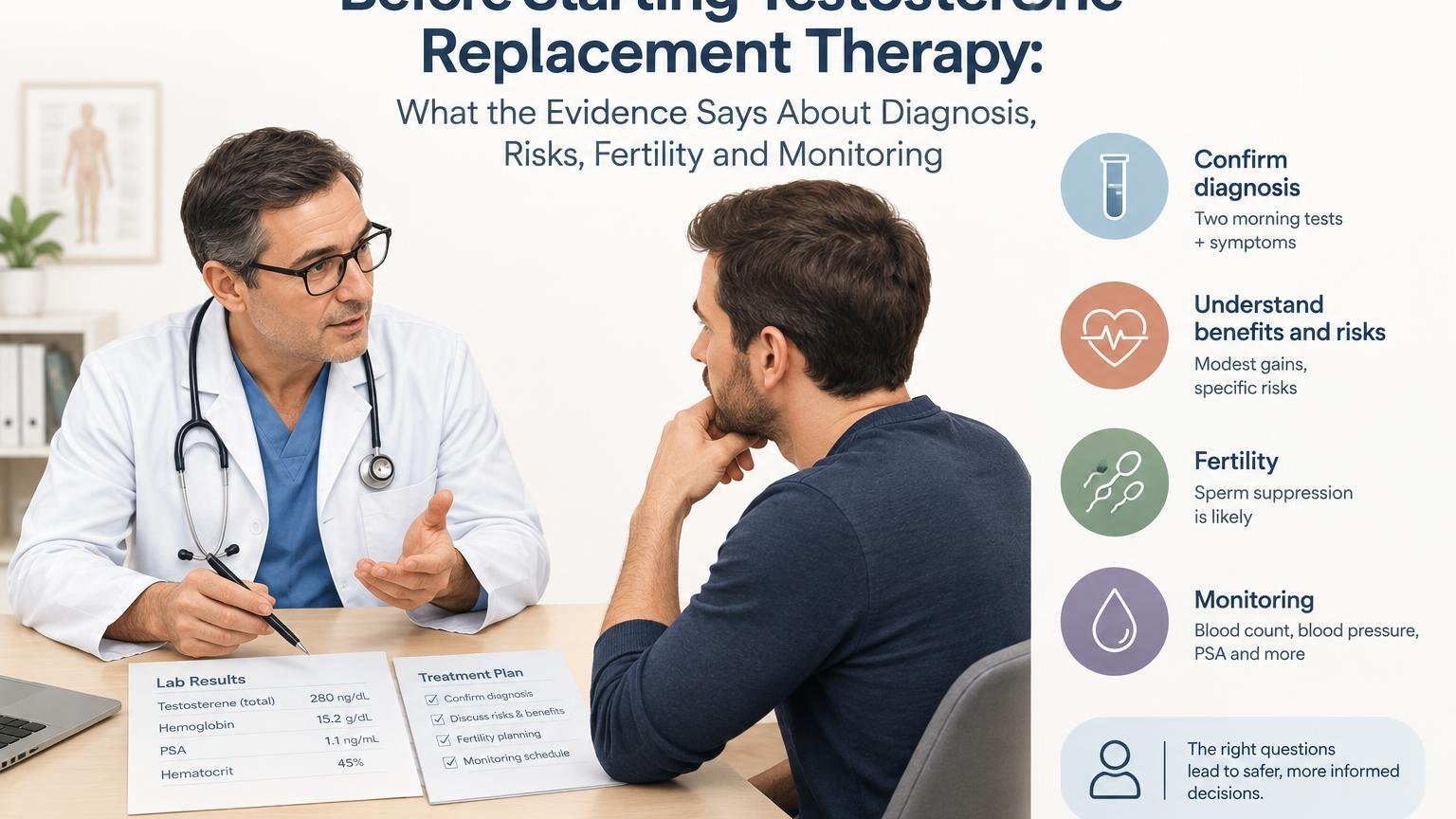


Category: Health Academy
Core Research Direction: Pre-TRT evaluation and monitoring: what a man should ask before starting testosterone replacement therapy, focused on diagnostic confirmation, risks, fertility, and monitoring
Search Intent: What should a man ask and understand before starting testosterone replacement therapy, and what does the available evidence actually support about benefits, risks, and fertility effects?
Platform: SANYUN Science Center
Evidence reviewed through: 2026-11-22
Executive Summary
A man considering testosterone replacement therapy is usually deciding two separate things at once: whether he actually has a confirmed testosterone deficiency, and whether a lifelong-style hormonal treatment with a specific risk and fertility profile suits his life. The clinical sources supplied for this explainer converge on an unglamorous answer — the quality of the pre-treatment evaluation matters more than the choice of formulation, because it determines whether the treatment is treating a diagnosis or a single number.[1]
The American Urological Association criteria, as reported in the supplied material, require symptoms or signs plus total testosterone below 300 ng/dL on two separate early-morning measurements. A single low value is treated as an inadequate basis for therapy, because levels fluctuate and some men fall within range on a repeat draw.[2]
The evidence base behind therapy is real but modest. A 2023 meta-analysis of about 2,000 older men with low testosterone found a small effect on strength (Hedges' g 0.21), fat mass fell by roughly 2 kg in one randomized trial, and libido and sexual activity improved with small effect sizes of 0.2–0.3 SMD, while erectile dysfunction did not improve.
Against those modest gains sit specific risks that monitoring is designed to catch: raised blood pressure, higher rates of atrial fibrillation, acute kidney injury and pulmonary embolism in the large TRAVERSE trial, and suppressed sperm production that varies between men and is not guaranteed to reverse.
Why This Matters
The supplied clinical communications describe a market that has grown faster than the standard of care within it. Therapy is easy to begin and easy to run badly, and the decisive difference between a managed protocol and a subscription service is visible mainly in what happens before the first prescription and after the first follow-up.[3][4]
That framing matters because testosterone is not a benign wellness supplement in regulatory terms. The supplied patient guide notes that it is a Schedule III controlled substance in the United States, so access is conditional and lawful rather than automatic, and that prescribing through telemedicine operates under a DEA extension effective through December 31, 2026 when conditions are met.
There is also a diagnostic trap. Testosterone declines gradually with age — about 1.6% per year in men aged 40–70 at enrollment in the Massachusetts Male Aging Study — which makes an age-related low value look like a disease and makes normal aging look treatable. The FDA has never approved testosterone for low levels caused solely by aging, according to the supplied guide.
For readers who want the broader trial evidence on confirmed hypogonadism, the accompanying analysis of baseline evaluation and downstream effects puts these questions in a fuller research context.
What Confirmation Should Look Like
The first question to ask is not which product is best but whether the diagnosis exists. The AUA criteria as reported require both a laboratory threshold — total testosterone below 300 ng/dL — and consistent symptoms or signs, measured on two separate early-morning samples. That combination separates a confirmed finding from an incidental number.
Morning timing is not a formality. Testosterone follows a daily rhythm, and the supplied clinic commentary warns that a single afternoon draw can place a normal man inside the treatment range. The patient guide makes the same point clinically: some men test low once and within range the next time, so a repeat draw is a check on the first, not a bureaucratic delay.
Beyond total testosterone, the supplied educational guide argues that free testosterone, SHBG and related markers deserve attention because total testosterone measures all circulating hormone, while free testosterone is the fraction unbound to proteins and available to tissues. SHBG rises with age, obesity and thyroid disease, binding testosterone and reducing what is available. This distinction is worth understanding, although the more expansive claims attached to it in commercial material should be treated cautiously.
A related question is whether something else is driving the low value. The clinic commentary lists sleep apnoea, obesity, thyroid disease and existing medications as common upstream causes, and notes that some men do not need replacement once those are addressed. The weight-loss data support the plausibility of that route: a meta-analysis of 24 studies reported average testosterone increases from baseline of about 83 ng/dL after low-calorie diets and 250 ng/dL after bariatric surgery in men with obesity, with larger weight loss linked to larger gains, and a 2003 Finnish study of 38 middle-aged men with a BMI over 35 found testosterone rose by about 80 ng/dL more than controls after roughly 14% body-weight loss.
What the Benefits and Risks Actually Are
The most useful framing for a prospective patient is that benefits are real, measurable and generally modest, while risks are specific enough to be monitored rather than vague enough to be dismissed. The table below draws only on the supplied evidence and keeps trial populations and timeframes attached to the numbers.
| Outcome | What the supplied evidence reports | Population and timeframe | Interpretation |
|---|---|---|---|
| Strength | Hedges' g of 0.21, a small effect | 2023 meta-analysis of about 2,000 older men with low testosterone | Small average benefit; not a guarantee for an individual |
| Body composition | Fat mass reduced by about 2 kg, lean mass increased by about the same | One randomized controlled trial without a weight-loss goal | Meaningful shift in composition, not a weight-loss drug |
| Libido and sexual activity | Small effect sizes of 0.2–0.3 SMD; erectile dysfunction did not improve | Reviewed studies of men on TRT | Desire may improve; erectile function is a different problem |
| Mood | Small mood and energy improvements overall; no significant mood benefit in moderately severe or severe depressive symptoms | TRAVERSE, over 5,000 men with low testosterone | Not a treatment for significant depression |
| Atrial fibrillation | 3.5% with testosterone versus 2.4% with placebo | TRAVERSE | A small absolute difference that matters at population scale |
| Fractures | 3.5% with testosterone versus 2.5% with placebo over about three years | Trial comparing testosterone and placebo | An unexpected direction; reinforces the need for monitoring |
| All-cause mortality | 5.5% with TRT versus 5.7% in controls, not statistically significant | TRAVERSE, over 5,000 men, average 2.8 years | No established longevity benefit |
| Sperm production | About 99% reduction in a six-month trial in men with normal baseline testosterone | Men with normal baseline testosterone | A large effect on fertility that belongs in the first conversation |
The regulatory picture has shifted in ways patients should know. In February 2025 the FDA removed the cardiovascular boxed warning after TRAVERSE but added a warning about increased blood pressure. TRAVERSE itself found no rise in major cardiac events overall, while the testosterone group had more pulmonary embolism, atrial fibrillation and acute kidney injury — a pattern that is reassuring on the primary endpoint and cautious on secondary ones.
Men should also be clear about what therapy does not do. It is not a substitute for erectile-dysfunction medication, and the mortality difference in TRAVERSE was not statistically significant, so no longevity benefit has been established.
Fertility: The Conversation That Belongs First
Exogenous testosterone suppresses the body's own signals to the testes and can substantially reduce sperm production. In a six-month trial in men with normal baseline testosterone, supplements reduced sperm counts by about 99%. Recovery happens for many men but is not assured: about two thirds recovered sperm production within six months of stopping and 90% within a year, while after longer treatment hormonal recovery can take over a year.
The mechanism is feedback suppression of the hypothalamic-pituitary-gonadal axis, which is why sperm effects are a predictable consequence of standard therapy rather than an idiosyncratic side effect. The effect nevertheless varies between individuals and is not guaranteed to reverse, which is the sentence that should shape the timing of the conversation.
Men who may want children — now or in ten years — should raise fertility before the first injection. The supplied sources mention hCG alongside testosterone or enclomiphene or clomiphene instead of it as options worth planning at the start rather than retrofitting later, and the detailed review of the hormonal feedback loop and preservation options explains why that sequencing matters.
Monitoring: What to Ask and How Often
Replacement is not set-and-forget. Testosterone increases red blood cell production, and in some men hematocrit rises above the normal range (polycythaemia), increasing blood viscosity; the supplied educational guide describes complete blood count monitoring at baseline and every 3–6 months as standard. A rising haematocrit calls for a dose adjustment and review, not reassurance.
Blood pressure belongs in the same conversation, given the labeling change described in the supplied material. Prostate monitoring is the third recurring theme: the supplied sources state that testosterone does not cause prostate cancer but can stimulate existing prostate tissue, including benign prostatic hyperplasia, so baseline PSA and a plan for abnormal results are part of a defensible protocol.
Two further practical questions are worth asking explicitly. First, how will success be judged — by validated symptom questionnaires as well as lab values, so that dose adjustment reflects how the man actually feels. Second, what happens if he stops after a long course, since recovery can take time and should be managed rather than left to the patient.
The target range cited in the supplied review is a total testosterone of 450–600 ng/dL, presented as a general goal rather than an individualized prescription. Readers who want more detail on the measurement itself can compare total versus free testosterone testing and why SHBG binding and repeat morning samples change interpretation.
Interpretation and Limitations
The evidence summarized here comes from secondary and commercial sources — patient guides, clinic blogs and an explainer review — not from the primary trials or guideline documents themselves. Guideline criteria, FDA labeling actions and DEA prescribing rules are reported second-hand and can change; the TRAVERSE findings are described without sample-size and follow-up detail beyond an average of 2.8 years for over 5,000 men.
Several claims in the supplied material are asserted rather than demonstrated. The suggestion that men above 300 ng/dL still benefit from treatment is a hypothesis stated without cited primary evidence, and the statement that the 300 ng/dL threshold is the lower limit of normal for young men sits alongside guideline criteria that require symptoms as well. Effect sizes are small to modest, and none of the supplied sources establishes causality for long-term outcomes such as mortality.
The literature is also not uniformly reassuring on prostate questions, where causality remains contested in the wider field, and the fertility data come from trials in men with normal baseline testosterone rather than from the men most likely to seek therapy. These gaps argue for cautious shared decision-making rather than confident promises in either direction.
Research Outlook
The most informative direction for future evidence is not another formulation but better characterization of who benefits. TRAVERSE provides reasonably robust short-to-medium-term safety data over an average of 2.8 years, yet the modest effect sizes on strength, body composition and libido suggest that symptom-level predictors of response remain poorly defined.
Fertility recovery after prolonged use, the comparative value of hCG or SERM co-treatment, and the long-term significance of hematocrit and blood-pressure changes are all areas where the supplied sources describe practice patterns more clearly than they describe outcomes. Men should expect that uncertainty to be acknowledged rather than resolved in a clinic brochure.
Key Takeaways
- A diagnosis requires symptoms plus total testosterone below 300 ng/dL on two separate early-morning measurements; a single low reading is not enough.
- Benefits are real but modest: small strength effects (Hedges' g 0.21), roughly 2 kg fat-mass reduction in one trial, and small libido gains without improvement in erectile dysfunction.
- TRAVERSE found no rise in major cardiac events overall but more atrial fibrillation (3.5% vs. 2.4%), acute kidney injury and pulmonary embolism, and no statistically significant mortality difference (5.5% vs. 5.7%).
- Exogenous testosterone can cut sperm counts by about 99% in six months; about two thirds of men recover within six months of stopping and 90% within a year, but reversal is not guaranteed.
- Ask how haematocrit, blood pressure, PSA and symptoms will be monitored and how often, and what the plan is if therapy is later stopped.
Questions and Answers
How is low testosterone confirmed before starting testosterone replacement therapy?
Guideline criteria as reported require symptoms or signs plus a total testosterone below 300 ng/dL on two separate early-morning measurements. A single low reading is not enough because levels fluctuate and some men test within range on a repeat draw. Morning timing matters because a single afternoon sample can misclassify a normal man.
How much do strength, body composition and libido actually improve on testosterone therapy?
Modest amounts. A 2023 meta-analysis of about 2,000 older men with low testosterone found a small strength effect (Hedges' g 0.21), one randomized trial reported fat mass falling by about 2 kg with a similar lean-mass gain, and libido and sexual activity improved with small effect sizes of 0.2–0.3 SMD. Erectile dysfunction did not improve.
What cardiovascular and safety risks does the TRAVERSE trial show for testosterone therapy?
TRAVERSE found no rise in major cardiac events overall, but the testosterone group had more atrial fibrillation (3.5% vs. 2.4%), acute kidney injury and pulmonary embolism. Fractures were also more common (3.5% vs. 2.5% over about three years). The mortality difference (5.5% vs. 5.7%) was not statistically significant, so no longevity benefit is established.
Does testosterone replacement therapy affect sperm count and fertility?
Yes, substantially. Exogenous testosterone suppresses the body's signals to the testes, and a six-month trial in men with normal baseline testosterone reported sperm counts reduced by about 99%. About two thirds of men recovered sperm production within six months of stopping and 90% within a year, but reversal is not guaranteed and can take over a year after longer treatment.
What blood tests and checks should be monitored during testosterone replacement therapy?
The supplied educational guide recommends complete blood count monitoring at baseline and every 3–6 months because testosterone raises red blood cell production and haematocrit can rise above normal. Blood pressure is flagged in the 2025 labeling change, and prostate monitoring is commonly discussed. Symptom questionnaires and periodic hormone levels also inform dose adjustment.
Is testosterone therapy approved for low testosterone caused by normal aging?
No. The FDA has never approved testosterone for low levels due solely to aging, according to the supplied guide. Testosterone declines gradually with age — about 1.6% per year in men aged 40–70 at enrollment in the Massachusetts Male Aging Study — but age-related decline is not by itself the diagnosis therapy is approved to treat.
Sources and References
- Questions To Ask Before Starting TRT: A Patient Guide.
- Crissman Loomis. Testosterone Therapy (TRT): Benefits, Risks, and Natural Boosters. 2026
- Dr. Ryan Ramos. Five questions to ask before you start TRT | Ageless Journal. 2026
- Questions to Ask Your TRT Provider Before Starting | SignalloomAI™. 2026
SANYUN Science Center explains published research on men's reproductive and sexual health, connecting scientific evidence with everyday questions while making sources and limitations clear.
Disclaimer: This article is for scientific education and research communication only. It does not provide medical advice, diagnosis, or individualized treatment recommendations, and does not endorse any medication, supplement, device, penile enlargement procedure, or other intervention. Decisions about sexual and reproductive health should be made in consultation with a qualified healthcare professional. Do not delay seeking professional care because of information in this article.
Original Content & Copyright Notice
- This article is prepared for SANYUN Science Center, drawing on published research and publicly available academic literature on men’s sexual and reproductive health. Its editorial explanations and presentation are developed for this platform.
- Copyright in the original editorial content, selection, and arrangement is reserved by SANYUN Science Center to the extent protected by applicable law. Referenced research, quotations, and third-party materials remain subject to the rights of their respective owners. This notice does not claim ownership of scientific facts or third-party research.
- Except where permitted by applicable law or an applicable license, prior written permission is required to reproduce, republish, translate, adapt, redistribute, or commercially reuse protected content. Attribution alone does not grant permission for such reuse.
- For permitted quotation or authorized reuse, clearly identify the source and retain a link to the original article.
- Source: SANYUN Science Center
- Original URL: Retain the original article URL on science.san-yun.com.
- Copyright Holder: SANYUN Science Center, for its own protected editorial content.
- Quotation, excerpts, or authorized reuse must not distort the scientific meaning, omit material limitations or disclaimers, or imply unverified medical claims, product efficacy, or endorsement by SANYUN Science Center.



