




Category: Health Academy
Core Research Direction: Patient-facing questions and clinical prerequisites before initiating testosterone replacement therapy for adult men with suspected hypogonadism, as framed by clinic education sources citing the AUA guideline
Search Intent: What should a man confirm and discuss with a clinician before starting testosterone replacement therapy?
Platform: SANYUN Science Center
Evidence reviewed through: 2026-11-21
Executive Summary
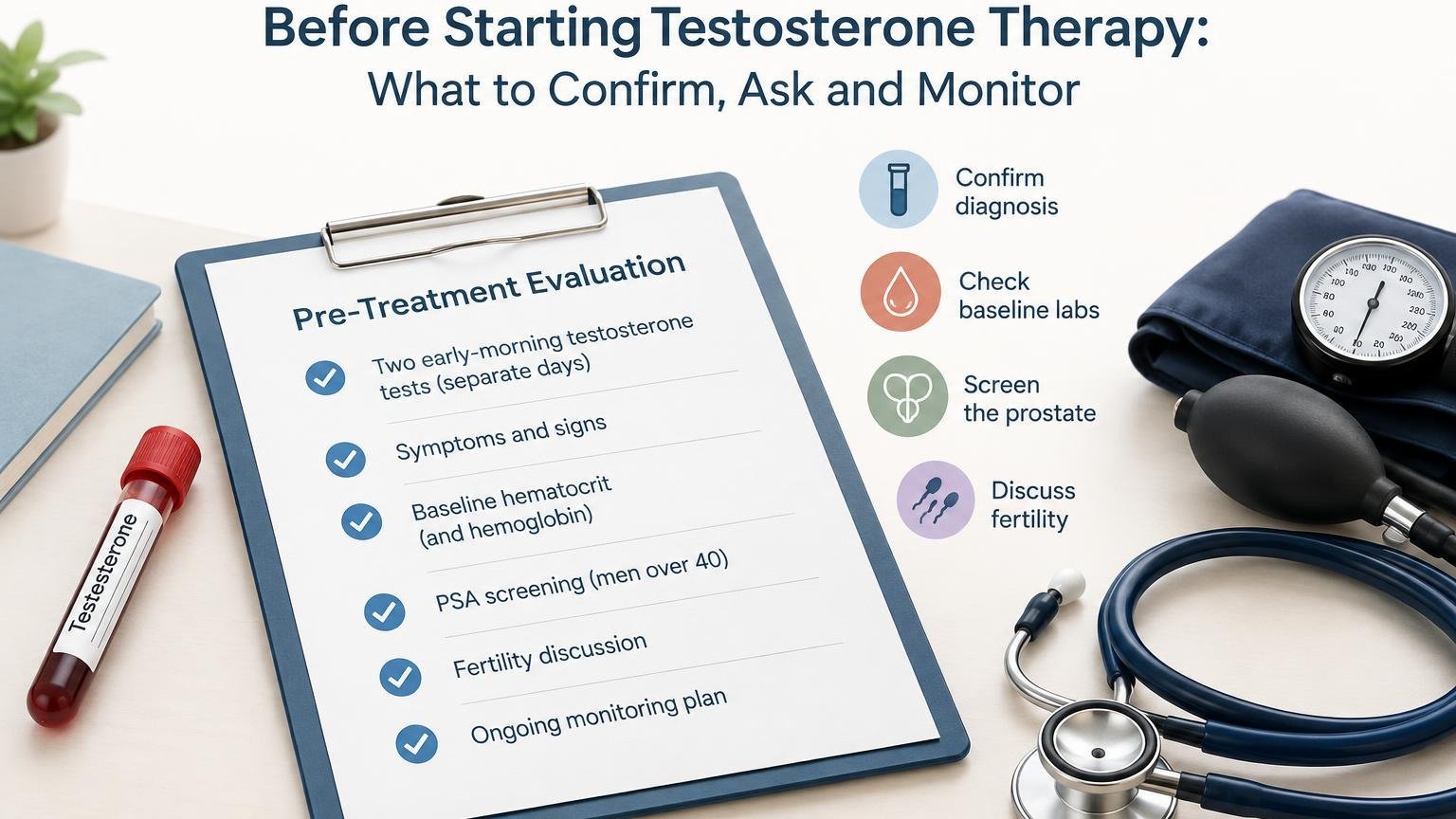
Testosterone replacement therapy is treatment for diagnosed hypogonadism, not a general tune-up for aging or fatigue. The clinic education sources reviewed here, several of which quote the American Urological Association guideline directly, converge on a similar pre-treatment sequence: confirm a low total testosterone on two separate early-morning blood draws, insist that symptoms accompany the number, look for a cause, record baseline hemoglobin and hematocrit, check PSA in men over 40, and discuss fertility before the first dose rather than after.[1][2]
The same sources also draw a sharper line around what therapy may and may not deliver. Benefits supported in guideline summaries include sexual function, bone mineral density and lean mass, while the evidence is described as inconclusive for energy, fatigue and broader quality of life. Cardiovascular labeling changed after the TRAVERSE trial, but the underlying trial population was restricted and secondary harms deserve attention.[3]
This article is an educational evidence review of patient-facing and clinic education material, not a new clinical study and not a systematic review. The primary AUA guideline text, FDA labeling and the original trials were not supplied; the summaries here should be read with that limitation in mind.
Why This Matters
Testosterone is a Schedule III controlled substance and a legally classified anabolic steroid. That framing matters for two reasons: access is regulated, and the difference between replacement and misuse is purpose, dose and monitoring rather than the molecule itself. Under a DEA extension effective through December 31, 2026, providers can prescribe via telemedicine without a prior in-person visit when conditions are met, which makes the quality of the remote evaluation more important, not less.
Men frequently arrive at a first consultation with a single number and no framework for judging it. The clinic sources describe a familiar commercial pattern: same-day labs, immediate results and a protocol before the patient leaves. One author argues that a single visit physically contains one morning and therefore one draw, which cannot satisfy a two-morning requirement. That is an argument about business models rather than a formal audit of clinic practice, but it identifies a real structural tension worth understanding.
The stakes are practical. Hematocrit can rise on therapy and requires evaluation, fertility can be suppressed and is not guaranteed to recover, and stopping treatment is not always a trivial decision because endogenous signaling is suppressed while exogenous testosterone is used. Each of those realities is easier to plan for before a prescription than afterward.
Mechanism: Why the Diagnosis Is Harder Than One Number
Testosterone is not a static value. It peaks roughly between 3am and 8am, and the sourced summary states that 32 to 39 percent of the day's total decline happens within the first thirty minutes of waking. By 4pm, men aged 30 to 40 are reported to measure 20 to 25 percent lower than at 8am, while men around 70 drop only about 10 percent. An afternoon draw in a younger man can therefore look deficient when he is not.
Assay variability compounds the problem. One source, quoting the AUA's own review, reports that repeat measurements in the same man can fluctuate 65 to 153 percent between tests depending on the assay used. That range is wide enough to explain why a single low reading cannot carry a diagnosis, and why retesting at the same laboratory with the same method is a reasonable question for a patient to ask.
Physiology also determines what replacement does downstream. Exogenous testosterone suppresses LH and FSH, reduces intratesticular testosterone, decreases sperm production and can reduce testicular volume. This is the same feedback loop that makes fertility a pre-treatment conversation: the treatment is not merely adding hormone, it is signaling the body to stop making its own.
What the Evidence and Guideline Summaries Require
Across the sources, the diagnostic standard is described consistently: low total testosterone on two separate early-morning measurements, combined with symptoms and/or signs. One source characterizes the two-draw statement as a Strong Recommendation at Grade A, and separately characterizes the below-300 ng/dL cutoff as a Moderate Recommendation at Grade B. That grading distinction is useful because it tells patients which part of the framing is firmer and which is a decision point rather than a biological boundary.
| Pre-treatment element | What the sourced guideline summary specifies | Why it matters for the patient conversation |
|---|---|---|
| Diagnostic confirmation | Two total testosterone measurements on separate occasions, both early morning, with symptoms or signs present | A single draw, especially an afternoon one, cannot support a diagnosis on its own |
| Threshold interpretation | Total testosterone below 300 ng/dL described as a reasonable cutoff, graded as a moderate recommendation | A number near the line is not self-interpreting; symptoms and repeat testing carry weight |
| Baseline blood count | Hemoglobin and hematocrit measured, with polycythemia risk discussed, before therapy is offered | Establishes a starting point for a risk that therapy can worsen; polycythemia described as hematocrit above 52 percent |
| Prostate screening | PSA measured in men over 40 before commencing therapy to exclude an existing prostate cancer diagnosis | Screening before starting, not because therapy is described as causing prostate cancer |
| Fertility discussion | Long-term impact of exogenous testosterone on spermatogenesis discussed with patients interested in future fertility | Framed as a strong recommendation; planning is easier before exposure than after |
| Cause investigation | Low testosterone may reflect testicular, pituitary or hypothalamic problems, or reversible factors such as sleep apnea, excess body fat, opioid or heavy alcohol use | Some men do not need replacement once an underlying cause is addressed |
Obesity appears in the sourced summaries as a strong association rather than a proven cause: the AUA is described as citing obese men as almost five times more likely to have low testosterone than non-obese men, with an odds ratio of 4.89. An odds ratio of that size in observational data cannot establish direction. Weight change, sleep apnea treatment and review of contributing medications are nonetheless reasonable things to discuss before committing to lifelong replacement.
The prostate question deserves particular care because it is easily misread in both directions. The sourced guideline language recommends PSA before commencement in men over 40 to exclude a prostate cancer diagnosis, and separately states that clinicians should inform patients of the absence of evidence linking testosterone therapy to the development of prostate cancer. In plain terms, the test exists to avoid starting therapy in someone who already has an undiagnosed cancer, not because replacement is established as a cause.
Benefits, Harms and the Cardiovascular Picture
The AUA list of outcomes therapy may improve, as quoted by one source, covers erectile function, low sex drive, anemia, bone mineral density, lean body mass and depressive symptoms. Separately, the same summary states the evidence is inconclusive for cognitive function, diabetes measures, energy, fatigue, lipid profiles and quality of life. That second list includes the symptoms that most often prompt a consultation, which is why realistic expectation-setting is a clinical skill rather than a marketing courtesy.
The Testosterone Trials, described as studying men aged 65 and older with low testosterone, improved sexual function but did not significantly improve the primary vitality outcome. The population restriction matters: these were older men with documented low testosterone, and the result does not license generalization to younger men seeking performance or energy gains.
On cardiovascular safety, the TRAVERSE trial is reported to have found testosterone gel noninferior to placebo for its primary major cardiovascular endpoint in middle-aged and older men with confirmed hypogonadism and existing or elevated cardiovascular risk. In February 2025, the FDA is described as having removed the cardiovascular boxed warning and added a warning about increased blood pressure. The same summary notes more pulmonary embolism, atrial fibrillation and acute kidney injury in the testosterone group. Noninferiority on a primary endpoint and a clean safety profile are not the same claim.
Regulatory status is a separate thread. The FDA has never approved testosterone for low levels due solely to aging, and the February 2025 labeling retained that limitation. Age-related decline is therefore a reason to test when symptoms are present, not an indication in itself.
Monitoring and the Fertility Conversation
Monitoring is described as the safety plan rather than an optional add-on. Hematocrit is the parameter most consistently emphasized: testosterone can raise it, a significant elevation requires clinical evaluation, and management may involve a dose, schedule or formulation change, or a pause in treatment. One clinician author suggests quarterly checks as a reasonable cadence and frames a rising hematocrit as requiring a dose change rather than reassurance. That cadence is an author's opinion in the supplied text and is not derived from a cited trial.[4]
Fertility counseling is framed as a strong recommendation at the highest confidence grade. Exogenous testosterone can suppress the body's own signals to the testes and may reduce sperm production, and the effect varies between individuals and is not guaranteed to reverse. For a man actively trying to conceive, standard replacement is generally described as not the appropriate first treatment, and options such as hCG or selective estrogen receptor modulators may be discussed depending on the diagnosis.
Discontinuation belongs in the same early conversation. Because exogenous testosterone generally suppresses endogenous signaling while it is used, symptoms may return if treatment stops and recovery of natural production varies. This is a reason to plan stopping or adjusting with the prescribing clinician rather than abruptly, and a reason to treat the decision as more than a short experiment.
Interpretation and Limitations
The sources reviewed here are commercial clinic education articles, not the primary guideline, the FDA label or the original trial reports. Several quote guideline statements accurately in tone and grading, but the underlying document was not supplied for verification, and the primary studies behind the variability and circadian figures are not described in enough detail to assess their methods. Numerical values in this article are therefore restatements of secondhand summaries.
There are also internal tensions worth naming. One source quotes a below-300 ng/dL cutoff as a moderate recommendation, another describes the same threshold as a reasonable cutoff that is not a diagnosis by itself. Both can be true, but the emphasis differs, and a reader should treat the threshold as a decision aid rather than a biological line. Similarly, quarterly hematocrit monitoring is presented as reasonable clinical practice rather than a measured finding.
Finally, the clinic sources have obvious commercial interests, and some include pricing and program promotion. Their descriptions of guideline requirements are the useful part; their product framing should be separated from the evidence. Associations such as the obesity odds ratio are observational and cannot establish that weight loss will normalize testosterone or resolve symptoms in any individual man.
Research Outlook
Several open questions recur across the sources. Which men with borderline values and overlapping symptoms, such as sleep apnea or depression, actually benefit from replacement remains incompletely characterized. The long-term reversibility of sperm suppression after prolonged exposure is described as variable rather than quantified. And the practical question of how telehealth-first prescribing, under the current regulatory extension, affects diagnostic rigor has not been studied in the supplied material.
For readers, the useful research posture is to ask for the study name, the population and the endpoint whenever a claim is made. Noninferiority on a cardiovascular endpoint, improvement in sexual function in older men, and inconclusive evidence on fatigue are three different statements that are often blended in marketing.
Key Takeaways
- Confirm low testosterone on two separate early-morning total testosterone measurements, with symptoms present, before accepting a diagnosis.
- Treat the 300 ng/dL threshold as a moderate-strength decision point, not a self-interpreting diagnosis.
- Ask for baseline hemoglobin and hematocrit before therapy and PSA before therapy if you are over 40.
- Raise fertility plans at the first conversation; sperm suppression is expected with exogenous testosterone and reversal is not guaranteed.
- Separate supported benefits from unproven ones: sexual function and body composition appear on the first list, energy and fatigue on the inconclusive list.
- Understand the cardiovascular update precisely: noninferiority in a restricted trial population, a removed boxed warning and a new blood pressure warning can coexist.
Questions and Answers
Why do I need two testosterone tests before starting TRT?
The sourced AUA guideline summary recommends confirming low testosterone only after two total testosterone measurements on separate occasions, both drawn early in the morning, accompanied by symptoms. Single readings are unreliable because of circadian rhythm, assay differences and within-person variability, which one source reports can span 65 to 153 percent between tests depending on the assay.
Is a total testosterone below 300 ng/dL enough to diagnose low testosterone?
No. The 300 ng/dL level is described as a reasonable cutoff supporting diagnosis and as a moderate-strength recommendation, not a diagnosis by itself. Diagnosis requires the low level combined with symptoms or signs. Values near the threshold need interpretation in context, and repeat morning testing is used to confirm the finding before treatment is considered.
What blood tests and checks come before a first testosterone prescription?
The sourced guideline summaries describe hemoglobin and hematocrit measured before therapy is offered, with polycythemia risk discussed, and PSA measured in men over 40 before commencing therapy to exclude an existing prostate cancer diagnosis. Fertility counseling is also framed as a pre-treatment requirement for men interested in future children, alongside confirmatory morning testosterone testing.
How does testosterone therapy affect sperm production and fertility?
Exogenous testosterone can suppress LH and FSH, reduce intratesticular testosterone, decrease sperm production and reduce testicular volume. The effect varies between men and is not guaranteed to reverse. For men actively trying to conceive, standard replacement is generally described as not the appropriate first treatment, and alternatives may be discussed depending on the diagnosis.
How strong is the evidence that TRT improves energy and fatigue?
Weak, according to the sourced guideline summary. Outcomes therapy may improve include erectile function, low sex drive, anemia, bone mineral density, lean mass and depressive symptoms, while the evidence is described as inconclusive for cognitive function, diabetes measures, energy, fatigue, lipid profiles and quality of life. The Testosterone Trials improved sexual function in men 65 and older but not the primary vitality outcome.
What changed about testosterone cardiovascular warnings after the TRAVERSE trial?
In February 2025 the FDA is described as removing the cardiovascular boxed warning and adding a blood pressure warning. TRAVERSE found testosterone gel noninferior to placebo for its primary major cardiovascular endpoint in men with confirmed hypogonadism and existing or elevated cardiovascular risk, while the testosterone group saw more pulmonary embolism, atrial fibrillation and acute kidney injury. Noninferiority is not proof of no risk.
Sources and References
- Questions To Ask Before Starting TRT: A Patient Guide.
- Ashley Harwyn. What to Ask a Men's Clinic Before TRT | Solcara Health. 2026
- Timothy W. Mackey. Is TRT Worth It? 15 Questions to Ask Before Starting.
- Ryan Ramos. Five questions to ask before you start TRT | Ageless Journal. 2026
SANYUN Science Center explains published research on men's reproductive and sexual health, connecting scientific evidence with everyday questions while making sources and limitations clear.
Disclaimer: This article is for scientific education and research communication only. It does not provide medical advice, diagnosis, or individualized treatment recommendations, and does not endorse any medication, supplement, device, penile enlargement procedure, or other intervention. Decisions about sexual and reproductive health should be made in consultation with a qualified healthcare professional. Do not delay seeking professional care because of information in this article.
Original Content & Copyright Notice
- This article is prepared for SANYUN Science Center, drawing on published research and publicly available academic literature on men’s sexual and reproductive health. Its editorial explanations and presentation are developed for this platform.
- Copyright in the original editorial content, selection, and arrangement is reserved by SANYUN Science Center to the extent protected by applicable law. Referenced research, quotations, and third-party materials remain subject to the rights of their respective owners. This notice does not claim ownership of scientific facts or third-party research.
- Except where permitted by applicable law or an applicable license, prior written permission is required to reproduce, republish, translate, adapt, redistribute, or commercially reuse protected content. Attribution alone does not grant permission for such reuse.
- For permitted quotation or authorized reuse, clearly identify the source and retain a link to the original article.
- Source: SANYUN Science Center
- Original URL: Retain the original article URL on science.san-yun.com.
- Copyright Holder: SANYUN Science Center, for its own protected editorial content.
- Quotation, excerpts, or authorized reuse must not distort the scientific meaning, omit material limitations or disclaimers, or imply unverified medical claims, product efficacy, or endorsement by SANYUN Science Center.



