




Category: Reproductive Care
Core Research Direction: Radiant heat exposure and reversible changes in semen quality among alloyed steel welders
Search Intent: Does moderate occupational exposure to radiant heat (welding) measurably affect sperm count, sperm shape, and sex hormone levels in men?
Platform: SANYUN Science Center
Evidence reviewed through: 2026-11-23
Executive Summary
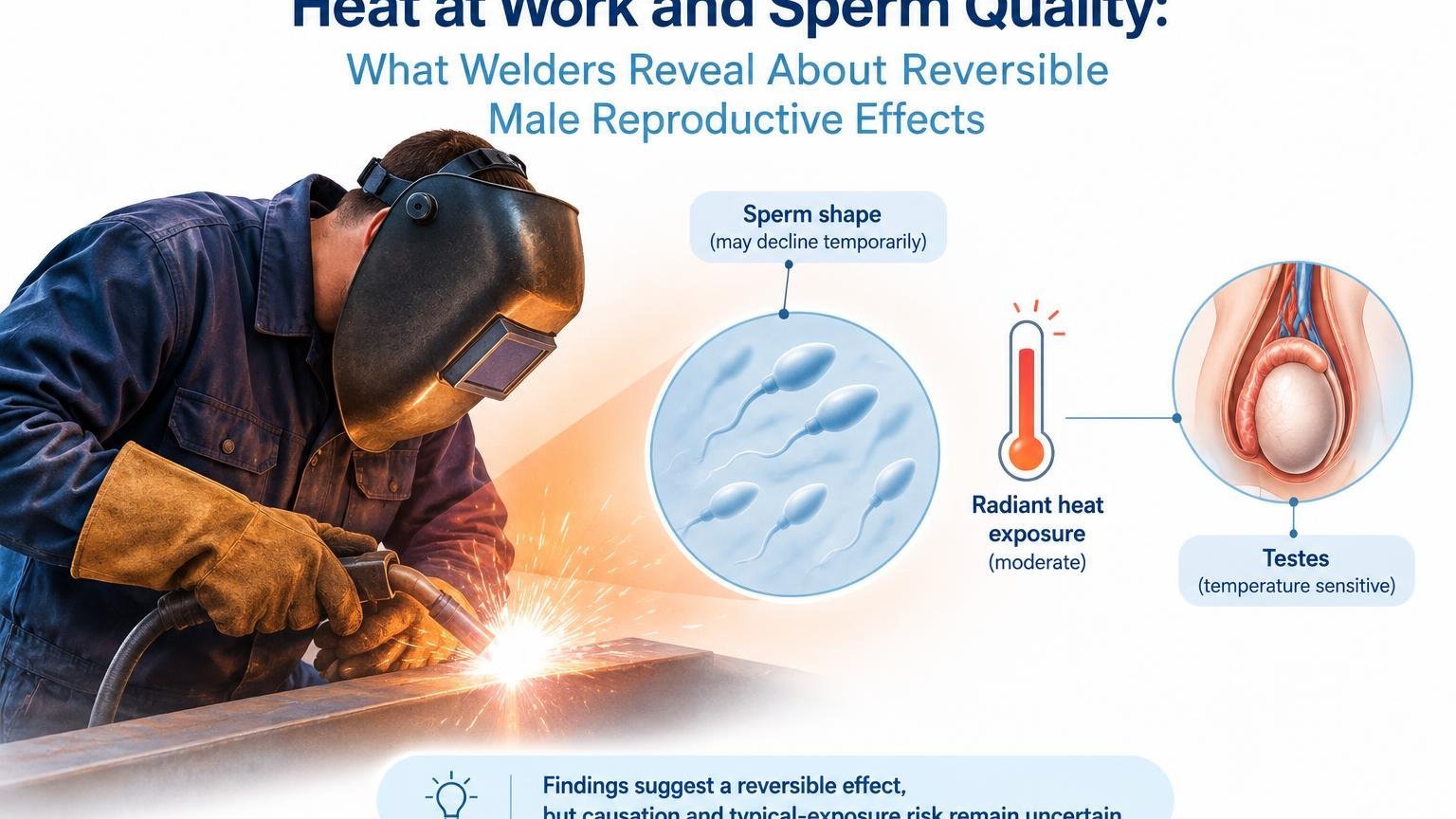
A small occupational study examined semen quality and sex hormone concentrations in 17 manual metal arc alloyed steel welders who had moderate radiant heat exposure but no substantial exposure to welding fume toxicants. Globe temperatures during work ranged from 31.1 to 44.8 °C, and groin skin temperature rose by an average of 1.4 °C during heat exposure.[1]
The clearest finding was within the welders themselves: the proportion of sperm with normal shape declined significantly after six weeks of heat exposure and increased after a break. Sperm count, motile sperm count and sperm concentration showed similar patterns of change, but the changes were not statistically significant. No consistent changes in sex hormone concentrations were found. The authors interpreted the results as suggesting a reversible decrease in semen quality most likely caused by moderate radiant heat exposure of about five hours a day over several weeks.
The study is old, small and observational, so it cannot prove that heat caused these changes or quantify risk for welders generally. Its main value is mechanistic and hypothesis-generating: it points to a plausible pathway by which sustained occupational heat could transiently affect sperm production, while leaving open whether lower, everyday exposure levels matter for fertility.
Why This Matters
Semen analysis is a central part of male fertility assessment, and sperm production is known to be sensitive to temperature. Occupational heat is therefore an intuitive concern for men who work in hot environments. The welder study is often cited because it was designed to separate heat from welding fume, a distinction that matters when trying to understand which exposure might be responsible for any reproductive effect.
The study also matters because the welders investigated were more exposed to radiant heat than welders in general. That makes the group a useful 'high-exposure' model for studying heat effects, but it also limits what can be said about typical welding work or about lower-level heat exposure in other occupations.
Biological and Clinical Mechanism
Sperm are produced in the testes at a temperature slightly below core body temperature, and sustained heat exposure is a recognized experimental stressor for spermatogenesis. The welder study measured a modest rise in groin skin temperature during heat exposure, which is consistent with a local thermal load reaching the scrotal area.
The timing of the observed changes is biologically coherent. Spermatogenesis takes weeks, so an effect appearing after six weeks of exposure and reversing after a break fits a process that disrupts sperm maturation rather than one that permanently damages the testis. The study's own interpretation emphasizes reversibility and moderate exposure of about five hours a day over several weeks, but this remains a hypothesis rather than a demonstrated causal mechanism.
What the Evidence Shows
| Outcome | What the study reported | Statistical status and interpretation |
|---|---|---|
| Groin skin temperature | Rose by 1.4 °C on average during heat exposure (SE ±0.72 °C) | Observed physiological change within the study group |
| Sperm shape | Proportion of normally shaped sperm declined significantly after six weeks of heat exposure and increased after a break | Statistically significant intraindividual change; small sample and no concurrent unexposed control for this trend |
| Sperm count and motile sperm count | Non-significantly reduced among welders compared with two reference groups | Between-group difference not statistically significant |
| Sperm count and concentration across exposure | Same intraindividual pattern as sperm shape, but changes were not statistically significant | Suggestive trend only; cannot be distinguished from chance |
| Sex hormones | No consistent changes in concentrations | Null finding; small sample limits ability to detect small shifts |
The pattern across outcomes is important. The only statistically significant change was in sperm shape within the welder group over time. Sperm count measures moved in the same direction but did not reach conventional statistical significance, and hormone levels did not show a consistent signal. That combination is more consistent with a modest, transient seminal effect than with a broad hormonal disruption.
Interpretation and Limitations
The headline claim that heat caused a reversible decline in semen quality is an interpretation, not a direct observation. The study was observational, the sample was small, and the within-person exposure analysis lacked a concurrent unexposed comparison group for the time trend. Changes in sperm shape could reflect seasonal variation, sampling timing, laboratory factors or other unmeasured influences.
Generalizability is another constraint. The welders studied had higher radiant heat exposure than welders in general, so the results do not establish that typical welding conditions affect semen quality. Whether lower exposure levels in the broader welder population have any impact on semen quality or fertility remains to be established.
The absence of consistent hormone changes does not rule out a local testicular effect, because hormones measured in blood can remain stable while sperm production is stressed. Equally, a non-significant sperm count change should not be read as proof of no effect; small studies are often underpowered to detect modest differences.
Research Outlook
The welder study raises a testable question rather than settling it. Useful next steps would include larger occupational cohorts, repeated semen analyses with standardized timing, direct measures of scrotal temperature, and comparison groups with clearly characterized heat exposure. Such designs could clarify whether the sperm shape change is reproducible and whether lower exposure levels carry any measurable risk.
For now, the study is best understood as early evidence supporting a reversible thermal effect on semen quality in a highly exposed group. It does not provide a basis for predicting an individual welder's fertility, and it does not show that welding causes permanent reproductive harm.
Key Takeaways
- In 17 alloyed steel welders with moderate radiant heat exposure, the proportion of normally shaped sperm fell significantly after six weeks and rose after a break.
- Sperm count, motile sperm count and concentration showed similar but non-significant patterns, while sex hormones showed no consistent changes.
- The authors interpreted the findings as a likely reversible heat effect from about five hours of exposure a day over several weeks, but causation was not established.
- The welders studied were more heat-exposed than welders in general, so effects at lower, typical exposure levels remain unknown.
Questions and Answers
How might radiant heat exposure affect sperm quality in welders?
Sperm production occurs in the testes at slightly below core body temperature, so sustained local heat is a plausible stressor. In the welder study, groin skin temperature rose by an average of 1.4 °C during heat exposure, and the proportion of normally shaped sperm declined after six weeks before rising after a break. This supports a reversible thermal hypothesis, but the observational design cannot prove causation.
What did the welder study find about sperm count and sperm shape?
The clearest finding was a significant decline in the proportion of normally shaped sperm after six weeks of heat exposure, followed by an increase after a break. Sperm count, motile sperm count and concentration showed similar within-person patterns, but these changes were not statistically significant, and comparisons with two reference groups were also non-significant.
Did welding heat change sex hormone levels in the study?
No consistent changes in sex hormone concentrations were found among the welders. This null result does not exclude a local testicular effect, because blood hormone levels can remain stable while sperm production is under thermal stress. The small sample also limits the ability to detect small hormone shifts.
How strong is the evidence that heat causes reversible semen changes in welders?
The evidence is suggestive but limited. It comes from one small observational study of 17 welders, with a statistically significant within-person change in sperm shape but non-significant changes in sperm counts and no consistent hormone signal. Without a concurrent unexposed control for the time trend, the findings support a hypothesis rather than establish a causal relationship.
Do these findings apply to welders with typical, lower heat exposure?
Probably not directly. The welders studied had higher radiant heat exposure than welders in general, so the results describe a relatively high-exposure group. Whether lower exposure levels typical of the broader welder population affect semen quality or fertility remains to be established, and no data in the study address that question.
What should a welder concerned about fertility understand from this research?
The study suggests that sustained moderate heat exposure may transiently affect sperm shape, with recovery after exposure ends, but it does not show permanent harm or predict any individual's fertility. A welder with fertility concerns should discuss exposure, symptoms and semen testing with a clinician rather than rely on this single small study for personal risk estimates.
Sources and References
- J P Bonde. Main menu. British Journal of Industrial Medicine. 1992 49(1):5
SANYUN Science Center explains published research on men's reproductive and sexual health, connecting scientific evidence with everyday questions while making sources and limitations clear.
Disclaimer: This article is for scientific education and research communication only. It does not provide medical advice, diagnosis, or individualized treatment recommendations, and does not endorse any medication, supplement, device, penile enlargement procedure, or other intervention. Decisions about sexual and reproductive health should be made in consultation with a qualified healthcare professional. Do not delay seeking professional care because of information in this article.
Original Content & Copyright Notice
- This article is prepared for SANYUN Science Center, drawing on published research and publicly available academic literature on men’s sexual and reproductive health. Its editorial explanations and presentation are developed for this platform.
- Copyright in the original editorial content, selection, and arrangement is reserved by SANYUN Science Center to the extent protected by applicable law. Referenced research, quotations, and third-party materials remain subject to the rights of their respective owners. This notice does not claim ownership of scientific facts or third-party research.
- Except where permitted by applicable law or an applicable license, prior written permission is required to reproduce, republish, translate, adapt, redistribute, or commercially reuse protected content. Attribution alone does not grant permission for such reuse.
- For permitted quotation or authorized reuse, clearly identify the source and retain a link to the original article.
- Source: SANYUN Science Center
- Original URL: Retain the original article URL on science.san-yun.com.
- Copyright Holder: SANYUN Science Center, for its own protected editorial content.
- Quotation, excerpts, or authorized reuse must not distort the scientific meaning, omit material limitations or disclaimers, or imply unverified medical claims, product efficacy, or endorsement by SANYUN Science Center.



