




Category: Latest Research
Core Research Direction: Early single-surgeon safety, device survival and patient satisfaction for the Rigicon Infla10 inflatable penile prosthesis
Search Intent: In a single surgeon's first patients receiving the newer Infla10 inflatable penile prosthesis, what early complication, revision and satisfaction outcomes were reported, and what follow-up limits do they have?
Platform: SANYUN Science Center
Evidence reviewed through: 2026-11-15
Executive Summary
A conference abstract reports early outcomes from one surgeon's first 58 patients implanted with the Rigicon Infla10 inflatable penile prosthesis between 2019 and 2023. Most received the Infla10 X girth-expansion cylinder and the remainder the Infla10 AX length-and-girth model. Follow-up ranged from 4 to 42 months, with a median of 19 months.[1]
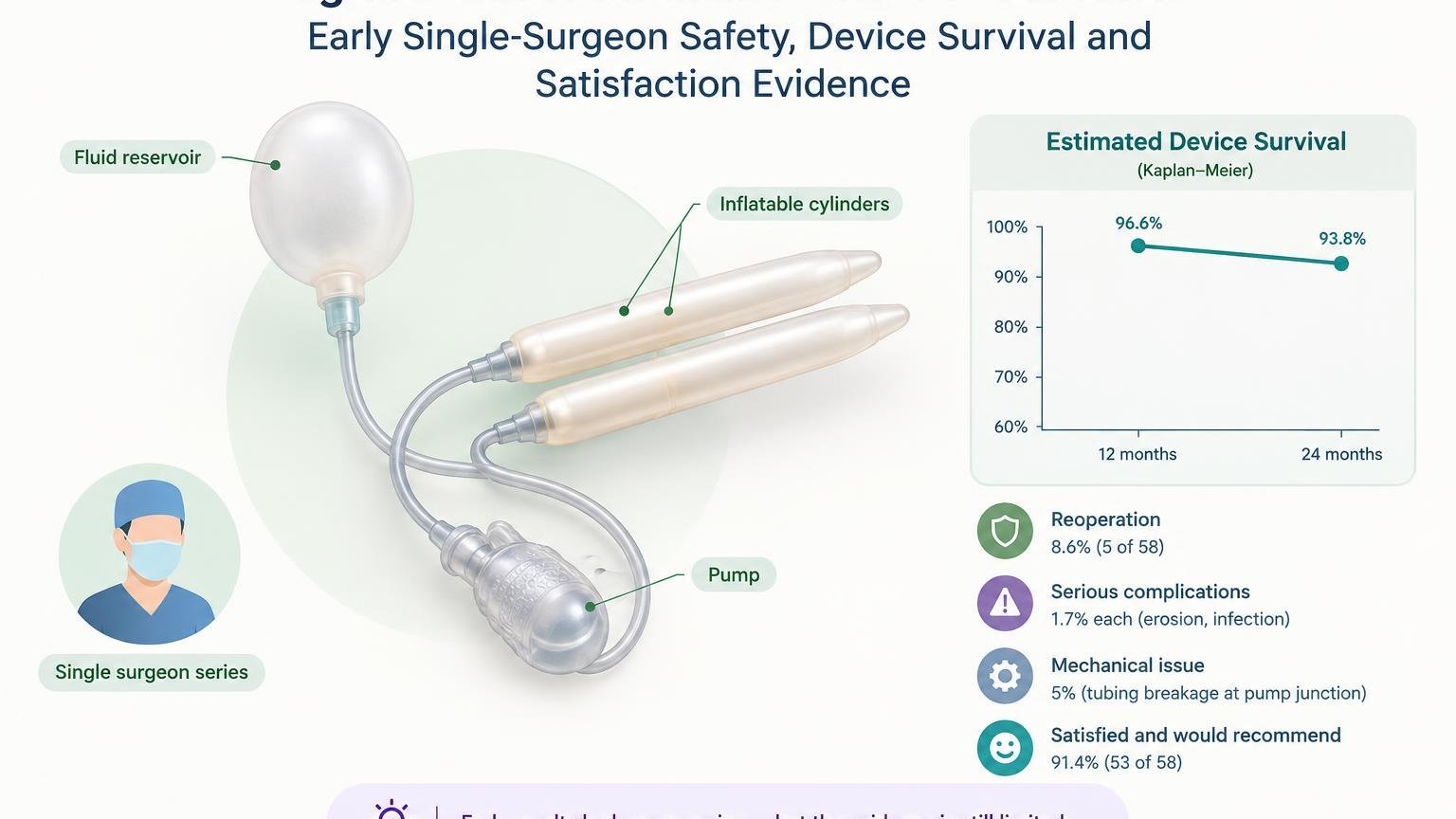
Five patients (8.6%) required reoperation. Reported complications were urethral erosion in one patient (1.7%), infection requiring explant in one (1.7%), and mechanical malfunction from tubing breakage at the pump junction in three (5%). Kaplan-Meier estimates of cumulative device survival were 96.6% at 12 months and 93.8% at 24 months. Fifty-three patients (91.4%) were satisfied and would recommend the procedure.
These are early descriptive signals from a small, uncontrolled, single-operator series presented in abstract form. They do not establish that the device performs as well as established three-piece prostheses, and they cannot separate device effects from surgeon learning, patient selection or measurement method.
Why This Matters
Inflatable penile prostheses are a reconstructive option for men whose erectile dysfunction has not responded to or is unsuitable for other treatments. Device choice involves trade-offs among mechanical reliability, revision risk, infection risk, ease of use and cost. A newer manufacturer entering this space is relevant to clinicians and patients because competition may broaden options, but newness also means the outcome literature is thinner.
Rigicon has produced the Infla10 outside the United States since 2019, and the authors note that FDA studies for US approval were underway at the time of the report. That regulatory context matters: an early single-surgeon series is a first look at safety and satisfaction, not the kind of controlled evidence regulators or guideline panels typically require before broad adoption claims.
For readers trying to interpret device news, the useful question is not whether a satisfaction figure sounds high in isolation. It is whether the figure comes from a defined population, a consistent follow-up window, a prespecified outcome measure and a credible comparator. This abstract supplies some of these elements and not others.
How the Device and the Study Work
A three-piece inflatable prosthesis typically combines a fluid reservoir, a pump placed in the scrotum and inflatable cylinders in the penis. The user squeezes the pump to transfer fluid into the cylinders for rigidity and activates a release mechanism to deflate. The Infla10 X cylinder in this series is described as providing girth expansion, while the AX model is described as providing length and girth expansion.
The study design is a retrospective single-surgeon case series of the surgeon's first 58 Infla10 implants performed between 2019 and 2023. It reports reoperation, specific complications, Kaplan-Meier device survival and a satisfaction question asking whether patients would recommend the procedure. It does not report a concurrent control group receiving another device, randomization or blinded outcome assessment.
That design is common for early device experience because it is practical and can reveal obvious safety problems quickly. Its weakness is that early experience in one surgeon's hands is strongly shaped by case selection and the learning curve. A first series may over-represent motivated patients who are good surgical candidates, and it may under-represent the complexity seen once a device is used more widely.
What the Evidence Shows
Reoperation was required in five of 58 patients, or 8.6%. The abstract does not break down which reoperations followed which complications, so the figure should be read as an overall early burden rather than a cause-specific revision rate. In a series this small, each additional event changes the percentage by roughly 1.7 percentage points, which is a useful reminder of how unstable small proportions are.
| Outcome | Reported result | What it means in this series | Important limit |
|---|---|---|---|
| Reoperation | 5 of 58 patients (8.6%) | Overall early surgical revision burden | Cause-specific reoperation links not reported; small denominator |
| Urethral erosion | 1 patient (1.7%) | A serious device-related complication occurred once | Single event; no risk-factor analysis |
| Infection requiring explant | 1 patient (1.7%) | One device had to be removed for infection | Single event; timing and organism not reported |
| Mechanical malfunction from tubing breakage at the pump junction | 3 patients (5%) | The most frequent specific mechanical problem reported | Authors state the manufacturer addressed it, but no formal before-and-after analysis is provided |
| Cumulative device survival by Kaplan-Meier | 96.6% at 12 months; 93.8% at 24 months | Estimated proportion free of device failure over time | Small sample; estimates beyond 24 months not reported |
| Satisfaction and recommendation | 53 of 58 patients (91.4%) | Most patients reported satisfaction and would recommend the procedure | Question wording, timing and collection method not detailed |
| Reasons for diminished satisfaction | Perceived penile shortening in 3 (5.1%); difficulty learning pump cycling in 2 (3.4%) | Dissatisfaction was not solely mechanical | Self-perceived reasons; very small counts |
The three tubing breakages at the pump junction are the most specific mechanical signal in the report. The authors state that the manufacturer addressed the issue and that no additional mechanical concerns followed. That is a descriptive statement rather than a formal comparison of devices made before and after a design or manufacturing change, and the abstract does not specify the time window or how many patients were implanted after the change.
Kaplan-Meier analysis produced estimated cumulative device survival of 96.6% at 12 months and 93.8% at 24 months. Survival analysis is appropriate for time-to-event data because it accounts for patients with different follow-up durations. However, with 58 patients, the confidence around those estimates is wide even though the abstract does not display confidence intervals. The estimates also stop at 24 months, so they say nothing about the three-, five- or ten-year horizon over which prosthesis durability matters most.
Satisfaction was high in the reported series: 91.4% were satisfied and would recommend the procedure. The reasons given for diminished satisfaction were perceived penile shortening in three patients (5.1%) and difficulty learning pump cycling in two (3.4%). These are clinically recognizable concerns. Perceived shortening can reflect changed anatomy, baseline expectations or comparison with pre-surgery appearance, and pump training difficulty is a usability and education issue as much as a device issue.
Interpreting the Numbers Without Overreading Them
The authors conclude that the series shows high satisfaction with acceptable early safety from revision, and they describe early revision-related efficacy and safety as comparable to competitive three-piece devices available for decades. That comparison is their interpretation. No concurrent comparator group is reported, and no formal statistical comparison with historical device cohorts appears in the abstract. Comparability claims therefore rest on informal benchmarking rather than a head-to-head trial.
Statistical survival estimates and clinical conclusions are different objects. A 93.8% two-year survival estimate describes the proportion of devices estimated to remain free of failure in this cohort; it does not by itself tell a patient what will happen to them, how satisfied they will be or how the device will behave in a different surgical setting. Likewise, a 91.4% satisfaction figure can be clinically meaningful while remaining methodologically fragile if the measure was informal, collected at variable times or influenced by the surgeon-patient relationship.
Single-surgeon series also blend device performance with operator performance. The first 58 implants include the surgeon's learning curve, and outcomes may improve or change as technique matures. The abstract does not report a time-ordered analysis of early versus later cases, so readers cannot tell whether the tubing breakages clustered early, whether erosion was associated with a particular model, or whether satisfaction differed by model.
The wide follow-up range of 4 to 42 months with a median of 19 months compounds these issues. Patients contribute different amounts of observation time, and the small number of events means one patient's outcome can shift the apparent rate. For a device intended to last years, a median follow-up under two years is early-phase evidence, not a durability verdict.
What This Does and Does Not Establish
- It establishes that in one surgeon's first 58 Infla10 implants, serious complications were uncommon in the reported follow-up: one urethral erosion and one infection requiring explant, each 1.7%.
- It establishes that three tubing breakages at the pump junction were reported, representing 5% of this small series, and that the authors describe a manufacturer response with no additional mechanical concerns afterward.
- It establishes that estimated device survival was 96.6% at 12 months and 93.8% at 24 months, and that 91.4% of patients reported satisfaction and would recommend the procedure.
- It does not establish equivalence to established three-piece prostheses. The abstract reports no control group, no randomization and no formal statistical comparison, so the comparability statement is a hypothesis-generating interpretation.
- It does not establish long-term durability, generalizability across surgeons and centers, or performance in higher-risk patients, because follow-up ranged from 4 to 42 months in a single-operator series.
Research Outlook
The natural next steps are larger, multi-surgeon series with prespecified outcome definitions, longer follow-up and a concurrent or historical comparator. Reporting confidence intervals around Kaplan-Meier estimates and separating outcomes by model would clarify how much of the signal is device-specific. Tracking the tubing breakage issue with a defined before-and-after cohort would test whether the manufacturer's change actually reduced mechanical failure rather than coinciding with the end of the observed problem.
Regulatory review in the United States, if completed, would add structured safety and effectiveness data to a field currently served mainly by early international experience. Until then, clinicians discussing a newer prosthesis should present the early signal honestly: a small series suggests reasonable short-term safety and high reported satisfaction, while durability, comparative performance and performance outside specialist hands remain open questions.
Key Takeaways
This is a small, single-surgeon, retrospective case series reported as a conference abstract, covering the first 58 Rigicon Infla10 implants performed between 2019 and 2023, with a median follow-up of 19 months. Its main value is early signal detection: uncommon serious complications, a specific mechanical issue that the authors say was addressed, encouraging short-term survival estimates and high reported satisfaction.
Its main limitation is design. Without a comparator, longer follow-up, broader surgeon representation and detailed outcome definitions, the data cannot show that the Infla10 is as safe or as durable as established devices. Patients and clinicians should treat the results as a reason for cautious interest and continued follow-up, not as a settled comparative verdict.
Questions and Answers
What is the Rigicon Infla10 inflatable penile prosthesis and how does it work?
The Infla10 is a three-piece inflatable penile prosthesis made by Rigicon, a newer manufacturer that has produced it for countries outside the United States since 2019. In the reported series, most patients received the Infla10 X girth-expansion cylinder and 30% received the Infla10 AX length-and-girth model. Like other three-piece devices, it uses a pump, reservoir and cylinders, and the abstract does not provide detailed engineering specifications.
What complication, reoperation and device survival results were reported for the Infla10 penile prosthesis?
Five of 58 patients (8.6%) required reoperation. Complications included urethral erosion in one patient (1.7%), infection requiring explant in one (1.7%) and tubing breakage at the pump junction in three (5%). Kaplan-Meier estimated cumulative device survival was 96.6% at 12 months and 93.8% at 24 months. Three patients cited perceived penile shortening and two cited difficulty learning pump cycling as reasons for diminished satisfaction.
How satisfied were patients with the Infla10 penile implant in the single-surgeon series?
Fifty-three of 58 patients (91.4%) were reported as satisfied and would recommend the procedure. Diminished satisfaction was attributed to perceived penile shortening in three patients (5.1%) and difficulty learning pump cycling in two (3.4%). The abstract does not describe the satisfaction questionnaire, when it was administered or how responses were collected, so the figure should be read as a positive early signal rather than a precise benchmark.
How strong is the evidence that the Infla10 is as safe as established three-piece penile prostheses?
The evidence is early and weak for comparative claims. The report is a single-surgeon retrospective case series of 58 patients presented as a conference abstract, with follow-up of 4 to 42 months and a median of 19 months. No concurrent comparator group, randomization or formal statistical comparison is reported. The authors describe early revision-related safety as comparable to older devices, but that is an interpretation rather than a head-to-head finding.
Can the Infla10 results be generalized to other surgeons and longer-term use?
Not reliably. The data come from one surgeon's first 58 implants, so they blend device performance with a learning curve and local patient selection. Follow-up ranges from 4 to 42 months, and survival estimates stop at 24 months. Outcomes may differ with other surgeons, higher-risk patients, different implant volumes and longer observation. The tubing breakage issue is described as addressed by the manufacturer, but no formal before-and-after analysis is provided.
What should patients understand about early penile implant device survival statistics?
Kaplan-Meier survival estimates describe the proportion of devices estimated to remain free of failure over time in a specific cohort. In this Infla10 series, estimates were 96.6% at 12 months and 93.8% at 24 months in 58 patients. They are not individual predictions, they carry uncertainty that the abstract does not quantify, and they do not cover the multi-year horizon most relevant to device durability. They also do not capture satisfaction or usability.
Sources and References
- IP18-27 PATIENT SATISFACTION STUDY FOR THE NEW RIGICON INFLA10® INFLATABLE PENILE PROSTHESIS INCLUDING SINGLE SURGEON SAFETY AND OUTCOMES DATA | Journal of Urology. DOI: 10.1097/01.JU.0001110060.12139.1b.27.
SANYUN Science Center explains published research on men's reproductive and sexual health, connecting scientific evidence with everyday questions while making sources and limitations clear.
Disclaimer: This article is for scientific education and research communication only. It does not provide medical advice, diagnosis, or individualized treatment recommendations, and does not endorse any medication, supplement, device, penile enlargement procedure, or other intervention. Decisions about sexual and reproductive health should be made in consultation with a qualified healthcare professional. Do not delay seeking professional care because of information in this article.
Original Content & Copyright Notice
- This article is prepared for SANYUN Science Center, drawing on published research and publicly available academic literature on men’s sexual and reproductive health. Its editorial explanations and presentation are developed for this platform.
- Copyright in the original editorial content, selection, and arrangement is reserved by SANYUN Science Center to the extent protected by applicable law. Referenced research, quotations, and third-party materials remain subject to the rights of their respective owners. This notice does not claim ownership of scientific facts or third-party research.
- Except where permitted by applicable law or an applicable license, prior written permission is required to reproduce, republish, translate, adapt, redistribute, or commercially reuse protected content. Attribution alone does not grant permission for such reuse.
- For permitted quotation or authorized reuse, clearly identify the source and retain a link to the original article.
- Source: SANYUN Science Center
- Original URL: Retain the original article URL on science.san-yun.com.
- Copyright Holder: SANYUN Science Center, for its own protected editorial content.
- Quotation, excerpts, or authorized reuse must not distort the scientific meaning, omit material limitations or disclaimers, or imply unverified medical claims, product efficacy, or endorsement by SANYUN Science Center.



