




Category: Latest Research
Core Research Direction: Nonhormonal on-demand male contraception targeting soluble adenylyl cyclase (sAC/ADCY10): preclinical validation and the pathway toward first-in-human safety testing
Search Intent: How far along is a nonhormonal, on-demand pill for men that works by blocking sperm's bicarbonate-sensing enzyme sAC, and what has actually been shown versus what is still planned?
Platform: SANYUN Science Center
Evidence reviewed through: 2026-11-08
Executive Summary
A research center at Weill Cornell Medicine has set out to advance a lead soluble adenylyl cyclase (sAC, gene ADCY10) inhibitor into first-in-human (FIH) safety studies, aiming at a nonhormonal, orally available male contraceptive taken only shortly before intercourse. The scientific rationale is unusually specific: bicarbonate-driven activation of sAC is described as an early step in sperm capacitation and motility, and loss of sAC leaves sperm immotile and males infertile in both mice and men.[1]
The distinction that matters for readers is between validation of a target and validation of a product. Genetic and pharmacological evidence in animals, plus human genetic observations, support sAC as a fertility-relevant target. But the reversible, on-demand pill itself has not been tested in men in any reported results: the first-in-human single ascending dose study, the FDA Investigational New Drug application, formulation and manufacturing work, and pharmacokinetic and reversibility studies are all described as planned program activities.
Why This Matters
Male contraceptive options remain narrow, and most developmental approaches have relied on hormones that suppress sperm production over weeks or months. An on-demand, nonhormonal pill would change the practical logic of male contraception: users would take it only when needed rather than maintaining continuous hormonal suppression. The program explicitly frames this as taking a product only as often as needed, shortly before intercourse.
The funding context indicates genuine institutional investment rather than a speculative editorial idea. The federal grant record lists a fiscal year 2026 award to Weill Medical College of Cornell University with a subtotal of $2,070,025, supporting a contraceptive research center structure with three development projects. Funding, however, signals intent and capacity, not efficacy; award size is not a measure of research progress or clinical promise.
The Biological Mechanism: Why Sperm Need sAC
In mammals, sperm leaving the epididymis are dormant and immotile; they cannot fertilize the egg in that state. After ejaculation they begin swimming and undergo capacitation, the maturation process that makes them competent to fertilize the oocyte.
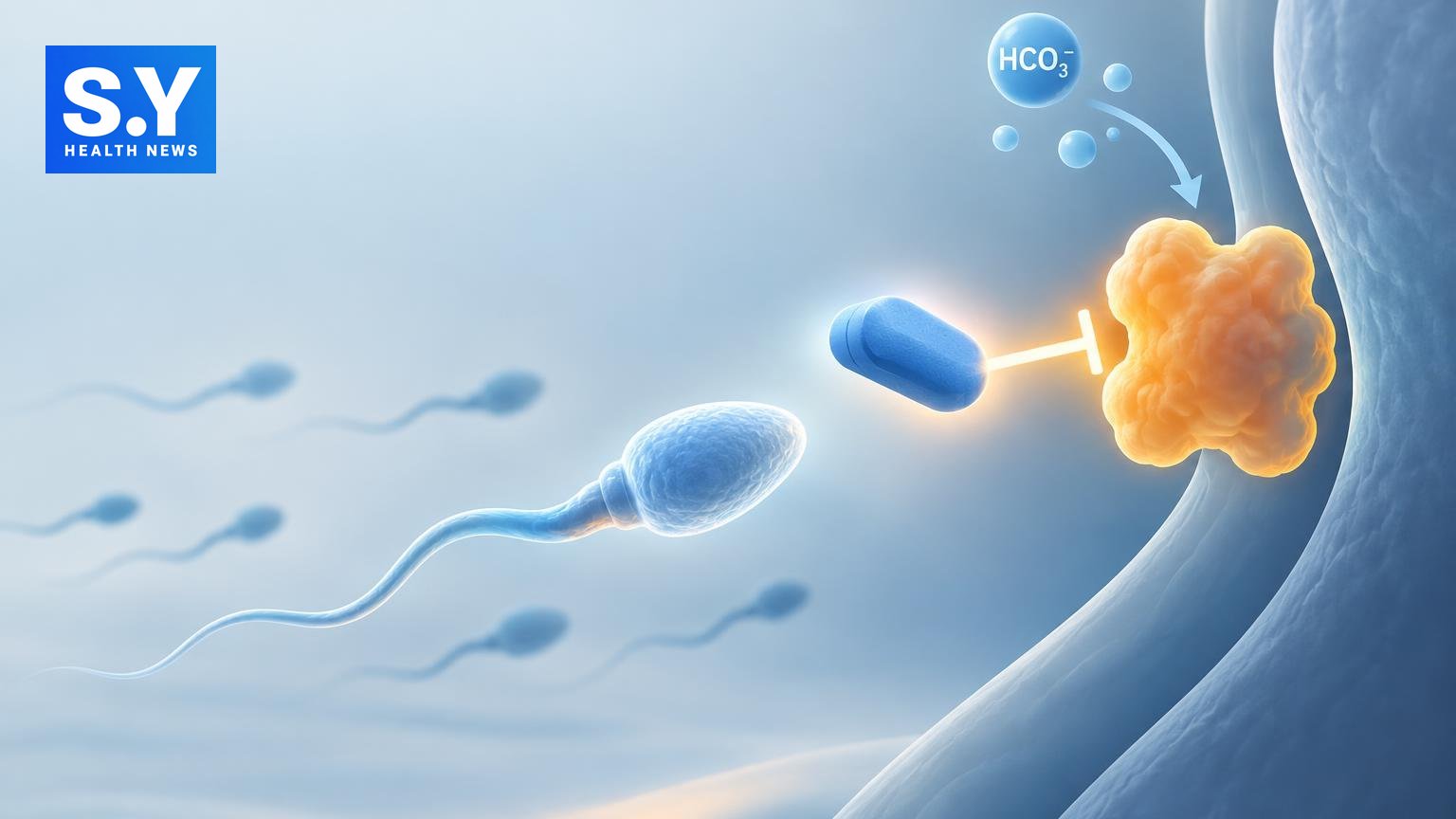
An early event in that transition is bicarbonate-induced stimulation of soluble adenylyl cyclase. In plain terms, sAC acts as a sensor and signal amplifier for bicarbonate, a molecule present in semen, and its activation helps switch on the motility and capacitation program. Blocking sAC is therefore conceptually different from hormonal contraception: it does not suppress sperm production through the brain-pituitary-gonadal axis, but interferes with the activation step that sperm require at the moment of ejaculation.
This mechanism also explains why the approach is described as potentially rapid in onset and short in duration. A drug that inhibits an acute activation event does not need to lower sperm counts over weeks; in principle, its effect could track the drug's presence. That remains a hypothesis about human performance, not a demonstrated clinical property.
What the Evidence Actually Shows
| Evidence type | What was reported | Population or setting | What it does and does not establish |
|---|---|---|---|
| Human and mouse loss-of-function genetics | Men and male mice lacking the sAC gene are infertile because their sperm are immotile. | Men and male mice with sAC knockout | Supports sAC as essential for male fertility; does not show that a drug can safely and reversibly mimic this state. |
| Pharmacological inhibition in living animals | In vivo administration of sAC inhibitors to male mice prevented sperm motility and made the males temporarily infertile. | Male mice | Animal proof of principle for temporary pharmacological infertility; not human efficacy or safety data. |
| Target validation claim | sAC is described as a nonhormonal target validated genetically and pharmacologically as essential for male fertility. | Program synthesis of prior evidence | A framing claim from a grant narrative, not an independent systematic review or a human trial result. |
| Chronic loss-of-function phenotypes | Apart from male-specific sterility, other effects of sAC knockout in men or mice are described as dependent on chronic, long-term loss of sAC. | sAC knockout men or mice | Suggests the safety question differs for acute versus chronic inhibition; specific phenotypes and measurements are not provided. |
| Planned first-in-human work | An FDA Investigational New Drug application and a first-in-human single ascending dose study are planned. | Men (planned studies) | Describes a regulatory and trial pathway; no dosing results, participant numbers or dates are reported. |
| Planned reversibility and pharmacokinetics | Reversibility, pharmacokinetics and distribution into efficacy-defining compartments, and metabolite safety and efficacy, are listed as objectives. | Lead compound (planned studies) | These are properties to be demonstrated, not reported findings. |
Taken together, the evidence base divides cleanly. The target has strong biological plausibility: sAC sits at a defined step in sperm activation, human genetic absence of sAC is associated with male infertility, and mouse experiments show that pharmacological inhibition can temporarily block fertility. What is absent from the supplied record is any human trial data on the candidate drug itself, including dose selection, duration of effect, recovery of normal sperm function, or adverse events.
Why Acute Dosing Is Central to the Safety Argument
A recurring theme in the program description is the difference between acute and chronic inhibition. The investigators propose acutely acting sAC inhibitors whose effects are expected to be transient, explicitly to avoid mechanism-based side effects and to limit the risks associated with chronic dosing.
That reasoning is biologically coherent but should be read as an expectation rather than a finding. The observation that non-fertility effects of sAC knockout depend on chronic loss over extended periods supports the idea that brief inhibition might avoid them, but it does not prove it. A drug taken repeatedly over years, even intermittently, still requires human safety data, including data on metabolites and on tissues where sAC may matter outside the reproductive tract. The program lists metabolite safety and efficacy among the studies still to be done.
Interpretation and Limitations
Several boundaries should temper enthusiasm. First, the core human evidence is genetic: people born without functional sAC are infertile, which establishes that the pathway matters but says nothing about whether a reversible inhibitor can be dosed safely. Second, the pivotal efficacy experiments are in male mice; species differences in semen composition, drug exposure and sperm physiology are real. Third, the mechanism implies that an on-demand product must act quickly and predictably, a pharmacokinetic demand that has not yet been demonstrated.
The source material also carries structural limits. It is a grant award description and program summary, not a published trial report, so it contains no sample sizes, effect estimates, confidence intervals, adverse event rates or peer-reviewed efficacy endpoints for the lead compound. Claims of genetic and pharmacological validation are the investigators' synthesis of earlier work, and the individual studies are not cited in the supplied text. Readers should not interpret the absence of reported harms as evidence of safety.
Finally, the contraceptive goal itself remains aspirational. The stated aim is a nonhormonal, orally available, on-demand contraceptive taken only when and as often as needed, shortly before intercourse. Nothing in the supplied material shows that this profile has been achieved in humans; the program is designed to test whether it can be.
What Comes Next: The Clinical Development Pathway
The program is organized around three projects. The first covers the studies needed to support an Investigational New Drug application to the FDA and a first-in-human single ascending dose study, typically an early trial in a small number of volunteers designed primarily to assess safety and how the body handles the drug. The second covers formulation and chemistry, manufacturing and controls work needed for clinical development. The third covers reversibility, pharmacokinetics and distribution into the biological compartments relevant to efficacy, plus safety and efficacy of potential metabolites.
For a general readership, the practical takeaway is timeline realism. A first-in-human single ascending dose study answers early safety and pharmacokinetic questions; it does not establish contraceptive efficacy in couples, nor does it establish that fertility returns reliably. Those questions require later, larger studies, which are not described in the supplied record. No dates, enrollment targets or interim results are available.
Key Takeaways
- The target is biologically specific: bicarbonate-induced activation of soluble adenylyl cyclase (ADCY10) is an early step in sperm capacitation and motility, and sAC loss leaves sperm immotile in men and mice.
- Animal pharmacology supports proof of principle: sAC inhibitors given to living male mice prevented sperm motility and caused temporary infertility, but animal results do not establish human safety or efficacy.
- The candidate product is not yet clinically tested in any reported result; an FDA Investigational New Drug application, a first-in-human single ascending dose study, formulation and manufacturing work, and reversibility and pharmacokinetic studies are planned.
- The safety rationale rests on short, intermittent exposure, an expectation the program intends to test rather than a demonstrated property of the drug.
- The grant record lists a fiscal year 2026 award of $2,070,025 to Weill Medical College of Cornell University; funding indicates investment, not clinical progress.
Questions and Answers
How does a soluble adenylyl cyclase (sAC) inhibitor work as a male contraceptive?
Sperm are stored dormant and immotile in the epididymis and become motile and capable of fertilization after ejaculation through capacitation. Bicarbonate-induced stimulation of sAC (ADCY10) is described as an early step in that activation. Inhibiting sAC is intended to block sperm motility at the moment it is needed, without hormones or suppressing sperm production over weeks.
Has an sAC inhibitor male birth control pill been tested in men?
No human dosing results for the lead sAC inhibitor are reported in the supplied material. The stated goal is to advance the compound into first-in-human safety studies, and the first-in-human single ascending dose study, the FDA Investigational New Drug application, formulation and manufacturing work, and reversibility and pharmacokinetic studies are described as planned rather than completed.
What evidence supports sAC as a male fertility target?
Support comes from genetics and animal pharmacology. Men and male mice lacking the sAC gene are infertile because their sperm are immotile, and in living male mice sAC inhibitors prevented sperm motility and made the males temporarily infertile. This establishes the pathway as essential for fertility in these settings but is not proof of a safe, reversible on-demand drug in men.
Is a nonhormonal on-demand male contraceptive safer than hormonal male birth control?
The sAC approach is nonhormonal and is designed for short, intermittent exposure, which the investigators propose to avoid mechanism-based side effects and limit risks of chronic dosing. However, this is an expectation to be tested. Human safety data, including effects of potential metabolites, are not yet reported, so no comparative safety claim can be made.
What are the main limitations of the sAC male contraceptive research so far?
The key limitations are the absence of human efficacy and safety data for the candidate drug, reliance on mouse pharmacology for temporary infertility, and a genetic human rationale that shows the pathway matters but not that an inhibitor can be dosed safely. The source is a grant program summary without sample sizes, effect estimates or adverse event rates.
What would first-in-human testing of an sAC contraceptive show, and what would it not show?
A first-in-human single ascending dose study is an early trial typically focused on safety, tolerability and how the body handles the drug. It would not by itself demonstrate contraceptive efficacy in couples or reliable return of fertility; reversibility and efficacy in the relevant biological compartments are separate planned objectives requiring later studies.
Sources and References
SANYUN Science Center explains published research on men's reproductive and sexual health, connecting scientific evidence with everyday questions while making sources and limitations clear.
Disclaimer: This article is for scientific education and research communication only. It does not provide medical advice, diagnosis, or individualized treatment recommendations, and does not endorse any medication, supplement, device, penile enlargement procedure, or other intervention. Decisions about sexual and reproductive health should be made in consultation with a qualified healthcare professional. Do not delay seeking professional care because of information in this article.
Original Content & Copyright Notice
- This article is prepared for SANYUN Science Center, drawing on published research and publicly available academic literature on men’s sexual and reproductive health. Its editorial explanations and presentation are developed for this platform.
- Copyright in the original editorial content, selection, and arrangement is reserved by SANYUN Science Center to the extent protected by applicable law. Referenced research, quotations, and third-party materials remain subject to the rights of their respective owners. This notice does not claim ownership of scientific facts or third-party research.
- Except where permitted by applicable law or an applicable license, prior written permission is required to reproduce, republish, translate, adapt, redistribute, or commercially reuse protected content. Attribution alone does not grant permission for such reuse.
- For permitted quotation or authorized reuse, clearly identify the source and retain a link to the original article.
- Source: SANYUN Science Center
- Original URL: Retain the original article URL on science.san-yun.com.
- Copyright Holder: SANYUN Science Center, for its own protected editorial content.
- Quotation, excerpts, or authorized reuse must not distort the scientific meaning, omit material limitations or disclaimers, or imply unverified medical claims, product efficacy, or endorsement by SANYUN Science Center.



