




Category: Penile Size
Core Research Direction: Self-reported versus measured penile size: social desirability bias in men's self-reports, and the limits of commercial/consumer claims about penile size and enhancement
Search Intent: Why do men's self-reported penile measurements tend to exceed medically measured averages, and what does the best-available evidence actually say about normal size and enhancement options?
Platform: SANYUN Science Center
Evidence reviewed through: 2026-11-15
Executive Summary
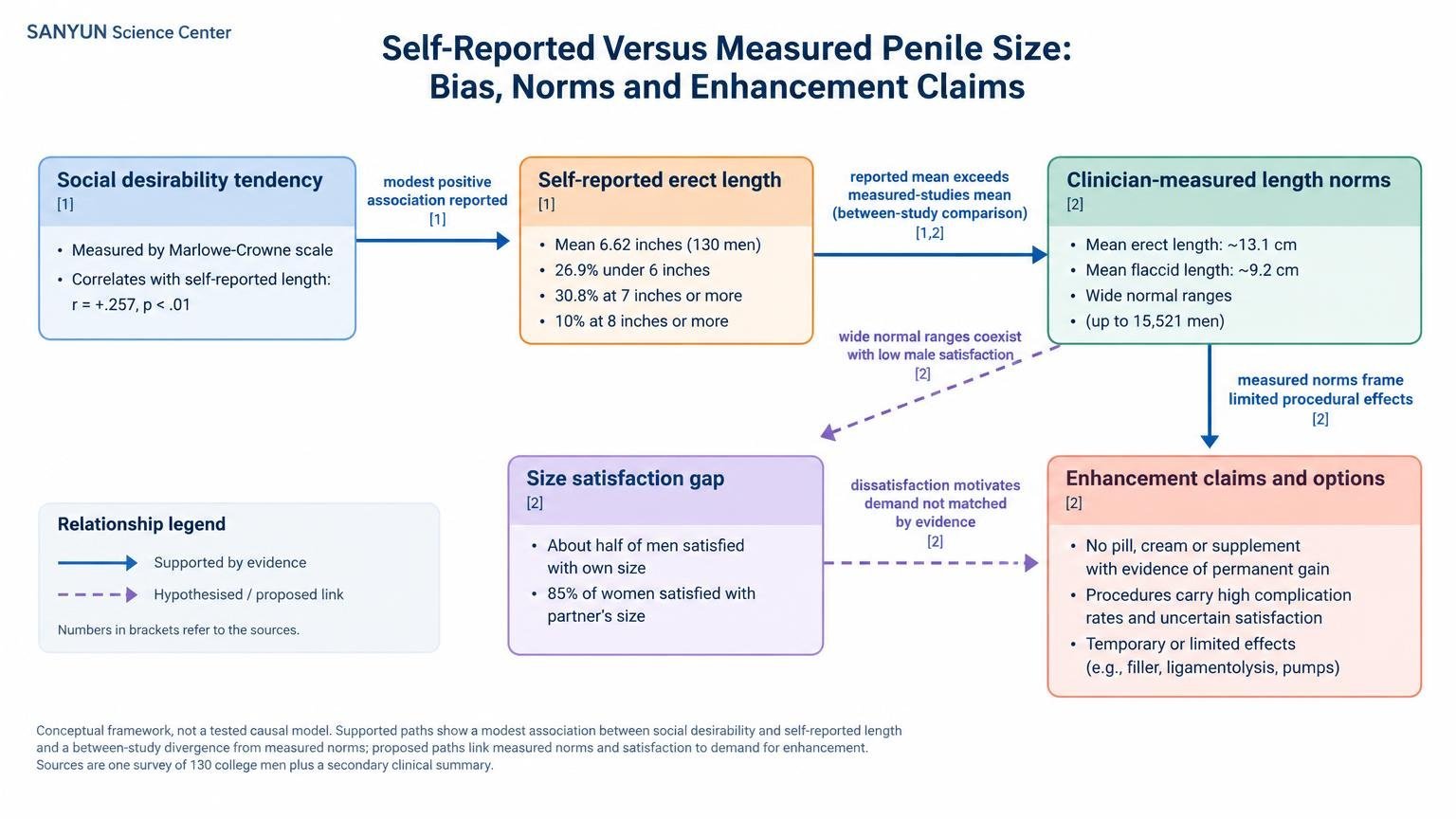
Men's beliefs about their penile size are shaped by at least two distinct information streams: what they measure or report themselves, and what clinicians record under standardised conditions. These streams do not reliably agree. In one observational survey of 130 sexually experienced college men, the mean self-reported erect length was 6.62 inches, a figure the authors judged greater than values obtained in earlier studies where researchers took the measurements themselves.[1]
That survey also found a modest positive correlation of +.257 (p < .01) between self-reported size and Marlowe-Crowne social desirability scores, suggesting that men more inclined to present themselves favourably were more likely to report a large penis. The distribution of responses is equally telling: only 26.9% of these men reported less than 6 inches, while 30.8% reported 7 inches or more and 10% reported 8 inches or more.
Against that, a systematic review of clinician-measured data in up to 15,521 men, as summarised in a clinical educational source, reported a mean erect length of about 13.1 cm and a mean flaccid length of about 9.2 cm, with wide normal ranges. The two datasets cannot be compared head-to-head, but the divergence is consistent with a reporting bias rather than a genuinely larger population.[2]
The practical implications run in two directions. First, self-reported size data should not be treated as normative reference values. Second, consumer claims about permanent enlargement have no supporting evidence base in the supplied material, while the medical options that do exist are limited, temporary or variable in effect. This review is an interpretation of published and educational sources, not a new study or systematic review.
Why the Self-Report Gap Matters
Penile size is a topic where measurement is unusually vulnerable to psychological distortion. The act of reporting a number is not neutral: it occurs in a social context where size carries perceived status. Prior research cited by the survey authors indicates that many men hold insecurities about penile size, often with low sexual self-esteem and sexual problems. That background makes accurate self-assessment difficult and makes the reporting context consequential.
The gap matters clinically because men often seek care on the basis of a belief rather than a measurement. A clinical educational source reports that a study by Mondaini and colleagues, which measured men requesting penile-lengthening surgery, found most had a normal size. If the typical presenting concern is generated by a distorted self-estimate, then the first clinical task is accurate measurement and expectation-setting, not a procedure.
The gap also matters commercially. Markets for pills, creams, supplements, pumps and traction devices depend on the premise that ordinary size is inadequate and improvable. Where the perceived baseline is inflated or deflated by bias rather than measurement, consumer demand can be driven by a distortion rather than by anatomy.
Mechanism: How Social Desirability Distorts Reported Size
Social desirability bias is the tendency to answer in ways that present the self favourably. The Marlowe-Crowne scale is a standard instrument for this tendency. In the survey, the correlation between that score and self-reported erect length was +.257 with p < .01. This is a statistically detectable but modest association: it explains only a small share of the variation in reported size and cannot, on its own, prove that individual men consciously exaggerated.
Several mechanisms could produce the same pattern. Men may round upward, recall a best-case measurement, measure along the dorsal rather than the standardised axis, include or exclude the suprapubic fat pad inconsistently, or simply estimate without measuring at all. The authors' interpretation that many men embellished their responses is explicitly a hypothesis rather than a demonstrated fact.
There is also a plausible perceptual mechanism. A clinical source notes that viewing the penis from above foreshortens the apparent length, and that flaccid size varies substantially with temperature, stress and time of day. Neither observation was measured in the survey, so they remain plausible contributors rather than established causes of the reported gap.
Performance and selection effects may operate differently again. Media comparisons involve performers selected for particular physical traits and filmed at favourable angles, which raises the internal benchmark. This is a plausible contextual influence on reporting, not a measured variable in the survey data.
What the Evidence Shows
The central numerical comparison in the supplied evidence is indirect. The survey's mean self-reported erect length of 6.62 inches in 130 sexually experienced college men is set against measured values from other studies, not against measurements of the same men. This is a between-study comparison across different samples, eras and methods, and it cannot quantify how much any individual overstated his size.
The response distribution sharpens the picture. Only 26.9% of these men reported lengths below 6 inches, while 30.8% reported 7 inches or more and 10% reported 8 inches or more. Whether these proportions are plausible against measured population data is a judgement the supplied material supports only qualitatively; the survey itself provides no measured comparator group.
On the measured side, the systematic review summarised in the clinical source pooled clinician measurements from up to 15,521 men and reported mean erect length of about 13.1 cm and mean flaccid length of about 9.2 cm, with wide normal ranges. The primary review itself was not supplied, so these values should be read as a secondary summary rather than independently verified here.
Satisfaction data complicate any simple size-to-wellbeing story. A large survey of over 50,000 adults, as cited, reported that only about half of men were satisfied with their own size, while 85% of women were satisfied with their partner's size. This is self-reported satisfaction from a cited survey, not a clinical outcome, and it points toward perception and expectation as major determinants.
On enhancement, the supplied material is consistent but not derived from primary trials. The clinical source states that no pill, cream or supplement has evidence for permanent size increase, and cites a systematic review by Marra and colleagues concluding that in men of normal size, many enhancement procedures carry high complication rates and uncertain satisfaction.
| Variable | What the evidence describes | How to interpret it |
|---|---|---|
| Self-reported erect length | Mean 6.62 inches among 130 sexually experienced college men | Self-report only; not verified by measurement in the same men |
| Social desirability correlation | r = +.257, p < .01 with Marlowe-Crowne scores | Statistically detectable, modest; consistent with bias but not proof of exaggeration |
| Reported size distribution | 26.9% under 6 inches; 30.8% at 7 inches or more; 10% at 8 inches or more | Describes this self-reporting sample only |
| Clinician-measured means | About 13.1 cm erect and 9.2 cm flaccid in up to 15,521 men | Secondary summary of a systematic review; wide normal ranges |
| Enhancement evidence | No pill, cream or supplement with evidence of permanent gain; cited review reports high complication rates and uncertain satisfaction | Absence-of-evidence statements from an educational source, not primary trial data |
| Satisfaction | About half of men satisfied with own size; 85% of women satisfied with partner's size | Self-reported survey figures from a cited study |
Interpretation and Limitations
The most important limitation is design. The survey measured self-report and a personality tendency in the same 130 men, but did not measure their anatomy. The comparison with measured studies is therefore ecological: it contrasts groups rather than individuals. A man who reported 7 inches may have been accurate; the aggregate pattern is what suggests bias.
The correlation of +.257 is statistically significant at p < .01, but statistical significance is not clinical significance. A correlation of this size leaves most variance unexplained, and social desirability is only one of many plausible contributors. Treating the coefficient as a direct measure of exaggeration would overstate what was found.
The sample itself limits generalisability. It comprised 130 sexually experienced college men, a narrow demographic group, and self-selection into a study about penile size may itself correlate with interest or concern about size. The supplied abstract does not report how recruitment was conducted or whether measurement instructions were standardised.
The measured reference values carry their own limitations. They reach this review through a commercial clinic's educational article summarising a systematic review; the primary review was not supplied. Means with wide normal ranges are population descriptors, not targets, and they cannot tell an individual man whether his own measurement is typical.
Claims about enhancement rest largely on absence-of-evidence statements and a cited review rather than on primary trial data included here. That supports caution but does not by itself establish that every intervention is ineffective; it establishes that the supplied evidence does not demonstrate permanent benefit.
What Medical Options Actually Involve
Where intervention is discussed at all, the supplied material describes limited and conditional effects. Hyaluronic acid filler is described as temporarily increasing girth but not length, with effects typically lasting about 1 to 2 years before natural breakdown. This is a clinic summary, not a controlled trial, and individual duration varies.
Ligamentolysis surgery is described as increasing visible flaccid length, with published studies reporting an average gain of around 1 to 2 cm. The same source notes that results vary widely and that some men gain little or none. An average gain in visible flaccid length is not the same as an erect length gain, and the supplied material does not quantify erect change.
Vacuum pumps are described as producing temporary erections with a role in erectile dysfunction care, but not increasing permanent size. Exercise and weight loss are described as not changing actual size, although in men with substantial abdominal fat, fat loss can make more of the penis visible; that is an appearance effect rather than growth.
These distinctions matter for evaluating consumer claims. A temporary girth change, a visible flaccid change and a permanent erect size increase are different outcomes, and marketing frequently blurs them. The supplied evidence supports none of the permanent-gain claims and describes real limits and risks for the options that do exist.
Research Outlook
The clearest gap is direct within-person comparison. A study that measured each participant under standardised conditions and then collected his self-report would allow the size and direction of individual error to be quantified, rather than inferred from separate samples. The supplied material contains no such design.
A second gap concerns measurement method. The abstract does not specify how men were asked to measure, and method choice plausibly affects reported values. Future work could test whether standardised instructions, anatomical landmarks and the presence of an observer reduce the self-report gap.
A third gap is psychological. The cited satisfaction survey suggests a substantial mismatch between men's and partners' views, and the survey authors point to insecurity as a common background. Research separating body-image concern from anatomical variation would help clinicians decide when the appropriate intervention is reassurance, psychological support or nothing at all rather than a procedure.
Key Takeaways
- In one survey of 130 sexually experienced college men, mean self-reported erect length was 6.62 inches, greater than measured values reported in earlier studies, suggesting overstatement rather than a genuinely larger sample.
- Self-reported size correlated modestly with social desirability scores (r = +.257, p < .01), a statistically detectable signal that does not prove deliberate exaggeration.
- Clinician-measured data summarised from a systematic review of up to 15,521 men describe mean erect length of about 13.1 cm and flaccid length of about 9.2 cm, with wide normal ranges.
- Reported satisfaction diverges sharply between sexes: about half of men were satisfied with their own size versus 85% of women with their partner's size in a cited survey of over 50,000 adults.
- The supplied material states that no pill, cream or supplement has evidence for permanent size increase, and that many enhancement procedures in normal-sized men carry high complication rates and uncertain satisfaction.
- Medical options are limited in kind and duration: hyaluronic acid filler temporarily increases girth for about 1 to 2 years, and ligamentolysis averages around 1 to 2 cm of visible flaccid length with wide variation.
Questions and Answers
Why do men's self-reported penile measurements tend to exceed clinically measured averages?
The best explanation in the supplied evidence is reporting bias rather than anatomy. In a survey of 130 sexually experienced college men, mean self-reported erect length was 6.62 inches, exceeding measured values from earlier studies, and self-reported size correlated modestly with social desirability scores (r = +.257, p < .01). The authors suggested many men embellished, but that remains an interpretation.
What is the average erect penile length according to clinician-measured data?
A systematic review summarised in a clinical educational source pooled clinician measurements from up to 15,521 men and reported a mean erect length of about 13.1 cm and a mean flaccid length of about 9.2 cm. Normal ranges are wide for both. These figures reach this review second-hand, as the primary systematic review was not supplied.
How strong is the evidence that social desirability bias inflates reported penis size?
Suggestive but not conclusive. The correlation was statistically significant (r = +.257, p < .01) in 130 college men, yet the magnitude is modest and most variance remains unexplained. The design measured self-report and personality tendency but not anatomy, so exaggeration is inferred from comparison with other samples rather than demonstrated within individuals.
Do penile enlargement pills, creams or supplements have evidence for permanent gains?
No. The supplied clinical educational source states that no pill, cream or supplement has evidence for permanent size increase. This is an absence-of-evidence statement from a secondary source rather than a primary trial, so it supports caution about consumer claims but does not itself establish that every product is ineffective.
What are the limitations of the study on social desirability and self-reported penis size?
The sample was 130 sexually experienced college men, a narrow and possibly self-selected group. Anatomy was not measured in the same men, so the comparison with measured norms is between studies, not within individuals. The correlation is modest, and the embellishment interpretation is a hypothesis rather than a demonstrated finding.
Are there any medical options that change penile size, and what do they actually do?
Options exist but with narrow effects. Hyaluronic acid filler is described as temporarily increasing girth, not length, typically lasting about 1 to 2 years. Ligamentolysis is described as increasing visible flaccid length by around 1 to 2 cm on average, with wide variation and some men gaining little. A cited review reports high complication rates and uncertain satisfaction.
Conceptual framework: Conceptual framework, not a tested causal model. Supported paths show a modest association between social desirability and self-reported length and a between-study divergence from measured norms; proposed paths link measured norms and satisfaction to demand for enhancement. Sources are one survey of 130 college men plus a secondary clinical summary.
Academic References & Evidence
- King BM; Duncan LM; Clinkenbeard KM; Rutland MB; Ryan KM. MEDLINE Abstract. J Sex Marital Ther. 2019 45(5):452-455 PMID: 30681032.
- Noppon Arunkajohnsak. เพิ่มขนาดน้องชาย: ขนาดปกติ อะไรได้ผลจริง ความเสี่ยง. Menscape Clinic (commercial patient-education website). 2026
SANYUN Science Center explains published research on men's reproductive and sexual health, connecting scientific evidence with everyday questions while making sources and limitations clear.
Disclaimer: This article is for scientific education and research communication only. It does not provide medical advice, diagnosis, or individualized treatment recommendations, and does not endorse any medication, supplement, device, penile enlargement procedure, or other intervention. Decisions about sexual and reproductive health should be made in consultation with a qualified healthcare professional. Do not delay seeking professional care because of information in this article.
Original Content & Copyright Notice
- This article is prepared for SANYUN Science Center, drawing on published research and publicly available academic literature on men’s sexual and reproductive health. Its editorial explanations and presentation are developed for this platform.
- Copyright in the original editorial content, selection, and arrangement is reserved by SANYUN Science Center to the extent protected by applicable law. Referenced research, quotations, and third-party materials remain subject to the rights of their respective owners. This notice does not claim ownership of scientific facts or third-party research.
- Except where permitted by applicable law or an applicable license, prior written permission is required to reproduce, republish, translate, adapt, redistribute, or commercially reuse protected content. Attribution alone does not grant permission for such reuse.
- For permitted quotation or authorized reuse, clearly identify the source and retain a link to the original article.
- Source: SANYUN Science Center
- Original URL: Retain the original article URL on science.san-yun.com.
- Copyright Holder: SANYUN Science Center, for its own protected editorial content.
- Quotation, excerpts, or authorized reuse must not distort the scientific meaning, omit material limitations or disclaimers, or imply unverified medical claims, product efficacy, or endorsement by SANYUN Science Center.



