




Category: Clinical Insights
Core Research Direction: How semen analysis results are interpreted against WHO 2025 reference limits in frontline male fertility care, and how proposed structured interpretation frameworks (SPG360°/SpermoMAP) differ from simple threshold comparison
Search Intent: How should clinicians interpret semen analysis parameters against WHO reference values, and what does a functional stratified interpretation framework add beyond single-parameter cutoffs?
Platform: SANYUN Science Center
Evidence reviewed through: 2026-10-31
Executive Summary
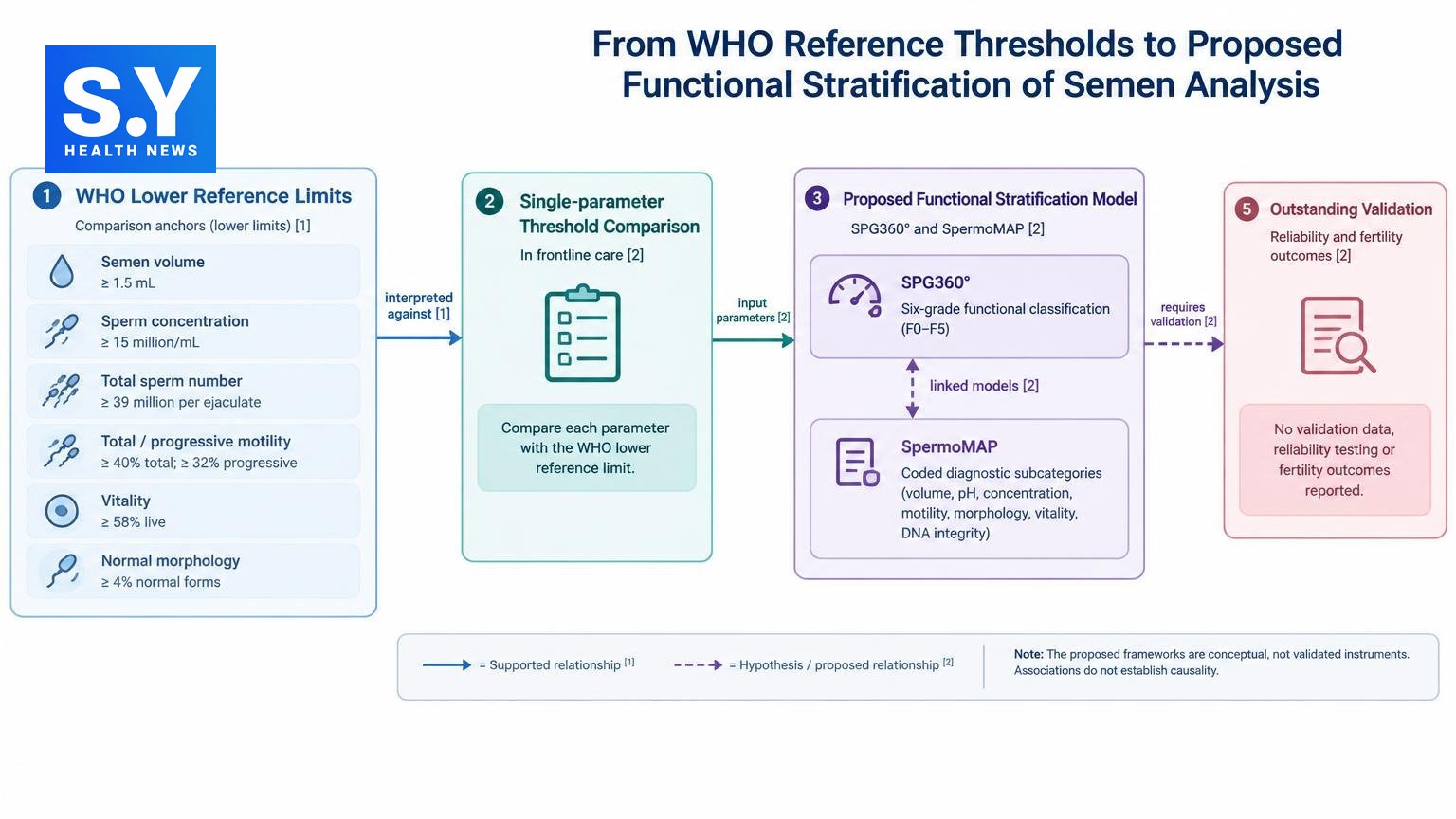
Semen analysis remains the core laboratory test in male fertility assessment, yet its interpretation in routine care is often reduced to comparing each parameter against a single lower reference limit. Widely circulated clinical guidance summarizes those limits as a semen volume of 1.5 mL or more, a sperm concentration of 15 million spermatozoa per mL or more, a total sperm number of 39 million or more per ejaculate, total motility of 40% or more with 32% or more progressive motility, vitality of 58% or more live spermatozoa, and normal morphology of 4% or more.[1]
A 2025 research article summarized in a science news report proposed a different organizing logic: SPG360°, a six-grade functional classification from F0 to F5, paired with SpermoMAP, a diagnostic coding system spanning volume, pH, concentration, motility, morphology, vitality and DNA integrity. The authors argued that single-parameter comparison neglects how parameters interact and framed the model as decision support for non-specialist clinicians rather than a replacement for specialist assessment. Importantly, the supplied evidence describes a proposed conceptual framework, not a validated diagnostic instrument.[2]
Why This Matters in Frontline Care
Semen analysis is frequently the first laboratory investigation a couple encounters, and it is commonly initially interpreted by gynecologists, general practitioners or endocrinologists rather than andrology specialists. That pattern creates a practical tension: the test produces a dense set of numbers, percentages and categorical descriptors, but the interpretive training of the first clinician to read it may be limited. A patient-facing clinic explainer acknowledges this directly, noting that results arrive as strange words, numbers and percentages that many people do not know how to interpret.[3]
The stakes are not trivial. One clinic page states that male infertility is the primary diagnosis in 40–50% of cases and that a male factor is present in roughly two out of three fertility problems. These figures are unreferenced clinic assertions and should not be treated as population estimates, but they convey why interpretation quality matters: a misread semen analysis can trigger unnecessary anxiety, inappropriate referrals or delayed treatment.
What the Reference Limits Are and Are Not
The threshold set is compact. Volume is flagged below 1.5 mL; concentration below 15 million/mL; total count below 39 million per ejaculate; total motility below 40% or progressive motility below 32%; vitality below 58% live; and normal morphology below 4%. These numbers are lower reference limits, not diagnostic categories and not fertility guarantees. A result above every cutoff does not establish fertility, and a result below one cutoff does not establish infertility, because semen parameters are continuous correlates of fecundity rather than binary determinants.
The supplied summaries also illustrate how loosely the word 'normal' is used in practice. A clinic page describes a concentration of at least 15 million/mL, or more than 39 million total spermatozoa per ejaculate, as 'normal', and it presents a normal volume range of 1.5 to 6 mL. The upper bound of 6 mL is not part of the WHO reference limit set and appears to reflect clinic-level descriptive ranges; conflating such ranges with guideline limits is a common source of patient confusion.
Test Performance and the Repeat-Test Principle
Because spermatogenesis is a long cycle, a single abnormal result is not a diagnosis. Guidance recommends offering a repeat confirmatory test ideally about 3 months after an abnormal first analysis, while advising earlier retesting when there is a gross deficiency such as azoospermia or severe oligozoospermia. This is a recommendation rather than a demonstrated outcome benefit in the supplied material, but it is a sensible safeguard against acting on biological and laboratory variability.
Azoospermia — no spermatozoa in the ejaculate — is described as potentially obstructive, where an alteration blocks sperm passage, or secretory, where production fails. That distinction matters because it changes the diagnostic pathway, but the supplied text gives no data on the relative frequency of these subtypes. Similarly, low volume is attributed to impaired seminal vesicle secretion, long abstinence, urinary sphincter dysfunction or low testosterone, while volume above 6 mL is linked speculatively to prolonged abstinence or varicocele. These are hypothesis-level explanations without supporting effect sizes.
The Proposed Functional Stratification Model
The 2025 framework was authored by three clinicians from private urology, andrology and assisted reproduction practices in São Paulo, Brazil, and was built by synthesizing medical literature, clinical guidelines and experience in high-complexity fertility care. It advances two linked components. SPG360° assigns semen results to one of six functional grades from F0 to F5, spanning states from completely unworkable to normal function. SpermoMAP adds a detailed diagnostic classification with codes and explanatory labels across volume, pH, concentration, motility, morphology, vitality and DNA integrity.
The conceptual difference from threshold comparison is integration. Rather than asking whether each parameter falls above or below a cutoff, the framework asks what the combination of findings implies functionally. A man with borderline concentration, reduced progressive motility and abnormal morphology would be categorized differently from a man with isolated low volume, even if both have one or more values below reference limits. The authors explicitly criticize traditional interpretation for focusing on single parameters and neglecting their interactions.
| Measure / finding | Result | Population / follow-up | Limitations |
|---|---|---|---|
| semen volume | 1.5 mL | men undergoing semen analysis | Editorial guideline summary; no primary study data or population detail provided. |
| sperm concentration | 15 million spermatozoa/mL | men undergoing semen analysis | Threshold cited without underlying derivation or reference population. |
| total sperm number per ejaculate | 39 million spermatozoa per ejaculate | men undergoing semen analysis | Threshold stated without underlying data. |
| total and progressive motility | 40% total; 32% progressive % motile spermatozoa | men undergoing semen analysis | Threshold summary without data on measurement methods or inter-lab variability. |
| vitality | 58% % live spermatozoa | men undergoing semen analysis | Threshold only; population base not supplied. |
| normal morphology | 4 % normal forms | men undergoing semen analysis | Reference value without discussion of strict vs other morphology criteria. |
| number of functional grades | 6 grades (F0-F5) | Descriptive of a proposed model; no inter-rater reliability or outcome data supplied. |
Interpretation and Limitations
The central limitation is evidence type. The supplied material describes the framework's construction and intended use, but reports no validation cohort, no inter-rater reliability testing, no comparison against specialist interpretation, and no fertility outcomes. The authors themselves acknowledge that ongoing clinical validation and refinement are required. Until such data exist, SPG360° and SpermoMAP should be understood as a proposed interpretive scaffold, not a diagnostic standard or a demonstrated improvement over guideline-based threshold review.
A second limitation concerns how the framework handles individual parameters. The underlying reference values remain those of the WHO set; the framework reorganizes their interpretation but does not replace the numeric limits with independently derived cutoffs. Readers should also distinguish the different evidentiary weight of the sources: guideline-aligned summaries of reference limits, patient-facing clinic explanations containing unreferenced statistics, and a news summary of a conceptual article are not interchangeable evidence.
Negative recommendations deserve equal attention. Screening for antisperm antibodies is not recommended because there is no evidence that treatment improves fertility outcomes. This is a reminder that interpretation should lead to actionable decisions, and that adding tests without therapeutic consequence can generate cost and anxiety without benefit.
Research Outlook
The obvious next studies are prospective validation in unselected frontline populations, measurement of agreement between non-specialist users of the framework and andrology specialists, and linkage of functional grades to reproductive outcomes such as time to pregnancy and assisted reproduction results. The authors position the framework as an educational and communication tool that could support standardized reporting and future algorithmic screening, but these downstream uses remain proposals rather than demonstrated capabilities.
Key Takeaways
- WHO lower reference limits are comparison anchors, not diagnostic categories: volume 1.5 mL, concentration 15 million/mL, total count 39 million, total motility 40%, progressive motility 32%, vitality 58% and normal morphology 4%.
- An abnormal first result should generally be repeated after about three months to cover a spermatogenesis cycle, with earlier retesting for azoospermia or severe oligozoospermia.
- SPG360° proposes six functional grades and SpermoMAP proposes coded subcategories, but the supplied evidence contains no validation, reliability or outcome data.
- Single-parameter 'normal versus abnormal' labeling, and clinic-specific ranges such as an upper volume bound of 6 mL, can mislead patients about what reference limits actually mean.
Questions and Answers
What are the main semen parameters compared against WHO reference limits?
The commonly cited set includes semen volume (1.5 mL or more), sperm concentration (15 million/mL or more), total sperm number (39 million or more), total motility (40% or more), progressive motility (32% or more), vitality (58% or more) and normal morphology (4% or more). Each is a lower reference limit used for comparison, not a diagnosis in itself.
Why should an abnormal semen analysis be repeated?
Spermatogenesis takes roughly three months, so a single abnormal result may reflect transient biological or laboratory variation. Guidance recommends offering a repeat confirmatory test ideally about three months later, with earlier retesting when azoospermia or severe oligozoospermia is present. The recommendation reflects prudent practice rather than a demonstrated outcome benefit in the supplied material.
What do the proposed SPG360° and SpermoMAP frameworks actually add?
They reorganize interpretation from isolated threshold comparison toward integrated functional classification. SPG360° assigns one of six functional grades from F0 to F5, while SpermoMAP provides detailed coded categories covering volume, pH, concentration, motility, morphology, vitality and DNA integrity. The stated aim is to support non-specialist clinicians without replacing specialist assessment.
How strong is the evidence supporting these structured frameworks?
It is conceptual rather than empirical. The supplied material describes the framework's development from literature, guidelines and clinical experience but reports no validation cohort, no inter-rater reliability data and no fertility outcomes. The authors themselves acknowledge that clinical validation and refinement are still required, so the frameworks should be treated as proposed interpretive scaffolds.
Do these frameworks change the underlying WHO reference values?
No. The numeric limits remain the WHO reference values; the proposed frameworks change how combinations of results are organized and communicated. They also introduce categories such as DNA integrity that go beyond the standard parameter set. Whether that reorganization improves clinical decisions compared with guideline-based threshold review has not been demonstrated in the supplied evidence.
What should patients and clinicians keep in mind when reading a semen analysis report?
Reference limits indicate where a value sits relative to a reference population; they do not confirm or exclude fertility. Clinic-specific ranges, such as an upper volume bound of 6 mL, should not be confused with guideline limits, and tests without therapeutic consequence, such as routine antisperm antibody screening, are not recommended. Interpretation should account for the full pattern of results and clinical context.
Conceptual framework: Conceptual framework. The figure maps how WHO lower reference limits feed into routine single-parameter comparison and, in the proposed 2025 model, into SPG360° functional grades and SpermoMAP coded categories. Supported links are shown for the reference limits as model inputs; the linkage between the two proposed components and their validation status are hypothesis-level. No outcome data are implied.
Academic References & Evidence
- Interpret Semen Analysis Results, and What Are the Key Parameters: Gui. 2025
- Guilheme Leme de Souza; Ana Flávia Quiarato Lozano; Jorge Hallak. SPG360°和SpermoMAP:一种用于一线生育护理中人类精液分析的功能性分层解读模型. European Journal of Obstetrics & Gynecology and Reproductive Biology. 2025
- Comment interpréter le séménogramme?.
SANYUN Science Center explains published research on men's reproductive and sexual health, connecting scientific evidence with everyday questions while making sources and limitations clear.
Disclaimer: This article is for scientific education and research communication only. It does not provide medical advice, diagnosis, or individualized treatment recommendations, and does not endorse any medication, supplement, device, penile enlargement procedure, or other intervention. Decisions about sexual and reproductive health should be made in consultation with a qualified healthcare professional. Do not delay seeking professional care because of information in this article.
Original Content & Copyright Notice
- This article is prepared for SANYUN Science Center, drawing on published research and publicly available academic literature on men’s sexual and reproductive health. Its editorial explanations and presentation are developed for this platform.
- Copyright in the original editorial content, selection, and arrangement is reserved by SANYUN Science Center to the extent protected by applicable law. Referenced research, quotations, and third-party materials remain subject to the rights of their respective owners. This notice does not claim ownership of scientific facts or third-party research.
- Except where permitted by applicable law or an applicable license, prior written permission is required to reproduce, republish, translate, adapt, redistribute, or commercially reuse protected content. Attribution alone does not grant permission for such reuse.
- For permitted quotation or authorized reuse, clearly identify the source and retain a link to the original article.
- Source: SANYUN Science Center
- Original URL: Retain the original article URL on science.san-yun.com.
- Copyright Holder: SANYUN Science Center, for its own protected editorial content.
- Quotation, excerpts, or authorized reuse must not distort the scientific meaning, omit material limitations or disclaimers, or imply unverified medical claims, product efficacy, or endorsement by SANYUN Science Center.



