




Category: Clinical Insights
Core Research Direction: How clinicians and men should interpret semen analysis parameters against WHO reference limits, with emphasis on reference values as guidance rather than diagnostic thresholds, the value of total sperm count, repeated testing, and the limits of morphology and abstinence-time-based inferences
Search Intent: What do the key semen analysis parameters actually mean, and why does a normal or abnormal result not by itself establish fertility or infertility?
Platform: SANYUN Science Center
Evidence reviewed through: 2026-11-13
Executive Summary
A semen analysis describes a sample, not a man's fertility. Widely quoted reference lower limits—semen volume 1.5 ml or more, sperm concentration 15 million per ml or more, total sperm number 39 million per ejaculate or more, total motility 40% or more with 32% or more progressive, vitality 58% or more, and normal morphology 4% or more—are descriptive boundaries drawn from men who have fathered children. The review material in this packet repeatedly stresses that these boundaries do not separate fertile from infertile men.[1][2][3]
Three interpretive habits follow. First, total sperm number per ejaculate, derived from concentration times volume, reflects testicular production capacity better than concentration alone. Second, an abnormal first result should usually be repeated, ideally after about three months to span a full spermatogenesis cycle, and sooner if azoospermia or severe oligozoospermia is found. Third, morphology and abstinence time are frequently over-read: morphology is operator-sensitive and classification-dependent, while abstinence intervals mainly standardise testing conditions.[4][5]
- Reference limits are 5th-percentile-style descriptors of a reference population, not decision thresholds for infertility; substantial overlap exists between semen profiles of fertile and infertile men.
- Total sperm number per ejaculate is the more physiologically meaningful count metric because it integrates concentration with volume.
- Very low concentrations are reported with wide sampling error; one review advises reporting '<2 million/ml' rather than spurious precision when counts are extremely low.
Why This Matters
Male factors are estimated to account for roughly 30% to 50% of infertility causes, and semen analysis is the first evaluation step for the male partner. Because the test is cheap, fast and non-invasive, it is often treated as a pass/fail gate. That framing misfires in both directions: a man above every limit may still be part of an infertile couple, and a man below one limit may still father a child without assistance.
The clinical review in this packet goes further, arguing that even minimal sperm parameter alterations can signal lifestyle and general health burdens linked to later comorbidity—framing semen analysis as a prevention-oriented test rather than only a fertility test. That is a hypothesis-generating position rather than a demonstrated causal pathway, and it should not be presented to men as established risk prediction.
What Each Parameter Actually Measures
Semen volume is the amount of seminal fluid ejaculated. Concentration is sperm per millilitre; it depends jointly on how many sperm are produced and how much fluid dilutes them. Total sperm number is concentration multiplied by volume, so it describes the whole ejaculate rather than a diluted aliquot. Motility describes the proportion moving, and separately the proportion making forward progress. Vitality estimates the proportion alive. Morphology estimates the proportion with normal form under strict criteria.
Two practical consequences are underappreciated. A low volume lowers total sperm number even when concentration looks acceptable, so concentration and total count can tell different stories. And in severe oligozoospermia, reported concentrations carry large sampling error; the review authors recommend a threshold-style report of less than 2 million/ml for clinical use and note that a figure reported when concentration is below 1 million/ml is essentially uninterpretable.
| Parameter | Reference lower limit in packet sources | What it describes | Interpretive caution |
|---|---|---|---|
| Semen volume | 1.5 ml or more | Volume of the ejaculate | Low volume can reflect duct problems or incomplete collection, and reduces total sperm number |
| Sperm concentration | 15 million/ml or more | Sperm per millilitre of semen | Depends on production and dilution; alone it is a weaker production marker than total count |
| Total sperm number | 39 million per ejaculate or more | Concentration multiplied by volume | Preferred count metric for testicular production capacity |
| Total and progressive motility | 40% or more total; 32% or more progressive | Proportion moving, and proportion moving forward | Grading schemes differ between manual and automated methods; single values vary over time |
| Vitality | 58% or more live | Proportion of live spermatozoa | Meaningful mainly when motility is very low; borderline values are within measurement uncertainty |
| Normal morphology | 4% or more normal forms | Proportion with normal shape under strict criteria | Threshold depends on classification and is operator-sensitive |
Reference Limits Are Guidance, Not Thresholds
The most consistently repeated message across the packet is that reference limits come from men who have fathered children and describe the lower tail of that distribution. Values below the limit do not establish infertility, and values above it do not establish fertility. The clinical review states the point bluntly: there is substantial overlap between semen assessments of fertile and infertile men, with no distinct boundary between the groups, and interpreting fertility from a percentile boundary alone is inadequate.
The sixth-edition reference dataset described in the review spanned 12 countries and five continents with 3,589 fertile men, plus additional data on 1,700 fertile men from five countries. Despite that expansion, the review reports no major shift in the lower reference values, which suggests the distribution is relatively stable. Stability, however, is not diagnostic validity: a stable percentile is still a percentile.
A related change in the sixth edition, as described by the review, was the deliberate removal of traditional category terms such as normozoospermia, asthenozoospermia, necrozoospermia and teratozoospermia from the manual. The rationale given is that no real boundaries separate those entities, so labeling men with them can mislead. The review's own laboratory experience is that such labels are poorly tolerated by patients—for example, calling a sample necrozoospermic when vitality sits one percentage point below a nominal threshold.
Why Total Sperm Count Earns More Weight
Because concentration is a ratio, it can fall simply because seminal volume rose. Total sperm number per ejaculate avoids that artefact by combining both measurements, and the review recommends using it in diagnosis rather than concentration alone because it reflects testicular production capacity more faithfully. This is a physiological argument about what the number represents, not evidence from a comparative outcome trial; the packet does not supply data showing that total count outperforms concentration in predicting pregnancy.
The same logic explains why extreme values deserve restraint. When few sperm are present, the counting error around the calculated concentration is inherently large, so a report that appears to improve from 0.50 to 0.80 million/ml may reflect sampling noise rather than biology—and may create false reassurance or false alarm. Reporting an interpretable threshold rather than a spuriously precise figure is a communication choice with clinical consequences, though the packet provides no formal accuracy data for it.
Repeat Testing and the Spermatogenesis Clock
Sperm production varies within the same man and is influenced by illness, stress, sleep patterns and the abstinence interval, so a single low result is not decisive. The urology explainer in this packet reports that at least two separate analyses a few weeks apart are usually requested, with a third if results diverge markedly. The guideline-aligned explainer advises repeating an abnormal first test ideally three months later to cover a full spermatogenesis cycle, but sooner when azoospermia or severe oligozoospermia is present. Another explainer similarly recommends at least two analyses spaced three months apart before concluding.[6]
These intervals are grounded in a roughly three-month sperm production cycle, which is also why lifestyle changes need at least that long before they can plausibly appear in a test. The packet's sources agree on the direction of this guidance but differ in wording—'a few weeks apart' versus 'three months'—reflecting a tension between detecting acute variability and allowing a full cycle to complete. Clinicians should treat the interval as a reasoned default rather than a validated optimum.
Morphology: A Narrow, Fragile Signal
Under Kruger strict criteria, adopted by WHO from 2010 and retained in the 2021 edition as described in the packet, a single anomaly in any of four structural classes is enough to classify a spermatozoon as atypical. That all-or-nothing rule is why a 4% normal-form limit can look alarmingly low: most sperm in most samples fail at least one criterion. The threshold is therefore largely a property of the classification system, not a biological cliff.
Classification dependence is not a technicality. The packet's explainer illustrates that 6% typical forms is normal under Kruger criteria but very low under modified David criteria, and warns that comparisons between reports are valid only if the same classification was used. Morphological assessment is also described as subjective and operator-sensitive, so between-laboratory and between-observer variation compounds biological variation.
The clinical review adds that the studies underpinning the morphology recommendations were conducted more than 20 years ago, that morphological detail reporting shows extreme heterogeneity between laboratories, and that marked teratozoospermia occurs in fertile men. It also reports that detailed anomaly scoring adds little for clinicians. These are appraisal statements from experienced reviewers rather than a systematic evidence synthesis, but they converge on the same practical caution: do not let a morphology percentage alone drive major decisions.
Abstinence Time: Standardisation Is Not Optimisation
WHO guidance, as summarised in the packet, recommends two to seven days of abstinence before sample collection mainly to standardise test conditions. That is a laboratory quality goal, not a claim that each man's optimal interval for conception sits inside that window. A short interval may lower volume and count; a long interval may reduce motility.
Evidence on outcomes is less settled than online advice implies. One explainer cites a retrospective cohort in which, within the WHO-recommended range, abstinence duration did not substantially affect final IVF live-birth outcomes. That is a single observational design vulnerable to confounding by indication, and it does not establish that abstinence timing is irrelevant for every couple or every treatment context. The honest interpretation is that abstinence time is one variable among many, and individualised adjustment is a clinical decision rather than an evidence-based rule.
What a Normal or Abnormal Result Does Not Tell You
Basic semen analysis evaluates sperm quantity and gross appearance; it does not assess internal quality or genetics. Semen examination alone cannot predict fertility, pregnancy or associated clinical outcomes given the multifactorial nature of fertilisation—a point that also implicating the female partner's age, tubal status and ovarian reserve, though the packet does not quantify those contributions. This is why meeting every reference limit does not guarantee natural conception, and why low values do not eliminate the possibility.
ICSI illustrates the same boundary. The Taiwanese explainer notes that ICSI can help some men with low count, poor motility or fertilisation failure achieve fertilisation, but cannot repair sperm DNA problems or guarantee normal embryo development. That is a statement about technique capability, not a comparative effectiveness result, and the packet supplies no success rates.
The packet also includes a negative recommendation against routine antisperm antibody screening, on the grounds that no evidence shows treatment improves fertility outcomes. This is a useful example of restraint: not every abnormal-looking finding warrants an intervention.
Interpretation and Limitations
This review synthesises clinical explainers, a guideline-aligned answer and one expert clinical commentary; it is not a systematic review, and no primary datasets were re-analysed. Several limitations follow. First, the packet's sources disagree slightly on the exact reference limits, and one explains that common practice often still follows 2010 fifth-edition criteria despite the 2021 update—so which limits appear on a report may not match the manual being cited.
Second, most recommendations here—repeat intervals, total-count preference, reporting thresholds for severe oligozoospermia—are expert or guideline positions without exposed primary comparative data in the supplied text. Third, the claim that semen parameters predict later comorbidity is hypothesis-level. Fourth, the morphological literature is old and heterogeneous, and the review authors' appraisal of it is not independently verifiable from the packet. Fifth, transferability is limited: reference populations differ by geography and era, and clinical thresholds may not travel intact across laboratories using different methods and classifications.
Research Outlook
The clearest gap the packet identifies is predictive validity: semen parameters describe sample characteristics but do not reliably predict pregnancy. Newer adjunct assessments—sperm DNA fragmentation, oxidative stress markers, chromatin condensation and acrosomal function—are named as second-level or research-level analyses, but the review notes that the manual lacks a discussion of how to apply their results in practice. Until that evidence matures, these tests should be framed as additional context, not as replacements for the basic analysis.
Methodologically, the review calls for automated and computer-assisted sperm analysis with validation and quality control, and for a simplified morphological report that retains detection of rare monomorphic anomalies such as globozoospermia or macrozoospermia while dropping routine detailed anomaly scoring. Those are proposals about laboratory practice, not demonstrated improvements in patient outcomes.
Key Takeaways
- Reference lower limits describe the lower tail of a fertile reference population; they are guidance for interpretation, not diagnostic thresholds for infertility.
- Total sperm number per ejaculate integrates concentration and volume and better reflects testicular production capacity than concentration alone.
- An abnormal first result should be confirmed on repeat testing, ideally after about three months to span a spermatogenesis cycle, and sooner for azoospermia or severe oligozoospermia.
- Morphology percentages are classification-dependent and operator-sensitive; a single percentage should not drive treatment decisions.
- Abstinence intervals of two to seven days standardise testing; they do not define each man's optimal timing, and outcome evidence remains observational.
- A basic semen analysis does not assess sperm DNA or genetics, so it cannot by itself establish fertility or infertility.
Questions and Answers
What do the WHO semen analysis reference limits actually mean?
They are lower boundaries drawn from the distribution of semen values among men who have fathered children—semen volume 1.5 ml or more, concentration 15 million/ml or more, total sperm number 39 million or more, total motility 40% and progressive motility 32%, vitality 58%, and normal morphology 4%. Values below these limits do not establish infertility and values above them do not guarantee fertility, because fertile and infertile men's semen profiles overlap substantially.
Why is total sperm count considered more useful than sperm concentration alone?
Concentration is sperm per millilitre, so it falls if seminal volume rises even when production is unchanged. Total sperm number multiplies concentration by volume and describes the whole ejaculate, which the packet's review argues reflects testicular production capacity more faithfully and should be used in diagnosis rather than concentration alone. This is a physiological argument, not evidence from a comparative outcome trial.
How long should a man wait before repeating an abnormal semen analysis?
Guidance in the packet suggests repeating an abnormal first analysis ideally after about three months, to cover a full spermatogenesis cycle, with sooner retesting when azoospermia or severe oligozoospermia is found. Other sources describe at least two analyses a few weeks apart, or two spaced three months apart, before concluding. These intervals are reasoned defaults rather than a validated optimum.
Does a low sperm morphology percentage mean a man cannot father a child?
No. Under Kruger strict criteria a single anomaly makes a spermatozoon atypical, which is why the 4% normal-form limit appears low, and the percentage depends heavily on which classification the laboratory uses—6% is normal under Kruger but very low under modified David criteria. Morphological assessment is also operator-sensitive, and marked teratozoospermia occurs in fertile men.
Does longer abstinence before a semen test improve sperm quality?
Not necessarily. The two-to-seven-day abstinence window is recommended mainly to standardise test conditions, not because it is each man's optimal interval; short abstinence may lower volume and count, long abstinence may reduce motility. One cited retrospective cohort found that within the WHO-recommended range, abstinence duration did not substantially affect IVF live-birth outcomes—an observational finding, not proof that timing never matters.
What can a basic semen analysis miss about male fertility?
It evaluates sperm quantity and appearance, not internal quality or genetics, and semen examination alone cannot predict fertility or pregnancy given the multifactorial nature of fertilisation. Sperm DNA fragmentation and similar second-level tests are sometimes added, but the packet does not establish that they reliably change outcomes, and ICSI cannot repair sperm DNA problems. Interpretation therefore needs history, examination and often the partner's assessment.
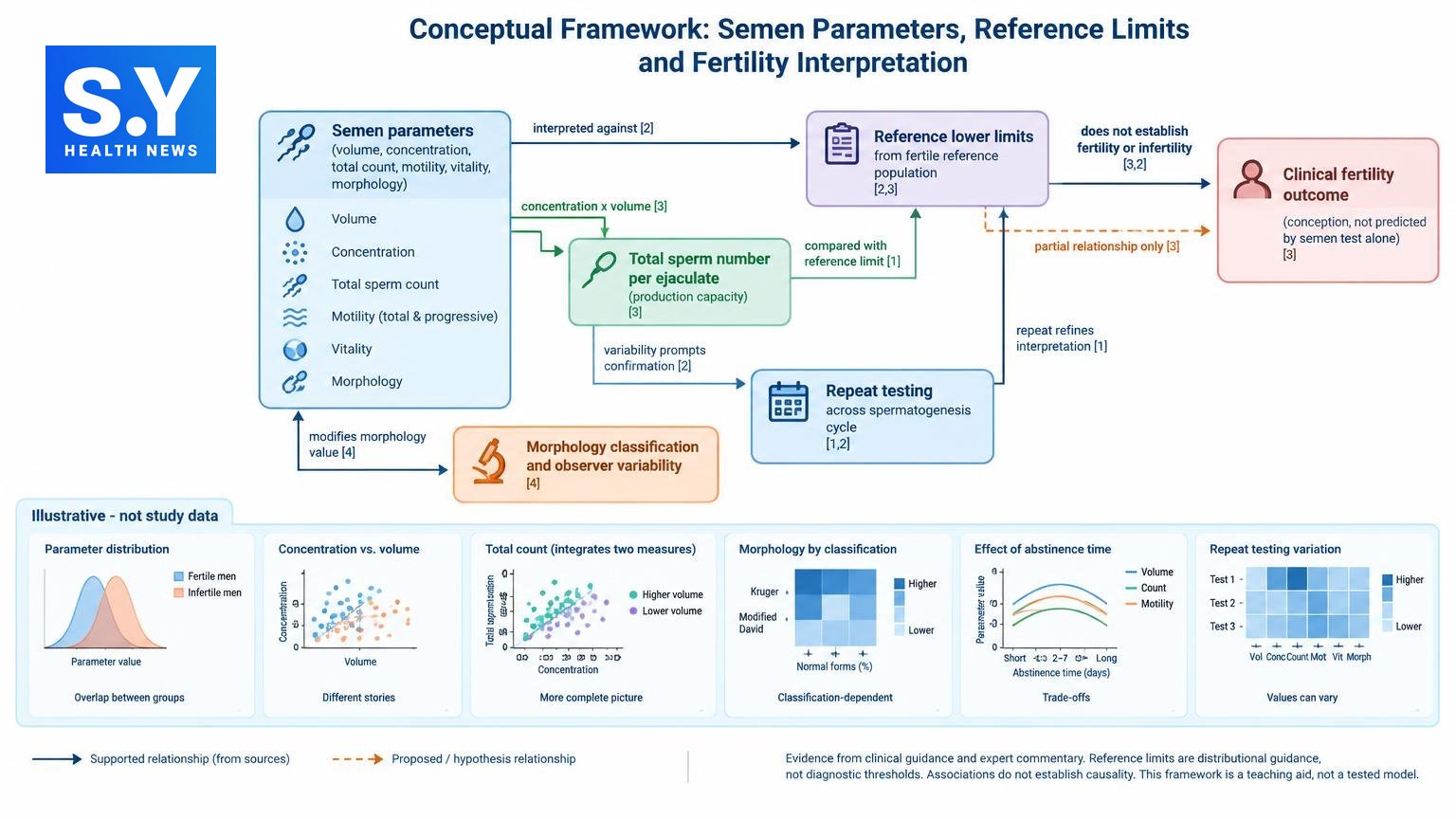
Conceptual framework: Conceptual framework. Semen parameters are read against reference lower limits drawn from fertile men; total sperm number integrates concentration and volume; repeat testing spans spermatogenesis; morphology depends on classification and observer. Arrows marked as supported reflect relationships stated in the supplied sources, while the link to clinical fertility outcomes is proposed and partial. This framework is a teaching aid, not a tested causal model.
Academic References & Evidence
- Kola Tytler. Interpret Semen Analysis Results, and What Are the Key Parameters to A.
- Zülfü Sertkaya. How to Read a Semen Analysis (Spermiogram): What Do the Values Mean? | Assoc. Prof. Zülfü Sertkaya, MD.
- Jerôme PFEFFER; Marlene CESBRON; Patrice CLÉMENT. L'analyse du sperme en 2026 : Mises à jour et informations essentielles à retenir pour les cliniciens très occupés. 2026
- Fivfrance. Spermocytogramme : morphologie des spermatozoïdes, critères Kruger et interprétation (2026).
- 黃珽琦醫師. 男性不孕與精液分析全解析:從精子品質到試管嬰兒成功關鍵 – 台北協育試管嬰兒中心 TAIPEI IVF|原黃建榮婦產科. 2026
- Marita Espejo Catena; Marta Barranquero Gómez; Sergio Rogel Cayetano; Zaira Salvador. Sperm Test Results Explained – Interpretation & Normal Values. 2026
SANYUN Science Center explains published research on men's reproductive and sexual health, connecting scientific evidence with everyday questions while making sources and limitations clear.
Disclaimer: This article is for scientific education and research communication only. It does not provide medical advice, diagnosis, or individualized treatment recommendations, and does not endorse any medication, supplement, device, penile enlargement procedure, or other intervention. Decisions about sexual and reproductive health should be made in consultation with a qualified healthcare professional. Do not delay seeking professional care because of information in this article.
Original Content & Copyright Notice
- This article is prepared for SANYUN Science Center, drawing on published research and publicly available academic literature on men’s sexual and reproductive health. Its editorial explanations and presentation are developed for this platform.
- Copyright in the original editorial content, selection, and arrangement is reserved by SANYUN Science Center to the extent protected by applicable law. Referenced research, quotations, and third-party materials remain subject to the rights of their respective owners. This notice does not claim ownership of scientific facts or third-party research.
- Except where permitted by applicable law or an applicable license, prior written permission is required to reproduce, republish, translate, adapt, redistribute, or commercially reuse protected content. Attribution alone does not grant permission for such reuse.
- For permitted quotation or authorized reuse, clearly identify the source and retain a link to the original article.
- Source: SANYUN Science Center
- Original URL: Retain the original article URL on science.san-yun.com.
- Copyright Holder: SANYUN Science Center, for its own protected editorial content.
- Quotation, excerpts, or authorized reuse must not distort the scientific meaning, omit material limitations or disclaimers, or imply unverified medical claims, product efficacy, or endorsement by SANYUN Science Center.



