




Category: Clinical Insights
Core Research Direction: Within-subject reproducibility and reliability of consecutive semen analyses in young men at risk for infertility (history of cryptorchidism or varicocele) transitioning from pediatric to adult care
Search Intent: In young men at risk for infertility, how much do two consecutive semen analyses vary within the same person, and how reliable is a single sample for classifying fertility potential?
Platform: SANYUN Science Center
Evidence reviewed through: 2026-11-14
Executive Summary
Semen analysis is the backbone of male fertility assessment, and the conventional concern is that one sample may misrepresent a man's reproductive potential because semen parameters fluctuate. A retrospective review examined this question in a narrowly defined group: young men with a history of cryptorchidism or varicocele who submitted two semen samples for fertility evaluation, typically around the time of transition from pediatric to adult care.[1]
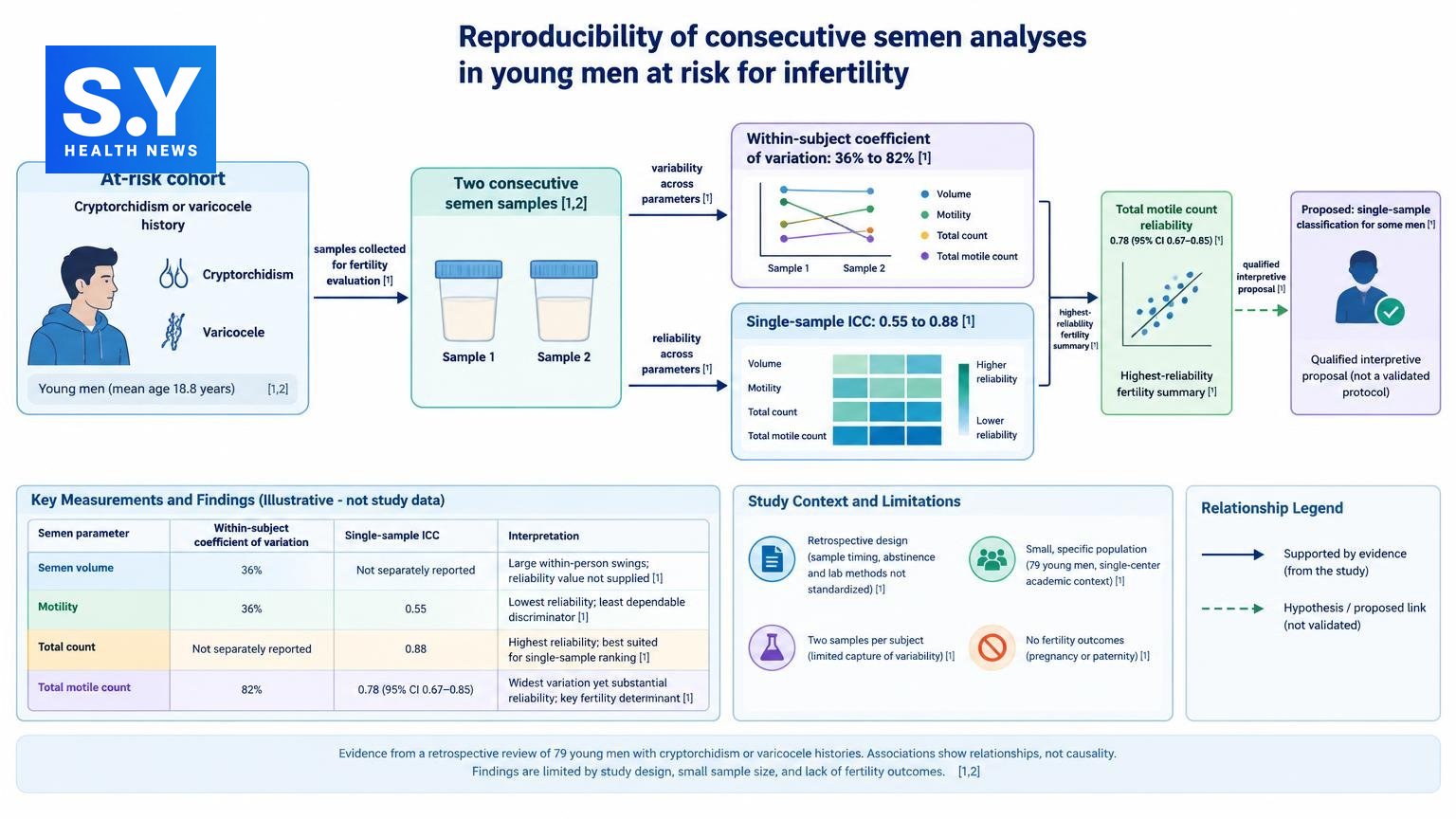
The study included 79 subjects with a mean age of 18.8 ± 1.2 years (range 17.8 to 24.7). Within-subject coefficient of variation was high across parameters, ranging from 36% for volume and motility to 82% for total motile count. Reliability of a single measurement, expressed as the intraclass correlation coefficient, ranged from 0.55 for motility to 0.88 for total count, and was 0.78 (95% CI 0.67–0.85) for total motile count—described by the authors as substantial.
The apparent tension—high variability alongside substantial reliability—is not a contradiction. Variability describes how much an individual's values move between samples; reliability describes how well a single value distinguishes one person from another in a group. The authors concluded that some young men could be appropriately classified from a single measurement, a qualified interpretive claim rather than a validated clinical pathway.
Why This Matters
Cryptorchidism and varicocele are well-recognized risk factors in the male infertility literature, and both commonly prompt semen testing in adolescence or early adulthood. The transition from pediatric to adult care is a practical pressure point: records move, follow-up can lapse, and repeated testing carries cost, travel and the awkwardness many young men feel about providing samples. Knowing how much a second sample is likely to change the clinical picture matters for both clinicians and patients.[2]
The counterweight is equally important. A single sample that falsely suggests poor fertility could generate anxiety, unnecessary escalation or premature conclusions about future fatherhood, while a single favorable sample could create false reassurance. Reproducibility data do not resolve that trade-off on their own, but they define how much confidence a single result can reasonably carry.
Biological and Clinical Mechanism
Semen output is not a fixed physiological quantity. Sperm production and transport are influenced by hormonal rhythms, the interval since last ejaculation, recent febrile illness, testicular temperature, and the method and timing of laboratory processing. The parameters measured also differ in how they are constructed: volume is a direct physical measurement, concentration requires counting, and total motile count multiplies concentration, volume and the proportion of motile sperm, so imprecision in component measures can compound in the composite.
That arithmetic helps explain why total motile count showed the widest within-subject variation at 82% while remaining highly reliable at the group level. A parameter that varies widely across samples can still rank individuals consistently if the between-person spread is wider still. Conversely, motility showed the lowest variability estimate at 36% but the weakest single-sample reliability at 0.55, illustrating that low variation does not automatically mean a dependable discriminator.
The at-risk population adds another layer. Prior cryptorchidism—particularly when surgically corrected—and varicocele are associated with impaired spermatogenesis in some men, but the effect is heterogeneous. A population already enriched for impaired production may show different variability and reliability patterns than healthy young adults, so results cannot be transplanted automatically to unselected men.
What the Evidence Shows
The design was a retrospective review of patients with a history of cryptorchidism or varicocele who had submitted two semen samples for fertility evaluation. A secondary summary describes the cohort as including surgically corrected unilateral or bilateral cryptorchidism or non-operated varicocele, with analyses covering total sperm count, semen volume and semen motility. The authors calculated the within-subject coefficient of variation and the intraclass correlation coefficient for each parameter.
The reported reliability pattern is the study's central result. Total count reached 0.88, the strongest single-sample reliability among the reported parameters, while motility reached only 0.55. Total motile count fell at 0.78 with a 95% confidence interval of 0.67 to 0.85, which the authors characterized as substantial. The secondary summary likewise reports substantial agreement between consecutive analyses, including total motile count.
The authors' interpretation deserves careful reading. They noted within-patient variability in individual parameters but overall substantial agreement between consecutive samples, especially for total motile count, which they describe as the most important determinant of fertility from a semen analysis. From this they proposed that some young men could be appropriately classified from a single measurement during transition from pediatric to adult care.
| Semen parameter | Within-subject coefficient of variation | Single-sample intraclass correlation coefficient | Interpretation |
|---|---|---|---|
| Semen volume | 36% | Not separately reported in the packet | Large within-person swings, but the source summary does not supply a volume-specific reliability value |
| Motility | 36% | 0.55 | Lowest reliability reported; a single motility value is the least dependable discriminator |
| Total count | Not separately reported in the packet | 0.88 | Highest reliability reported; the parameter best suited to single-sample ranking |
| Total motile count | 82% | 0.78 (95% CI 0.67–0.85) | Widest within-person variation yet substantial reliability; described by the authors as the key fertility determinant |
The table makes the central distinction concrete: variability and reliability answer different questions. A man's total motile count may move substantially between two ejaculates, yet a single total motile count still places him reasonably well relative to other men in the cohort. This is why the authors could simultaneously acknowledge high variability and argue for substantial agreement.
Interpretation and Limitations
Several constraints limit how far this should shape practice. The study is retrospective, which means sample collection intervals, abstinence times and laboratory methods were not prospectively standardized; those factors directly influence semen variability. With only two samples per subject, a single within-subject coefficient of variation cannot capture day-to-day or seasonal patterns, and estimates based on two observations are statistically fragile.
The population is small and specific. Seventy-nine young men around age 19 with cryptorchidism or varicocele histories were studied in what appears to be a single-center academic context, and the available record reports results at abstract level without full covariate adjustment, full distributional details or clinical fertility outcomes. No pregnancy or paternity data were reported, so reliability of a semen parameter is not the same as predictive validity for fatherhood.
The conclusion itself is carefully hedged, stating that it is possible to appropriately classify some young men from a single measurement. Some is doing real work here. The data do not identify which men, which thresholds, or which clinical decisions a single sample can safely support, and they do not justify abandoning a second confirmatory sample for men with borderline or poor results.
There is also a reference-standard problem. The World Health Organization's laboratory manual on the examination of human semen provides standardized methods that underpin modern interpretation of concentration, motility and morphology. The available record does not specify which laboratory standards were used, so comparison with contemporary reference limits should be tentative.
Research Outlook
What would strengthen this evidence base is prospective collection with defined abstinence intervals, standardized laboratory methods and more than two samples per participant, ideally spanning months rather than a single transition visit. Mixed models separating within-person variance from between-person variance would give more stable reliability estimates than two-observation calculations.
Clinical usefulness would also require linking semen parameters to outcomes that matter to patients—time to conception, need for assisted reproduction, and referral decisions—in the same at-risk population. Until then, the sensible reading is that a single total motile count carries meaningful information in this group, but individual parameters such as motility remain too noisy to stand alone.
Key Takeaways
- In 79 young men around age 19 with cryptorchidism or varicocele histories, two consecutive semen analyses showed high within-subject variability, with coefficients of variation from 36% to 82%.
- Single-sample reliability ranged from 0.55 for motility to 0.88 for total count; total motile count reached 0.78 (95% CI 0.67–0.85), described as substantial.
- Variability and reliability measure different things, and a parameter can vary widely within a person while still ranking that person reliably in a group.
- The authors proposed that some young men could be classified from a single measurement, but this is a qualified hypothesis, not a validated one-sample protocol.
- Retrospective design, two samples per subject, abstract-level reporting and no fertility outcomes limit how far these findings can guide clinical decisions.
Questions and Answers
What is within-subject variability in semen analysis and why does it matter?
It describes how much an individual's semen parameters change between separate samples. In the reviewed cohort, the within-subject coefficient of variation ranged from 36% for volume and motility to 82% for total motile count. High variability means a single result may not reflect a man's typical output, which is why repeat testing is traditionally considered.
How reliable is a single semen analysis in young men with cryptorchidism or varicocele?
Single-sample intraclass correlation coefficients ranged from 0.55 for motility to 0.88 for total count, with 0.78 (95% CI 0.67–0.85) for total motile count. Total count and total motile count were therefore reasonably reliable at the group level, whereas motility was less dependable as a stand-alone discriminator.
How variable was total motile count between two consecutive semen samples?
Total motile count showed the largest within-subject coefficient of variation reported, at 82%, despite having substantial reliability of 0.78 (95% CI 0.67–0.85). This combination indicates large individual swings alongside good ability to rank individuals relative to one another in this cohort.
Can one semen sample classify fertility potential in young men transitioning from pediatric to adult care?
The authors suggested it may be possible to appropriately classify some young men from a single measurement during this transition. That is a qualified hypothesis. The study did not identify which patients or thresholds qualify, and borderline or poor results would generally warrant confirmatory testing rather than a one-sample conclusion.
What are the main limitations of the semen analysis reproducibility study?
It was a retrospective review of 79 young men with two samples each, reported at abstract level, without standardized collection timing or clinical fertility outcomes. Two observations give fragile variance estimates, and the specific at-risk population limits generalization to unselected men or other age groups.
Why can variability be high while reliability is substantial in semen testing?
Variability measures movement of values within one person; reliability measures how well a single value separates people from each other. If between-person differences are wider than within-person swings, a single total motile count can still rank a man meaningfully even though his own count changes substantially between samples.
Conceptual framework: Conceptual framework: in a retrospective review of 79 young men with cryptorchidism or varicocele histories (mean age 18.8 years), two consecutive semen samples yielded high within-subject variability (36% to 82%) alongside substantial single-sample reliability (intraclass correlation 0.55 to 0.88; total motile count 0.78). The dashed proposal that some men could be classified from one sample is hypothetical, not a validated protocol.
Academic References & Evidence
- Reproducibility and Reliability of Semen Analysis in Youths at Risk for Infertility | Journal of Urology. 2013
- Reproducibility and Reliability in Youths at Risk for Infertility.
SANYUN Science Center explains published research on men's reproductive and sexual health, connecting scientific evidence with everyday questions while making sources and limitations clear.
Disclaimer: This article is for scientific education and research communication only. It does not provide medical advice, diagnosis, or individualized treatment recommendations, and does not endorse any medication, supplement, device, penile enlargement procedure, or other intervention. Decisions about sexual and reproductive health should be made in consultation with a qualified healthcare professional. Do not delay seeking professional care because of information in this article.
Original Content & Copyright Notice
- This article is prepared for SANYUN Science Center, drawing on published research and publicly available academic literature on men’s sexual and reproductive health. Its editorial explanations and presentation are developed for this platform.
- Copyright in the original editorial content, selection, and arrangement is reserved by SANYUN Science Center to the extent protected by applicable law. Referenced research, quotations, and third-party materials remain subject to the rights of their respective owners. This notice does not claim ownership of scientific facts or third-party research.
- Except where permitted by applicable law or an applicable license, prior written permission is required to reproduce, republish, translate, adapt, redistribute, or commercially reuse protected content. Attribution alone does not grant permission for such reuse.
- For permitted quotation or authorized reuse, clearly identify the source and retain a link to the original article.
- Source: SANYUN Science Center
- Original URL: Retain the original article URL on science.san-yun.com.
- Copyright Holder: SANYUN Science Center, for its own protected editorial content.
- Quotation, excerpts, or authorized reuse must not distort the scientific meaning, omit material limitations or disclaimers, or imply unverified medical claims, product efficacy, or endorsement by SANYUN Science Center.



