




Category: Health Academy
Core Research Direction: Patient-facing explanation of what a semen analysis measures, how samples are collected, what affects the results, and how abnormal or borderline results are interpreted and repeated
Search Intent: What does a semen analysis actually measure, and what do abnormal or variable results really mean for a man's fertility?
Platform: SANYUN Science Center
Evidence reviewed through: 2026-11-07
Executive Summary
A semen analysis is a non-invasive laboratory test that examines a fresh ejaculate sample under a microscope. It supports male fertility investigation, helps confirm the success of vasectomy, and can be used to follow conditions or treatments that affect sperm production. The test is inexpensive, quick to perform and usually well tolerated, but its results are not a direct measure of whether a man can father a child.[1][2]
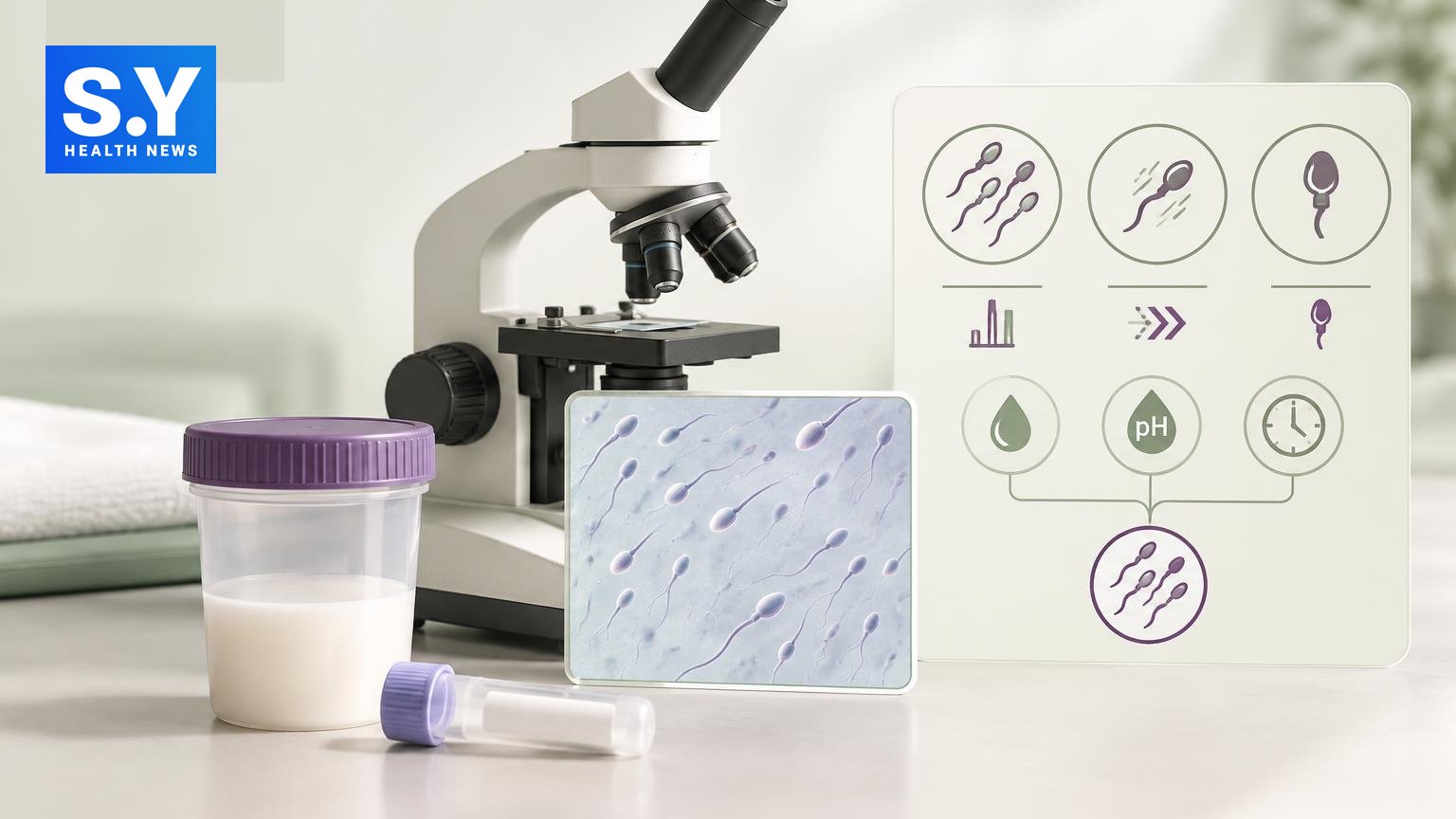
Most laboratories report three core sperm measures: concentration (how many sperm per millilitre), motility (the percentage that are moving) and morphology (the percentage with normally shaped structures). Samples may also be assessed for volume and pH, and some laboratories record liquefaction time. These measurements are combined to understand how many moving sperm are present in the entire ejaculate, often called total motile sperm.[3]
A single semen analysis can fluctuate substantially. Results depend on abstinence time, recent illness, sample transport, collection method and natural biological variation. For this reason, abnormal or borderline results are usually repeated before conclusions are drawn about long-term sperm production. The sources differ on recommended abstinence windows and repeat intervals, which reflects genuine variation in laboratory practice rather than one universal standard.[4]
Why This Matters
Fertility is often discussed as if it were mostly a female concern, yet male factor issues are widely acknowledged to contribute to a substantial share of conception difficulties. One clinic states that male factor issues contribute to around half of all conception difficulties, and another states that male fertility accounts for roughly half of all infertility cases. These approximate figures are not attributed to a specific study in the source material, so they are best treated as broad orientation rather than precise epidemiology.
For couples trying to conceive for 12 months or more without success, semen analysis is recommended as one of the first tests in fertility investigation. It is also used after vasectomy to confirm that no sperm remain in the semen, and to follow up conditions such as varicocele or undescended testis. Because it is cheap and non-invasive, it can be done early and can spare couples more invasive investigations if a clear male factor is identified.
What the Test Measures
Sperm concentration is defined as the number of sperm per millilitre of ejaculate. It is not the same as total sperm count, which also depends on volume. Motility refers to the percentage of sperm in the sample that are moving or swimming normally. Morphology examines the shape of sperm and the condition of key structures such as the head, midpiece and tail. Some laboratories also report volume, pH and liquefaction time, which describes how quickly semen becomes fluid after ejaculation.
These values are used together. Total motile sperm, for example, is calculated from concentration, motility and sample volume, and represents the number of moving sperm in the whole ejaculate. This matters because a sample with a modest concentration but a large volume could contain more moving sperm than a smaller sample with a higher concentration. Clinicians use this calculation when deciding whether procedures such as intrauterine insemination or cryopreservation are appropriate, but the exact thresholds used vary by clinic and are not specified in the sources here.
| Measure | What it describes | Why it matters |
|---|---|---|
| Sperm concentration | Number of sperm per millilitre of ejaculate | A low value is called oligospermia; it is one component used to judge fertility |
| Motility | Percentage of sperm that are moving or swimming normally | Reflects the proportion of sperm capable of reaching and potentially fertilising an egg |
| Morphology | Shape of sperm and status of key structures | Abnormal shapes can make it harder for sperm to fertilise an egg |
| Volume and pH | Overall health and chemical balance of the ejaculate | Provides context for how many total sperm are present and whether the sample is typical |
| Liquefaction time | How quickly semen becomes fluid after collection | Aids laboratory handling and may be part of the reported assessment |
| Total motile sperm | Number of moving sperm in the entire sample | Used in decisions about certain assisted reproduction procedures |
How a Sample Is Collected
Samples are usually produced by masturbation into a sterile, wide-mouth container. Collection in a private room at the clinic or laboratory is preferred because it minimises the time between ejaculation and analysis. Some clinics also allow home collection if the sample is delivered quickly. One hospital advises that a home-collected sample must reach the laboratory within one hour, while a fertility clinic states samples should arrive within 45 minutes. These instructions reflect operational practice rather than a single agreed rule.
Standard lubricants, condoms and saliva should not be used during collection because they can damage sperm cells. If a condom is needed for collection, the clinic should supply a non-spermicidal collection condom rather than an ordinary one. Hands should be washed beforehand to reduce contamination, and the sample container should be sealed and labelled according to the laboratory's instructions. Partners are sometimes allowed in the collection room, but oral contact with the sample should be avoided because saliva can affect sperm viability.
Abstinence before the test is important, but the recommended window differs across sources. One clinic asks for one day of abstinence and two to three ejaculations in the preceding week; another advises two to five days; a hospital requires two to seven days. The common principle is that both a very short and a very long abstinence period can distort results. A short interval may reduce ejaculate volume and sperm count, while a long interval can increase volume but reduce motility because older sperm are less active. Men should follow the specific instructions given by their own laboratory.
Recent illness is another consideration. Because new sperm production takes roughly 74 days according to one clinic, a high fever or flu a few weeks before the test can temporarily lower sperm quality. One hospital advises that if a febrile illness has occurred recently, testing is preferably done two to three months later. This is a general precaution, not proof that every fever will cause a clinically important change.
What the Evidence Says About Results
The core measures are well established in clinical practice, but the sources here are patient information pages, not trials or systematic reviews. That means the article can explain what the test measures and how results are typically handled, but it cannot quantify how often a given result leads to pregnancy or how much treatment improves outcomes. Readers should treat the figures as practical guidance from clinics rather than as newly generated evidence.
A semen analysis can identify lower-than-average sperm count (oligospermia), poor motility, abnormal morphology and complete absence of sperm in the fluid (azoospermia). It is also used after vasectomy to confirm sterility. However, a normal result does not guarantee fertility, and an abnormal result does not necessarily mean that natural conception is impossible. The test measures features of the ejaculate; it does not directly test the sperm's ability to fertilise an egg or the ability of a couple to conceive.
Even when two tests show no sperm, sperm may still be found surgically in most men with a blockage and in around 40% of men with a sperm-production problem where the testes are not working properly. This figure is uncited and applies specifically to a subgroup of men with azoospermia, not to all men with no sperm in the ejaculate. It illustrates why azoospermia is a finding that requires specialised urological assessment rather than an immediate conclusion that fatherhood is impossible.
Interpreting Abnormal or Borderline Results
Results should be interpreted by a clinician, usually a urologist or fertility specialist, in the context of the couple's history. The sources do not provide universal cut-off values for what counts as abnormal. One hospital states that results are reported according to WHO 2021 reference values, but the actual thresholds are not listed in the packet. This absence is important: reference ranges describe a distribution in a reference population, not a binary fertility diagnosis. A value near a threshold should be considered alongside motility, morphology, total motile sperm and clinical history.
Because sperm counts fluctuate, it is common for clinics to analyse two or more semen samples at separate intervals. One clinic states that a semen analysis can be repeated after four to six weeks to determine whether abnormalities are permanent or temporary. Another recommends repeating borderline or abnormal results after two to four weeks. A third recommends two tests three months apart before concluding that there is a long-term reduction in sperm count. These intervals are not identical, and the best timing depends on the clinical question and the laboratory's protocols.
A single abnormal result is not diagnostic on its own. Comprehensive assessment may include repeat semen analyses, hormone blood tests and, when sperm count is very low or absent, genetic testing. Genetic tests may look for Y-chromosome microdeletions, karyotype abnormalities or CFTR mutations associated with congenital absence of the vas deferens. Hormone tests typically measure FSH, LH, testosterone and prolactin to assess how the testes and pituitary gland are functioning. These additional tests are not routine for every man and are chosen based on the initial findings.
If the semen analysis is normal, a clinician may recommend that the partner be evaluated before ordering further male tests. If abnormalities are found, they may be temporary or permanent, and management can include lifestyle changes, treatment of infection, varicocele repair, hormone treatment, or assisted reproduction such as intrauterine insemination or in vitro fertilisation. These options are described by clinics as possible pathways, not as guaranteed solutions, and the sources do not report comparative success rates.
What Can Affect the Sample
Sperm quality can be affected by a range of factors. The sources mention infections, high fever, congenital testicular abnormalities, varicocele, drug use, smoking, excessive alcohol and excessive heat such as hot tubs and saunas. These factors may act through different mechanisms—for example, fever can temporarily disrupt sperm production, while varicocele may affect temperature regulation in the testis—but the sources do not provide detailed evidence for each mechanism. The practical message is that a recent illness or a significant lifestyle factor should be mentioned to the clinician interpreting the test.
Collection and transport also matter. Prolonged transport time may reduce the reliability of results, and some clinics require delivery within 45 minutes or one hour. The laboratory may wait for liquefaction, usually 15 to 30 minutes, before microscopic evaluation. Samples are typically analysed the same day to support accuracy. These steps are about preserving the sample, not about changing the underlying biology, but they can influence the reported numbers.
Research Outlook
The sources are clinical explainers, not research studies, and they do not describe new experiments in progress. They do, however, point to areas where more evidence would help patients: how to standardise abstinence instructions, how to choose the best repeat interval, and how to interpret borderline values in the context of total motile sperm and morphology. Future guidance could clarify when additional tests such as hormone and genetic testing are most useful, and how to communicate uncertainty without causing unnecessary alarm.
Key Takeaways
- A semen analysis measures sperm concentration, motility and morphology, and often volume, pH and liquefaction time. Total motile sperm is calculated from concentration, motility and volume.
- Abstinence instructions vary between clinics, from one day to seven days. Follow the specific instructions from your laboratory, because both very short and very long intervals can distort results.
- Semen results fluctuate. Abnormal or borderline findings are usually repeated, but the sources recommend different intervals, ranging from two to four weeks to three months apart.
- A single abnormal result is not diagnostic. Comprehensive assessment can include repeat tests, hormone bloodwork and genetic testing when sperm count is very low or absent.
- Even azoospermia (no sperm in the ejaculate) does not always mean no sperm are present. One uncited figure states that sperm may be found surgically in around 40% of men with a sperm-production problem, and in most men with a blockage.
- A normal semen analysis does not prove fertility, and an abnormal one does not prove infertility. Results should be interpreted by a clinician alongside the couple's history and other tests.
Questions and Answers
What does a semen analysis measure?
A semen analysis measures sperm concentration (sperm per millilitre), motility (percentage moving normally) and morphology (shape and structure). Many laboratories also report sample volume, pH and liquefaction time. These values can be combined to calculate total motile sperm, which is the number of moving sperm in the whole ejaculate. The test is a laboratory assessment of the sample, not a direct test of whether a couple will conceive.
How long should a man abstain before a semen analysis?
Recommendations vary. One clinic asks for one day of abstinence and two to three ejaculations in the preceding week; another advises two to five days; a hospital requires two to seven days. Both very short and very long abstinence can distort results. Men should follow the specific instructions from their own laboratory rather than assuming one universal rule.
Why are semen analysis results repeated?
Sperm counts and other semen parameters naturally fluctuate, so a single result may not reflect long-term sperm production. Clinics commonly analyse two or more samples. When an abnormality is found, one clinic suggests repeating after four to six weeks, another after two to four weeks, and another recommends two tests three months apart. The best interval depends on the clinical question and laboratory protocol.
What does an abnormal semen analysis mean for fertility?
An abnormal result does not automatically mean infertility. It indicates that one or more semen parameters are outside the reference range, but a single test is not diagnostic. Clinicians interpret results alongside repeat tests, the couple's history, hormone tests and sometimes genetic tests. Some causes, such as infection or recent fever, may be temporary, and assisted reproduction may still be possible. A specialist can discuss the meaning and options for the individual case.
Can semen analysis results vary because of how the sample is collected?
Yes. Collection method, abstinence time, transport time and recent illness can affect results. Standard lubricants, condoms and saliva can damage sperm, so clinics provide appropriate containers and instructions. Prolonged transport may reduce reliability, and some clinics require delivery within 45 minutes or one hour. Waiting for liquefaction (usually 15 to 30 minutes) is standard before microscopic evaluation. Following laboratory instructions helps reduce avoidable variation.
Does a normal semen analysis guarantee that a man can father a child?
No. A normal semen analysis means the measured parameters fall within the laboratory's reference range, but it does not directly prove that sperm can fertilise an egg or that a couple will conceive. Fertility depends on many factors, including the partner's reproductive health. Conversely, an abnormal result does not prove infertility. The test is one part of a broader fertility assessment, and results should be discussed with a clinician.
Sources and References
- Semen Analysis in Cambridge | Cambridge Urology. 2026
- What Can I Expect from a Semen Analysis? Andrology & Fertility FAQs.
- Inception Fertility. Male Fertility Tests: Semen Analysis & Beyond | Blog. 2026
- Semen analysis | Tıbbi Hizmetler | Saygı Hastanesi.
SANYUN Science Center explains published research on men's reproductive and sexual health, connecting scientific evidence with everyday questions while making sources and limitations clear.
Disclaimer: This article is for scientific education and research communication only. It does not provide medical advice, diagnosis, or individualized treatment recommendations, and does not endorse any medication, supplement, device, penile enlargement procedure, or other intervention. Decisions about sexual and reproductive health should be made in consultation with a qualified healthcare professional. Do not delay seeking professional care because of information in this article.
Original Content & Copyright Notice
- This article is prepared for SANYUN Science Center, drawing on published research and publicly available academic literature on men’s sexual and reproductive health. Its editorial explanations and presentation are developed for this platform.
- Copyright in the original editorial content, selection, and arrangement is reserved by SANYUN Science Center to the extent protected by applicable law. Referenced research, quotations, and third-party materials remain subject to the rights of their respective owners. This notice does not claim ownership of scientific facts or third-party research.
- Except where permitted by applicable law or an applicable license, prior written permission is required to reproduce, republish, translate, adapt, redistribute, or commercially reuse protected content. Attribution alone does not grant permission for such reuse.
- For permitted quotation or authorized reuse, clearly identify the source and retain a link to the original article.
- Source: SANYUN Science Center
- Original URL: Retain the original article URL on science.san-yun.com.
- Copyright Holder: SANYUN Science Center, for its own protected editorial content.
- Quotation, excerpts, or authorized reuse must not distort the scientific meaning, omit material limitations or disclaimers, or imply unverified medical claims, product efficacy, or endorsement by SANYUN Science Center.



