


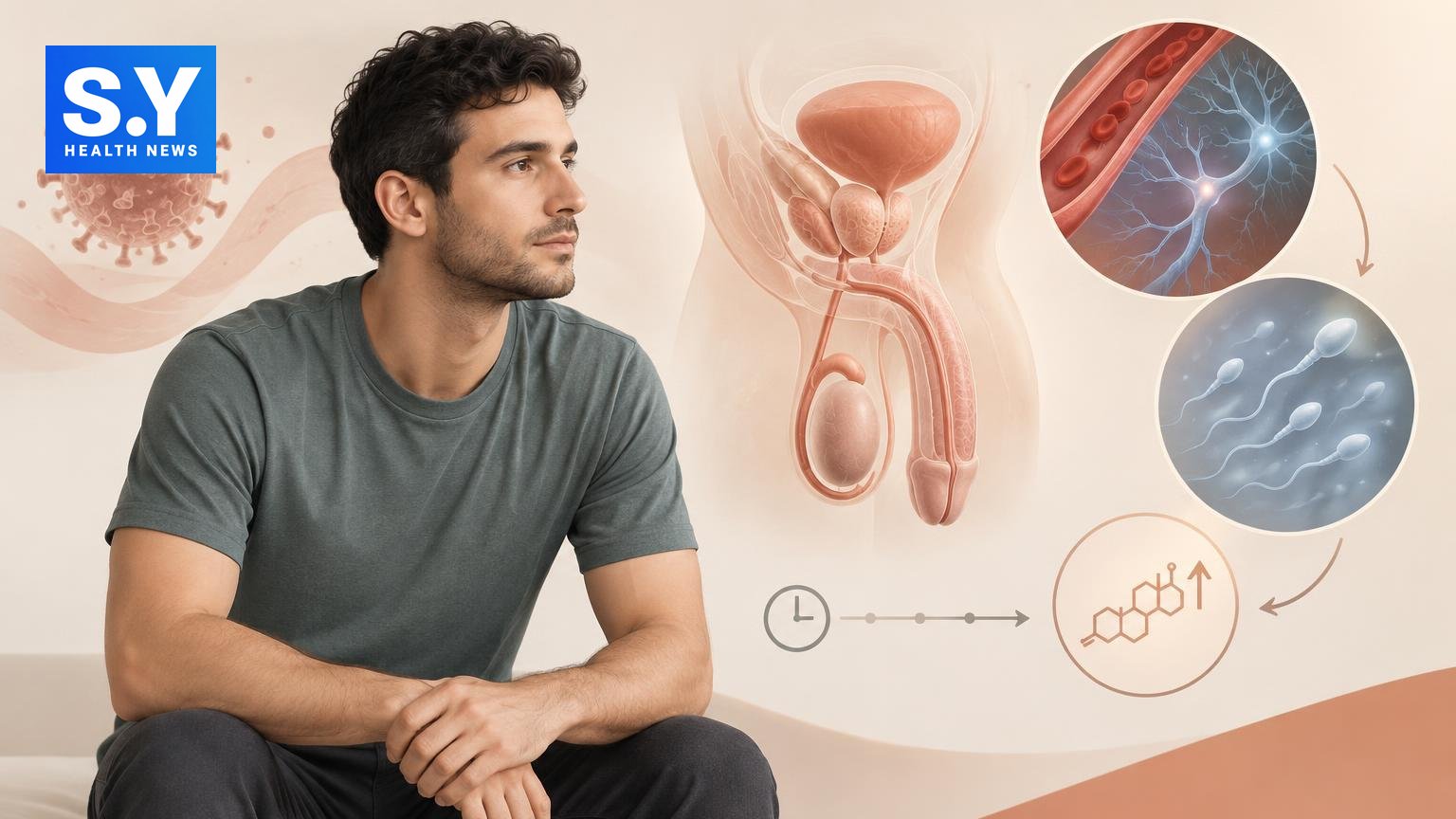


Category: Reproductive Care
Core Research Direction: Seminal and gonadal effects of SARS-CoV-2 infection: what prospective semen-parameter and testosterone follow-up studies can and cannot show
Search Intent: After recovering from COVID-19, do men's semen quality and testosterone levels change—and for how long?
Platform: SANYUN Science Center
Evidence reviewed through: 2026-11-13
Executive Summary
A comparative summary of nine observational studies, published in 2024, suggests that some men recovering from SARS-CoV-2 infection show measurable differences in semen parameters, most often lower sperm counts, sperm concentration or motility, when compared with controls or with their own earlier samples. The largest prospective study in that summary, involving 55 patients and 145 controls sampled at a mean of 77.3 days after recovery, reported reduced sperm counts, concentration and motility, with no significant difference in semen volume or progressive motility. Trends across the table are inconsistent: results vary by semen parameter, by study design and by how long after recovery sampling occurred.[1]
The summary condenses each study into significance directions: reduced, not significant, elevated or not available. It does not report effect sizes, confidence intervals or the number of men contributing to each individual parameter. That makes it useful for mapping the direction of early findings and unsuitable for estimating how much any individual's semen quality might change, or for how long.
- Most of the summarized prospective studies reported at least one reduced semen parameter in the months after recovery; sperm counts and concentration were the parameters most often affected.
- A cross-sectional study of 29 men assessed a mean of 4.52 months after recovery found no significant differences in any reported semen parameter.
- Testosterone findings were sparse: one study of 21 men reported elevated testosterone, while another of 26 men reported no significant difference, leaving the hormonal picture unresolved.
Why This Matters
Semen quality and testosterone are common sources of anxiety after a viral illness, and respiratory viruses with systemic symptoms have long been studied for possible short-term effects on male reproductive function. Because sperm production takes roughly two to three months to complete a cycle, any disturbance during or shortly after an acute illness could plausibly surface in semen analyses weeks to months later. That biological timing is one reason follow-up period matters when interpreting these studies.
At the same time, fertility concerns after COVID-19 need to be placed in proportion. The available studies are small and observational, and the summarized results are directional rather than quantified. Population-level fertility data are not required here and are not offered by this evidence. The practical value of the research is more modest: it helps couples and clinicians understand why a transient change on a semen analysis after a significant illness would not by itself be alarming, while making clear that persistent concerns deserve proper clinical assessment rather than interpretation of a single study.
What Prospective Semen Follow-Up Actually Measures
A semen analysis is a panel of measurements, not a single score. The summary table separates semen volume, sperm counts, sperm concentration, total motility, progressive motility, vitality and abnormal sperm morphology. Each of these can move independently, and a study can report a significant change in one parameter while finding nothing in another. That pattern is visible across the summarized studies and is one reason headline statements such as 'COVID-19 lowers sperm quality' are too coarse.
Two designs dominate the table. Some studies compared men who had recovered from infection with separate control groups, while others used a self-control approach, comparing the same men before and after infection or against earlier samples. The first design is vulnerable to differences between groups, including age and timing; the second is stronger on within-person comparison but depends on the availability and timing of prior samples.
| Study design | Patients and controls | Sampling after recovery | Reported semen findings |
|---|---|---|---|
| Prospective, no self-control | 41 patients, 50 controls | 56 and 84 days | Reduced counts, concentration, motility and progressive motility; volume, vitality and morphology not significant |
| Prospective, self-controlled | 21 patients | 51 days | Reduced volume, motility and progressive motility; abnormal morphology elevated; counts and concentration not significant |
| Prospective, no self-control | 55 patients, 145 controls | Mean 77.3 days | Reduced counts, concentration and motility; volume and progressive motility not significant |
| Prospective, no self-control | 36 patients, 45 controls | 83 and 175 days | Reduced sperm counts; volume, concentration, motility and progressive motility not significant |
| Prospective, no self-control | 22 patients, 36 controls | Mean 91.5 days | Reduced volume and concentration; other parameters not significant |
| Prospective, self-controlled | 24 patients | Mean 111.5 days | Reduced concentration; volume and motility not significant |
| Cross-sectional, self-controlled | 29 patients | Mean 4.52 months | No significant differences in any reported semen parameter |
What the Evidence Shows on Sampling Time
The most conspicuous pattern in the summary is not a single parameter but a difference in study conclusions by timing. Studies sampling within roughly the first three months after recovery more often reported reductions in at least one semen parameter, whereas the cross-sectional study assessed at a mean of 4.52 months found no significant differences in any reported parameter. That is consistent with gradual restoration of sperm production over time, but it is also precisely the kind of pattern that can arise from comparing different groups of men in different studies.
The data do not settle the question of trajectory. Most studies contribute a single sampling window, and even the one prospective study with two time points at 83 and 175 days reported reduced sperm counts without significant differences in the other parameters, which is difficult to map onto a simple recovery curve. A study with repeated semen analyses in the same men, spanning the acute phase and several months beyond, would be needed to describe how parameters change over time within individuals.
Very short follow-up also complicates interpretation. A cohort study of only four patients sampled a mean of 25.5 days after recovery found reduced counts, concentration, motility and progressive motility compared with 14 controls. The short interval and the small patient group make that finding vulnerable to transient factors such as fever and illness severity, which were not characterized in the summary.
Testosterone and Viral Presence in Semen
The hormonal picture is thinner than the semen picture. Only a few summarized studies reported testosterone at all. One self-controlled prospective study of 21 men, sampled at 51 days, reported elevated testosterone alongside reduced semen volume and motility and elevated abnormal sperm morphology. A retrospective self-controlled study of 26 men, sampled more than 4 months after recovery, reported no significant testosterone difference and no significant differences in volume, counts, concentration, motility or progressive motility, though abnormal sperm morphology was again reported as elevated.
These entries point in different directions and involve small numbers. Elevated testosterone in one small sample could reflect normal variability, a difference in how and when blood was drawn, or other factors not captured in a summary. None of this establishes a hormonal effect of infection, and the table explicitly marks testosterone as not available in most of the studies it lists, which limits any broader conclusion.
Detection of virus in semen is a separate and frequently conflated question. The summary reports whether virus was found in semen in each study, but detection of viral material does not by itself establish infectivity or a direct effect on sperm-producing tissue, and the table does not provide the underlying methods. Readers should treat the two questions, whether the virus can be found in semen and whether semen parameters change, as distinct.
Interpretation and Limitations
The central limitation is that the summary reports direction and statistical significance without magnitude. 'Reduced' can mean a small shift or a large one, and 'no significance' can reflect either no true difference or a sample too small to detect one. With patient groups ranging from 4 to 55 men across the summarized studies, statistical power varies enormously, and a larger study could reasonably find a significant difference where a small one did not.
Statistical significance is not the same as clinical importance. A statistically significant reduction in sperm concentration in a group of men does not mean an individual's fertility is impaired, particularly since semen parameters fluctuate naturally and can be affected by fever, stress, sleep and the interval since the last ejaculation. None of the summarized studies is positioned to answer whether fertility outcomes, rather than laboratory parameters, differ after infection, because fertility outcomes are not reported here.
Observational designs also leave open alternative explanations. Men recovering from a systemic illness may differ from controls in age, health status, medication use or time since infection. The summary gives average ages but little else about confounding, and where studies did not use a self-control design, baseline differences between patients and controls cannot be fully removed. The morphology entries, reported as 'elevated' for abnormal forms without numeric context in two studies, are a useful reminder that direction and magnitude are not interchangeable.
Finally, the table is a secondary summary of studies, not a pooled analysis. Individual studies used different laboratory methods, different definitions for abnormal parameters and different sampling schedules. Combining them into a single narrative about 'COVID-19 and semen' would overstate the coherence of the underlying evidence.
Research Outlook
The most informative next step would be prospective cohorts with repeated, standardized semen analyses and hormone measurements in the same men, enrolled at the time of acute infection and followed for at least six to twelve months. Such designs could distinguish transient illness effects from persistent changes and could report effect sizes rather than significance categories alone. Blood draws standardized by time of day would matter for testosterone, which varies diurnally.
Studies that record fever severity, medication use, vaccination status and time from illness to sampling would help separate a general effect of illness from an effect specific to SARS-CoV-2. Measuring fertility outcomes, rather than laboratory parameters alone, would move the field from inference about risk to evidence about what actually matters to couples. Until such evidence exists, the current literature supports cautious reassurance about the likelihood of transient laboratory changes, not confident claims about cause.
Key Takeaways
- Several small prospective studies summarize reductions in sperm counts, concentration or motility in the months after COVID-19 recovery, but the summary reports directions, not effect sizes.
- A cross-sectional study of 29 men assessed at a mean of 4.52 months after recovery found no significant differences in the reported semen parameters, consistent with possible recovery over time but not proof of it.
- Testosterone findings are limited to a few small studies with conflicting directions, and most studies in the summary did not report testosterone.
- The evidence is observational and small, and it cannot establish whether semen findings reflect a specific viral effect or a general effect of illness.
- Persistent fertility concerns after recovery should prompt a proper clinical assessment rather than reliance on any single study.
Questions and Answers
Do semen parameters change after COVID-19 recovery?
Several small prospective studies summarized in a 2024 comparative table reported reductions in sperm counts, concentration or motility in the months after recovery, most often with sampling within the first three months. A cross-sectional study assessed at a mean of 4.52 months after recovery found no significant differences. The summary reports only whether findings were statistically significant, not how large the changes were, so the evidence describes directions rather than magnitudes.
What is the difference between self-controlled and control-group semen studies after SARS-CoV-2 infection?
Self-controlled studies compare the same men before and after infection or against earlier samples, which reduces differences related to age or baseline health. Control-group studies compare patients with separate controls; the summarized studies used varying numbers of controls and no self-control in several cases. Both designs are observational, and the table reports neither effect sizes nor full adjustment details for confounders.
Does COVID-19 affect testosterone levels in men?
The summarized evidence is sparse and conflicting. A self-controlled prospective study of 21 men sampled at 51 days reported elevated testosterone, while a retrospective self-controlled study of 26 men sampled more than 4 months after recovery reported no significant difference. Most studies in the summary did not report testosterone at all, and the small sample sizes mean neither direction should be treated as established.
How long do changes in sperm quality last after COVID-19?
This cannot be answered from the available summary. Most studies contributed a single sampling window, and the one prospective study with two time points at 83 and 175 days reported reduced sperm counts without significant differences in other parameters. A cross-sectional study at a mean of 4.52 months found no significant differences. These observations are consistent with gradual recovery but do not establish a timeline for individual men.
How strong is the evidence that COVID-19 reduces sperm count?
The evidence is observational and small. Patient groups in the summarized studies ranged from 4 to 55 men, and the table condenses findings into significance directions without effect sizes or confidence intervals. A reduction in a study group does not mean an individual man's fertility is impaired, and semen parameters fluctuate naturally for many reasons. Current evidence is hypothesis-relevant rather than definitive.
What are the main limitations of follow-up studies on semen quality after COVID-19?
Key limits include small samples, varied sampling times, mixed designs, lack of effect sizes in the summary, and limited adjustment for confounders such as age, fever severity and medication use. Detection of virus in semen is a separate question from changes in semen parameters. The summary is a secondary table rather than a pooled analysis, so methods and definitions differ across the underlying studies.
Sources and References
SANYUN Science Center explains published research on men's reproductive and sexual health, connecting scientific evidence with everyday questions while making sources and limitations clear.
Disclaimer: This article is for scientific education and research communication only. It does not provide medical advice, diagnosis, or individualized treatment recommendations, and does not endorse any medication, supplement, device, penile enlargement procedure, or other intervention. Decisions about sexual and reproductive health should be made in consultation with a qualified healthcare professional. Do not delay seeking professional care because of information in this article.
Original Content & Copyright Notice
- This article is prepared for SANYUN Science Center, drawing on published research and publicly available academic literature on men’s sexual and reproductive health. Its editorial explanations and presentation are developed for this platform.
- Copyright in the original editorial content, selection, and arrangement is reserved by SANYUN Science Center to the extent protected by applicable law. Referenced research, quotations, and third-party materials remain subject to the rights of their respective owners. This notice does not claim ownership of scientific facts or third-party research.
- Except where permitted by applicable law or an applicable license, prior written permission is required to reproduce, republish, translate, adapt, redistribute, or commercially reuse protected content. Attribution alone does not grant permission for such reuse.
- For permitted quotation or authorized reuse, clearly identify the source and retain a link to the original article.
- Source: SANYUN Science Center
- Original URL: Retain the original article URL on science.san-yun.com.
- Copyright Holder: SANYUN Science Center, for its own protected editorial content.
- Quotation, excerpts, or authorized reuse must not distort the scientific meaning, omit material limitations or disclaimers, or imply unverified medical claims, product efficacy, or endorsement by SANYUN Science Center.



