




Category: Erectile Dysfunction
Core Research Direction: Sexual dysfunction, including erectile dysfunction, among adults with major depressive disorder in Swedish national registers: recorded incidence and prevalence before and after a first specialist MDD diagnosis, and associations with different antidepressants (SSRIs, SNRIs, mirtazapine, bupropion) in a nested male case-control analysis
Search Intent: In adults diagnosed with major depressive disorder, how often is sexual dysfunction—including erectile dysfunction—recorded before and after diagnosis, and which antidepressants are associated with higher recorded odds of sexual dysfunction in men, while accounting for how under-recording and confounding by indication limit these estimates?
Platform: SANYUN Science Center
Evidence reviewed through: 2026-11-06
Executive Summary
Sexual dysfunction is both a symptom of major depressive disorder and a recognised adverse effect of antidepressant treatment, yet population-scale data on how often it is documented and when it emerges have been limited. Much earlier work in this area relied almost entirely on questionnaire surveys with modest participant numbers. A nationwide Swedish registry cohort published in the Journal of Affective Disorders took a different approach, using national health registers to describe how sexual dysfunction is documented and treated in routine specialist psychiatric care.[1][2][3]
The cohort included 169,430 adults aged 18 to 65 years with an incident diagnosis of major depressive disorder in specialist care between 2006 and 2014. Sexual dysfunction was ascertained from recorded diagnoses and from prescriptions for erectile dysfunction medications, mostly PDE5 inhibitors, rather than from systematic symptom assessment.
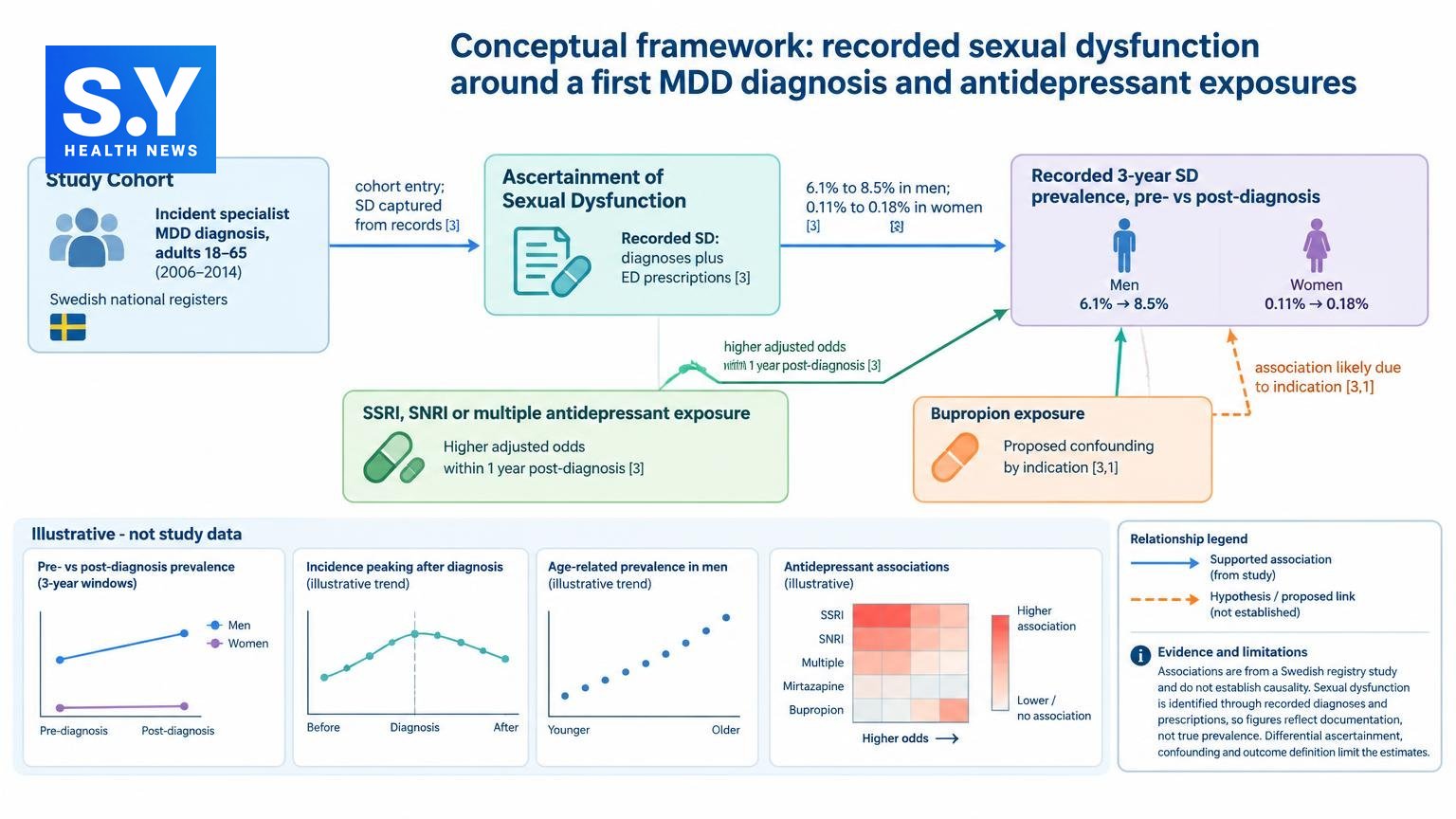
Recorded three-year prevalence rose from 6.1% before diagnosis to 8.5% after diagnosis in men, and from 0.11% to 0.18% in women, with recorded incidence peaking in the first year after the diagnosis. In a nested case-control analysis restricted to men, SSRI use (adjusted odds ratio 1.36, 95% CI 1.15 to 1.61), SNRI use (1.75, 95% CI 1.40 to 2.18) and concurrent use of multiple antidepressants (1.68, 95% CI 1.39 to 2.02) were associated with higher adjusted odds of recorded sexual dysfunction within one year after diagnosis. Mirtazapine showed no significant association, and the authors interpreted a bupropion association (2.01, 95% CI 1.16 to 3.48) as likely confounding by indication rather than a drug effect.
Why This Matters
Sexual difficulties are among the problems patients most often find hard to raise and among the adverse effects most likely to affect adherence to antidepressant treatment. For clinicians choosing between agents, knowing which drugs carry the strongest signal of recorded sexual dysfunction is useful, but only if the source of that signal is understood. This study matters because it measures the problem at population scale and because it shows, equally clearly, the limits of register-based measurement.
The central constraint is ascertainment. Sexual dysfunction entered the dataset only when a clinician recorded a diagnosis or issued a prescription for an erectile dysfunction medication, predominantly a PDE5 inhibitor. A man with distressing erectile difficulties who never mentions them contributes nothing to the count, and women, for whom no equivalent on-label medication pathway exists, are even less likely to appear. The authors state that the figures reflect how sexual dysfunction is identified and managed in care rather than how common it actually is.
Clinical and Pharmacological Context
Two overlapping pathways can produce sexual dysfunction in this population, and the registry design cannot cleanly separate them. Depression itself is associated with reduced libido, anhedonia, fatigue and impaired arousal, and sexual difficulties may predate the diagnosis or contribute to the presentation. Antidepressant pharmacology provides the second pathway. Serotonergic agents, particularly SSRIs and SNRIs, are widely described as capable of delaying ejaculation, reducing libido and impairing erectile function, which is why the authors interpret their SSRI and SNRI associations as plausibly reflecting pharmacological contributions.
Noradrenergic and specific serotonergic agents occupy a different position. Mirtazapine showed no significant association with recorded sexual dysfunction in the male case-control analysis, and this null finding held with extended follow-up. That does not demonstrate that mirtazapine is free of sexual effects. A null result in observational data may reflect genuine absence of a clinically meaningful effect, limited statistical power, or prescribing patterns in which mirtazapine was offered to patients whose sexual concerns had already been discussed.
Bupropion illustrates a third pattern, in which the association runs in a counterintuitive direction. Bupropion is often chosen because it is thought to be relatively sparing of sexual function, so an elevated adjusted odds ratio of 2.01 is hard to read as a causal harm. The authors interpret it as confounding by indication: the drug is preferentially prescribed to men who already have sexual dysfunction or pronounced anhedonia, so the indication itself, rather than the drug, plausibly drives the recorded outcome.
What the Evidence Shows
The cohort comprised 67,783 men and 101,647 women. Across the whole cohort, recorded sexual dysfunction incidence was highest in the year immediately after the specialist diagnosis, and among men the recorded prevalence increased with age. The pre- versus post-diagnosis comparison produced the headline prevalence shift over three-year windows: 6.1% to 8.5% in men and 0.11% to 0.18% in women. The absolute scale of the female figures is striking and, as the authors note, almost certainly reflects differential ascertainment rather than a genuinely near-absent problem in women.
The treatment associations come from a different analytic layer. Within the cohort, a nested case-control analysis among men used conditional logistic regression to relate recorded sexual dysfunction to antidepressant exposure and clinical factors. That design compares men with and without recorded sexual dysfunction while conditioning on the matched set structure and adjusting for measured covariates; it does not randomise treatment. The odds ratios therefore describe associations between the drug a man happened to receive and whether sexual dysfunction was subsequently recorded, not the effect of assigning that drug.
| Measure | Population and time window | Reported value | How to read it |
|---|---|---|---|
| Recorded three-year prevalence change | Men with incident MDD, three-year windows around diagnosis | 6.1% pre-diagnosis to 8.5% post-diagnosis | Documented prevalence, not true prevalence; men could appear through diagnoses or erectile dysfunction prescriptions |
| Recorded three-year prevalence change | Women with incident MDD, three-year windows around diagnosis | 0.11% pre-diagnosis to 0.18% post-diagnosis | Implausibly low for true occurrence; authors attribute the gap to differential ascertainment |
| SSRI exposure | Men, nested case-control, within one year post-diagnosis | aOR 1.36 (95% CI 1.15 to 1.61) | Adjusted association, compatible with a pharmacological contribution |
| SNRI exposure | Men, nested case-control, within one year post-diagnosis | aOR 1.75 (95% CI 1.40 to 2.18) | Adjusted association; the largest reported signal among serotonergic classes |
| Multiple concurrent antidepressants | Men, nested case-control, within one year post-diagnosis | aOR 1.68 (95% CI 1.39 to 2.02) | Adjusted association; may also mark greater illness severity |
| Mirtazapine exposure | Men, nested case-control, within one year and extended follow-up | No significant association | Null finding; does not establish absence of effect |
| Bupropion exposure | Men, nested case-control, within one year post-diagnosis | aOR 2.01 (95% CI 1.16 to 3.48) | Author-interpreted as confounding by indication, not drug causation |
Interpretation and Limitations
Three limitations shape how far these numbers can be pushed. The first is ascertainment. Sexual dysfunction required a recorded diagnosis or an erectile dysfunction prescription, so the study measures clinical visibility rather than symptoms. The very low recorded rates in women suggest the same mechanism operates more severely where no approved drug pathway exists. The authors' conclusion that sexual dysfunction is rarely recorded in psychiatric care, particularly among women, is best read as a statement about documentation rather than about occurrence.
The second limitation is confounding. Antidepressant choice is not random: clinicians select agents based on symptom profile, prior response, comorbidity and existing sexual concerns. That is why the authors interpret the bupropion result as confounding by indication, and the same logic applies to a lesser extent to the serotonergic associations, which may partly reflect illness severity or the characteristics of patients started on SNRIs. The case-control analysis adjusted for measured clinical factors, but unmeasured confounding and surveillance bias cannot be excluded. Patients who are asked about sexual function may be both more likely to be prescribed certain drugs and more likely to have problems recorded, and these two effects can run in the same direction.
The third limitation concerns the outcome definition. The study's framing describes sexual dysfunction as reduced libido, orgasm difficulties and erectile dysfunction, but register capture is weighted heavily toward the last of these, because erection is the component with an identifiable medication. The odds ratios therefore cannot be read as drug effects specific to erection, and the treatment associations are reported as adjusted odds ratios without absolute risk differences, so the clinical magnitude for an individual patient remains uncertain.
Clinical and Research Outlook
The study's clinical message is less about ranking drugs than about the routine conversation. Sexual health is part of psychiatric care, sexual dysfunction may be both a depressive symptom and a treatment effect, and patients rarely raise it unprompted, which is why clinician-initiated enquiry is the practical implication the authors emphasise. The mirtazapine null result is offered as something to weigh when sexual dysfunction is a pronounced concern, while the bupropion signal serves mainly as a reminder that prescribing patterns can generate apparently paradoxical associations.
Future work would benefit from prospectively measured sexual function rather than recorded events, from validated instruments applied before and during treatment, and from designs that capture women's sexual difficulties as reliably as men's. Causal-inference approaches such as target-trial emulation, which explicitly model why a clinician chose one drug over another, could clarify whether the serotonergic associations represent modifiable pharmacological effects. The present study cannot settle those questions, but it establishes a population-scale baseline for how often sexual dysfunction surfaces in specialist depression care.
Key Takeaways
- In 169,430 Swedish adults with a first specialist diagnosis of major depressive disorder, recorded sexual dysfunction was uncommon but rose after diagnosis, from 6.1% to 8.5% over three-year windows in men and from 0.11% to 0.18% in women.
- Recorded sexual dysfunction incidence peaked within one year of the major depressive disorder diagnosis, and recorded prevalence rose with age among men.
- In men, SSRI use (aOR 1.36, 95% CI 1.15 to 1.61), SNRI use (aOR 1.75, 95% CI 1.40 to 2.18) and multiple antidepressant use (aOR 1.68, 95% CI 1.39 to 2.02) were associated with higher adjusted odds of recorded sexual dysfunction within one year post-diagnosis.
- Mirtazapine showed no significant association, including with extended follow-up, while the bupropion association (aOR 2.01, 95% CI 1.16 to 3.48) is attributed by the authors to confounding by indication.
- Because sexual dysfunction was identified from diagnoses and erectile dysfunction prescriptions, the figures reflect documentation in specialist care, not true prevalence, and likely underestimate occurrence, especially in women.
Questions and Answers
How is sexual dysfunction defined and measured in the Swedish major depressive disorder registry study?
The study describes sexual dysfunction as reduced libido, orgasm difficulties and erectile dysfunction. Operationally, it was captured through recorded ICD diagnoses and prescriptions for erectile dysfunction medications, mostly PDE5 inhibitors such as sildenafil and tadalafil. This means the study measured documented and treated sexual dysfunction in specialist care, not symptoms reported on a questionnaire, so its rates are a minimum estimate.
What did the Swedish registry study find about recorded sexual dysfunction before and after a first MDD diagnosis?
Recorded three-year prevalence in men rose from 6.1% before diagnosis to 8.5% after diagnosis, and from 0.11% to 0.18% in women. Recorded incidence peaked within the first year after diagnosis, and among men the recorded prevalence increased with age. These are documentation-based figures, so the absolute values should not be read as true population prevalence.
Which antidepressants were associated with higher odds of sexual dysfunction in men with major depressive disorder?
In the nested case-control analysis restricted to men, SSRI use (aOR 1.36, 95% CI 1.15 to 1.61), SNRI use (aOR 1.75, 95% CI 1.40 to 2.18) and concurrent use of multiple antidepressants (aOR 1.68, 95% CI 1.39 to 2.02) were associated with higher adjusted odds of recorded sexual dysfunction within one year of diagnosis. These are adjusted associations from observational data, not proof of causation.
Does mirtazapine cause less sexual dysfunction than SSRIs or SNRIs in depression treatment?
Mirtazapine showed no significant association with recorded sexual dysfunction in the male case-control analysis, even with extended follow-up, while SSRIs and SNRIs showed positive associations. This is a null observational finding, not evidence that mirtazapine is free of sexual effects. The study was not designed as a head-to-head safety comparison, and limited power or prescribing patterns could explain the absence of a signal.
Why was bupropion linked to higher odds of sexual dysfunction if it is often considered sexually sparing?
The bupropion association (aOR 2.01, 95% CI 1.16 to 3.48) is interpreted by the study authors as confounding by indication. Bupropion is preferentially prescribed to patients who already have sexual dysfunction or pronounced anhedonia, so the pre-existing indication, rather than the drug, plausibly drives the recorded outcome. Registry data of this kind cannot separate the two explanations.
What are the main limitations of registry research on sexual dysfunction in major depressive disorder?
Sexual dysfunction was identified from recorded diagnoses and erectile dysfunction prescriptions, so the study measures clinical documentation rather than symptoms and likely underestimates occurrence, especially in women. Antidepressant exposure is non-randomised, leaving confounding by indication and surveillance bias possible. The outcome is also weighted toward erectile dysfunction, the component with an identifiable medication, so drug associations are not specific to erection.
Conceptual framework: Conceptual framework of the study variables. Adults entered the Swedish cohort at a first specialist MDD diagnosis; sexual dysfunction was ascertained from recorded diagnoses and erectile dysfunction prescriptions. SSRI, SNRI and multiple antidepressant exposures were associated with higher adjusted odds of recorded sexual dysfunction in men, while the bupropion association is proposed to reflect confounding by indication. Relations are associational, not causal.
Academic References & Evidence
- Josef Isung; Par Karlsson; Onur Tankaya; Viktoria Johansson; Karin Gembert; Johan Reutfors. Sexuell dysfunktion vid depression | Modern Psykiatri. Journal of Affective Disorders. 2026 410(1):121999 DOI: 10.1016/j.jad.2026.121999.
- Isung, J.; Karlsson, P.; Tankaya, O.; Johansson, V.; Gembert, K.; Reutfors, J.. Patterns and treatment of sexual dysfunction in major depressive disorder: A cohort and case-control study in Sweden. Journal of Affective Disorders. 2026 410 DOI: 10.1016/j.jad.2026.121999.
- Patterns and treatment of sexual dysfunction in major depressive disorder: A cohort and case-control study in Sweden.. DOI: 10.1016/j.jad.2026.121999.
SANYUN Science Center explains published research on men's reproductive and sexual health, connecting scientific evidence with everyday questions while making sources and limitations clear.
Disclaimer: This article is for scientific education and research communication only. It does not provide medical advice, diagnosis, or individualized treatment recommendations, and does not endorse any medication, supplement, device, penile enlargement procedure, or other intervention. Decisions about sexual and reproductive health should be made in consultation with a qualified healthcare professional. Do not delay seeking professional care because of information in this article.
Original Content & Copyright Notice
- This article is prepared for SANYUN Science Center, drawing on published research and publicly available academic literature on men’s sexual and reproductive health. Its editorial explanations and presentation are developed for this platform.
- Copyright in the original editorial content, selection, and arrangement is reserved by SANYUN Science Center to the extent protected by applicable law. Referenced research, quotations, and third-party materials remain subject to the rights of their respective owners. This notice does not claim ownership of scientific facts or third-party research.
- Except where permitted by applicable law or an applicable license, prior written permission is required to reproduce, republish, translate, adapt, redistribute, or commercially reuse protected content. Attribution alone does not grant permission for such reuse.
- For permitted quotation or authorized reuse, clearly identify the source and retain a link to the original article.
- Source: SANYUN Science Center
- Original URL: Retain the original article URL on science.san-yun.com.
- Copyright Holder: SANYUN Science Center, for its own protected editorial content.
- Quotation, excerpts, or authorized reuse must not distort the scientific meaning, omit material limitations or disclaimers, or imply unverified medical claims, product efficacy, or endorsement by SANYUN Science Center.



