




Category: Clinical Insights
Core Research Direction: Shared decision-making (SDM) practices reported by urologists for erectile dysfunction, benchmarked against other urologic conditions, and cautionary evidence on overstatement of recommendation strength in clinical guidelines
Search Intent: When urologists see patients with erectile dysfunction, how consistently do they report carrying out the core elements of shared decision-making, and how does guideline-based decision support hold up against underlying evidence?
Platform: SANYUN Science Center
Evidence reviewed through: 2026-11-11
Executive Summary
Shared decision-making (SDM) is the process by which clinicians lay out the reasonable options, explain the evidence behind their risks and benefits, elicit what matters to the patient, confirm the patient feels ready to choose, and then arrange to revisit that choice. For erectile dysfunction (ED), the menu is unusually wide and preference-sensitive, spanning lifestyle measures, oral and injectable drugs, vacuum devices, and surgery, each with different trade-offs in spontaneity, invasiveness, cost and reliability. How consistently that conversation actually happens is therefore a meaningful quality question.[1]
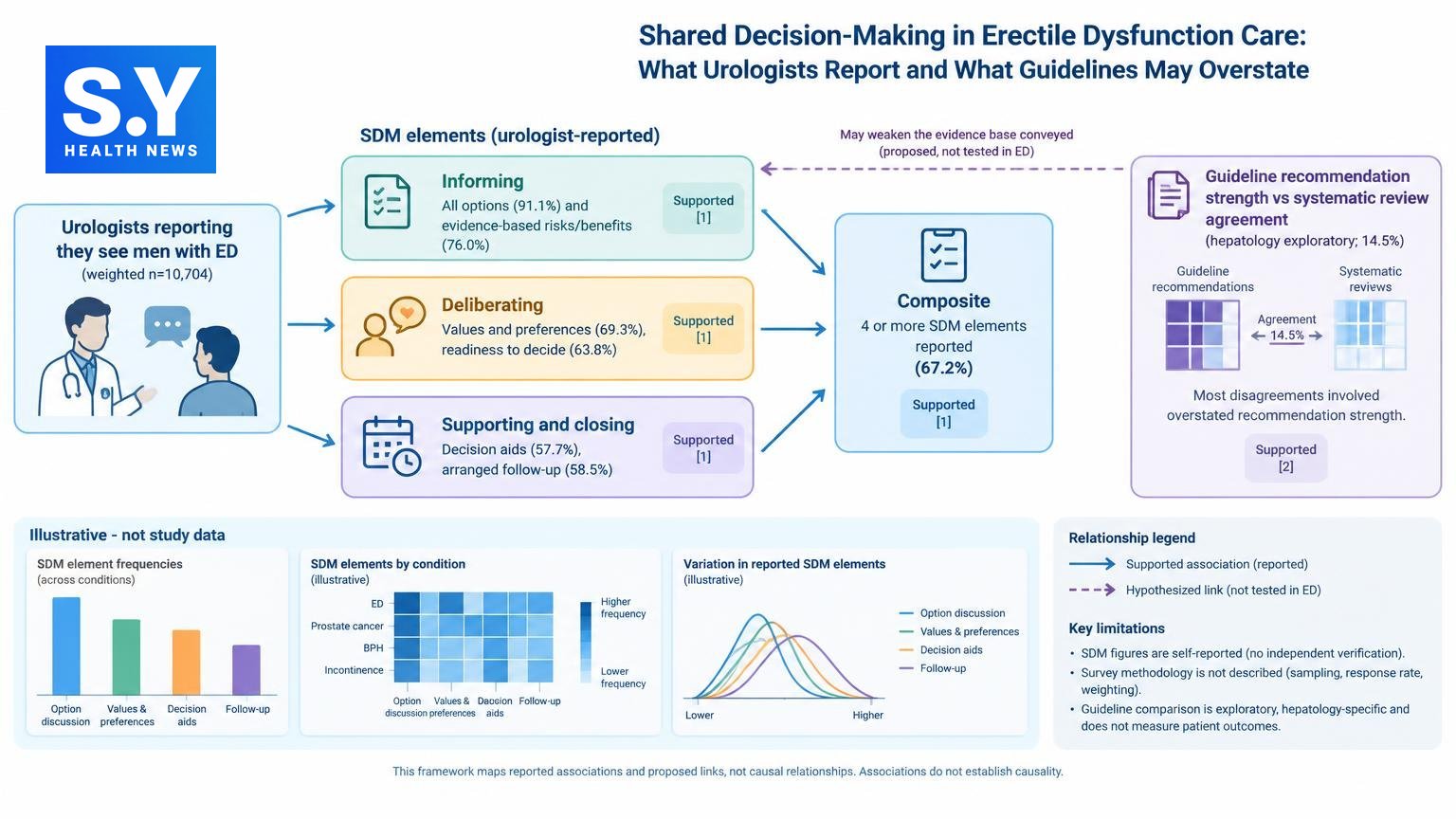
The most directly relevant data in this packet come from a survey table in which urologists were asked whether they performed six specific SDM behaviors for each of seven urologic conditions. Among urologists who reported seeing men with ED (weighted n=10,704), 91.1% said they discuss all available treatment options and 76.0% said they discuss evidence-based risks and benefits. Lower proportions were reported for eliciting values and preferences (69.3%), asking whether the patient is prepared to make a decision (63.8%), arranging a time to follow up on the decision (58.5%) and giving patients decision aids (57.7%); 67.2% reported four or more of the six elements.
These are self-reported practices, not observed consultations, and the supplied material does not describe the survey's sampling frame, response rate or weighting method. The figures therefore describe what urologists say they do. A second, unrelated analysis offers a caution about the inputs to such conversations: an exploratory comparison of clinical practice guidelines on decompensated cirrhosis with Cochrane systematic reviews found agreement in only 14.5% of overlapping statements (95% CI 7.7% to 25.6%), with most disagreement reflecting guideline authors overstating recommendation strength. That study is in hepatology, not sexual medicine, and cannot be transplanted to ED guidelines, but it illustrates why the 'evidence-based risks and benefits' a clinician conveys deserve scrutiny of their own.[2]
Why This Matters
ED is a condition where the 'right' treatment depends heavily on what a man values. A patient who prioritizes spontaneity may weigh on-demand therapy differently from one who prefers a daily regimen; a patient concerned about invasiveness may decline intracavernosal injection even if it is effective; a patient's partner and the couple's sexual goals may matter as much as the erectile mechanism itself. Clinical guidelines can summarize efficacy and safety, but they cannot resolve these trade-offs for an individual. That is precisely the work SDM is designed to do, which is why the completeness of the conversation, not just the prescription, is a legitimate marker of care quality.
The practical significance of the reported gaps is not that most urologists are doing nothing. On the contrary, the headline behaviors are common: option disclosure exceeded 90% for ED and for most other conditions in the table. The concern is the asymmetry. The elements that make a decision genuinely shared, namely eliciting preferences, testing readiness, providing a decision aid and scheduling follow-up, are precisely the elements reported least often. If those self-reports are even approximately accurate, many consultations may inform without fully involving.
There is also the question of how strong the underlying recommendations are. If a guideline presents a treatment as strongly recommended when the supporting evidence is weaker or more uncertain, then even a well-conducted SDM conversation transmits a distorted picture of the trade-offs. The cirrhosis comparison is a reminder that strength-of-recommendation labels are human judgements and can drift from the systematic evidence they are meant to summarize.
Biological and Clinical Mechanism: What SDM Is Meant to Address in ED
Erectile dysfunction is typically multifactorial, with vascular, neurologic, hormonal and psychological contributors, and it frequently coexists with cardiometabolic disease. This matters for SDM because the treatment decision is rarely a single-variable choice: addressing the erectile complaint may intersect with blood pressure, glucose control, relationship factors and medication side effects. A conversation that only lists drug options without eliciting the patient's priorities risks producing a technically correct prescription that the patient does not follow or does not find satisfying.
The six surveyed elements map onto a recognizable clinical sequence. Discussing all options and their evidence-based risks and benefits corresponds to informing; asking about values and asking about readiness correspond to deliberating; providing a decision aid supports deliberation between visits; and arranging follow-up closes the loop so that a decision made under uncertainty can be revisited. Decision aids, in particular, are intended to shift the conversation from a clinician's recommendation toward a structured comparison the patient can absorb at their own pace, which is why their relatively low reported use is notable.
Whether these reported behaviors change outcomes is not established by this packet. The survey table contains no linkage to patient satisfaction, adherence, decisional regret or clinical results. The mechanism by which SDM might help, such as better alignment between treatment and patient priorities, is plausible but remains a hypothesis in this evidence base rather than a demonstrated effect.
What the Evidence Shows
The survey table presents, for each condition, the percentage of responding urologists selecting each SDM element, alongside a composite of those reporting four or more elements. The denominators are urologists who reported seeing such patients. The table describes the respondents' self-selected behaviors and does not report independent verification of the consultations.
| Condition (weighted n) | Discussed all options | Elicited values and preferences | Provided a decision aid | Reported 4+ SDM elements |
|---|---|---|---|---|
| Erectile dysfunction (10,704) | 91.1% | 69.3% | 57.7% | 67.2% |
| Prostate cancer (11,201) | 89.9% | 71.0% | 63.5% | 73.8% |
| Benign prostatic hypertrophy (11,359) | 89.3% | 71.8% | 61.0% | 71.6% |
| Urinary incontinence (11,065) | 87.3% | 66.2% | 53.8% | 63.2% |
Several patterns stand out. First, option disclosure is the most commonly reported element across the conditions shown, ranging from 87.3% for urinary incontinence to 91.1% for ED and asymptomatic 1 cm kidney stone. Second, the composite four-or-more measure is consistently lower, from 63.2% for urinary incontinence to 73.8% for prostate cancer; ED sits at 67.2%, below prostate cancer and benign prostatic hypertrophy but above urinary incontinence. Third, decision aids are the least reported element in every condition shown, with ED at 57.7%.
ED does not stand out as a conspicuously weak area in relative terms. Its option-discussion figure (91.1%) is the joint-highest in the table, tied with the asymptomatic kidney stone scenario, and its values-elicitation figure (69.3%) is close to the prostate cancer and benign prostatic hypertrophy figures. What ED shares with the other conditions is the trailing of the back end of the SDM sequence: readiness checks, follow-up and decision aids.
The guideline-versus-review comparison is a different design entirely. Investigators selected four decompensated cirrhosis topics, identified nine clinical practice guidelines from major US and European liver organizations, and isolated 62 statements that were also addressed by seven Cochrane systematic reviews. Two researchers independently judged agreement between each statement and the review conclusions, including the strength of recommendation. Agreement was 14.5% (95% CI 7.7% to 25.6%), and most disagreements concerned overstated recommendation strength. The authors reported that differences in search dates did not explain the disagreements.
Read together, these two sources answer different questions. The survey describes the reported frequency of SDM behaviors; the guideline comparison assesses whether recommendation labels match systematic evidence in a separate specialty. Neither source measured ED guideline quality, and neither followed patients to outcomes.
Interpretation and Limitations
The most important limitation of the SDM data is that they are self-reported. Clinicians tend to overestimate adherence to recommended communication behaviors, and a survey cannot distinguish a genuine discussion of all treatment options from a brief mention. The supplied table also omits basic methodological information: who was surveyed, how they were sampled, what the response rate was and how the weighted n values were derived. Without those details, the percentages should be read as a description of respondents' claims rather than an estimate of national practice.
The four-or-more composite also requires caution. Selecting a threshold of four of six elements is a reasonable summary device, but the table does not justify the cutoff, and the elements are not equally demanding. A clinician could meet four elements while omitting decision aids and follow-up, which are arguably the parts that most distinguish shared from informed decision-making. The composite therefore should not be read as a pass mark.
The cirrhosis analysis is exploratory and narrow. It covers one disease area, a purposive sample of guidelines, and a modest number of overlapping statements, and its agreement judgement depends on the raters' interpretations. Its finding that recommendation strength was often overstated is the authors' conclusion from that dataset, and the broader claim of a systematic problem across guideline development is framed by the authors as a suggestion, not a demonstrated general law. Extending it to urology or sexual medicine guidelines would be speculation.
Finally, nothing in this packet connects SDM frequency or guideline strength to patient outcomes in ED. No data are provided on decisional regret, treatment adherence, satisfaction, or clinical response. Claims that better SDM improves erectile outcomes would be extrapolation, however reasonable, from other fields.
Research Outlook
The obvious next step is to move from self-report to observation. Audio or video recording of ED consultations, or standardized patients, could establish how often each SDM element genuinely occurs and how decision aids are actually used. Linking such measures to patient-reported outcomes, including decisional conflict and satisfaction, would test whether the reported gaps matter clinically.
A parallel line of work concerns decision support content. If recommendation strength in guidelines can diverge from systematic review conclusions, as the cirrhosis study suggests, then the risk-and-benefit statements used in SDM conversations deserve their own audit. For ED specifically, that would mean comparing the strength of recommendations in urologic guidelines with the underlying systematic reviews, using a design similar to the cirrhosis comparison but powered and prespecified rather than exploratory.
The survey table also invites a benchmarking question: why decision aids and follow-up lag option disclosure across every condition shown. Possible explanations include time pressure, lack of suitable aids, workflow design and clinician beliefs about patient preferences, but the packet contains no data to discriminate among them. Qualitative and workflow research would be needed before designing interventions.
Key Takeaways
- Among urologists reporting they see men with ED (weighted n=10,704), 91.1% said they discuss all treatment options and 76.0% said they discuss evidence-based risks and benefits, but only 57.7% said they provide decision aids and 58.5% said they arrange follow-up on the decision.
- The composite measure showed 67.2% of these urologists reporting four or more of the six SDM elements, below prostate cancer (73.8%) and benign prostatic hypertrophy (71.6%) and above urinary incontinence (63.2%).
- All SDM figures are self-reported practices among urologists who reported seeing such patients; the table does not describe sampling, response rate or weighting methodology, and none of the behaviors was independently observed.
- In a separate exploratory comparison of decompensated cirrhosis guidelines with Cochrane reviews, only 14.5% of 62 overlapping statements agreed (95% CI 7.7% to 25.6%), with most disagreements reflecting guideline authors overstating recommendation strength.
- That finding is specific to hepatology guidelines up to January 2022 and was reported by its authors as suggesting a systematic issue; it does not establish that ED guidelines overstate evidence, and no patient outcomes were measured in either source.
Questions and Answers
What is shared decision-making in erectile dysfunction care?
Shared decision-making is a structured conversation in which the clinician presents the reasonable treatment options and their evidence-based risks and benefits, asks what matters to the patient, checks whether the patient feels ready to choose, and arranges follow-up on the decision. In ED this matters because options differ in spontaneity, invasiveness and reliability, so the preferred choice depends on individual priorities rather than on efficacy alone.
How often do urologists report using shared decision-making elements for erectile dysfunction?
Among urologists reporting they see men with ED (weighted n=10,704), 91.1% said they discuss all treatment options and 76.0% said they discuss evidence-based risks and benefits. Lower proportions reported eliciting values and preferences (69.3%), asking about readiness to decide (63.8%), arranging follow-up (58.5%) and providing decision aids (57.7%). Overall, 67.2% reported four or more of the six elements. These are self-reports, not observed consultations.
How strong is the evidence that urologists actually practice shared decision-making in ED?
The evidence is limited. The figures come from urologist self-report, which tends to overestimate adherence to recommended communication behaviors. The supplied table does not describe the survey's sampling frame, response rate or weighting method, and no consultations were independently observed. The figures therefore describe what responding urologists said they do, not verified practice.
Is shared decision-making for erectile dysfunction better or worse than for other urologic conditions?
The table does not rank conditions definitively. ED's option-discussion figure (91.1%) was among the highest shown, while its composite of four or more SDM elements (67.2%) was below prostate cancer (73.8%) and benign prostatic hypertrophy (71.6%) but above urinary incontinence (63.2%). Across all conditions, decision aids and follow-up were the least reported elements, suggesting a shared gap rather than an ED-specific one.
Can clinical practice guidelines overstate the strength of recommendations?
In one exploratory comparison of decompensated cirrhosis guidelines with Cochrane systematic reviews, only 14.5% of 62 overlapping statements agreed (95% CI 7.7% to 25.6%), and most disagreements involved guideline authors overstating recommendation strength. The authors framed this as suggesting a systematic issue, but the study was exploratory, confined to hepatology guidelines up to January 2022, and did not measure patient outcomes. It does not establish that ED guidelines overstate evidence.
What should men with erectile dysfunction expect from a shared decision-making conversation?
They should expect to hear all reasonable options and the evidence behind their risks and benefits, to be asked what matters most to them, to be asked whether they feel ready to decide, and to have a follow-up planned so the choice can be revisited. Decision aids can support this between visits. Because the evidence here is self-reported clinician behavior rather than observed practice, patients may need to prompt these steps themselves.
Conceptual framework: Conceptual framework. This figure maps the constructs discussed in this review: urologist-reported shared decision-making behaviors for erectile dysfunction, grouped into informing, deliberating and supporting/follow-up, with a composite indicator and a separate proposed link from guideline strength calibration. Population and study context: a survey table of self-reported practices (weighted n=10,704 for ED) plus an exploratory hepatology guideline-versus-review comparison. Supported relations reflect reported associations only; the link from overstatement to ED decision support is proposed and untested. The framework is not a tested causal model.
Academic References & Evidence
- Table 3:.
- Gurusamy, K; Roberts, D; Leung, J; O’Brien, A; Gluud, C; Pavlov, C; Davidson, BR. Clinical practice guidelines recommendations compared to the findings of the Cochrane systematic reviews on the management of decompensated liver cirrhosis in the USA and Europe. Frontline Gastroenterology. 2026 DOI: 10.1136/flgastro-2026-103856.
SANYUN Science Center explains published research on men's reproductive and sexual health, connecting scientific evidence with everyday questions while making sources and limitations clear.
Disclaimer: This article is for scientific education and research communication only. It does not provide medical advice, diagnosis, or individualized treatment recommendations, and does not endorse any medication, supplement, device, penile enlargement procedure, or other intervention. Decisions about sexual and reproductive health should be made in consultation with a qualified healthcare professional. Do not delay seeking professional care because of information in this article.
Original Content & Copyright Notice
- This article is prepared for SANYUN Science Center, drawing on published research and publicly available academic literature on men’s sexual and reproductive health. Its editorial explanations and presentation are developed for this platform.
- Copyright in the original editorial content, selection, and arrangement is reserved by SANYUN Science Center to the extent protected by applicable law. Referenced research, quotations, and third-party materials remain subject to the rights of their respective owners. This notice does not claim ownership of scientific facts or third-party research.
- Except where permitted by applicable law or an applicable license, prior written permission is required to reproduce, republish, translate, adapt, redistribute, or commercially reuse protected content. Attribution alone does not grant permission for such reuse.
- For permitted quotation or authorized reuse, clearly identify the source and retain a link to the original article.
- Source: SANYUN Science Center
- Original URL: Retain the original article URL on science.san-yun.com.
- Copyright Holder: SANYUN Science Center, for its own protected editorial content.
- Quotation, excerpts, or authorized reuse must not distort the scientific meaning, omit material limitations or disclaimers, or imply unverified medical claims, product efficacy, or endorsement by SANYUN Science Center.



