




Category: Clinical Insights
Core Research Direction: Shared decision-making in urology: how often urologists report discussing treatment options, evidence-based risks and benefits, patient values, decision readiness, follow-up, and decision aids for erectile dysfunction and benign prostatic hypertrophy, with context on the limits of these self-reported survey data
Search Intent: When men are treated for erectile dysfunction or benign prostatic hypertrophy, what elements of shared decision-making do urologists report using, and what can this self-reported survey evidence not establish?
Platform: SANYUN Science Center
Evidence reviewed through: 2026-11-07
Executive Summary
Shared decision-making is a consultation process in which clinicians present the realistic options, discuss the evidence behind their benefits and harms, elicit the patient's values and preferences, confirm whether the patient feels ready to decide, and arrange follow-up. A published survey table reports how often urologists say they perform each of these elements, broken down by the conditions they treat. The picture it paints is uneven and, in places, internally revealing.[1]
For erectile dysfunction, 91.10% of urologists who reported seeing such patients said they discuss all available treatment options, and 76.00% said they discuss evidence-based risks and benefits of each treatment. Reported use fell progressively for more participatory steps: 69.30% said they ask patients to share values and preferences, 63.80% said they ask whether patients are prepared to make a decision, 58.50% said they arrange a time to follow up on the decision, and 57.70% said they give decision aids. Overall, 67.20% reported four or more of the six elements.
For benign prostatic hypertrophy, the reported figures followed a similar ordering but were generally a little higher: 89.30% discussed all treatment options, 81.30% discussed evidence-based risks and benefits, 71.80% asked about values and preferences, 66.30% asked about decision readiness, 62.00% arranged follow-up, and 61.00% provided decision aids, with 71.60% reporting four or more elements.
- The reported pattern is consistent across conditions: information-giving elements are reported far more often than decision-support elements such as readiness checks and decision aids.
- Every figure describes what urologists say they do among patients they say they see, not what happens in recorded consultations or what patients report.
Why This Matters
Erectile dysfunction and benign prostatic hypertrophy are both preference-sensitive: more than one reasonable treatment path exists, and the right choice depends heavily on how a man weighs symptom relief against side effects, invasiveness, cost, partner considerations and his own priorities. That is precisely the setting in which shared decision-making is supposed to matter most. If men are not asked what matters to them, or are not helped to reach a decision they feel ready to make, the treatment chosen may be clinically defensible but personally wrong.
The survey data are also a check on how shared decision-making is understood in practice. Telling a patient about every option is necessary but not sufficient. The elements that convert information into a decision — asking about values, testing readiness, supplying a decision aid and following up — are exactly the ones reported least often, particularly for erectile dysfunction.
What Each Shared Decision-Making Element Measures
| Reported element | What it asks of the clinician | What it does not tell us |
|---|---|---|
| Discussing all available treatment options | Whether the urologist says the full option set was presented | Whether options were presented in a balanced, understandable or unbiased way |
| Discussing evidence-based risks and benefits of each treatment | Whether the urologist says the evidence behind benefits and harms was discussed | Whether numbers were given, how they were framed, or whether they were understood |
| Asking patients to share values and preferences | Whether the patient's priorities were explicitly elicited | Whether the elicited values changed the decision |
| Asking whether the patient is prepared to make a decision | Whether decision readiness was checked | Whether a formal readiness tool was used or how uncertainty was handled |
| Arranging follow-up on the decision | Whether a planned review of the choice occurred | Whether follow-up actually happened or changed management |
| Giving patients decision aids | Whether a decision aid was reportedly provided | Which aid, of what quality, and whether the patient used it |
The Pattern Across Conditions
The table covers several urological conditions, which is useful because it allows internal comparison. Among urologists reporting they see prostate cancer patients, 89.90% said they discuss all treatment options, falling to 61.40% for asking about decision readiness, with 73.80% reporting four or more elements. Urinary incontinence showed a similar gradient, from 87.30% for discussing all options to 53.80% for decision aids, with 63.20% reporting four or more elements.
Two adult conditions relevant here fit the same shape. Erectile dysfunction had the highest reported rate of discussing all options (91.10%) and the highest reported rate of providing decision aids (57.70%) among the conditions shown, yet it had the lowest reported rate of arranging follow-up (58.50%) and one of the lower rates for asking about decision readiness (63.80%). Benign prostatic hypertrophy reported higher rates than erectile dysfunction on every element except discussing all options, and the highest overall proportion reporting four or more elements (71.60%).
A pediatric condition, vesicoureteral reflux, is included in the table but is not directly applicable to adult men's care; it was reported at lower levels across the board, from 83.60% for discussing all options to 39.90% for decision aids, with 50.50% reporting four or more elements. Its inclusion is best read as context about how urologists' self-reports vary by population, not as evidence about adult decision quality.
Interpretation: What Clinician Self-Report Can and Cannot Show
The single most important qualification is embedded in the table's own note: the percentages correspond to urologists who say they see such patients and who selected that particular element. The data describe clinician belief about their own behaviour. They are not audio-recorded consultations, not chart audits and not patient surveys. That distinction matters because self-reported shared decision-making tends to be higher than what independent observation and patient accounts show in general clinical research, though this survey table itself does not test that gap.
Several biases are plausible. Recall and social desirability can inflate affirmative answers: a clinician who believes shared decision-making is good practice may more readily remember doing it. A checklist framing — each element answered yes or no — cannot capture quality, depth or nuance. Reporting that one discussed risks and benefits does not show whether absolute risks, natural frequencies or uncertainty were communicated, or whether the patient could restate them.
The denominators are also a source of uncertainty. Percentages are calculated among urologists who reported seeing patients for that condition, and the weighted sample sizes are large, but the table as reported does not document response rate, sampling frame, survey mode or non-response characteristics. Without those details, the extent to which respondents represent urologists generally cannot be judged. The figures should be read as descriptive proportions within a respondent group, not as national practice benchmarks.
Finally, the outcome is process, not outcome. Nothing in this table links a reported element to patient satisfaction, decisional regret, adherence, symptom improvement or safety. The gap between discussing options (91.10% for erectile dysfunction) and supporting the decision (67.20% reporting four or more elements) is suggestive of a quality improvement target, but it is a hypothesis about where practice might lag, not a demonstration that care is deficient or that addressing the gap would improve results.
Clinical Relevance
Taken cautiously, the survey points to a practical asymmetry. Urologists overwhelmingly report telling men about their options in both erectile dysfunction and benign prostatic hypertrophy, which is the entry point of informed choice. Fewer report the relational and structural steps — eliciting values, checking readiness, giving a decision aid, planning to revisit the decision — that make the choice genuinely shared. For clinicians, those are the concrete behaviours a consultation could be audited against.
The follow-up element deserves particular attention in erectile dysfunction, where 58.50% reported arranging a time to follow up on the decision. Treatments for erectile dysfunction often involve trials, tolerability issues and partner dynamics that evolve after the initial choice, so a planned review is a plausible point of leverage. Again, this is a reasonable inference from the process elements, not an outcome demonstrated in these data.
Research Outlook
The obvious next step is triangulation: pairing clinician self-report with patient-reported measures of shared decision-making, recorded or observed consultations, and decision-aid uptake records. Studies could also test whether decision readiness checks and structured follow-up change decisional conflict, treatment persistence or satisfaction in erectile dysfunction and benign prostatic hypertrophy specifically. Until such data exist, the survey's contribution is to describe reported practice and to identify where self-reported behaviour is least complete.
- Treat the reported percentages as descriptive self-report within a respondent group, not as verified practice rates or quality scores.
- The clearest reported gap is structural decision support, especially decision aids and readiness checks, rather than discussion of options.
- For adult men, the erectile dysfunction and benign prostatic hypertrophy rows are the directly relevant figures; the pediatric row is contextual only.
Questions and Answers
What is shared decision-making in urology?
It is a consultation process in which the urologist presents the realistic treatment options and the evidence on their benefits and harms, asks about the patient's values and preferences, checks whether the patient feels ready to decide, provides decision support such as a decision aid, and arranges follow-up on the decision. This survey table measures six such elements as yes/no self-reports, so it captures whether clinicians say they do each step, not how well they do it.
How often do urologists report discussing treatment options for erectile dysfunction?
Among urologists who reported seeing erectile dysfunction patients, 91.10% said they discuss all available treatment options, and 76.00% said they discuss evidence-based risks and benefits of each treatment. Reported rates fell for more participatory steps, including asking about values and preferences (69.30%), checking decision readiness (63.80%), arranging follow-up (58.50%) and giving decision aids (57.70%). Overall, 67.20% reported four or more elements.
What shared decision-making elements are reported most for benign prostatic hypertrophy?
For benign prostatic hypertrophy, 89.30% of relevant urologists reported discussing all treatment options and 81.30% reported discussing evidence-based risks and benefits, the two highest elements. Values and preferences were reported by 71.80%, decision readiness by 66.30%, follow-up by 62.00% and decision aids by 61.00%. In total, 71.60% reported four or more of the six elements. These are self-reported figures among urologists who say they see such patients.
How strong is the evidence from this urologist survey on shared decision-making?
It is descriptive self-report evidence. The percentages reflect urologists who say they see patients for each condition and who selected each element, not observed consultations, chart audits or patient reports. The table does not report response rate, sampling frame or survey mode, and it uses a yes/no checklist that cannot capture quality or depth. It is useful for describing reported practice, not for proving what patients experience.
Do these shared decision-making figures apply to all urologists and all patients?
Not necessarily. Percentages are calculated only among urologists who reported seeing patients for the relevant condition, so each condition has a different denominator. The table as reported does not document how respondents were selected or how representative they are, and it includes a pediatric condition that is not applicable to adult men. The erectile dysfunction and benign prostatic hypertrophy rows are the most relevant to adult men's care, but they remain clinician reports.
What do these self-reported shared decision-making data not prove about treatment decisions?
They do not show that discussions were balanced, understandable or tailored, nor that patients understood the numbers or felt involved. They do not link any reported element to satisfaction, decisional regret, adherence or clinical outcomes. The gap between discussing options and supporting the decision suggests a plausible quality improvement target, but it is a hypothesis about where practice may lag, not proof that current care is deficient or that changing it would improve results.
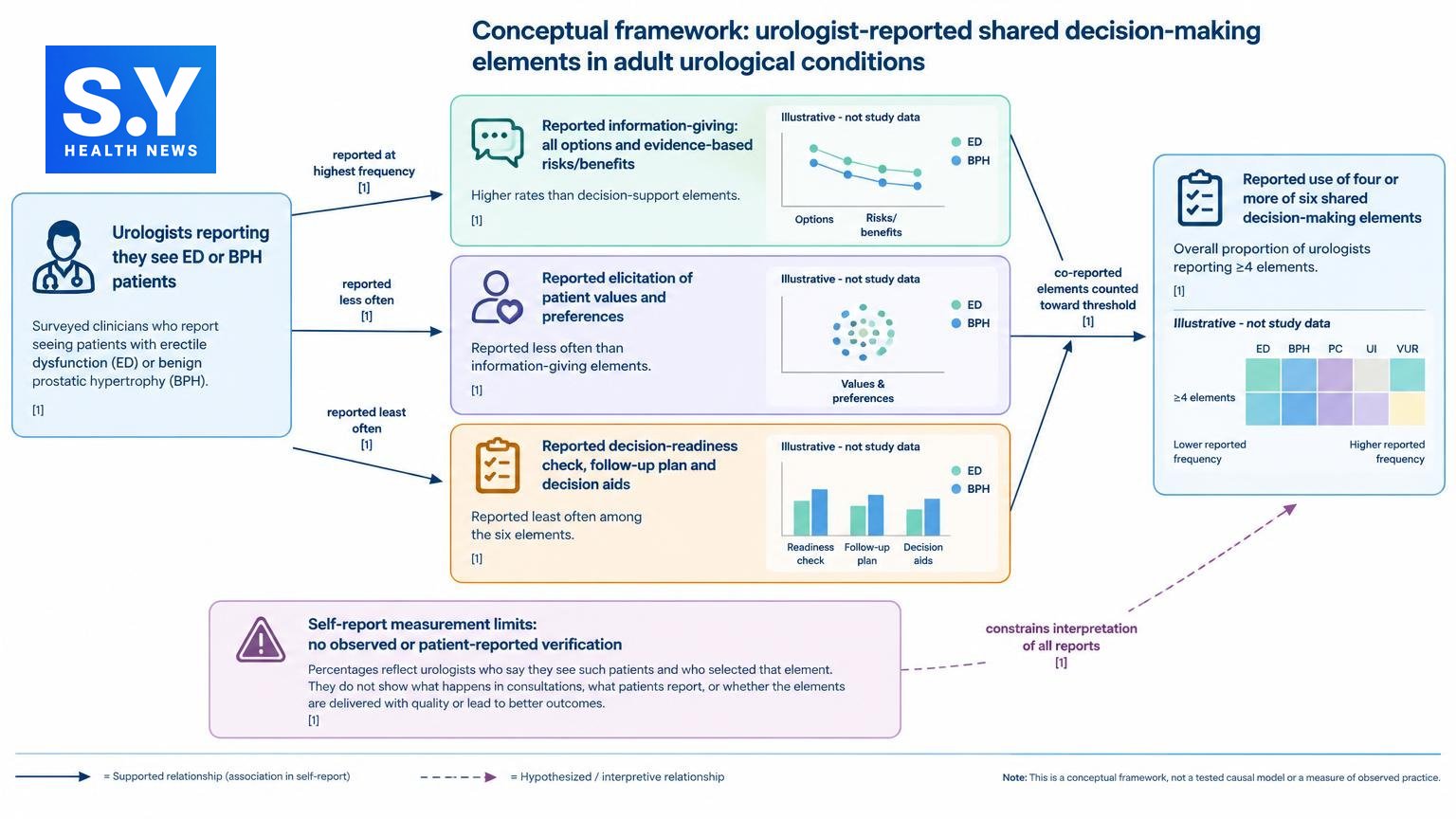
Conceptual framework: Conceptual framework. The figure maps the six urologist-reported shared decision-making elements for erectile dysfunction and benign prostatic hypertrophy, from information-giving to decision support, and flags self-report as an interpretive limit. It is not a tested causal model or a measure of observed practice.
Academic References & Evidence
SANYUN Science Center explains published research on men's reproductive and sexual health, connecting scientific evidence with everyday questions while making sources and limitations clear.
Disclaimer: This article is for scientific education and research communication only. It does not provide medical advice, diagnosis, or individualized treatment recommendations, and does not endorse any medication, supplement, device, penile enlargement procedure, or other intervention. Decisions about sexual and reproductive health should be made in consultation with a qualified healthcare professional. Do not delay seeking professional care because of information in this article.
Original Content & Copyright Notice
- This article is prepared for SANYUN Science Center, drawing on published research and publicly available academic literature on men’s sexual and reproductive health. Its editorial explanations and presentation are developed for this platform.
- Copyright in the original editorial content, selection, and arrangement is reserved by SANYUN Science Center to the extent protected by applicable law. Referenced research, quotations, and third-party materials remain subject to the rights of their respective owners. This notice does not claim ownership of scientific facts or third-party research.
- Except where permitted by applicable law or an applicable license, prior written permission is required to reproduce, republish, translate, adapt, redistribute, or commercially reuse protected content. Attribution alone does not grant permission for such reuse.
- For permitted quotation or authorized reuse, clearly identify the source and retain a link to the original article.
- Source: SANYUN Science Center
- Original URL: Retain the original article URL on science.san-yun.com.
- Copyright Holder: SANYUN Science Center, for its own protected editorial content.
- Quotation, excerpts, or authorized reuse must not distort the scientific meaning, omit material limitations or disclaimers, or imply unverified medical claims, product efficacy, or endorsement by SANYUN Science Center.



