


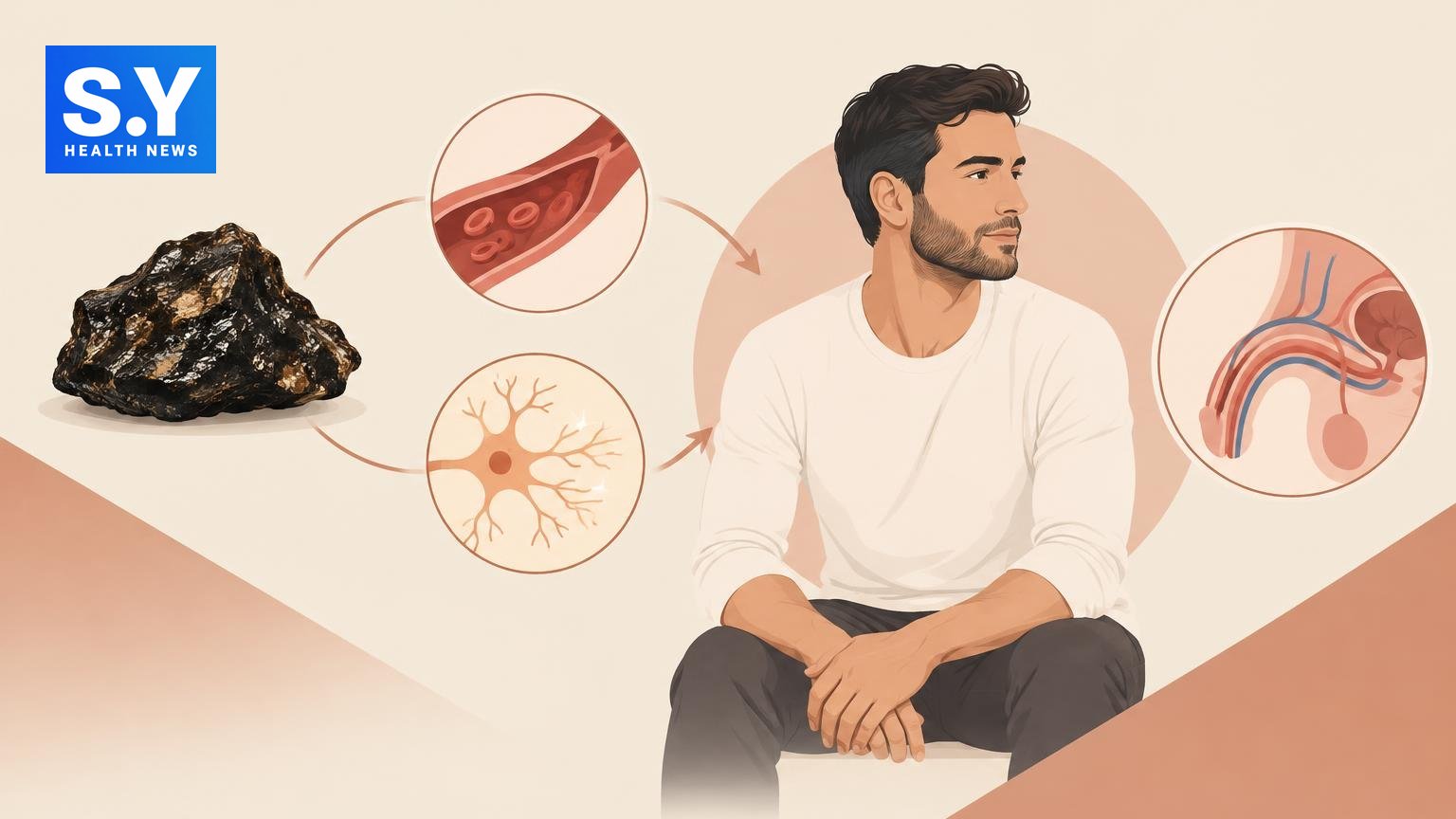


Category: Latest Research
Core Research Direction: New evidence on standardized shilajit resin for erectile function and testosterone in men with mild-to-moderate erectile dysfunction: what the first reported placebo-controlled trial in a diagnosed ED population shows, and how it differs from earlier testosterone and sperm-parameter research
Search Intent: Does a standardized shilajit resin actually improve erectile function and testosterone in men with diagnosed mild-to-moderate erectile dysfunction, and how strong and how applicable is that evidence?
Platform: SANYUN Science Center
Evidence reviewed through: 2026-11-07
Executive Summary
A randomised, double-blind, placebo-controlled, two-site trial enrolled 100 men aged 35–55 with mild-to-moderate erectile dysfunction (IIEF erectile function domain score 11–25) and symptoms suggestive of androgen deficiency. Participants were allocated to 250 mg twice daily of a standardised shilajit resin product (TruBlk™) or matched placebo for 90 days. The manuscript is a preprint and was funded by the manufacturer of the tested product.[1]
The registered primary endpoints were change from baseline in IIEF total and domain scores, total and free testosterone, cortisol, and Hypogonadism Impact of Symptoms Questionnaire (HIS-Q) domain scores. At Day 90, IIEF total score improved by 32.1% with the shilajit product versus 13.6% with placebo (d=0.67, p=0.005), total testosterone rose 46.1% versus 10.0% (d=0.44, p=0.030) and free testosterone 37.4% versus 6.8% (d=0.41, p=0.048). Secondary outcomes including fatigue and global assessment also favoured the product, while nitric oxide showed no significant between-group difference.
Exploratory semen subsets suggested improvements in sperm concentration and motility, but these analyses were not the trial's primary purpose. The authors describe their findings as supporting a promising intervention that merits further evaluation, not as established efficacy. Earlier shilajit evidence involved healthy men's testosterone or sperm parameters, not erectile function, and a commonly cited positive erectile-function trial tested an eight-herb blend containing no shilajit. That makes this preprint a meaningful change in the evidence base, but not a conclusive one.[2]
Why This Matters
Erectile dysfunction is common, and many men are reluctant to start or continue conventional drug treatment. Supplements marketed for male sexual health fill that gap commercially, but the evidence behind them is often thin, borrowed from unrelated endpoints, or derived from trials in healthy volunteers rather than men with a diagnosis. Until now, the most frequently cited shilajit trials examined testosterone in healthy men aged 45–55 taking 250 mg twice daily for 90 days, or sperm parameters in 28 men with low sperm counts taking 100 mg twice daily for 90 days. Neither measured erectile function.
A review published in September 2026 stated plainly that no published placebo-controlled clinical trial had tested shilajit by itself with erectile dysfunction as an outcome. The new preprint directly addresses that gap by enrolling men with a diagnosed condition and using a validated erectile-function instrument. For readers trying to interpret supplement claims, this is the first study that can legitimately be described as a placebo-controlled erectile-function trial of a shilajit product in a clinical population. The caveats — single trial, preprint, industry funding, modest sample — determine how much weight it can carry.
Biological and Clinical Mechanism
Erectile function is primarily a vascular and neurological process: nitric-oxide-mediated smooth-muscle relaxation increases blood flow to the penis. Circulating testosterone contributes to sexual desire and long-term tissue health, but it is not a direct readout of erectile performance. In men without diagnosed testosterone deficiency, raising testosterone further does not reliably translate into better erections; the relationship is stronger in men who are clinically hypogonadal at baseline. This distinction matters because a supplement that moves a hormone panel is not automatically an erectile-dysfunction treatment.
Shilajit is a resinous plant exudate used in Ayurvedic medicine, and its proposed mechanisms include adaptogenic, antioxidant and androgen-modulating effects. The new trial's testosterone results are consistent with an androgen-pathway effect, but the trial also found no significant between-group difference in nitric oxide, a marker central to the vascular explanation of erection. That null result is informative: it argues against a simple nitric-oxide mechanism and leaves the pathway behind any erectile benefit unresolved. The fatigue improvement is also notable because fatigue can affect sexual function and is a symptom domain relevant to hypogonadism, but the trial was not designed to establish causal pathways.
What the Evidence Shows
| Outcome | Shilajit resin result | Placebo result | Effect size and p value | Trial role |
|---|---|---|---|---|
| IIEF total score change | 32.1% improvement | 13.6% improvement | d=0.67; p=0.005 | Primary endpoint |
| IIEF domain scores | Significant gains in erectile function, orgasmic function, overall satisfaction and intercourse satisfaction | Smaller gains | d=0.52–0.61; p=0.011–0.044 | Primary endpoint domains |
| Sexual desire domain | Smaller improvement | Smaller improvement | d=0.44; p=0.109 (not significant) | Primary endpoint domain |
| Total testosterone | 46.1% increase | 10.0% increase | d=0.44; p=0.030 | Primary endpoint |
| Free testosterone | 37.4% increase | 6.8% increase | d=0.41; p=0.048 | Primary endpoint |
| HIS-Q sexual, energy and sleep domains | Favoured shilajit | Less improvement | d=−0.59 to −0.82; p<0.02 | Primary endpoint domains |
| Fatigue Severity Scale | 51.8% reduction | 27.4% reduction | d=−1.13; p<0.0001 | Secondary endpoint |
| Global assessment (much or very much improved) | 56–58% of participants | 12–14% of participants | Not reported in supplied text | Secondary endpoint |
| Nitric oxide | No significant difference between groups | No significant difference between groups | Not reported in supplied text | Secondary endpoint |
| Sperm concentration (exploratory subset, n=57) | Improved relative to placebo | Less improvement | δ=0.53; p<0.001 | Exploratory |
| Progressive motility (exploratory subset, n=40) | Improved relative to placebo | Less improvement | d=0.82; p=0.014 | Exploratory |
The primary results are internally consistent: total IIEF improved with a moderate-to-large effect size, four of five domains improved significantly, and the two testosterone measures moved together. The HIS-Q results favoured the product in three of five domains, with cognition and mood showing smaller, non-significant differences (d=−0.46 to −0.49, p=0.06–0.10). The fatigue result was the largest reported effect (d=−1.13), and the global assessment percentages — 56–58% versus 12–14% rated much or very much improved — are clinically noticeable, though the global assessment is a subjective secondary measure.
The semen findings belong to a different question. In exploratory subsets, sperm concentration improved (n=57, δ=0.53, p<0.001), total motility improved (n=40, δ=0.63, p<0.001) and progressive motility improved (d=0.82, p=0.014). These subsets were small, not the trial's primary purpose, and not powered for fertility conclusions. They are hypotheses for future fertility research, not evidence that the product treats infertility.
How This Differs From Earlier Shilajit Research
The older evidence base is narrower than marketing suggests. The 2016 trial in healthy men aged 45–55 reported significant increases in total and free testosterone with 250 mg twice daily for 90 days while LH and FSH remained stable, but the source notes the published abstract gave neither sample size nor the size of the rise. That trial did not measure erectile function, sexual satisfaction or any validated erectile score. It cannot be treated as interchangeable with an erectile-function trial.
The other commonly cited study enrolled 28 men with low sperm counts who took processed shilajit 100 mg twice daily for 90 days, reporting a 61.4% increase in total sperm count along with improved motility, morphology and reduced seminal oxidative stress. That is fertility evidence, not erectile-function evidence. Separately, a 2025 randomised trial that reported a large erectile-function benefit and a 46.5% testosterone increase tested an eight-herb blend containing no shilajit, so citing it as shilajit evidence is a factual error.
The new preprint therefore represents a genuine shift: it is the first placebo-controlled trial in a diagnosed erectile-dysfunction population using a validated erectile-function scale. But the formulation is one specific standardised product at 250 mg twice daily, and results cannot be generalised to other shilajit products, doses or preparations. As the source review notes, no trial has compared shilajit head-to-head against a PDE5 inhibitor, so comparisons with prescription ED drugs remain unsupported.
Interpretation and Limitations
The most important caveat is publication status and independence. The manuscript is a preprint, meaning it has not completed journal peer review in the supplied material, and the trial was funded by the manufacturer of the tested product, with two authors identified as company founders. Financial ties do not invalidate a well-conducted trial, but they raise the bar for independent replication and full reporting. Data are available only on reasonable request, so independent reanalysis cannot be assumed.
The sample of 100 men across two sites is modest for a multi-domain trial with subgroup analyses. Many outcomes were tested, and the supplied text does not describe multiplicity correction, which increases the chance that some domain-level findings are chance fluctuations. The percentage changes lack absolute baseline and endpoint concentrations or scores in the supplied text, making it difficult to judge clinical as opposed to statistical significance: a 46.1% testosterone rise means little without knowing the starting level and whether men crossed a clinically meaningful threshold. The 90-day duration is too short to assess durability, and the trial enrolled men with symptoms suggestive of androgen deficiency, so results may not apply to men with ED without such symptoms or with more severe dysfunction.
The null nitric-oxide finding also complicates interpretation. If the erectile benefit were purely vascular through nitric-oxide pathways, one might expect a between-group difference in that marker; its absence suggests either a different mechanism, an insensitive assay, or a partly placebo-amplified subjective response. The global assessment and HIS-Q are participant- or investigator-rated and susceptible to expectancy effects, even in a double-blind design, because the active product may have a distinguishable taste or appearance. None of these points disproves the findings; together they mean the trial should be read as promising but preliminary.
Research Outlook
The authors themselves frame the results as supporting a promising intervention that merits further clinical evaluation, not as definitive proof. The logical next steps are independent replication in a larger sample, longer follow-up beyond 90 days, reporting of absolute hormone concentrations and IIEF scores, pre-specified fertility analyses if sperm outcomes are of interest, and eventually comparative studies against standard care. Until such work exists, the appropriate conclusion is that one company-funded 90-day trial in 100 men found moderate improvements in erectile function and testosterone with a specific standardised shilajit resin, with secondary benefits in fatigue and self-rated improvement.
Key Takeaways
- A new preprint reports the first placebo-controlled trial of a standardised shilajit resin with erectile function as an outcome, enrolling 100 men aged 35–55 with mild-to-moderate erectile dysfunction and symptoms suggestive of androgen deficiency.
- At Day 90, IIEF total score improved 32.1% versus 13.6% with placebo (d=0.67, p=0.005), total testosterone rose 46.1% versus 10.0% (d=0.44, p=0.030) and free testosterone 37.4% versus 6.8% (d=0.41, p=0.048).
- Secondary findings included a 51.8% versus 27.4% reduction in fatigue scores and much or very much improvement in 56–58% versus 12–14% on global assessment, while nitric oxide showed no significant difference.
- Earlier shilajit trials measured testosterone in healthy men or sperm parameters in men with low sperm counts, not erectile function; a widely cited 2025 erectile-function trial tested an eight-herb blend containing no shilajit.
- The evidence remains preliminary: the study is a preprint, was funded by the product's manufacturer, involved 100 men over 90 days, and lacks absolute score reporting and independent replication.
Questions and Answers
Does shilajit improve erectile function in men with diagnosed erectile dysfunction?
A new preprint reports that 90 days of a standardised shilajit resin improved erectile function scores in 100 men with mild-to-moderate erectile dysfunction: IIEF total score rose 32.1% versus 13.6% with placebo (d=0.67, p=0.005). This is the first placebo-controlled trial to measure erectile function as an outcome in a diagnosed population, but it is a single preprint with industry funding, so it supports further evaluation rather than a firm conclusion.
How much did shilajit increase testosterone in the new erectile dysfunction trial?
Total testosterone rose 46.1% with the shilajit resin versus 10.0% with placebo (d=0.44, p=0.030), and free testosterone rose 37.4% versus 6.8% (d=0.41, p=0.048) over 90 days. The supplied text does not report absolute baseline or endpoint concentrations, so the clinical significance of these percentage increases for an individual man cannot be determined from the available summary.
Is the shilajit erectile dysfunction evidence strong enough to recommend it?
Not as a general recommendation. The trial is a preprint funded by the manufacturer, with two company founders among the authors, and it enrolled only 100 men for 90 days. It reports statistically significant improvements across several outcomes, including a moderate effect on erectile function, but without independent replication, peer-reviewed publication, or absolute score reporting, it should be seen as promising preliminary evidence rather than a basis for confident clinical advice.
How is the new shilajit trial different from earlier shilajit testosterone and sperm studies?
Earlier trials measured different things: a 2016 study in healthy men aged 45–55 examined testosterone with 250 mg twice daily for 90 days, and a study of 28 men with low sperm counts examined sperm parameters with 100 mg twice daily for 90 days. Neither measured erectile function. The new trial enrolled men with diagnosed mild-to-moderate erectile dysfunction and used a validated erectile-function score, making it a genuinely different and more directly relevant question.
Can shilajit be compared to Viagra or other ED drugs?
No trial in the supplied evidence has compared shilajit head-to-head against a PDE5 inhibitor such as sildenafil or tadalafil. The new trial compared the product with placebo only. Claims that shilajit is a natural equivalent to prescription ED drugs are not supported by any comparative data, and the evidence base for those drugs in erectile dysfunction is directly established in a way that the shilajit evidence is not.
What are the main limitations of the new shilajit erectile dysfunction trial?
Key limitations are that the manuscript is a preprint, was funded by the product's manufacturer, and enrolled a modest 100 men over 90 days. The supplied text lacks absolute IIEF and hormone values, does not describe multiplicity correction, and does not report whether the product was distinguishable from placebo. Confirmation in an independent, peer-reviewed, longer trial is needed before the findings can be applied broadly.
Sources and References
- Divya Yadav; Amandeep Singh; Karan Shah; Utsa Basu; Kurmi Prakash Harishchandra; Manoj Karwa; Surya Teja Reddy. TruBlk™ Shilajit Resin Improves Sexual Function in Men with Erectile Dysfunction: A Randomised, Double-Blind, Placebo-Controlled, Multicenter Trial. DOI: 10.64898/2026.10.23.26366294. (preprint)
- Pandit S; Biswas TK; Ganu GP. Shilajit and Erectile Dysfunction: What the Research Actually Shows.
SANYUN Science Center explains published research on men's reproductive and sexual health, connecting scientific evidence with everyday questions while making sources and limitations clear.
Disclaimer: This article is for scientific education and research communication only. It does not provide medical advice, diagnosis, or individualized treatment recommendations, and does not endorse any medication, supplement, device, penile enlargement procedure, or other intervention. Decisions about sexual and reproductive health should be made in consultation with a qualified healthcare professional. Do not delay seeking professional care because of information in this article.
Original Content & Copyright Notice
- This article is prepared for SANYUN Science Center, drawing on published research and publicly available academic literature on men’s sexual and reproductive health. Its editorial explanations and presentation are developed for this platform.
- Copyright in the original editorial content, selection, and arrangement is reserved by SANYUN Science Center to the extent protected by applicable law. Referenced research, quotations, and third-party materials remain subject to the rights of their respective owners. This notice does not claim ownership of scientific facts or third-party research.
- Except where permitted by applicable law or an applicable license, prior written permission is required to reproduce, republish, translate, adapt, redistribute, or commercially reuse protected content. Attribution alone does not grant permission for such reuse.
- For permitted quotation or authorized reuse, clearly identify the source and retain a link to the original article.
- Source: SANYUN Science Center
- Original URL: Retain the original article URL on science.san-yun.com.
- Copyright Holder: SANYUN Science Center, for its own protected editorial content.
- Quotation, excerpts, or authorized reuse must not distort the scientific meaning, omit material limitations or disclaimers, or imply unverified medical claims, product efficacy, or endorsement by SANYUN Science Center.



