




Category: Latest Research
Core Research Direction: Low-intensity extracorporeal shockwave therapy (LI-ESWT) versus sham for mild-to-moderate vasculogenic erectile dysfunction: IIEF-EF changes, responder rates, and short-term safety in a multicenter double-blind randomized trial
Search Intent: In men with mild or moderate vasculogenic erectile dysfunction, does low-intensity extracorporeal shockwave therapy improve erectile function more than a sham procedure, and how large and durable is that difference?
Platform: SANYUN Science Center
Evidence reviewed through: 2026-11-09
Executive Summary
A multicenter, double-blind, randomized sham-controlled trial enrolled 70 men aged 20-70 years with mild or moderate vasculogenic erectile dysfunction, assigning 46 to low-intensity extracorporeal shockwave therapy (LI-ESWT) and 24 to a placebo procedure.[1]
The treatment protocol was planned as four weekly sessions, each delivering 5000 shockwaves across four areas, with outcomes assessed at baseline and one and three months after treatment.
In the Full Analysis Set, mean IIEF-EF rose from 18.04 at baseline to 22.02 at one month and 22.54 at three months; the abstract also reports success rates of 67.39% versus 20.83% at one month and 69.57% versus 20.83% at three months, with no side effects reported.
The findings were presented in 2017 as a podium abstract in the Journal of Urology, a format that limits what can be verified about randomization, blinding integrity, the definition of success and between-group effect sizes.[2]
Why This Matters
Erectile dysfunction is a common concern, and vasculogenic disease—impaired blood flow into and within the penis—is one of its major contributors. Many men look for options beyond daily medication or invasive procedures, and LI-ESWT has been marketed as a noninvasive, restorative treatment.
That marketing makes sham-controlled evidence especially important. When a procedure generates sound, warmth and a clinic visit, expectation and ritual alone can shift self-reported sexual outcomes. Only a comparison against a convincing placebo can separate a specific biological effect from those nonspecific influences.
This trial matters because it was designed as double-blind and sham-controlled in a defined population—men with mild or moderate, rather than severe, vasculogenic ED—and followed participants for three months. The trade-off is that its results are available only at abstract level, which constrains interpretation.
How Shockwave Therapy Is Supposed to Work
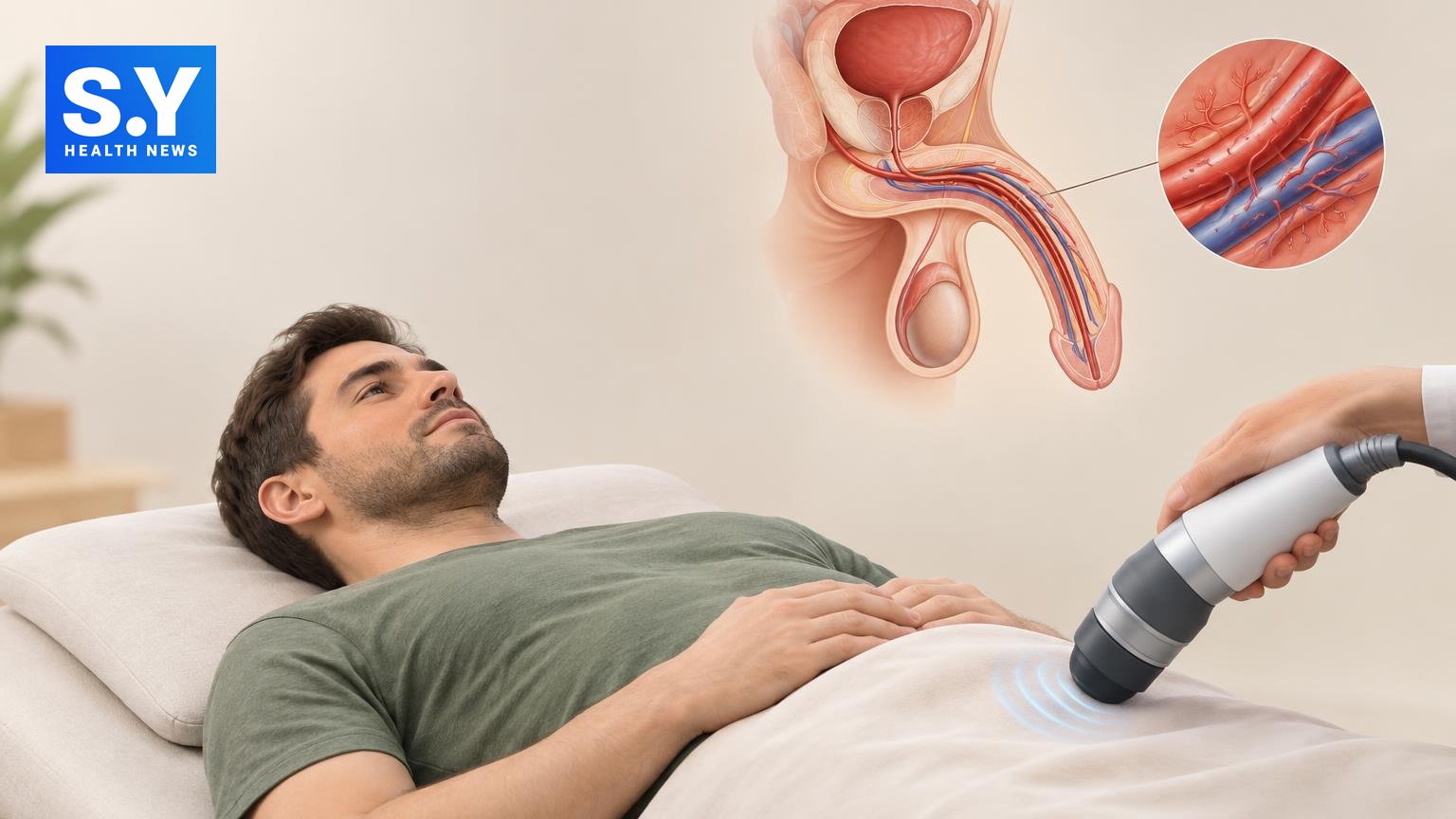
LI-ESWT delivers low-energy acoustic pulses to the tissue. The proposed rationale is that these mechanical stimuli may promote angiogenesis—new small blood vessel formation—and improve local blood flow and endothelial function in penile tissue, potentially addressing an underlying vascular contributor rather than producing an immediate erection.
That mechanism remains a hypothesis. The abstract does not report vascular imaging, endothelial biomarkers or any direct measure of penile blood flow, so it cannot confirm that the observed score changes arose through angiogenesis or vascular remodeling.
The planned dose was substantial: four weekly sessions, each with 5000 shockwaves distributed across four areas, including 900 shockwaves to the right and left crura. The abstract's description of how the remaining pulses were distributed is internally inconsistent, so exact dosing cannot be reconstructed from it.
What the Trial Measured and Found
Erectile function was assessed with the IIEF erectile function domain, questions 2 and 3 of the Sexual Encounter Profile, Global Assessment Question scores and the Erection Hardness Scale at baseline and at one and three months after treatment.
For the Full Analysis Set, with Per-Protocol values in parentheses, mean IIEF-EF increased from 18.04 (17.90) at baseline to 22.02 (21.95) at one month and was 22.54 (22.49) at three months. The abstract does not report the placebo group's IIEF-EF means, so the between-group score difference cannot be calculated from the available text.
By Full Analysis Set, the LI-ESWT success rate was 67.39% at one month versus 20.83% with placebo, and 69.57% at three months versus 20.83% with placebo; Per-Protocol rates were 73.17% at both time points versus 23.81% with placebo.
SEP, GAQ and EHS outcomes were also reported as significantly improved compared with placebo controls at p<0.05, though exact effect sizes and individual p-values are not given in the abstract. No side effects were reported during the study.
| Measure | LI-ESWT result | Placebo result | Time point | Interpretation note |
|---|---|---|---|---|
| Mean IIEF-EF, Full Analysis Set | 18.04 at baseline; 22.02 at 1 month; 22.54 at 3 months | Not reported in abstract | Baseline, 1 and 3 months | Placebo means are absent, so between-group differences cannot be derived |
| Mean IIEF-EF, Per-Protocol Set | 17.90 at baseline; 21.95 at 1 month; 22.49 at 3 months | Not reported in abstract | Baseline, 1 and 3 months | Per-Protocol results are similar to Full Analysis Set results |
| Success rate, Full Analysis Set | 67.39% at 1 month; 69.57% at 3 months | 20.83% at 1 month; 20.83% at 3 months | 1 and 3 months | Definition of 'success' is not specified in the abstract |
| Success rate, Per-Protocol Set | 73.17% at 1 month; 73.17% at 3 months | 23.81% at 1 month; 23.81% at 3 months | 1 and 3 months | Per-Protocol rates are higher than Full Analysis Set rates |
| SEP, GAQ and EHS | Reported as significantly improved versus placebo | Reference comparator | Not specified beyond assessment schedule | Reported as p<0.05; effect sizes not provided |
| Reported side effects | None reported | None reported | Through 3-month follow-up | Short follow-up in a small trial cannot establish long-term safety |
Statistical Signal Versus Clinical Meaning
The reported p-values indicate that the differences were unlikely to arise from chance alone under the trial's assumptions, but statistical significance and clinical importance are different questions. A meaningful change on the IIEF-EF is usually discussed in terms of the minimal clinically important difference, and the abstract does not report that benchmark or the proportion of men who crossed it.
The mean IIEF-EF trajectory—from about 18 at baseline to about 22—sits in a range often described as mild erectile dysfunction, and the trial enrolled only men with mild or moderate vasculogenic ED. Whether similar changes would appear in men with more severe dysfunction is unknown from these data.
A placebo success rate of 20.83% is itself notable and consistent with the idea that sham procedures can produce meaningful perceived improvement. The gap between arms is large in absolute terms, but without confidence intervals, the definition of success, or the placebo group's IIEF-EF scores, the precision and practical magnitude of that gap cannot be judged.
Interpretation and Limitations
The most important limitation is the publication format. The trial was reported as a podium abstract in the Journal of Urology in April 2017, and abstracts typically omit randomization methods, allocation concealment, blinding checks, handling of missing data, adverse event collection and prespecified analysis plans.
Several specific gaps follow from that format. The abstract does not define what counted as treatment 'success,' does not report placebo-group IIEF-EF means, and does not give between-group differences with confidence intervals. It also does not describe how the sham procedure was delivered or whether participants and assessors remained blinded.
The sample was 70 men, split 46 to active treatment and 24 to placebo, which is small for a multicenter trial and limits precision. The follow-up extended to three months, so the durability of any benefit beyond that window is unknown. The absence of reported side effects in a small, short trial is reassuring but not evidence of long-term safety.
The authors concluded that LI-ESWT is feasible, noninvasive and effective for improving erectile function in this population. That conclusion should be treated as the authors' interpretation of a single abstract rather than an established treatment standard, especially because sham-controlled trials in this field have produced mixed results over time.
Research Outlook
What would strengthen the evidence is a full peer-reviewed report of this trial with complete methods, prespecified outcomes and between-group estimates. Beyond that, larger sham-controlled trials with longer follow-up, standardized success definitions, objective vascular measures and comparisons across ED severity would clarify who, if anyone, is most likely to benefit.
Readers should also distinguish this trial's population—men with mild or moderate vasculogenic ED—from the broader groups sometimes treated in clinical practice. Extrapolating these results to men with severe ED, diabetes-related ED, post-prostatectomy ED or other causes is not supported by the abstract.
Key Takeaways
- In a 2017 multicenter, double-blind, sham-controlled trial, 70 men with mild or moderate vasculogenic ED received LI-ESWT or placebo, with outcomes assessed at one and three months.
- Mean IIEF-EF in the active arm rose from 18.04 at baseline to 22.02 at one month and 22.54 at three months, but placebo-group means and between-group differences were not reported in the abstract.
- Success rates favored LI-ESWT—67.39% versus 20.83% at one month and 69.57% versus 20.83% at three months by Full Analysis Set—but 'success' is undefined in the abstract.
- No side effects were reported, yet the small sample and three-month horizon cannot establish long-term safety.
- The findings come from a 2017 conference abstract, so methodological detail is limited and the results should be read as promising but not definitive.
Questions and Answers
What is low-intensity extracorporeal shockwave therapy and how is it thought to help erectile dysfunction?
LI-ESWT delivers low-energy acoustic pulses to penile tissue, typically in a series of clinic sessions. The proposed mechanism is that mechanical stimulation may promote angiogenesis and improve endothelial function and local blood flow, addressing a vascular contributor to erectile dysfunction. This mechanism remains a hypothesis; the abstract did not measure blood flow or vessel growth directly.
How did IIEF-EF scores change after shockwave therapy in the 2017 sham-controlled trial?
In the Full Analysis Set, mean IIEF-EF rose from 18.04 at baseline to 22.02 at one month and was 22.54 at three months; Per-Protocol values were 17.90, 21.95 and 22.49. The abstract did not report placebo-group IIEF-EF means or between-group differences with confidence intervals, so the size of the advantage over sham cannot be fully judged.
What responder rates did the shockwave trial report compared with sham?
By Full Analysis Set, success was 67.39% with LI-ESWT versus 20.83% with placebo at one month and 69.57% versus 20.83% at three months. Per-Protocol rates were 73.17% versus 23.81% at both time points. The abstract does not define what counted as success, which limits interpretation of these percentages.
How strong is the evidence that shockwave therapy works for vasculogenic erectile dysfunction?
The evidence from this trial is promising but limited. It was randomized, double-blind and sham-controlled, which is a strong design, but it was reported only as a conference abstract, enrolled 70 men, followed them for three months and omitted key methodological and effect-size details. It supports further study rather than a definitive conclusion.
Which men were included in the shockwave therapy trial, and can the results be generalized?
Participants were men aged 20-70 years with mild or moderate vasculogenic erectile dysfunction, assessed with the IIEF erectile function domain. Whether results extend to men with severe ED, diabetes-related ED, post-surgical ED or other causes is unknown, because those groups were not represented in the reported population.
Were there side effects from low-intensity shockwave therapy in this trial?
The investigators reported no side effects. However, the trial was small and follow-up lasted only three months, so the absence of reported events does not establish long-term safety. Men considering this treatment should discuss the limited safety database and the abstract-only evidence with a clinician.
Sources and References
- PD69-04 SAFETY AND EFFICACY OF LOW-INTENSITY EXTRACORPOREAL SHOCKWAVE IN THE TREATMENT OF VASCULOGENIC ERECTILE DYSFUNCTION: A MULTI-CENTER, DOUBLE-BLIND, RANDOMIZED SHAM-CONTROLLED CLINICAL TRIAL | Journal of Urology.
- Zhongcheng Xin; Ruili Guan; Wanshou Cui; Xiaodong Zhang; Long Tian; Yi Xie; Hongen Lei; Jihong Liu; Tao Wang. SAFETY AND EFFICACY OF LOW-INTENSITY… : Journal of Urology. Journal of Urology. 2017 197(4):e1345-e1346 DOI: 10.1016/j.juro.2017.02.3145.
SANYUN Science Center explains published research on men's reproductive and sexual health, connecting scientific evidence with everyday questions while making sources and limitations clear.
Disclaimer: This article is for scientific education and research communication only. It does not provide medical advice, diagnosis, or individualized treatment recommendations, and does not endorse any medication, supplement, device, penile enlargement procedure, or other intervention. Decisions about sexual and reproductive health should be made in consultation with a qualified healthcare professional. Do not delay seeking professional care because of information in this article.
Original Content & Copyright Notice
- This article is prepared for SANYUN Science Center, drawing on published research and publicly available academic literature on men’s sexual and reproductive health. Its editorial explanations and presentation are developed for this platform.
- Copyright in the original editorial content, selection, and arrangement is reserved by SANYUN Science Center to the extent protected by applicable law. Referenced research, quotations, and third-party materials remain subject to the rights of their respective owners. This notice does not claim ownership of scientific facts or third-party research.
- Except where permitted by applicable law or an applicable license, prior written permission is required to reproduce, republish, translate, adapt, redistribute, or commercially reuse protected content. Attribution alone does not grant permission for such reuse.
- For permitted quotation or authorized reuse, clearly identify the source and retain a link to the original article.
- Source: SANYUN Science Center
- Original URL: Retain the original article URL on science.san-yun.com.
- Copyright Holder: SANYUN Science Center, for its own protected editorial content.
- Quotation, excerpts, or authorized reuse must not distort the scientific meaning, omit material limitations or disclaimers, or imply unverified medical claims, product efficacy, or endorsement by SANYUN Science Center.



