




Category: Latest Research
Core Research Direction: A completed, not-prospectively-registered single-centre pilot randomized open-label trial comparing a frenular silicone band versus topical lidocaine-prilocaine spray (each plus behavioural counselling) for lifelong premature ejaculation in men aged 18-35: what its design permits and cannot establish.
Search Intent: What did a small pilot trial comparing a silicone frenulum band with lidocaine-prilocaine spray in men with lifelong premature ejaculation actually measure, and what can a 32-man open-label trial with no posted results tell us?
Platform: SANYUN Science Center
Evidence reviewed through: 2026-11-24
Executive Summary
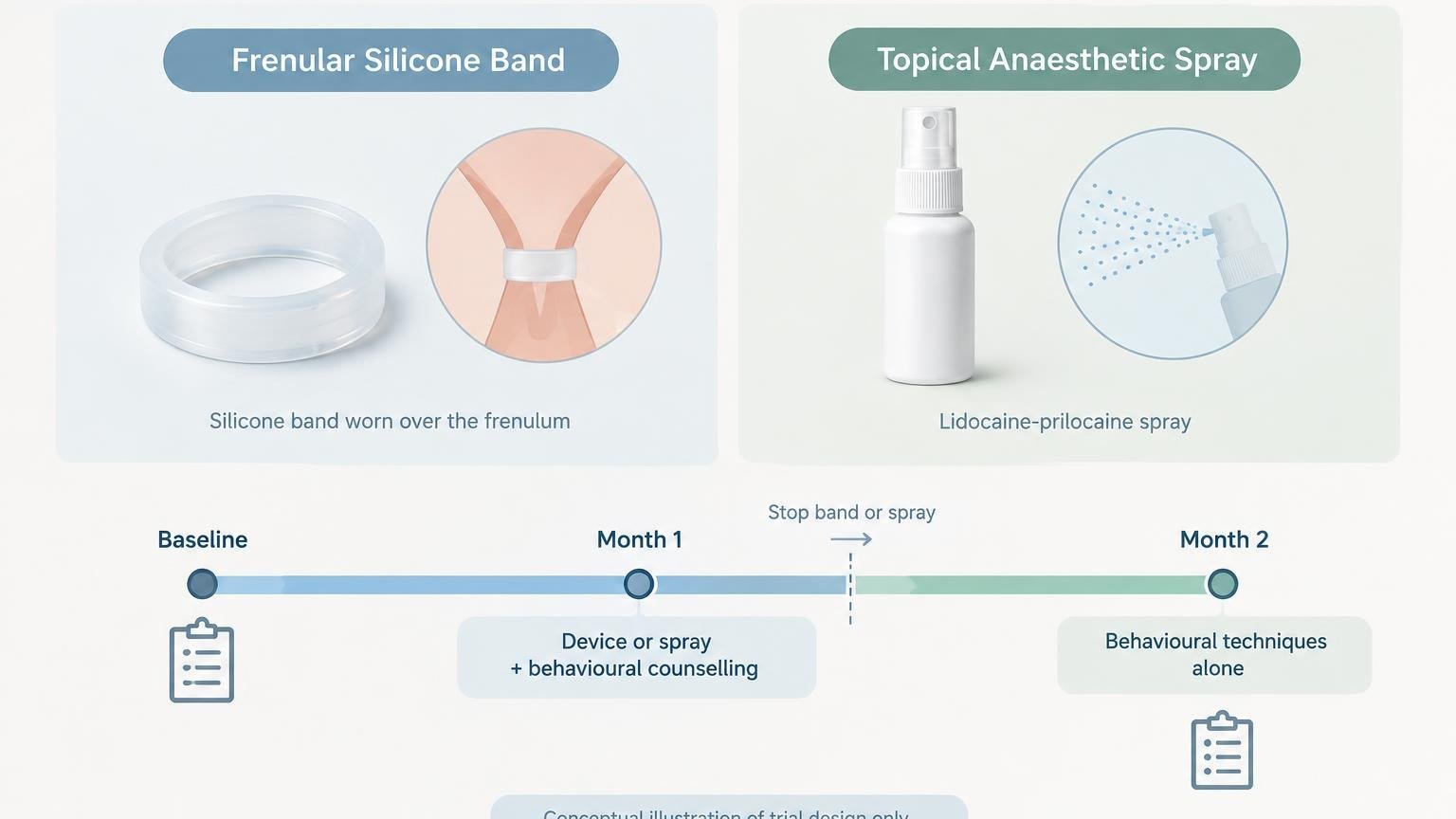
A completed single-centre, randomized, open-label pilot trial compared a soft silicone band worn over the frenulum with topical lidocaine-prilocaine spray, each given alongside behavioural counselling, in men with lifelong premature ejaculation. Thirty-two men aged 18-35 were randomly assigned; the record describes 16 participants per group and an explicitly preliminary purpose. The intervention phase lasted one month, followed by one month in which participants stopped the band or spray and continued behavioural techniques alone.[1]
Two co-primary endpoints were listed: change from baseline in Premature Ejaculation Diagnostic Tool score and change from baseline in patient-estimated intravaginal ejaculatory latency time, both assessed at baseline, month one and month two. No outcome values appear in the supplied records, and results were not posted at the time of the aggregator snapshot. The trial was also not prospectively registered: the record was submitted after study completion.[2][3]
This article therefore cannot tell readers which intervention performed better, whether either outperformed behavioural counselling alone, or how large any effect was. What it can do is explain the trial's architecture, the meaning of its endpoints, the specific biases an open-label pilot invites, and the questions a future, adequately powered and properly registered study would need to answer.
Why This Record Matters Even Without Numbers
Lifelong premature ejaculation is a common and often undertreated complaint. Many men try topical anaesthetics, condoms, behavioural techniques or off-label drugs, and the evidence base for each option varies widely in quality. A small randomised pilot is not a verdict on any of these approaches, but it is a legitimate way to test feasibility, estimate variability and decide whether a larger trial is worth funding.
The record is also useful as a case study in reading trial registries carefully. It shows how much a design description can tell you before results exist: who was eligible, what was compared, when outcomes were measured, and whether the study was registered before or after the fact. Those details shape how much weight any eventual results should carry. Readers who want a broader look at the strength of evidence for numbing agents can consult an analysis of topical numbing sprays for premature ejaculation.
The Biological Logic of Two Very Different Interventions
The two arms work through different mechanisms. Lidocaine-prilocaine spray is a topical anaesthetic combination that temporarily reduces sensation when applied before intercourse; the registry describes it as a medicine that temporarily reduces sensation. The silicone band, by contrast, is a physical device placed over the frenulum, the sensitive area on the underside of the head of the penis, to modify stimulation mechanically rather than pharmacologically.
The band deserves particular scrutiny. According to the record, it was cut from medical-grade silicone adhesive tape intended for wound contact and used outside its stated intended purpose, with the use described in the ethics-approved protocol and participant information sheet. That is not the same as a purpose-built, regulator-cleared device. It means the intervention is best understood as an improvised, protocol-specified application of a material with a different intended use, and any safety or efficacy conclusions would apply to that specific use, not to silicone bands in general.
Behavioural counselling was delivered in both arms: the stop-start technique, the squeeze technique, and breathing and relaxation exercises. This is an important design choice. Behavioural therapy is itself an active intervention, so both arms are effectively combination treatments. Any observed change reflects the combination, and the trial is not designed to isolate how much of the change came from the device or spray versus the counselling.
What the Trial Actually Measured
The endpoints are worth unpacking because each carries a different meaning. The table below summarises the core measurement choices described in the registry record.
| Measure | What it captures | How it was collected | Key limitation |
|---|---|---|---|
| Change from baseline in PEDT score | Premature ejaculation symptom burden, based on a multi-item questionnaire reflecting control, distress and related domains | Collected at baseline, month 1 and month 2 | Questionnaire-based; scores can shift with expectation in an open-label design |
| Change from baseline in patient-estimated IELT | Self-reported average time from vaginal penetration to ejaculation | Recalled average over the preceding two weeks, rounded to the nearest minute, with no stopwatch, diary or contemporaneous record | Recall-based and subjective; rounded values reduce precision |
| Treatment outcome and satisfaction | Premature Ejaculation Treatment Outcome questionnaire and a five-point satisfaction scale | Administered at the end of month 1 only | Not repeated at month 2, so persistence of satisfaction is not captured |
| Tolerability and safety | Local reactions, discomfort, band displacement and other adverse events | Asked at study visits | Descriptive only in a pilot; rare harms would not be reliably detected |
The choice to estimate IELT by recall rather than with a stopwatch or diary is a meaningful methodological decision. Stopwatch-measured IELT is often treated as the more objective standard in ejaculation research; participant recall over two weeks, rounded to the nearest minute, introduces both random error and the possibility of systematic bias if one group feels more optimistic about its treatment. A pilot can tolerate this imprecision, but a larger trial relying on the same method would need careful justification, and the effect of this measurement choice on any observed difference would need to be considered rather than assumed away.
Design Strengths and the Limits of a 32-Man Pilot
The trial's strengths are real but modest. Allocation used a 1:1 computer-generated random sequence, and assignment was concealed from the enrolling investigator using envelopes. Randomisation and allocation concealment are the features that separate a randomised trial from an uncontrolled case series, and their presence here means the two groups were, in expectation, comparable at baseline on measured and unmeasured characteristics.
The trial was single-centre, conducted at the Department of Urology at a hospital in Istanbul, Turkey. A single site limits generalisability: local referral patterns, counselling delivery and participant expectations may differ from other settings. The study size was described as pragmatic at 16 participants per group, intended to provide preliminary estimates to inform further research. A pilot of this size cannot reliably detect small or moderate differences, and the confidence intervals around any estimated effect would be wide.
The open-label design is the most consequential limitation for interpretation. Participants and treating clinicians knew which intervention was assigned. In a condition where expectation, anxiety and partner dynamics strongly influence experience, that knowledge can shape self-reported outcomes. The PEDT and IELT measures are both self-reported, so the risk of expectancy-driven reporting is not hypothetical. An open-label pilot can still generate useful estimates of variability and feasibility; it cannot establish comparative efficacy in the way a blinded trial can.
Regression to the mean is another consideration. Men were eligible if they reported a PEDT score of 11 or higher and difficulty delaying ejaculation, and men who enrol in a trial during a difficult period may improve partly because of natural fluctuation, attention and structured counselling. Without a behavioural-counselling-only control arm, the design cannot separate the specific contribution of the band or spray from these broader effects. That is not a flaw unique to this trial; it is a standard challenge for early-phase behavioural and device research.
Who the Findings Would and Would Not Apply To
Eligibility was narrow. Participants had lifelong, primary premature ejaculation with a reported inability to delay ejaculation, were aged 18-35, were in a stable heterosexual relationship for at least six months, and could engage in vaginal intercourse at least three times per week. Men with acquired premature ejaculation were excluded, as were men with erectile dysfunction defined by a five-item International Index of Erectile Function score below 22, chronic systemic disease including diabetes or hypertension, psychiatric disorders or recent psychiatric medication use, and penile anatomical abnormalities.
These criteria mean the trial population is a relatively healthy, high-frequency, partnered group. Men outside those parameters — those with comorbid erectile dysfunction, chronic illness, lower intercourse frequency, or non-heterosexual relationship contexts — are not represented. Any conclusions would be limited to the type of participant the trial actually enrolled, and would need replication before being extended.
The Registration Problem
The trial was not prospectively registered; the record was submitted after study completion. According to the aggregator record, the actual start was September 2025, primary completion was December 2025, completion was January 2026, and registration occurred in September 2026. That sequence matters because prospective registration fixes the primary outcomes and analysis plan before data are seen, which reduces the opportunity for selective reporting or post hoc reframing of endpoints.
This does not mean the trial was conducted improperly. It means readers cannot independently verify that the outcomes now listed as primary were the ones originally planned. A retrospective registration is better than no registration at all, but it offers weaker protection. When results eventually appear, the comparison between the registered plan and the reported analysis will be part of how the evidence should be judged.
What Could Be Concluded If Results Were Reported
Suppose complete results were published. Even then, the most that a 32-person open-label pilot could support is a set of preliminary observations: whether the interventions were tolerable, whether the outcome measures behaved sensibly, how variable the responses were, and whether a larger trial appears feasible. It could not establish that one intervention is superior, that either is effective relative to counselling alone, or that benefits persist beyond the two-month window.
Statistical significance in such a small sample would also be fragile. With 16 per group, only large differences would be likely to be detected, and a non-significant result would not show equivalence. Conversely, a nominally significant finding could reflect chance, baseline imbalance or reporting bias in an open-label setting. Distinguishing statistical from clinical meaning is especially important here: a change in a questionnaire score may not correspond to a difference men or their partners would notice or value.
Research Outlook
The wider field is active. A separate phase 2 trial of an investigational agent, KH-001, is listed as recruiting and is designed to evaluate intravaginal ejaculatory latency time, patient-reported outcomes and safety in men with lifelong premature ejaculation. That kind of placebo-controlled, phase 2 design is the type of study that can begin to answer efficacy questions more convincingly than a small open-label pilot.[4]
For the silicone band specifically, a future study would ideally use a purpose-built device rather than a wound-contact tape applied off-label, include a behavioural-therapy-only comparison, blind outcome assessment where feasible, and use a contemporaneous latency measure such as a diary or stopwatch. Prospective registration would allow readers to confirm that the primary outcomes were fixed in advance. Until such data exist, the band should be regarded as an experimental approach, not an established treatment.
Key Takeaways
- The trial randomised 32 men aged 18-35 with lifelong premature ejaculation to a frenular silicone band or lidocaine-prilocaine spray, each plus behavioural counselling, with 16 participants per group.
- The listed co-primary endpoints were change from baseline in PEDT score and change from baseline in patient-estimated IELT, assessed at baseline, month one and month two.
- No outcome values are available in the supplied records, and results were not yet posted; no claim about comparative efficacy can be made.
- The trial was open-label, single-centre and not prospectively registered, three features that limit how much weight any eventual findings should carry.
- The silicone band was cut from medical-grade silicone adhesive tape intended for wound contact and used outside its stated intended purpose, so findings would apply to that specific improvised use, not to silicone devices generally.
- Eligibility excluded acquired premature ejaculation, erectile dysfunction, chronic systemic disease and psychiatric disorders, so any conclusions would apply only to a narrowly defined, relatively healthy group.
Questions and Answers
What is a frenular silicone band and how is it supposed to help premature ejaculation?
In this trial the band was a piece of medical-grade silicone adhesive tape cut and placed over the frenulum, the sensitive area under the glans, to reduce stimulation physically. It was used outside the tape's stated intended purpose, under an ethics-approved protocol. That makes it an improvised, protocol-specific application rather than a purpose-built medical device, and no efficacy claim follows from the design alone.
What did the silicone band versus lidocaine-prilocaine spray trial actually measure in men with lifelong premature ejaculation?
The listed co-primary endpoints were change from baseline in Premature Ejaculation Diagnostic Tool score and change from baseline in patient-estimated intravaginal ejaculatory latency time, assessed at baseline, month one and month two. Secondary measures included a treatment outcome questionnaire, a five-point satisfaction scale at month one, and questions about local reactions, discomfort, band displacement and other adverse events.
Are there published results from the frenular silicone band premature ejaculation trial?
No. The supplied records list the trial as completed with 32 participants, but results were not yet posted, and no numerical outcomes appear in the available sources. That means questions about which intervention performed better, how large any change was, or whether benefits persisted after the one-month withdrawal period cannot be answered from this record.
How strong is the evidence from a 32-man open-label pilot trial like this one?
It is preliminary by design. With 16 participants per group, the study can generate estimates of variability and feasibility but cannot reliably detect small or moderate differences, and wide uncertainty would surround any estimate. The open-label design adds potential expectancy and reporting bias, and the lack of a behavioural-therapy-only arm means the specific contribution of the band or spray cannot be separated.
Who was eligible for the silicone band versus prilocaine spray trial, and who was excluded?
Participants were men aged 18-35 with lifelong premature ejaculation, a PEDT score of 11 or higher, a stable heterosexual relationship of at least six months, and vaginal intercourse at least three times per week. Exclusions included acquired premature ejaculation, erectile dysfunction with IIEF-5 below 22, chronic systemic disease such as diabetes or hypertension, psychiatric disorders, and penile anatomical abnormalities.
Why does retrospective registration matter when judging a premature ejaculation trial?
Prospective registration fixes the primary outcomes and analysis plan before data are seen, which protects against selective reporting and post hoc endpoint changes. This trial was not prospectively registered; the record was submitted after completion, with an actual start in September 2025 and registration in September 2026. That does not prove misconduct, but it means readers cannot independently verify that the listed primary outcomes were planned in advance.
Sources and References
- Silicone Band Versus Prilocaine Spray for Lifelong Premature Ejaculation.
- lidocaine-prilocaine spray — 1 site, updated Nov 2026 | DataLookout.
- Silicone Band Versus Prilocaine Spray for Lifelong Premature Ejaculation · Urology.
- DataLookout — Clinical Trial Intelligence.
SANYUN Science Center explains published research on men's reproductive and sexual health, connecting scientific evidence with everyday questions while making sources and limitations clear.
Disclaimer: This article is for scientific education and research communication only. It does not provide medical advice, diagnosis, or individualized treatment recommendations, and does not endorse any medication, supplement, device, penile enlargement procedure, or other intervention. Decisions about sexual and reproductive health should be made in consultation with a qualified healthcare professional. Do not delay seeking professional care because of information in this article.
Original Content & Copyright Notice
- This article is prepared for SANYUN Science Center, drawing on published research and publicly available academic literature on men’s sexual and reproductive health. Its editorial explanations and presentation are developed for this platform.
- Copyright in the original editorial content, selection, and arrangement is reserved by SANYUN Science Center to the extent protected by applicable law. Referenced research, quotations, and third-party materials remain subject to the rights of their respective owners. This notice does not claim ownership of scientific facts or third-party research.
- Except where permitted by applicable law or an applicable license, prior written permission is required to reproduce, republish, translate, adapt, redistribute, or commercially reuse protected content. Attribution alone does not grant permission for such reuse.
- For permitted quotation or authorized reuse, clearly identify the source and retain a link to the original article.
- Source: SANYUN Science Center
- Original URL: Retain the original article URL on science.san-yun.com.
- Copyright Holder: SANYUN Science Center, for its own protected editorial content.
- Quotation, excerpts, or authorized reuse must not distort the scientific meaning, omit material limitations or disclaimers, or imply unverified medical claims, product efficacy, or endorsement by SANYUN Science Center.



