




Category: Premature Ejaculation
Core Research Direction: Evaluating selective alpha-1 blocker silodosin as an alternative to dapoxetine for premature ejaculation: magnitude of IELT prolongation versus risk of reduced/retrograde ejaculation, situated within contemporary consensus definitions and treatment recommendations.
Search Intent: In men with premature ejaculation, how much does silodosin prolong intravaginal ejaculation latency time compared with control, and at what cost in ejaculatory adverse effects such as reduced or retrograde ejaculation?
Platform: SANYUN Science Center
Evidence reviewed through: 2026-10-30
Executive Summary
Premature ejaculation is common and burdensome. A 2024 systematic review and meta-analysis of randomized controlled trials pooled four studies and reported that men given silodosin, a selective alpha-1 blocker, achieved a significantly longer intravaginal ejaculation latency time (IELT) than controls, with a mean difference of 132.54 (95% CI 51.51–213.57). The same review found a significantly higher odds of reduced semen ejaculation with silodosin (OR 10.79, 95% CI 3.46–33.67).[1]
The authors concluded that silodosin significantly increased IELT while reducing semen ejaculation, and interpreted this as support for its use as an alternative treatment. That conclusion rests on a small evidence base, an unstated IELT unit in the supplied abstract, and adverse-event odds ratios with wide confidence intervals. The benefit is statistically clear in the pooled estimate; whether it is clinically sufficient, and for whom the ejaculatory cost is acceptable, remains a judgment that the pooled data cannot settle alone.
Why This Matters
The review's introduction states that premature ejaculation occurs in 31% of men aged 18–59 years and is associated with disappointment and avoidance of sexual relations. The figure is cited without detailed denominator information, so it should be read as an indicative prevalence rather than a precise population estimate. Even so, a condition affecting a substantial share of adult men, and reshaping couple relationships, warrants careful treatment evaluation.
Contemporary consensus work frames ejaculatory disorders, including premature and delayed ejaculation, as common conditions with a substantial impact on quality of life and relationships. The Fifth International Consultation on Sexual Medicine set out to provide evidence-based recommendations for definition, classification and treatment, with scope covering lifelong and acquired premature ejaculation, dapoxetine, other SSRIs, psychotherapy, penile hypersensitivity and IELT. That scope note is useful context: the field's authoritative framing is multi-modal and definition-sensitive, not a single-drug question.[2]
Against that backdrop, the review positions dapoxetine as the current guideline treatment while asserting that its adverse effects limit long-term use. The exact adverse-effect profile is not quantified in the supplied text, so the contrast with silodosin is a rationale rather than a head-to-head comparison. Readers should not infer that one agent is safer overall from this framing alone.
Biological and Clinical Rationale
Silodosin is an alpha-1 blocker. The review states that it has been proposed as a new option for treating premature ejaculation because of its minimal side effects. That premise is best treated as a hypothesis motivating the analysis: the same review later reports a substantially elevated odds of reduced semen ejaculation, which directly qualifies any claim of minimal side effects. The mechanism by which alpha-1 blockade might delay ejaculation is not detailed in the supplied material, and this article does not assert one.
The clinical logic is a trade-off rather than a free gain. A drug that lengthens latency by acting on ejaculatory physiology may plausibly disturb the ejaculatory process itself; the review's adverse-event finding is consistent with that concern but does not establish a mechanism. Distinguishing a plausible rationale from a demonstrated causal pathway matters when counseling men about what to expect.
What the Evidence Shows
The review was conducted in accordance with Cochrane Handbook guidance, with searches across PubMed, ScienceDirect and the Cochrane Central Register of Controlled Trials. Inclusion required premature ejaculation patients, silodosin intervention, comparison with placebo or another premature ejaculation therapy, and reporting of both IELT and treatment-related adverse events. These are sensible but restrictive criteria: trials that measured other outcomes, or that did not report IELT, would have been excluded.
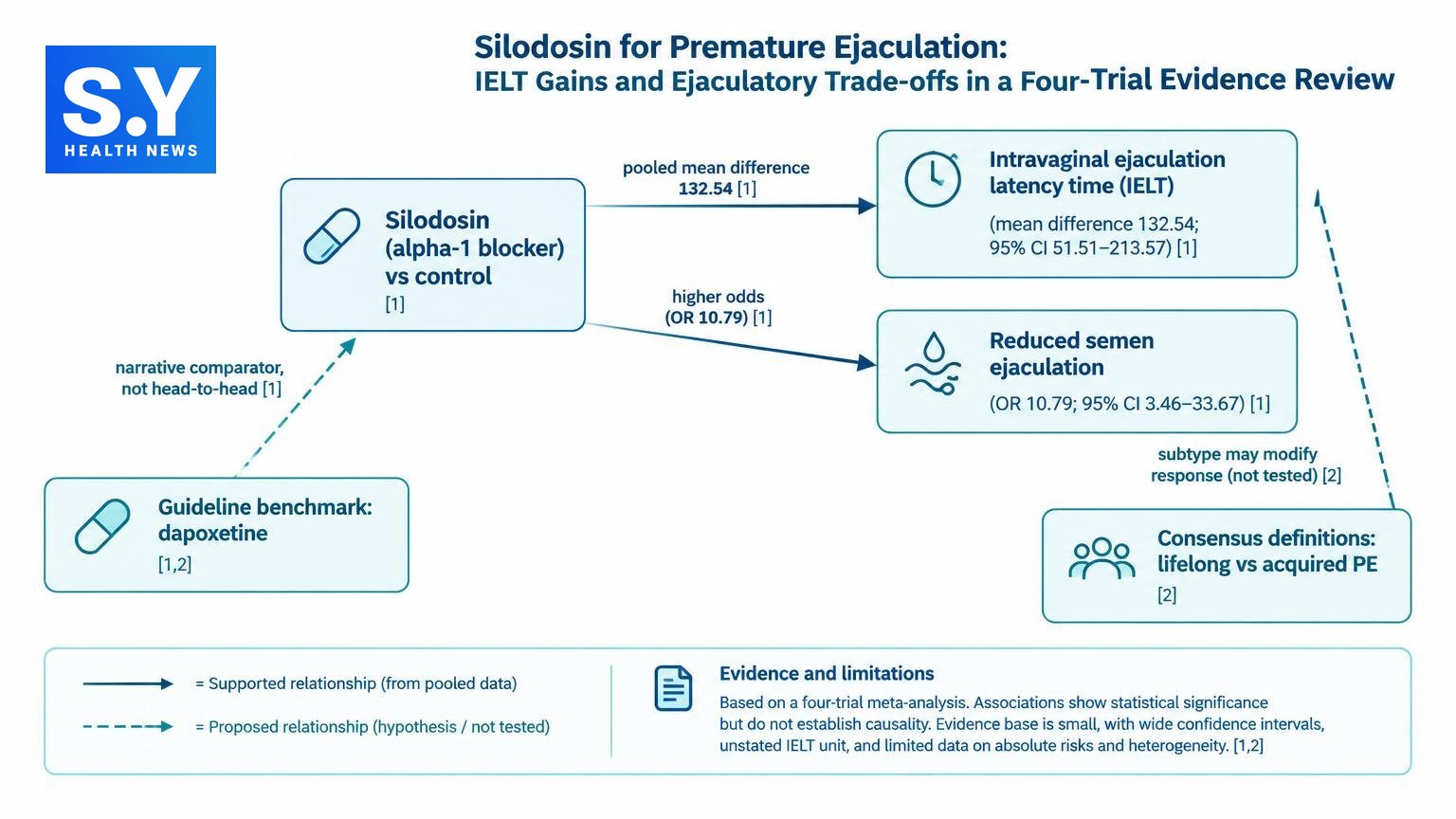
Four studies were included. Pooled analysis showed that patients receiving silodosin had a significantly longer IELT than controls, with a mean difference of 132.54 (95% CI 51.51–213.57, p < 0.001). In the same pooled dataset, silodosin-treated patients had a significantly higher risk of reduced semen ejaculation (OR 10.79, 95% CI 3.46–33.67, p < 0.0001). The review's conclusion was that silodosin significantly increased IELT but also reduced semen ejaculation, and that this supports its clinical use as an alternative treatment.
| Measure / finding | Result | Population / follow-up | Limitations |
|---|---|---|---|
| number of included studies | 4 studies | Small pooled evidence base; total participant count and trial-level details are not reported in the supplied text. | |
| mean difference in IELT (silodosin vs control) | 132.54 seconds (assumed IELT unit) | men with premature ejaculation in included RCTs | Unit not stated in the supplied abstract; only four studies pooled; wide confidence interval indicating imprecision; no total sample size reported; no assessment of heterogeneity reported in the supplied text. |
| odds ratio for reduced semen ejaculation | 10.79 odds ratio (95% CI 3.46-33.67) | men with premature ejaculation in included RCTs | Rare-event odds ratios with wide confidence intervals can be unstable; absolute event rates not reported in supplied text. |
Two features of these numbers deserve emphasis. First, the confidence interval for the IELT mean difference is wide, spanning roughly 52 to 214 in whatever unit the trials used; the supplied abstract does not state the unit, so the magnitude should not be translated into seconds or minutes by assumption. Second, the odds ratio for reduced semen ejaculation is large but imprecise, with a confidence interval from about 3.5 to about 34. Wide intervals around large odds ratios often reflect sparse events and small samples, and they argue for caution rather than confident point estimates.
Interpretation and Limitations
Statistical significance and clinical significance are not the same. The pooled IELT difference is statistically robust in the sense that its confidence interval excludes zero, but the review did not report, in the supplied text, whether the change crossed a threshold meaningful to patients or partners. Likewise, the adverse-event odds ratio establishes an association between silodosin and reduced semen ejaculation in the pooled trials; it does not by itself quantify the absolute risk, because baseline event rates are not given. Men and clinicians need absolute numbers to weigh a benefit against a harm, and those are absent here.
Several limitations bound the conclusions. The evidence base comprises only four studies, and the supplied text does not report total participant numbers, heterogeneity statistics, or trial-level risk-of-bias results, even though the review states that risk of bias was assessed. The absence of a stated IELT unit in the abstract complicates interpretation. The odds ratio for a relatively uncommon adverse event can be unstable. And the review's recommendation of silodosin as an alternative treatment is the authors' interpretive judgment, not a directly measured outcome.
The consensus review adds a broader caveat. Its scope includes definition and classification of lifelong and acquired premature ejaculation, which implies that the population entering any drug trial is heterogeneous. Men with lifelong versus acquired premature ejaculation may respond differently, and the supplied meta-analysis does not stratify by subtype. Nor does it compare silodosin directly against dapoxetine in a head-to-head synthesis; the comparison is silodosin versus control, with dapoxetine serving as a narrative benchmark.
Research Outlook
The most useful next steps are practical rather than speculative. Larger randomized trials with prespecified IELT units and absolute adverse-event rates would allow a genuine benefit-harm calculation. Direct comparisons between silodosin and dapoxetine, rather than comparisons against control, would inform the choice the review implicitly raises. Stratification by lifelong versus acquired premature ejaculation, and by baseline severity, would test whether the average effect conceals important variation. Longer follow-up would address the assertion that dapoxetine's adverse effects limit long-term use, and whether silodosin's ejaculatory effects persist, resolve on discontinuation, or affect fertility-related concerns.
Until such data exist, the review should be read as a signal of efficacy and a clear warning about ejaculatory adverse effects, not as a settled treatment algorithm. The field's consensus process explicitly aims to synthesize etiology, epidemiology, evaluation and management, which suggests that drug choice belongs within a broader assessment rather than as a stand-alone decision.
Key Takeaways
- In a 2024 meta-analysis of four randomized trials, silodosin was associated with a significantly longer IELT than control (mean difference 132.54; 95% CI 51.51–213.57).
- The same pooled analysis found a significantly higher odds of reduced semen ejaculation with silodosin (OR 10.79; 95% CI 3.46–33.67), a wide and imprecise estimate.
- The review's own conclusion supports silodosin as an alternative treatment, but that is an interpretive judgment from a small evidence base lacking reported absolute event rates.
- Contemporary consensus work frames premature ejaculation within definition, classification and multi-modal management, not as a single-drug decision.
Questions and Answers
What is silodosin and why is it being studied for premature ejaculation?
Silodosin is a selective alpha-1 blocker. The reviewed meta-analysis notes that it has been proposed as a new treatment for premature ejaculation because of its minimal side effects, in contrast to dapoxetine, which the review says is the current guideline treatment but has adverse effects that limit long-term use. That rationale is a hypothesis motivating the analysis, and the same review's finding of increased reduced semen ejaculation qualifies the 'minimal side effects' premise.
How much does silodosin prolong intravaginal ejaculation latency time?
In a pooled analysis of four randomized trials, men receiving silodosin had a significantly longer IELT than controls, with a mean difference of 132.54 (95% CI 51.51–213.57, p < 0.001). The supplied abstract does not state the unit of IELT, and the confidence interval is wide, so the magnitude should be read as an imprecise pooled estimate rather than a precise expected gain for an individual man.
What adverse effect was found with silodosin?
Silodosin-treated patients had a significantly higher risk of reduced semen ejaculation than controls, with an odds ratio of 10.79 (95% CI 3.46–33.67, p < 0.0001). The odds ratio is large but imprecise, and the supplied text does not report absolute event rates, so the practical risk for an individual cannot be calculated from this abstract alone. Retrograde ejaculation is named among the review's keywords, but the pooled estimate reported is for reduced semen ejaculation.
How strong is this evidence?
Moderate at best. The meta-analysis followed Cochrane Handbook guidance and pooled randomized trials, which is a reasonable design, but only four studies were included. The supplied text does not report total participants, heterogeneity, or trial-level risk-of-bias results. The IELT unit is unstated, and the adverse-event odds ratio has a wide confidence interval. The conclusion that silodosin is a viable alternative is the authors' interpretation, not a directly measured outcome.
Does this mean silodosin should replace dapoxetine?
Not on this evidence. The pooled comparison is silodosin versus control, not silodosin versus dapoxetine. The review positions dapoxetine as the guideline treatment and cites its adverse effects as a limitation, but provides no head-to-head synthesis. The consensus review's scope covers dapoxetine, other SSRIs, psychotherapy, penile hypersensitivity and IELT, indicating that treatment decisions are multi-modal. Replacing one agent with another requires direct comparative data and absolute risk estimates, which are not supplied here.
What should men and clinicians take from this review?
That silodosin shows a statistically clear latency benefit alongside a substantial and statistically clear increase in reduced semen ejaculation. The trade-off is real, but the evidence is small and the absolute risks are not reported. Men considering treatment should discuss both potential benefit and ejaculatory side effects with a clinician, and should understand that premature ejaculation has lifelong and acquired forms that may respond differently. This article is educational and does not provide personal medical advice.
Conceptual framework: Conceptual framework of the variables examined in the four-trial meta-analysis of silodosin for premature ejaculation. Supported links show the pooled IELT benefit and the increased odds of reduced semen ejaculation versus control. Proposed links indicate that dapoxetine serves only as a narrative benchmark and that lifelong versus acquired premature ejaculation may modify response, which the pooled data did not test. This is an interpretive framework, not a tested causal model.
Academic References & Evidence
- Muhammad Ilham Fauzan; Besut Daryanto; Taufiq Nur Budaya; Moh Anfasa Giffari Makkaraka; Muhammad Fakhri; Ilham Akbar Rahman. Promising selective alpha-1 blocker silodosin as a new therapeutic strategy for premature ejaculation and analysis of its drug adverse effect: A systematic review and meta-analysis of randomized controlled trials. Archivio Italiano di Urologia e Andrologia. 2024 96(4):Article 12984 DOI: 10.4081/aiua.2024.12984.
- Contemporary consensus and emerging directions in premature and delayed ejaculation: recommendations from the 5th International Consultation on Sexual Medicine.. Sexual medicine reviews PMID: 42855438.
SANYUN Science Center explains published research on men's reproductive and sexual health, connecting scientific evidence with everyday questions while making sources and limitations clear.
Disclaimer: This article is for scientific education and research communication only. It does not provide medical advice, diagnosis, or individualized treatment recommendations, and does not endorse any medication, supplement, device, penile enlargement procedure, or other intervention. Decisions about sexual and reproductive health should be made in consultation with a qualified healthcare professional. Do not delay seeking professional care because of information in this article.
Original Content & Copyright Notice
- This article is prepared for SANYUN Science Center, drawing on published research and publicly available academic literature on men’s sexual and reproductive health. Its editorial explanations and presentation are developed for this platform.
- Copyright in the original editorial content, selection, and arrangement is reserved by SANYUN Science Center to the extent protected by applicable law. Referenced research, quotations, and third-party materials remain subject to the rights of their respective owners. This notice does not claim ownership of scientific facts or third-party research.
- Except where permitted by applicable law or an applicable license, prior written permission is required to reproduce, republish, translate, adapt, redistribute, or commercially reuse protected content. Attribution alone does not grant permission for such reuse.
- For permitted quotation or authorized reuse, clearly identify the source and retain a link to the original article.
- Source: SANYUN Science Center
- Original URL: Retain the original article URL on science.san-yun.com.
- Copyright Holder: SANYUN Science Center, for its own protected editorial content.
- Quotation, excerpts, or authorized reuse must not distort the scientific meaning, omit material limitations or disclaimers, or imply unverified medical claims, product efficacy, or endorsement by SANYUN Science Center.



