




Category: Erectile Dysfunction
Core Research Direction: Whether obstructive sleep apnea and broader subjective sleep disturbances (daytime sleepiness, morning awakening difficulty) predict incident erectile dysfunction in a large prospective male cohort, and how reliable the overall evidence base for ED treatments is
Search Intent: Does sleep apnea or poor sleep quality actually raise a man's risk of developing erectile dysfunction, and how strong is the evidence behind current ED treatments?
Platform: SANYUN Science Center
Evidence reviewed through: 2026-11-07
Executive Summary
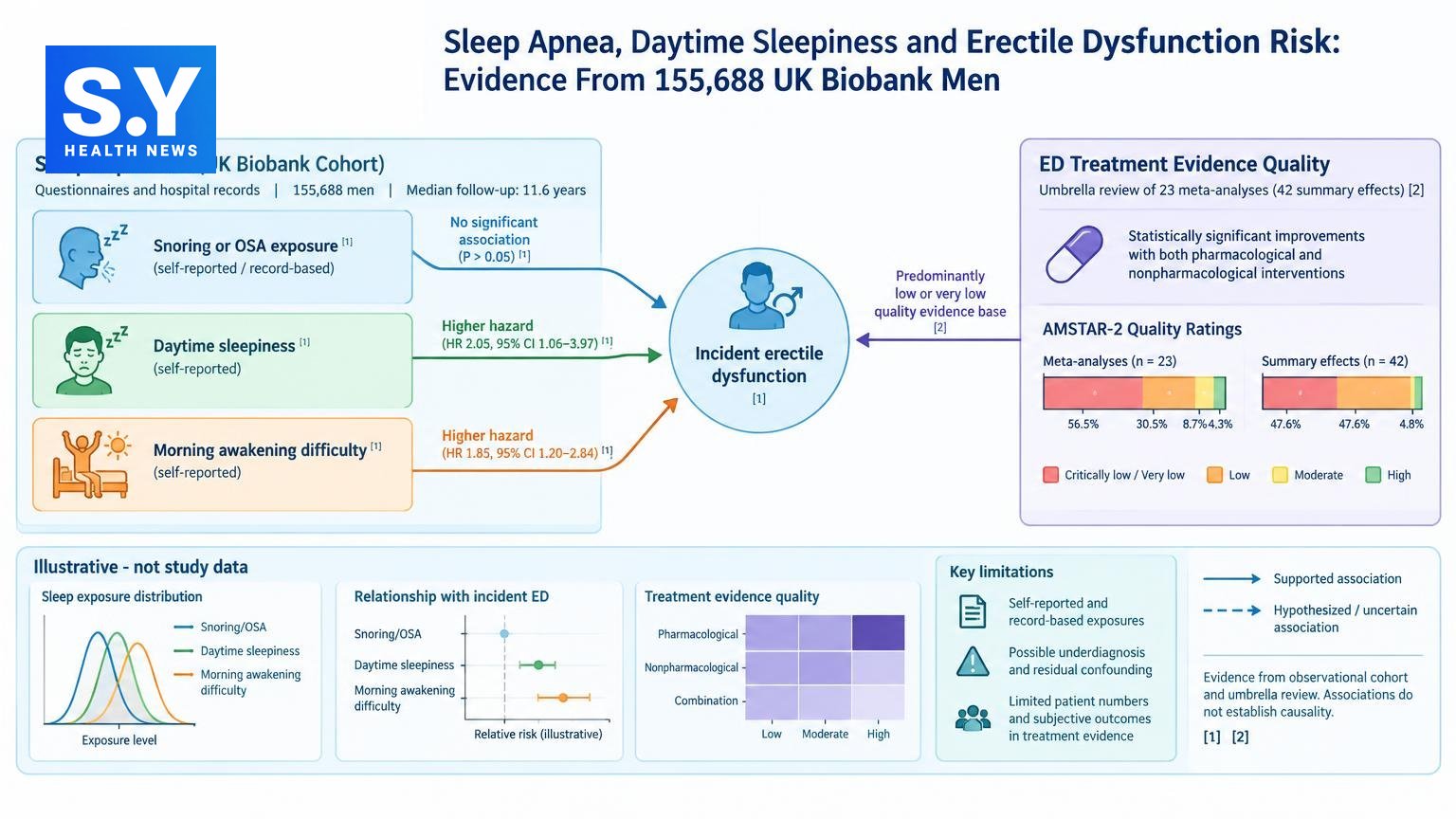
The headline finding is a split result. In a prospective cohort of 155,688 UK Biobank men followed for a median of 11.6 years, snoring or obstructive sleep apnea (OSA) was not significantly associated with incident erectile dysfunction (ED). Yet two broader subjective sleep measures were: men reporting more daytime sleepiness had roughly double the hazard of incident ED compared with less sleepy men, and men who found morning awakening harder also had a higher hazard.[1]
The cohort used questionnaires and hospital records to define snoring and OSA exposures, defined incident ED as the outcome, and applied Cox regression adjusted for covariates. Participants with snoring or OSA carried more cardiometabolic risk, with higher body mass index, diabetes and hypertension, but the adjusted association with ED remained non-significant.
A separate umbrella review of ED treatments offers a sobering counterweight to the prevention question. Across 23 published meta-analyses and 42 summary effects covering 36 interventions, the authors concluded that the current treatment evidence base is predominantly of low or very low quality. Statistically significant improvements were reported for both pharmacological and nonpharmacological interventions, but with explicit caution about limited patient numbers and subjective outcome measures.[2]
Why This Matters
Erectile dysfunction is common, and the search for modifiable risk factors has practical value for counselling and prevention. Sleep is an appealing candidate because it is measurable, potentially treatable and plausibly linked to vascular, hormonal and neurological function. The OSA-ED literature has nonetheless been inconsistent, and the cohort authors note that little has been known about broader sleep characteristics beyond a formal apnea diagnosis.
The second question, how reliable the treatment evidence is, matters for a different reason. A widening treatment landscape can create an impression of robust efficacy even when the supporting meta-analytic evidence is weak. The umbrella review argues that the field needs better-designed single-treatment trials and high-quality comparisons between treatments.
What the Cohort Measured and Found
The cohort's exposures were defined pragmatically from questionnaires and hospital records rather than from overnight sleep studies, and the outcome was incident ED recorded prospectively. Median follow-up reached 11.6 years, a duration that should allow meaningful numbers of new ED events to accumulate in a sample of this size. Covariate-adjusted Cox models were used to estimate associations.
For snoring and OSA, the adjusted analyses produced no statistically significant association with incident ED, with all reported P values above 0.05. This was not a clean contrast between healthy sleepers and untreated apnea alone: participants with snoring or OSA had higher body mass index, diabetes and hypertension, so they entered follow-up with a heavier cardiometabolic burden.
The subjective sleep dimensions behaved differently. Men reporting greater daytime sleepiness had a significantly higher risk of incident ED than the less sleepy reference group, with a hazard ratio of 2.05 and a 95% confidence interval of 1.06 to 3.97. Difficulty with morning awakening was associated with higher risk than easy awakening, with a hazard ratio of 1.85 and a 95% confidence interval of 1.20 to 2.84.
Mouth breathing was examined as an additional sleep-related exposure but did not survive adjustment: its association was only marginally significant and attenuated after full adjustment, with a P value of 0.071. The cohort authors framed daytime sleepiness and difficulty getting up in the morning as significant risk factors for ED and called for broader sleep quality dimensions to be considered in male reproductive health.
Interpreting the Diverging Sleep Signals
The contrast between a null OSA finding and positive subjective sleep findings invites several readings, and the data cannot choose between them. One possibility is misclassification: questionnaire and hospital-record definitions of snoring and OSA may capture diagnosed disease unevenly, and undiagnosed apnea would be counted as unexposed. The authors themselves suggested that limited case numbers and underdiagnosis may explain the null result, which means absence of an association here is not evidence that OSA is irrelevant to sexual function.
A second reading is that daytime sleepiness and difficult morning awakening capture something the apnea label does not, such as chronic sleep insufficiency, fragmented sleep or a general burden of poor sleep health. These self-reported measures are also non-specific: sleepiness can accompany depression, sedating medication, shift work, thyroid disease or other conditions that independently affect sexual function. The wide confidence interval around the sleepiness hazard ratio, running from 1.06 to 3.97, signals genuine uncertainty about the size of that association even though the interval excludes 1.0.
None of these findings establishes causation. A prospective cohort establishes temporal order, which is valuable, but unmeasured confounding and reverse-direction explanations cannot be excluded, and the exposures are self-reported. The sleep findings are best read as hypotheses about modifiable sleep health that deserve testing with objective measures, not as proof that improving sleep will prevent ED.
What the Umbrella Review Found About Treatment Evidence
The umbrella review searched PubMed, Web of Science, the Cochrane Library and Embase, covering studies published up to October 2025. From 1191 studies it extracted 23 published meta-analyses, which together yielded 42 summary effects distributed across the International Index of Erectile Function, its five-item and erectile-function versions, and the erectile hardness score, spanning 36 interventions.
Quality appraisal was the review's most consequential output. On AMSTAR-2, 13 meta-analyses, or 56.5%, were rated critically low quality; 7 (30.5%) were low; 2 (8.7%) were moderate; and only 1 (4.3%) was high quality. At the level of individual summary effects, 20 (47.6%) were rated low and another 20 (47.6%) very low, leaving just one high-quality and one moderate-quality effect.
Statistically significant improvements were observed with both pharmacological and nonpharmacological interventions, but the authors urged caution because of the limited number of patients and the subjective nature of outcome indicators. They concluded that the treatment landscape for ED is increasingly diverse while the reliability of the evidence is poor. In plain terms, statistical significance here does not translate automatically into confident clinical guidance.
Comparing the Two Evidence Streams
| Evidence stream | Question addressed | What was found | Main limitation |
|---|---|---|---|
| UK Biobank prospective cohort | Do snoring, OSA and broader sleep measures predict incident ED? | Snoring or OSA: no significant association (all P > 0.05). Daytime sleepiness: HR 2.05 (95% CI 1.06–3.97). Morning awakening difficulty: HR 1.85 (95% CI 1.20–2.84). Mouth breathing: P = 0.071 after full adjustment. | Self-reported and record-based exposures; possible underdiagnosis; observational associations only |
| UK Biobank prospective cohort | How large and how long was the follow-up? | 155,688 men; median follow-up 11.6 years; Cox regression adjusted for covariates | Exposure misclassification could bias associations toward the null |
| Umbrella review of meta-analyses | How effective are current ED treatments, and how good is that evidence? | 23 meta-analyses from 1191 studies; 42 summary effects on IIEF, IIEF-5, IIEF-EF and erectile hardness score across 36 interventions | Statistical significance does not offset low or very low certainty in underlying evidence |
| Umbrella review of meta-analyses | How was methodological quality rated? | AMSTAR-2: 13 critically low (56.5%), 7 low (30.5%), 2 moderate (8.7%), 1 high (4.3%). Summary effects: 20 low (47.6%), 20 very low (47.6%), with high- and moderate-quality effects confined to one each. | Grading reflects confidence in effect estimates; included patients were limited in number |
Limitations and Clinical Boundaries
The cohort's central limitation is measurement of exposure. Snoring and OSA were defined through questionnaires and hospital records rather than polysomnography or home sleep apnea testing, so participants with undiagnosed apnea would be classified as unexposed and true associations could be diluted. The authors explicitly flagged limited case numbers and underdiagnosis as likely contributors to the null finding, which means the null result is informative but not definitive.
The subjective sleep findings carry their own constraints. Daytime sleepiness and morning awakening difficulty are self-reported and non-specific, and their associations with ED survived adjustment without eliminating residual confounding. A hazard ratio near 2 with a confidence interval running from 1.06 to 3.97 should be communicated as a signal of possible risk rather than a precise multiplier. Applying these figures to an individual man in a clinical conversation would be an overreach.
The umbrella review has a different limitation profile. It summarizes already-published meta-analyses, so it inherits their design flaws, and it is not itself a new trial. Its quality grading expresses confidence in effect estimates, and the authors note that included patient numbers were limited and outcome indicators subjective. The review also observes that single-treatment trials and head-to-head comparisons remain scarce, which limits what any summary can say about choosing between interventions for a given patient.
Research Outlook
For the sleep question, the natural next step is to replace questionnaire and record-based exposure definitions with objective sleep measurement, such as home sleep apnea testing or actigraphy, combined with validated ED instruments and repeated outcome assessment. That design could separate diagnosed apnea, undiagnosed apnea and subjective sleep complaints, and would help test whether the sleepiness signal reflects a treatable pathway or a marker of broader health burden.
For the treatment question, the umbrella review's recommendation is direct: well-designed studies of single treatments and high-quality meta-analyses comparing interventions against one another. Given that only one included meta-analysis reached high quality on AMSTAR-2 and only two of 42 summary effects were rated high or moderate, the gap between recommended practice and reliable evidence is substantial. Until better studies arrive, patients and clinicians should weigh statistical significance against the certainty behind it.
Key Takeaways
- In 155,688 UK Biobank men followed for a median of 11.6 years, snoring and OSA were not significantly associated with incident ED (all P > 0.05), though the authors cite limited case numbers and underdiagnosis as possible explanations.
- Greater daytime sleepiness was associated with a higher hazard of incident ED (HR 2.05, 95% CI 1.06–3.97), and difficulty with morning awakening with an HR of 1.85 (95% CI 1.20–2.84); both are observational associations with uncertainty about effect size.
- Mouth breathing showed only a marginal association that attenuated after full adjustment (P = 0.071), so it should not be read as an established sleep-related ED risk factor.
- An umbrella review of 23 meta-analyses rated 56.5% of them critically low on AMSTAR-2, and 47.6% of summary effects low with another 47.6% very low, indicating that statistically significant ED treatment effects rest on largely uncertain evidence.
Questions and Answers
Does obstructive sleep apnea increase the risk of erectile dysfunction?
In a prospective UK Biobank cohort of 155,688 men followed for a median of 11.6 years, snoring and OSA were not significantly associated with incident ED (all P > 0.05). The authors suggested limited case numbers and underdiagnosis may explain the null result, so this cohort does not rule out a relationship, particularly where apnea is undiagnosed or measured more precisely.
What is the link between daytime sleepiness and erectile dysfunction risk?
Men in the UK Biobank cohort who reported greater daytime sleepiness had a significantly higher hazard of incident ED than less sleepy men (HR 2.05, 95% CI 1.06–3.97, P = 0.033). The association is observational and the confidence interval is wide, so it suggests a possible risk signal rather than a precise or proven causal effect.
How strong is the evidence behind current erectile dysfunction treatments?
An umbrella review of 23 published meta-analyses found the evidence base predominantly low or very low quality. On AMSTAR-2, 56.5% of meta-analyses were critically low, and of 42 summary effects only one was high quality and one moderate, with 47.6% low and 47.6% very low. Statistically significant improvements were reported, but certainty is limited.
What are the main limitations of the sleep apnea and erectile dysfunction cohort study?
The study is observational, and snoring and OSA were defined from questionnaires and hospital records rather than sleep studies, so misclassification and undiagnosed cases are likely. The authors cite limited case numbers and underdiagnosis as possible reasons for the null OSA result. Self-reported sleep measures also leave residual confounding possible, so associations are not causal.
Do these UK Biobank findings apply to all men with sleep problems?
The cohort is large and prospectively followed, but it reflects UK Biobank volunteers, whose health profiles and participation patterns may differ from the general male population. Exposures were self-reported and record-based, and outcome ascertainment depends on ED being recorded. The results should inform hypotheses and conversations, not individual risk prediction or screening policy.
Can patients trust claims that a specific erectile dysfunction treatment works?
Claims should be weighed against evidence certainty, not only statistical significance. The umbrella review found that significant improvements were reported for both pharmacological and nonpharmacological interventions, but most supporting meta-analyses and summary effects were rated low or critically low quality on AMSTAR-2, and included patient numbers were limited with subjective outcomes. Individual treatment decisions still require clinical assessment.
Conceptual framework: Conceptual framework for this evidence review: sleep exposures and incident ED in a UK Biobank cohort of 155,688 men, plus a separate umbrella review of ED treatment evidence quality. Arrows show reported associations, not causal effects.
Academic References & Evidence
- Hujun Zhou; Yifan Wang; Dong Liu; Lin Zhang; Chaobing Gao. : Publication 17355. Scientific Reports. 2026 DOI: 10.1038/s41598-026-36847-x. PMID: 41844679.
- Current treatment for erectile dysfunction: an umbrella review of systematic reviews and meta-analyses. 2026 DOI: 10.6084/m9.figshare.31562993.v1.
SANYUN Science Center explains published research on men's reproductive and sexual health, connecting scientific evidence with everyday questions while making sources and limitations clear.
Disclaimer: This article is for scientific education and research communication only. It does not provide medical advice, diagnosis, or individualized treatment recommendations, and does not endorse any medication, supplement, device, penile enlargement procedure, or other intervention. Decisions about sexual and reproductive health should be made in consultation with a qualified healthcare professional. Do not delay seeking professional care because of information in this article.
Original Content & Copyright Notice
- This article is prepared for SANYUN Science Center, drawing on published research and publicly available academic literature on men’s sexual and reproductive health. Its editorial explanations and presentation are developed for this platform.
- Copyright in the original editorial content, selection, and arrangement is reserved by SANYUN Science Center to the extent protected by applicable law. Referenced research, quotations, and third-party materials remain subject to the rights of their respective owners. This notice does not claim ownership of scientific facts or third-party research.
- Except where permitted by applicable law or an applicable license, prior written permission is required to reproduce, republish, translate, adapt, redistribute, or commercially reuse protected content. Attribution alone does not grant permission for such reuse.
- For permitted quotation or authorized reuse, clearly identify the source and retain a link to the original article.
- Source: SANYUN Science Center
- Original URL: Retain the original article URL on science.san-yun.com.
- Copyright Holder: SANYUN Science Center, for its own protected editorial content.
- Quotation, excerpts, or authorized reuse must not distort the scientific meaning, omit material limitations or disclaimers, or imply unverified medical claims, product efficacy, or endorsement by SANYUN Science Center.



