




Category: Erectile Dysfunction
Core Research Direction: Whether obstructive sleep apnea and broader sleep characteristics (daytime sleepiness, morning awakening difficulty) predict incident erectile dysfunction in a large prospective UK Biobank cohort, and how this fits the wider ED treatment evidence base
Search Intent: Does obstructive sleep apnea or poor sleep quality actually increase a man's risk of developing erectile dysfunction, and how strong is the evidence for current ED treatments overall?
Platform: SANYUN Science Center
Evidence reviewed through: 2026-11-09
Executive Summary
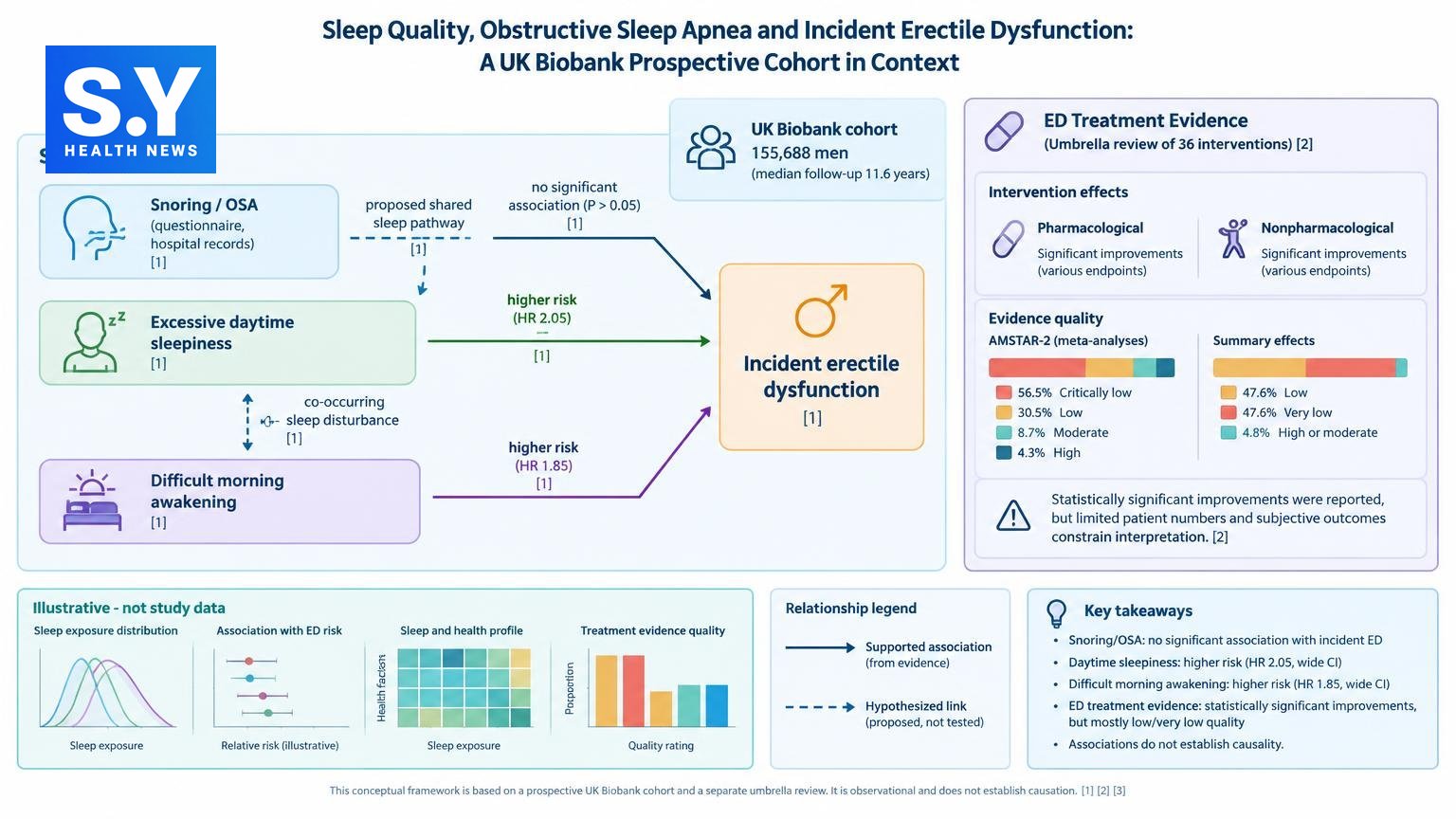
A prospective cohort study drawing on the UK Biobank followed 155,688 men for a median of 11.6 years to test whether obstructive sleep apnea (OSA), snoring and broader sleep characteristics predict incident erectile dysfunction (ED). Snoring and OSA were defined from questionnaires and hospital records, and ED was ascertained as an incident outcome. Men with snoring or OSA had higher BMI, diabetes and hypertension prevalence, yet no significant association with incident ED was observed (all P > 0.05).[1]
By contrast, two subjective sleep dimensions were associated with higher risk. Men reporting more daytime sleepiness had a hazard ratio of 2.05 (95% CI 1.06–3.97, P = 0.033) compared with the less-sleepy reference group, and those who found it harder to get up in the morning had a hazard ratio of 1.85 (95% CI 1.20–2.84, P = 0.005) compared with those who woke easily. Mouth breathing showed only a marginal association that attenuated after full adjustment (P = 0.071). The authors concluded that the null OSA finding may reflect limited case numbers and underdiagnosis, and identified excessive daytime sleepiness and difficult morning awakening as significant risk factors for ED.
These findings sit alongside a separate 2026 umbrella review of 23 published meta-analyses covering 36 ED interventions. That review extracted 42 summary effects on the IIEF, IIEF-5, IIEF-EF and erectile hardness score, but rated 13 of 23 meta-analyses (56.5%) as critically low quality on AMSTAR-2 and only one as high quality. Of the 42 summary effects, 47.6% were low quality and 47.6% very low quality. Statistically significant improvements were seen with both pharmacological and nonpharmacological interventions, but the authors cautioned that limited patient numbers and subjective outcome measures constrain interpretation.[2]
Why This Matters
Erectile dysfunction is common, distressing and often the first clinical signal of systemic vascular disease. If a readily measurable sleep characteristic — daytime sleepiness, for example — predicts incident ED years later, it would offer a low-cost opportunity to identify men at risk and to discuss sleep, metabolic health and cardiovascular screening before sexual function deteriorates. The UK Biobank analysis is unusual in size and follow-up for this question: 155,688 men followed for a median 11.6 years is a far larger and longer dataset than the small clinic-based samples that previously suggested an OSA–ED link.
At the same time, the treatment evidence base for ED is weaker than its public visibility suggests. The umbrella review found that most meta-analyses and most summary effects were of low or very low quality, even though statistically significant improvements were reported across pharmacological and nonpharmacological interventions. Understanding both strands — who is at risk and how strong the treatment evidence really is — matters for clinicians, researchers and men making decisions about their own health.
Biological and Clinical Mechanisms Underlying the OSA–ED Hypothesis
Why would sleep apnea plausibly cause erectile dysfunction? A secondary physician-authored clinical guide proposes a threefold mechanism: intermittent nocturnal hypoxia damages the vascular endothelium; sleep fragmentation disrupts testosterone production, which peaks during REM sleep; and chronic sympathetic activation raises catecholamines and worsens endothelial function. All three converge on the same vascular pathway that PDE5 inhibitors target. This is a plausible explanatory framework, not a direct test of mechanism — the guide is a secondary source and did not measure these pathways in the cohort.[3]
The same guide reports that a 2018 study of 150 men newly diagnosed with moderate to severe OSA found an ED prevalence of 51%. That figure is striking — roughly one in two — but it comes from a secondary citation in a clinical guide rather than a primary paper supplied here, and it describes prevalence in a selected sleep-clinic population, not incidence in a general population. Prevalence in a clinic sample and incident risk in a cohort are different quantities and should not be conflated. The UK Biobank study was designed to test the latter.
Daytime sleepiness, the exposure most strongly associated with ED in the UK Biobank analysis, is not simply a proxy for apnea severity. It can arise from insufficient sleep, depression, medication effects, shift work, primary hypersomnia or fragmented sleep from any cause. The study's authors interpret their findings as evidence that broader sleep quality dimensions — not only apnea — should be considered in male reproductive health. That reframing is important: the subjective experience of poor sleep may carry risk information that a diagnosis code for OSA does not capture.
What the Evidence Shows
In the UK Biobank cohort, men with snoring or OSA were metabolically sicker at baseline — more obesity, diabetes and hypertension — yet the fully adjusted Cox models found no significant association with incident ED (all P > 0.05). This is a null result in a large, long-followed sample. The authors explicitly attribute it in part to limited case numbers and underdiagnosis, which would bias estimates toward the null. Underdiagnosis is especially plausible because OSA exposure was defined from questionnaires and hospital records rather than objective sleep testing, so many men with genuine OSA would be misclassified as unexposed.
The positive findings concern subjective sleep. More daytime sleepiness was associated with a hazard ratio of 2.05 (95% CI 1.06–3.97) relative to the less-sleepy reference group, with a P value of 0.033. Difficulty getting up in the morning was associated with a hazard ratio of 1.85 (95% CI 1.20–2.84, P = 0.005) relative to easy awakening. The confidence intervals are wide and the lower bounds modest — an HR of 1.06 in the sleepiness analysis is barely above the null — so the precision of these estimates is limited. Mouth breathing's association attenuated after full adjustment (P = 0.071) and did not reach conventional significance.
| Sleep exposure | Reported association with incident ED | Statistical detail | Interpretation |
|---|---|---|---|
| Snoring or OSA (questionnaire/hospital records) | No significant association | All P > 0.05 | Metabolically sicker baseline but null adjusted result; authors cite limited cases and underdiagnosis |
| Greater daytime sleepiness vs less-sleepy reference | Significantly higher risk | HR 2.05 (95% CI 1.06–3.97), P = 0.033 | Wide interval with lower bound near null; observational, self-reported exposure |
| Harder morning awakening vs easy awakening | Significantly higher risk | HR 1.85 (95% CI 1.20–2.84), P = 0.005 | Observational association; cannot establish causality |
| Mouth breathing | Marginal, attenuated after full adjustment | P = 0.071 | Not statistically significant after adjustment |
The treatment side of the evidence base is broad but shallow. The umbrella review extracted 42 summary effects from 23 meta-analyses on 36 interventions, using IIEF, IIEF-5, IIEF-EF and erectile hardness score as endpoints. Pharmacological and nonpharmacological interventions both produced statistically significant improvements. But methodological quality was poor: 13 meta-analyses (56.5%) were critically low on AMSTAR-2, 7 (30.5%) low, 2 (8.7%) moderate and only 1 (4.3%) high. At the level of summary effects, 20 (47.6%) were low quality and 20 (47.6%) very low, leaving only two rated high or moderate.
This does not mean ED treatments do not work — statistically significant improvements were observed across many interventions. It means the confidence with which any single treatment can be ranked against another is limited. The umbrella review authors call for better-designed single-treatment studies and high-quality head-to-head meta-analyses, because the current literature cannot reliably answer comparative questions. For clinicians, the practical implication is that treatment choices remain grounded in established first-line options and shared decision-making, while the comparative evidence continues to mature.
Interpretation and Limitations
The central interpretive tension is that a plausible biological mechanism (OSA-driven endothelial and hormonal dysfunction) did not translate into a detectable association in a very large cohort, while subjective sleep complaints — measured by questionnaire, not sleep study — did. Several explanations are possible, and they are not mutually exclusive. First, exposure misclassification: questionnaire and hospital-record definitions of OSA capture diagnosed and self-recognized disease, missing undiagnosed cases and diluting any true effect toward the null. Second, outcome ascertainment: incident ED identified through health records may capture only men who sought care, which is a minority. Third, confounding: daytime sleepiness and difficult awakening may partly index depression, obesity, medication use or socioeconomic factors that also affect sexual function, and residual confounding cannot be excluded in an observational design.
The precision of the positive findings deserves emphasis. The sleepiness hazard ratio of 2.05 carries a 95% CI from 1.06 to 3.97 — compatible with anything from a trivial to a fourfold increase in risk. The morning-awakening estimate (HR 1.85, 95% CI 1.20–2.84) is somewhat more precise but still wide. Statistical significance at P = 0.033 and P = 0.005 in a large dataset does not guarantee clinical importance, and multiple sleep exposures were likely tested, raising the possibility that some associations reflect chance. The authors' conclusion that subjective sleep disturbances are significant risk factors is reasonable as a hypothesis-generating statement, but it is not a causal claim.
The treatment umbrella review has its own limitations. Its quality appraisal was based on AMSTAR-2 for meta-analyses and a separate rating for summary effects; the predominance of low and very low ratings reflects the underlying primary studies, many of which used subjective IIEF-type endpoints with limited patient numbers. The review covers studies published up to October 2025 and summarizes 36 interventions, but cannot compare interventions that were never directly compared in a meta-analysis. Its call for intertreatment comparisons highlights a structural gap, not a failure of any individual treatment.
Research Outlook
Several research directions follow. First, objective sleep phenotyping — home sleep apnea testing or polysomnography — in large cohorts would reduce exposure misclassification and allow dose–response analyses by apnea severity, oxygen desaturation index and sleep fragmentation. Second, linking sleep exposures to both subjective and objective erectile function measures (IIEF-EF plus nocturnal penile tumescence or Rigiscan) would strengthen outcome ascertainment. Third, mechanistic studies measuring endothelial function, testosterone and sympathetic markers in men with and without excessive daytime sleepiness could test the proposed threefold pathway directly rather than inferring it from a secondary guide.
On the treatment side, the priority is methodological. Well-designed randomized trials of single interventions with adequate sample sizes, validated endpoints and blinded assessment would raise the quality of the evidence base. High-quality network or component meta-analyses comparing active treatments head-to-head are needed before comparative rankings can be trusted. Until then, the umbrella review's conclusion stands: the treatment landscape is diverse, but the reliability of the evidence is poor, and statistically significant improvements should be interpreted with caution given limited patient numbers and subjective outcome indicators.
Key Takeaways
- In 155,688 UK Biobank men followed for a median 11.6 years, snoring and OSA were not significantly associated with incident ED (all P > 0.05), though metabolic comorbidity was higher in that group.
- Excessive daytime sleepiness (HR 2.05, 95% CI 1.06–3.97) and difficulty getting up in the morning (HR 1.85, 95% CI 1.20–2.84) were associated with higher ED risk, with wide confidence intervals and observational design limiting causal inference.
- Mouth breathing's marginal association (P = 0.071) attenuated after full adjustment and did not reach significance.
- The authors attribute the null OSA finding partly to limited case numbers and underdiagnosis, consistent with questionnaire-based exposure ascertainment.
- A 2026 umbrella review of 23 meta-analyses found statistically significant ED treatment effects but rated 56.5% of meta-analyses critically low quality and 95.2% of summary effects low or very low, calling for better comparative research.
Questions and Answers
Does obstructive sleep apnea increase the risk of developing erectile dysfunction?
In a UK Biobank prospective cohort of 155,688 men followed for a median 11.6 years, snoring and OSA were not significantly associated with incident ED (all P > 0.05). The authors cautioned that this null result may partly reflect limited case numbers and underdiagnosis, since OSA was defined from questionnaires and hospital records rather than objective sleep testing. This observational finding does not prove that OSA is irrelevant to erectile function, only that this study did not detect an association.
Which sleep symptoms were linked to higher erectile dysfunction risk in the UK Biobank cohort?
Excessive daytime sleepiness was associated with a hazard ratio of 2.05 (95% CI 1.06–3.97, P = 0.033) versus a less-sleepy reference group, and difficulty getting up in the morning was associated with a hazard ratio of 1.85 (95% CI 1.20–2.84, P = 0.005) versus easy awakening. Mouth breathing showed only a marginal association that attenuated after full adjustment (P = 0.071). These are observational associations with wide confidence intervals, not causal effects.
How strong is the evidence for erectile dysfunction treatments overall?
A 2026 umbrella review of 23 meta-analyses covering 36 interventions found statistically significant improvements with both pharmacological and nonpharmacological treatments, but methodological quality was poor. On AMSTAR-2, 56.5% of meta-analyses were critically low quality and only 4.3% high quality. Among 42 summary effects, 47.6% were low and 47.6% very low quality. The authors concluded that the evidence base is predominantly low or very low quality and called for better-designed studies and comparative meta-analyses.
Can sleep apnea cause erectile dysfunction through a biological mechanism?
A secondary physician-authored clinical guide proposes a threefold mechanism: intermittent nocturnal hypoxia damages the vascular endothelium; sleep fragmentation disrupts testosterone production, which peaks during REM sleep; and chronic sympathetic activation raises catecholamines and worsens endothelial function. All three converge on the vascular pathway targeted by PDE5 inhibitors. This is a plausible explanatory framework drawn from secondary review, not a direct test of mechanism, and the UK Biobank cohort did not confirm an OSA–ED association.
What are the main limitations of the sleep apnea and erectile dysfunction cohort study?
Exposure to snoring and OSA was defined from questionnaires and hospital records rather than objective sleep testing, which likely misclassifies undiagnosed cases and biases estimates toward the null. ED was ascertained as an incident outcome, and the authors cite limited case numbers and underdiagnosis as reasons for the null OSA finding. The positive associations for daytime sleepiness and morning awakening are observational, with wide confidence intervals (lower bounds 1.06 and 1.20), and cannot establish causation.
What does excessive daytime sleepiness have to do with erectile dysfunction?
In the UK Biobank cohort, men reporting more daytime sleepiness had a significantly higher risk of incident ED (HR 2.05, 95% CI 1.06–3.97) than less-sleepy men. Daytime sleepiness can reflect insufficient sleep, sleep fragmentation, depression, medication effects or other causes, so it may index broader sleep and health problems rather than apnea alone. The authors suggest that broader sleep quality dimensions, not only OSA diagnosis, should be considered in male reproductive health.
Conceptual framework: Conceptual framework of sleep exposures and incident erectile dysfunction in a UK Biobank cohort of 155,688 men, with ED treatment evidence quality shown separately. Supported edges reflect reported associations; the proposed shared-pathway link is hypothesis only. This is not a tested causal model.
Academic References & Evidence
- Hujun Zhou; Yifan Wang; Dong Liu; Lin Zhang; Chaobing Gao. : Publication 17355. Scientific Reports. 2026 DOI: 10.1038/s41598-026-36847-x. PMID: 41844679.
- Current treatment for erectile dysfunction: an umbrella review of systematic reviews and meta-analyses. 2026 DOI: 10.6084/m9.figshare.31562993.v1.
- Erectile Dysfunction.
SANYUN Science Center explains published research on men's reproductive and sexual health, connecting scientific evidence with everyday questions while making sources and limitations clear.
Disclaimer: This article is for scientific education and research communication only. It does not provide medical advice, diagnosis, or individualized treatment recommendations, and does not endorse any medication, supplement, device, penile enlargement procedure, or other intervention. Decisions about sexual and reproductive health should be made in consultation with a qualified healthcare professional. Do not delay seeking professional care because of information in this article.
Original Content & Copyright Notice
- This article is prepared for SANYUN Science Center, drawing on published research and publicly available academic literature on men’s sexual and reproductive health. Its editorial explanations and presentation are developed for this platform.
- Copyright in the original editorial content, selection, and arrangement is reserved by SANYUN Science Center to the extent protected by applicable law. Referenced research, quotations, and third-party materials remain subject to the rights of their respective owners. This notice does not claim ownership of scientific facts or third-party research.
- Except where permitted by applicable law or an applicable license, prior written permission is required to reproduce, republish, translate, adapt, redistribute, or commercially reuse protected content. Attribution alone does not grant permission for such reuse.
- For permitted quotation or authorized reuse, clearly identify the source and retain a link to the original article.
- Source: SANYUN Science Center
- Original URL: Retain the original article URL on science.san-yun.com.
- Copyright Holder: SANYUN Science Center, for its own protected editorial content.
- Quotation, excerpts, or authorized reuse must not distort the scientific meaning, omit material limitations or disclaimers, or imply unverified medical claims, product efficacy, or endorsement by SANYUN Science Center.



