




Category: Erectile Dysfunction
Core Research Direction: Association between obstructive sleep apnea severity and erectile dysfunction (and lower urinary tract symptoms) in adult men, with attention to whether the relationship is independent of confounders such as age, BMI, and metabolic disease
Search Intent: In adult men with obstructive sleep apnea, is greater apnea severity associated with worse erectile function, and how strong and how confounded is that evidence?
Platform: SANYUN Science Center
Evidence reviewed through: 2026-11-05
Executive Summary
In adult men with obstructive sleep apnea (OSA), does greater apnea severity track with worse erectile function, and does that relationship hold after accounting for age, body mass index (BMI) and metabolic disease? Two small, single-center Turkish studies in the available evidence suggest the direction of the first answer is yes: men with more severe apnea scored lower on the International Index of Erectile Function (IIEF). Neither study reports an adjusted analysis, so the second question — independence — is not answered by these data.[1][2]
The larger study was a retrospective comparison of 81 patients diagnosed with OSA, enrolled between March 2019 and June 2024 and divided into three groups by polysomnography-derived apnea-hypopnea index (AHI). IIEF score correlated with apnea severity, but so did BMI — a shared driver of both sleep apnea and erectile dysfunction (ED). The smaller 2016 study compared 50 men over age 50, and found a statistically significant difference in IIEF scores and nocturia across groups but not in urinary symptom scores or uroflowmetry.
Why This Matters
Erectile dysfunction is not only a sexual-health issue. A commercial physician-authored patient guide in this packet summarizes a 2023 umbrella review reporting higher relative risks in men with ED for cardiovascular disease (RR 1.45, 95% CI 1.36-1.54), coronary heart disease (RR 1.50), cardiovascular mortality (RR 1.50), myocardial infarction (RR 1.55), stroke (RR 1.36) and all-cause mortality (RR 1.25), all with P<0.001. These figures are secondhand and come from observational meta-analyses, but they explain why treatable contributors such as sleep apnea attract clinical attention.[3]
The practical stakes are different depending on the answer. If apnea severity independently worsens erectile function, sleep evaluation becomes part of ED assessment. If the association is mostly shared metabolic risk, the emphasis shifts toward weight and cardiometabolic care. Telling these apart requires multivariable adjustment that this packet does not provide.
The Proposed Biological Link
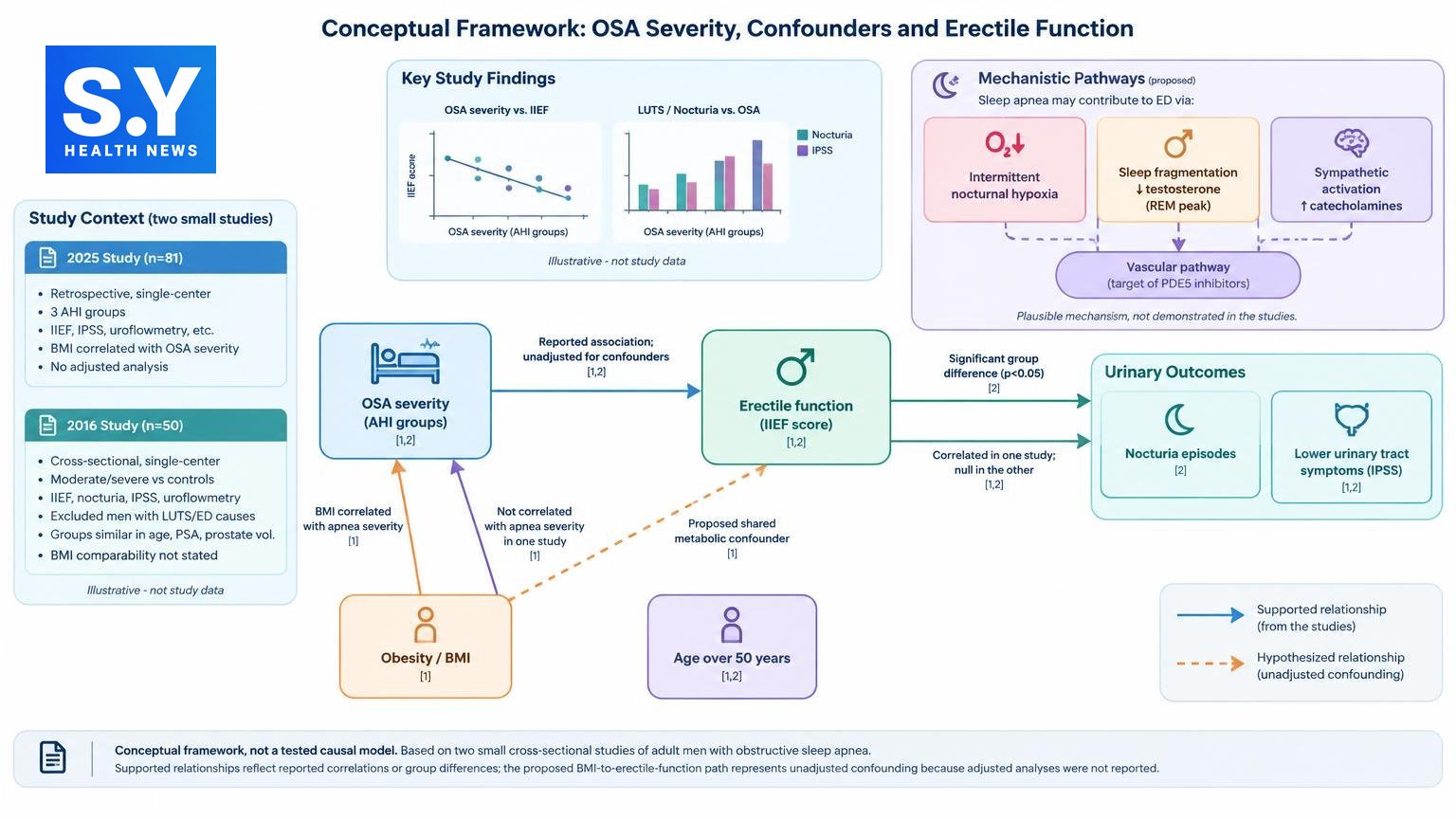
The commercial guide proposes three parallel routes from sleep apnea to erectile difficulty: intermittent nocturnal hypoxia damaging the vascular endothelium; sleep fragmentation disrupting testosterone production that peaks during REM sleep; and chronic sympathetic activation raising catecholamines and worsening endothelial function. The guide frames all three as feeding the same vascular pathway that PDE5 inhibitors target. This is a plausible narrative mechanism, not an experimental demonstration in the supplied text, and the guide does not cite primary studies for each step.
Mechanistic plausibility does not resolve confounding. Obesity, insulin resistance and hypertension can produce endothelial dysfunction and low testosterone independently of apnea, and they cluster with apnea. In other words, the same mechanisms could be driven by the metabolic company apnea keeps. Biological reasoning should therefore support, not substitute for, adjusted epidemiological estimates.
What the Evidence Shows
| Study feature | 81-patient OSA study (2025) | 50-man OSA vs control study (2016) |
|---|---|---|
| Design | Retrospective single-center comparison of three AHI-defined severity groups | Cross-sectional single-center comparison of moderate/severe OSA versus OSA-negative controls |
| Population and size | 81 patients diagnosed with OSA, enrolled March 2019 to June 2024 | Men over 50 with sleep-apnea symptoms: 11 moderate (AHI 15-30), 18 severe (AHI >30), 21 controls (AHI <5) |
| Erectile function measure | IIEF score | IIEF score |
| Erectile function result | IIEF score correlated with OSA severity | Statistically significant difference across groups (p<0.05); direction and magnitude not given in the excerpt |
| Urinary symptom result | IPSS, urinary quality of life and bladder wall thickness correlated with OSA severity | No significant IPSS or uroflowmetry difference (p>0.05); nocturia episodes differed (p<0.05) |
| Confounder handling | BMI also correlated with OSA severity; no adjusted model reported in the excerpt | Patients with diseases that could cause LUTS or ED excluded; groups similar on age, PSA and prostate volume; BMI comparability not stated |
The 2025 study stated its aim as investigating whether the difference in apnea severity relates to the degree of lower urinary tract symptoms (LUTS) and erectile dysfunction in patients diagnosed with OSA. Investigators analyzed polysomnography reports, split patients into three AHI-based groups, and assessed them with urologic examination, ultrasonography, uroflowmetry, blood tests, the International Prostate Symptom Score (IPSS), a urinary quality-of-life scale and the IIEF.
Age, smoking, prostate-specific antigen (PSA) and periodic leg movements per hour were not correlated with apnea severity. BMI, prostate volume, minimum and maximum partial oxygen pressure, uroflowmetry parameters, IPSS, urinary quality of life, bladder wall thickness and IIEF score were correlated with OSA severity. The authors concluded that increased OSA severity leads to increased severity of LUTS and ED — causal wording that a cross-sectional comparison cannot support.
The 2016 study enrolled men over 50 presenting with sleep-apnea symptoms who underwent overnight polysomnography, pooling 11 moderate and 18 severe cases into an OSA group and comparing them with 21 OSA-negative controls. Patients with diseases that could cause LUTS or ED were excluded. Groups were similar in age, PSA and prostate volume. The authors concluded that OSA was not an additional risk factor for LUTS other than nocturia but was related to ED and nocturia.
One further figure circulates: the commercial guide states that a 2018 study of 150 men newly diagnosed with moderate-to-severe OSA found an ED prevalence of about 51 percent, meaning roughly one in two. The primary study is not in this packet, so its design, ED definition and confounder handling cannot be checked. Treat the prevalence as secondary context, not independent support for the severity association.
Interpretation and Limitations
Directionally, the two primary studies agree: men with more severe apnea tended to score lower on the IIEF, and the 2016 study found that difference statistically significant. But statistical significance in small samples is not the same as a large or clinically decisive effect. The supplied excerpts report no IIEF point differences, correlation coefficients or confidence intervals, so the size of the association cannot be judged from this packet — only its direction.
The confounding problem is the core weakness. In the 2025 study, BMI itself correlated with apnea severity, and BMI is a strong determinant of both sleep apnea and erectile dysfunction. Without a model adjusting for BMI, age, diabetes, hypertension and other metabolic disease, the IIEF-apnea correlation cannot be attributed to apnea severity specifically. The 2016 study took a different route, excluding men with conditions that could cause ED and matching groups on age, PSA and prostate volume, but it does not state whether BMI or metabolic status were comparable.
- Design: both studies compare groups at a single time point, so neither can establish whether sleep apnea precedes or causes erectile dysfunction.
- Sample size: 81 patients and 50 men respectively, with the smaller study's moderate and severe groups comprising only 11 and 18 men, limiting power and precision.
- Measurement: erectile function was assessed only by IIEF self-report, without objective nocturnal erectile testing or partner-reported outcomes.
- Generalizability: excluding men with diseases that could cause LUTS or ED and enrolling only men over 50 makes the 2016 findings hard to extend to typical ED populations with cardiometabolic comorbidity.
- Reporting: AHI cut-points for the 2025 three-group classification, correlation magnitudes and adjusted analyses are absent from the supplied text, preventing quantitative synthesis.
There is also a conflict worth naming. The 2025 study reported that IPSS and urinary quality of life correlated with apnea severity, whereas the 2016 study found no significant IPSS or uroflowmetry difference and concluded that OSA was not an additional risk factor for LUTS other than nocturia. Different eligibility criteria — particularly the exclusion of comorbid disease in the smaller study — may explain part of the discrepancy, but the packet does not allow a definitive reconciliation. Both findings concern LUTS, not the erectile outcome, so they do not directly contradict each other on ED.
Research Outlook
The decisive analysis would be a multivariable model in a larger cohort reporting the IIEF-apnea association adjusted for BMI, age, diabetes, hypertension, smoking and medication use, with effect sizes and confidence intervals. Longitudinal designs following men from OSA diagnosis, or from continuous positive airway pressure treatment onward, would clarify temporal order and whether treating apnea changes erectile function. None of these analyses appears in the supplied evidence.
Interventional evidence would be especially informative: if effective apnea treatment improved IIEF scores independently of weight change, that would support a causal contribution. The packet contains no such trial. The 2016 authors' suggestion that men with ED or nocturia be evaluated for OSA, and that OSA patients be screened for ED, is a hypothesis-generating recommendation rather than a validated screening policy.
The broader context in the commercial guide — cardiovascular risk associations and proposed hypoxia, testosterone and sympathetic mechanisms — frames why the question matters, but it is secondary and partly uncited. It should not be used to upgrade the strength of the primary apnea-ED evidence, which remains limited to small cross-sectional comparisons.
Key Takeaways
- Two small single-center studies found that men with more severe OSA tended to have lower IIEF erectile function scores, one with a statistically significant difference across groups.
- Neither study reports adjusted analyses, and BMI correlated with apnea severity in the larger one, so independence from obesity and metabolic disease is unproven.
- Causal wording about apnea leading to ED exceeds what cross-sectional designs can show; the relationship is best described as an association with unresolved confounding.
- Screening men with ED for sleep apnea is a plausible clinical suggestion, not a demonstrated outcome benefit.
Questions and Answers
How is obstructive sleep apnea severity measured in studies of erectile dysfunction?
Severity is classified with the apnea-hypopnea index (AHI) from overnight polysomnography, which counts apneas and hypopneas per hour of sleep. The 2025 study divided 81 patients into three AHI-based groups, though the cut-points are not given in the available text. The 2016 study defined moderate OSA as AHI 15-30, severe as AHI >30 and OSA-negative controls as AHI <5.
Do men with more severe sleep apnea have worse erectile function scores?
Both available studies point that way. The 2025 study reported that IIEF score correlated with apnea severity among 81 patients. The 2016 study found a statistically significant difference in IIEF scores between OSA groups and controls (p<0.05). However, neither excerpt reports the size of the IIEF difference or any adjusted estimate, so the magnitude and independence of the association remain uncertain.
Is the sleep apnea and erectile dysfunction link independent of obesity and metabolic disease?
Not established. In the 2025 study, BMI correlated with apnea severity alongside IIEF score, and no adjusted multivariable model appears in the available text. The 2016 study excluded men with conditions causing ED and matched groups on age, PSA and prostate volume, but BMI and metabolic comparability are not stated. Confounding by shared metabolic risk therefore remains plausible in both.
How strong is the evidence that sleep apnea causes erectile dysfunction?
Weak for causal claims. Both studies are small, single-center, cross-sectional comparisons — 81 patients and 50 men, with very small severity subgroups in the second. No longitudinal follow-up or treatment trial is reported. The 2025 authors' statement that increased apnea severity leads to increased ED severity exceeds what these designs support; the evidence shows association only.
Do the sleep apnea studies agree about lower urinary tract symptoms?
Partly not. The 2025 study reported that IPSS and urinary quality-of-life scores correlated with apnea severity. The 2016 study found no significant IPSS or uroflowmetry difference (p>0.05), though nocturia episodes differed (p<0.05), and concluded apnea was not an additional risk factor for LUTS other than nocturia. Different eligibility criteria and small samples may explain part of the gap.
Should men with erectile dysfunction be screened for sleep apnea?
The 2016 authors suggested that patients with ED or nocturia be evaluated for OSA, and that OSA patients be screened for ED. This is their interpretation of cross-sectional data, not a tested screening program with proven benefit. It is a reasonable discussion point with a clinician, but not an established mandatory pathway, and no trial in this packet shows that screening or treatment improves erectile outcomes.
Conceptual framework: Conceptual framework, not a tested causal model. Based on two small cross-sectional studies of adult men with obstructive sleep apnea. Supported relationships reflect reported correlations or group differences; the proposed BMI-to-erectile-function path represents unadjusted confounding because adjusted analyses were not reported.
Academic References & Evidence
- Nihat Türkmen; Cemil Kutsal; Dilek Aslan Kutsal; Abdullah Hızır Yavuzsan; Eminegül Yavuzsan; Figen Banu Kireççi; Sinan Levent Kireççi. Relationship between the Severity of Sleep Apnea and of LUTS and Erectile Dysfunction. Archivos Españoles de Urología. 2025 78(2):157-163 DOI: 10.56434/j.arch.esp.urol.20257802.22.
- Can Obstructive Sleep Apnea Syndrome be Associated with Urinary Symptoms and Erectile Dysfunction. 2016 5(2)
- Erectile Dysfunction.
SANYUN Science Center explains published research on men's reproductive and sexual health, connecting scientific evidence with everyday questions while making sources and limitations clear.
Disclaimer: This article is for scientific education and research communication only. It does not provide medical advice, diagnosis, or individualized treatment recommendations, and does not endorse any medication, supplement, device, penile enlargement procedure, or other intervention. Decisions about sexual and reproductive health should be made in consultation with a qualified healthcare professional. Do not delay seeking professional care because of information in this article.
Original Content & Copyright Notice
- This article is prepared for SANYUN Science Center, drawing on published research and publicly available academic literature on men’s sexual and reproductive health. Its editorial explanations and presentation are developed for this platform.
- Copyright in the original editorial content, selection, and arrangement is reserved by SANYUN Science Center to the extent protected by applicable law. Referenced research, quotations, and third-party materials remain subject to the rights of their respective owners. This notice does not claim ownership of scientific facts or third-party research.
- Except where permitted by applicable law or an applicable license, prior written permission is required to reproduce, republish, translate, adapt, redistribute, or commercially reuse protected content. Attribution alone does not grant permission for such reuse.
- For permitted quotation or authorized reuse, clearly identify the source and retain a link to the original article.
- Source: SANYUN Science Center
- Original URL: Retain the original article URL on science.san-yun.com.
- Copyright Holder: SANYUN Science Center, for its own protected editorial content.
- Quotation, excerpts, or authorized reuse must not distort the scientific meaning, omit material limitations or disclaimers, or imply unverified medical claims, product efficacy, or endorsement by SANYUN Science Center.



