




Category: Erectile Dysfunction
Core Research Direction: Relationship between erectile dysfunction and obstructive sleep apnoea, including proposed mechanisms and whether CPAP treatment improves ED severity
Search Intent: Does obstructive sleep apnoea contribute to erectile dysfunction, and does treating OSA with CPAP improve erectile function?
Platform: SANYUN Science Center
Evidence reviewed through: 2026-11-05
Executive Summary
Obstructive sleep apnoea (OSA) is a common condition defined by repeated episodes of intermittent hypoxia during sleep. Erectile dysfunction (ED) is the inability to achieve or maintain a penile erection sufficient for satisfactory sexual activity. A 2025 mixed-method systematic review and narrative synthesis searched the literature published between January 2000 and January 2022 and included 18 studies — 5 randomised controlled trials, 11 prospective studies and 2 cross-sectional studies — to examine the link between the two conditions and the impact of OSA treatment on ED severity.[1]
The literature reviewed reported ED prevalence in men with OSA of up to 82%, and the review authors concluded that an association does appear to exist between OSA and ED. Studies of continuous positive airway pressure (CPAP) for ED in this population, however, ranged from no significant effect to complete resolution. The authors called for further randomised trials and noted that CPAP is a safe treatment likely to help individuals with OSA, without negatively affecting erectile function, although its specific effect on ED symptoms remains uncertain.
Why This Matters
OSA and ED are each common in adult men, and both carry substantial effects on quality of life, relationships and cardiovascular health. If OSA contributes meaningfully to ED, then identifying and treating sleep-disordered breathing could address a cause rather than only a symptom, and men presenting with erectile difficulties might benefit from screening for sleep problems that would otherwise go unrecognised.[2]
The size of the signal in the reviewed literature is notable. In one included study of 94 men with severe OSA, defined as an apnoea–hypopnoea index (AHI) greater than 30 events per hour of sleep, 68% also had ED defined by an International Index of Erectile Function short-form (IIEF-5) score below 21. Another included study of 55 patients with OSA reported concomitant ED in 63%, and a further clinical cohort found that 82% of men with OSA had severe ED, with 11 having already undergone penile prosthesis insertion.
A secondary physician-authored clinical guide cites a separate 2018 study of 150 men newly diagnosed with moderate to severe OSA in which ED prevalence was 51%. That figure comes from a secondary citation without the primary study supplied, so it should be read as supportive context rather than independently verified evidence. Taken together, the reported prevalence figures vary widely across cohorts, which is itself an important finding about the heterogeneity of this literature.
Definitions and Study Design
The OSA severity grading used in the reviewed literature is based on the apnoea–hypopnoea index, the number of apnoea events per hour: normal is below 5/h, mild 5–15/h, moderate 15–30/h and severe more than 30/h. Erectile outcomes were generally assessed with the IIEF or its short form, and OSA severity with the AHI. These two instruments anchor the relationship examined in this article, but neither captures the full complexity of either condition.
The 2025 review was a mixed-method systematic review and narrative synthesis. Because included studies differed in design, methods and population size, the authors judged quantitative pooling inappropriate and used narrative synthesis instead. This is a legitimate choice for heterogeneous evidence, but it means the review presents no pooled effect estimate, and conclusions must be read at the level of direction and consistency rather than numerical precision.
Proposed Biological and Clinical Mechanisms
Several mechanisms have been proposed to explain how OSA might impair erectile function. One described in the review involves hypoxia reducing levels of prostaglandin E1, which ordinarily inhibits pro-fibrotic cytokines. The proposed consequence is increased collagen deposition in the penis, reduced elasticity and poorer erectile quality. Increased collagen content could also impair compression of the subtunical veins, contributing to veno-occlusive dysfunction and incomplete tumescence.
A secondary clinical guide describes a three-part mechanistic account: intermittent nocturnal hypoxia damaging the vascular endothelium, sleep fragmentation disrupting testosterone production that peaks during REM sleep, and chronic sympathetic activation raising catecholamines and worsening endothelial function. These are mechanistic hypotheses rather than relationships demonstrated experimentally within the reviewed studies, and they overlap only partly with the fibrotic pathway described in the systematic review.
A neurophysiological strand of evidence also appears. In one small study of 25 men with OSA, 17 (68%) had an altered bulbocavernosus reflex, and 11 of those 17 (44%) showed reduced amplitude and prolonged latency. Affected patients had higher AHI, more sleep time with oxygen saturation below 90%, and lower daytime oxygen pressure. This is a small single study with indirect relevance to erectile function, but it suggests that neurological involvement may accompany severe OSA.
Hormonal pathways complicate the picture further. Testosterone modulates nitric oxide release in endothelial cells and phosphodiesterase 5 in smooth muscle, so androgen status is biologically relevant to erection. A cross-sectional study included in the review found both free and total testosterone were lower in men with OSA and obesity than in men with obesity alone, but the direction of any causal influence between OSA, adiposity and androgen levels remains unresolved.
What the Evidence Shows: Prevalence and Severity
The prevalence data are the most consistent part of the evidence base. Across included studies, the review reports ED prevalence in men with OSA of up to 82%, with individual cohorts reporting 68% in severe OSA, 63% in a 55-patient cohort, and 82% severe ED in a clinical series. A gradient by OSA severity is also reported: in one prospective study, ED prevalence was 24%, 48% and 60% in mild, moderate and severe OSA respectively, with an overall 47% of OSA patients having ED.
These figures must be interpreted cautiously. Prevalence within OSA cohorts does not establish that OSA causes ED; both conditions share risk factors such as obesity, age, diabetes and smoking, and clinic-based samples may over-represent more severe disease. The severity gradient is suggestive but cross-sectional in nature. The review authors themselves framed the conclusion as an association rather than a causal relationship, and the included cross-sectional designs cannot resolve temporal order.
What the Evidence Shows: CPAP Treatment Effects
The treatment literature is where the evidence becomes genuinely contradictory. The systematic review reported that studies investigating CPAP for ED in this population varied from no significant effect to complete resolution of ED. Individual studies illustrate this divergence starkly, and the differences in design, duration, comparator, population and outcome instrument make direct comparison unreliable.
| Study design and sample | CPAP exposure | Erectile or related outcome |
|---|---|---|
| RCT, 30 men with OSA and ED; sildenafil vs CPAP | 12 weeks | Successful intercourse 54% vs 24%; IIEF increase 62% vs 26%; satisfaction 53% vs 20% |
| RCT, men with OSA and ED; CPAP vs PDE5 inhibitor | 12 weeks | Insignificant IIEF improvement of 11% with CPAP; nocturnal erections 2.7 to 4.1; arterial stiffness 13.7 to 7.3; no change in testosterone, LH or FSH |
| Prospective, 80 patients with OSA and ED | 3 months | 23% reclassified as normal; proportion with >80% nocturnal penile rigidity rose from 14% to 40% |
| Prospective, 27 men with type 2 diabetes and OSA | 3 months | No change in total or free testosterone or SHIM score; 84% had some form of ED at baseline |
| Prospective, severe OSA subgroup of 32 men | 1 month | IIEF improvement of 35%; FSH 4.8–11.7 IU/L and testosterone 4.5–12.1 nmol/L after CPAP |
| Prospective, 207 men stratified by OSA severity | 3 months | CPAP did not significantly change serum testosterone; severe OSA had lower testosterone (14.06) than simple snoring (17.02) |
Two randomised trials are especially instructive because they point in different directions. In a small trial of 30 men, sildenafil outperformed CPAP on successful intercourse, IIEF improvement and satisfaction at 12 weeks. A later randomised trial comparing CPAP with a PDE5 inhibitor for 12 weeks found only an insignificant 11% IIEF improvement with CPAP, yet CPAP increased the number of nocturnal erections from 2.7 to 4.1 and improved arterial stiffness from 13.7 to 7.3, with no hormonal change in either arm.
This pattern suggests that CPAP may improve physiological markers of vascular and nocturnal erectile function without consistently translating into large patient-reported gains in sexual function. Prospective single-arm studies have reported improvements — a 23% reclassification to normal and a rise in the proportion with greater than 80% nocturnal rigidity from 14% to 40% after three months, and a 35% IIEF improvement after one month in severe OSA — but such designs lack controls and are vulnerable to regression to the mean, placebo effects and co-intervention.
Null findings also exist. In 27 men with type 2 diabetes and OSA who completed three months of CPAP, there was no change in total or free testosterone or in SHIM score, despite 84% having some form of ED at baseline. Among 207 men stratified by OSA severity, three months of CPAP did not significantly change serum testosterone, and severe OSA patients had lower testosterone than a simple snoring group at baseline.
Interpretation and Limitations
The central interpretative question is whether these findings support a causal chain from OSA through hypoxia, endothelial and cavernosal injury, and hormonal disruption to ED, or whether the association largely reflects shared risk factors. The review's conclusion of an association, together with the inconsistent treatment effects, argues for caution. An intervention that reversed a dominant causal pathway would be expected to produce more consistent improvement across trials than has been observed.
Several methodological limitations constrain the evidence. The review used narrative synthesis because of heterogeneity, so no pooled estimate or confidence interval is available. The search covered peer-reviewed literature published between January 2000 and January 2022, so more recent randomised evidence is not captured. Included samples were often small, follow-up was frequently short, and several key studies were single-arm and uncontrolled.
Outcome measurement is a further problem. ED was variously defined by IIEF, IIEF-5 or SHIM thresholds, and OSA severity by AHI, but adherence to CPAP — which determines the delivered dose of treatment — is rarely handled uniformly. A trial with poor adherence may underestimate benefit, while an uncontrolled study with motivated participants may overestimate it. Comparator choice also matters: sildenafil is an active treatment with a rapid, well-characterised effect, so trials using it as the comparator will naturally show smaller relative gains for CPAP.
Hormonal outcomes deserve separate caution. Testosterone findings ranged from improvement after one month of CPAP to no significant change after three months, while another trial found no hormonal change with either CPAP or a PDE5 inhibitor. Units were not consistently reported in the tabulated evidence. This inconsistency means hormonal pathways should be treated as plausible contributors rather than established mediators of any CPAP effect on erections.
The broader cardiovascular context adds interpretive weight without resolving causality. A secondary clinical guide reports that ED is associated with increased risks of cardiovascular disease, coronary heart disease, myocardial infarction and stroke in umbrella-review data. Since OSA is itself linked to cardiometabolic disease, shared vascular pathology is a strong candidate confounder for the OSA–ED association. These are observational risk associations, not proof that treating one condition reverses the other.
Research Outlook
The review authors' principal recommendation was for further randomised controlled trials evaluating the efficacy of CPAP on ED in men with OSA. Such trials would ideally be adequately powered, use validated and consistently defined erectile outcomes, measure CPAP adherence objectively, follow participants long enough to detect change in a slow vascular process, and control for obesity, diabetes and baseline androgen status.
Until such evidence exists, the practical reading is modest. CPAP remains a safe and appropriate treatment for OSA itself, and the review authors state it does not negatively affect erectile function and is most likely to offer some degree of improvement, while acknowledging that the degree of effect on ED symptoms is not yet clear. That framing keeps the treatment rationale anchored in OSA management rather than in unproven erectile benefit.
For clinical practice, the evidence supports considering sleep-disordered breathing in men with ED, especially those with obesity, daytime sleepiness or known cardiometabolic risk, while maintaining realistic expectations about what treating OSA may do for sexual function. PDE5 inhibitors remain the first-line pharmacological option for ED according to the secondary guideline summary reviewed here, and CPAP should not be positioned as a substitute for established ED care.
Key Takeaways
- The 2025 systematic review included 18 studies of heterogeneous design and concluded that an association appears to exist between OSA and ED.
- Reported ED prevalence in men with OSA reached up to 82%, with individual cohorts reporting 68%, 63% and 82%, alongside evidence of a severity gradient.
- CPAP studies ranged from no significant effect to complete resolution of ED, and a narrative synthesis without pooled estimates cannot resolve that inconsistency.
- Some trials show physiological improvement, such as nocturnal erections rising from 2.7 to 4.1 and arterial stiffness falling from 13.7 to 7.3, without a significant IIEF gain.
- Proposed mechanisms include hypoxia-driven fibrosis, endothelial injury, sleep fragmentation and hormonal disruption, but these remain hypotheses rather than confirmed mediators.
- Higher-quality randomised trials are needed, and the reviewed evidence covered publications only up to January 2022.
Questions and Answers
What is the proposed biological link between obstructive sleep apnoea and erectile dysfunction?
Proposed mechanisms include intermittent nocturnal hypoxia reducing prostaglandin E1 and increasing penile collagen deposition, which may reduce elasticity and impair venous compression. A secondary guide also describes endothelial damage, sleep fragmentation disrupting testosterone production and sympathetic activation. These are mechanistic hypotheses: the reviewed studies did not establish them experimentally, and hormonal findings across studies were inconsistent.
How common is erectile dysfunction in men with obstructive sleep apnoea?
Reported prevalence varies widely. The systematic review cites ED prevalence up to 82% in men with OSA; individual cohorts reported 68% in severe OSA, 63% in a 55-patient cohort and 82% severe ED in a clinical series. A secondary guide cites 51% in 150 men with newly diagnosed moderate to severe OSA. Variation reflects differing populations and ED definitions.
Does CPAP treatment improve erectile function in men with sleep apnoea?
The evidence is inconsistent. Studies ranged from no significant effect to complete resolution of ED. One trial found only an 11% insignificant IIEF improvement with CPAP despite more nocturnal erections and better arterial stiffness; others reported a 35% IIEF gain at one month or 23% reclassified as normal at three months. Designs, durations and comparators differ, so no reliable effect size exists.
How strong is the evidence that sleep apnoea causes erectile dysfunction?
It supports an association, not causation. The review included 5 randomised trials, 11 prospective studies and 2 cross-sectional studies, but heterogeneity required narrative synthesis without pooled estimates. Shared risk factors such as obesity, diabetes and cardiovascular disease could explain much of the link, and inconsistent CPAP effects weaken a simple causal model.
What are the main limitations of research on CPAP and erectile dysfunction?
Key limitations include small samples, short follow-up, frequent single-arm designs, inconsistent ED definitions and variable CPAP adherence. The review searched only peer-reviewed publications from January 2000 to January 2022, so newer trials are excluded. Hormonal outcomes also conflicted, ranging from testosterone improvement to no change, and units were not uniformly reported.
Should men with erectile dysfunction be screened for obstructive sleep apnoea?
It is reasonable to consider, especially with obesity, daytime sleepiness or cardiometabolic risk, because the association is consistent and CPAP is safe for OSA itself. However, the review notes the effect on ED symptoms is not yet clear, and CPAP does not appear to harm erectile function. PDE5 inhibitors remain first-line ED therapy; decisions should be individualised with a clinician.
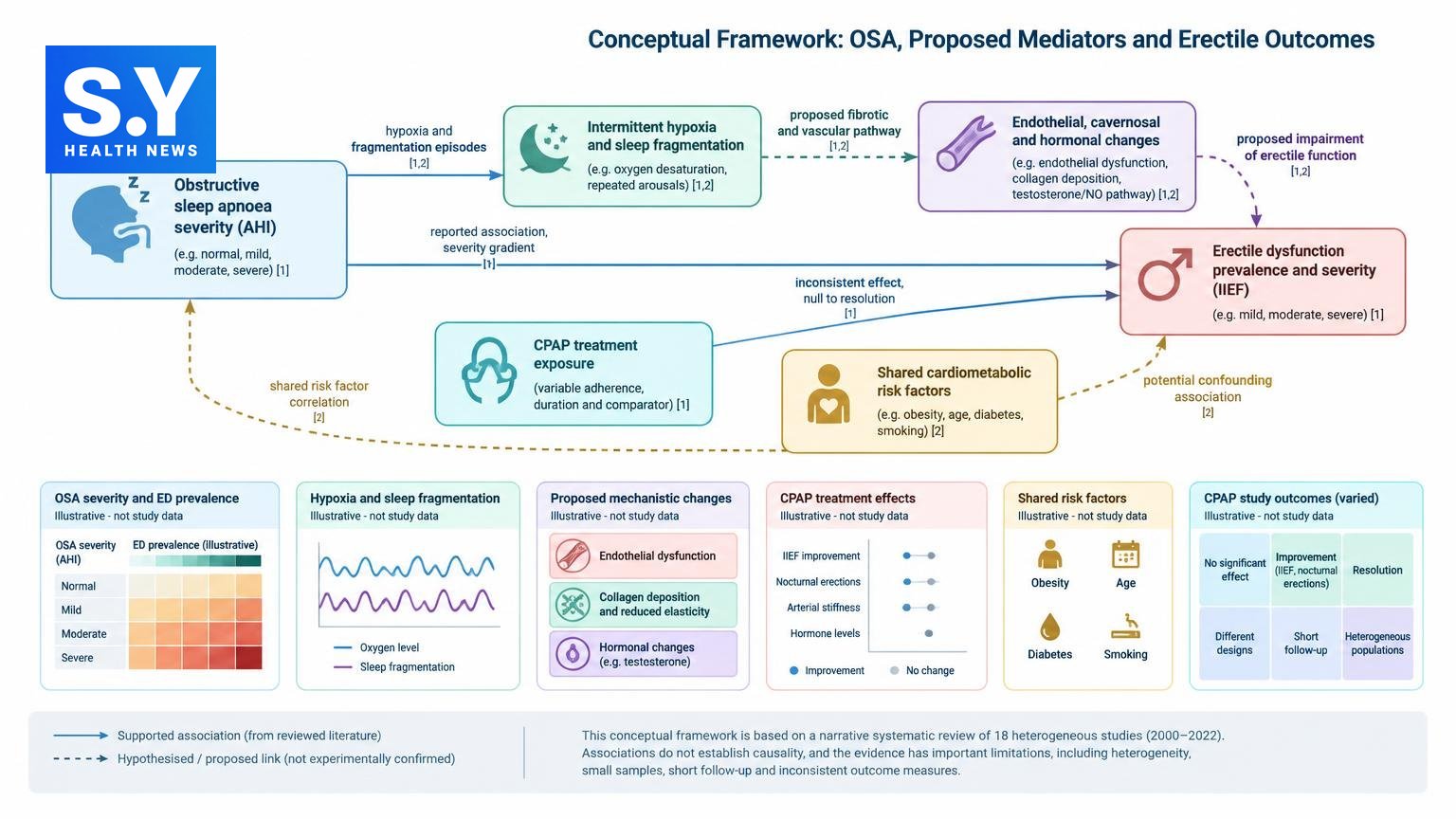
Conceptual framework: Conceptual framework. The reviewed cohorts report an association between OSA severity and ED, while proposed mediating pathways and the confounding role of shared cardiometabolic risk are hypothesised rather than confirmed. CPAP effects on erectile function were inconsistent across studies. This is an interpretive framework based on a narrative systematic review, not a tested causal model.
Academic References & Evidence
- Zain Ahmed Siddiqui; Daniel Peter McNicholas; Adam Spacey; Ian Pearce; Vaibhav Modgil. The Relationship between Erectile Dysfunction and Obstructive Sleep Apnoea and the Impact on Severity of ED following Treatment of OSA: A Systematic Review. Urol Int. 2025 DOI: 10.1159/000546690. PMID: 40784340.
- Erectile Dysfunction. 2026
SANYUN Science Center explains published research on men's reproductive and sexual health, connecting scientific evidence with everyday questions while making sources and limitations clear.
Disclaimer: This article is for scientific education and research communication only. It does not provide medical advice, diagnosis, or individualized treatment recommendations, and does not endorse any medication, supplement, device, penile enlargement procedure, or other intervention. Decisions about sexual and reproductive health should be made in consultation with a qualified healthcare professional. Do not delay seeking professional care because of information in this article.
Original Content & Copyright Notice
- This article is prepared for SANYUN Science Center, drawing on published research and publicly available academic literature on men’s sexual and reproductive health. Its editorial explanations and presentation are developed for this platform.
- Copyright in the original editorial content, selection, and arrangement is reserved by SANYUN Science Center to the extent protected by applicable law. Referenced research, quotations, and third-party materials remain subject to the rights of their respective owners. This notice does not claim ownership of scientific facts or third-party research.
- Except where permitted by applicable law or an applicable license, prior written permission is required to reproduce, republish, translate, adapt, redistribute, or commercially reuse protected content. Attribution alone does not grant permission for such reuse.
- For permitted quotation or authorized reuse, clearly identify the source and retain a link to the original article.
- Source: SANYUN Science Center
- Original URL: Retain the original article URL on science.san-yun.com.
- Copyright Holder: SANYUN Science Center, for its own protected editorial content.
- Quotation, excerpts, or authorized reuse must not distort the scientific meaning, omit material limitations or disclaimers, or imply unverified medical claims, product efficacy, or endorsement by SANYUN Science Center.



