




Category: Erectile Dysfunction
Core Research Direction: An evidence-quality and cardiovascular framing review of current ED treatments: what guideline-based options exist, how strong the evidence base is, and how reliable each specific efficacy claim should be considered.
Search Intent: What does the research evidence actually show — and how strong is it — for the main erectile dysfunction treatments, including the cardiovascular warning signal?
Platform: SANYUN Science Center
Evidence reviewed through: 2026-11-09
Executive Summary
Erectile dysfunction (ED) is common: the U.S. National Institute of Diabetes and Digestive and Kidney Diseases (NIDDK) states that research suggests between 30 million and 50 million men in the United States have ED, and that about 40% of men are affected by age 40 while 70% report ED by age 70.[1]
NIDDK frames ED as more likely with older age but not a routine part of aging, with vascular, neurologic and hormonal conditions, medicines, mental health issues and lifestyle behaviors all listed as potential contributors.
Clinical guidance summarized across the sources describes treating an identifiable underlying cause where possible, and otherwise focusing on sexual function. Oral phosphodiesterase type 5 (PDE5) inhibitors are the usual first-line pharmacological option, with testosterone reserved for men who also have low testosterone, and devices, injections and surgery considered when tablets are unsuitable or insufficient.[2][3][4]
The critical caveat for readers is evidentiary. A 2026 umbrella review of systematic reviews and meta-analyses extracted 23 meta-analyses and 42 summary effects from 1191 screened studies, and rated 13 of the meta-analyses (56.5%) as critically low quality on AMSTAR-2 and 7 (30.5%) as low quality, with only 2 moderate and 1 high. The authors concluded the evidence base is predominantly low or very low quality and recommended caution when interpreting statistically significant improvements.[5]
ED is also a cardiovascular signal. Secondhand summaries of meta-analytic work report elevated relative risks for future cardiovascular events in men with ED, and reports describe ED symptoms preceding heart symptoms in a majority of men with coronary artery disease by a mean of 38.8 months. These are observational associations, not proof of causation, but they change how an initial ED conversation should be framed.[6]
Why This Matters
Treatment of ED is often discussed in terms of product choice, but the research question is better framed as three questions: which options have credible efficacy data, how confident should patients and clinicians be in each claim, and what does ED reveal about wider health. The evidence-quality data suggest these questions have different answers.
There is also a care-gap dimension. A secondary statistics aggregation reports that in a claims analysis of 6,228,509 insured US men diagnosed with ED, only 25.4% filled a prescription for treatment within a year, and that PDE5 inhibitor discontinuation runs at about 4% per month, approaching 50% after one year. Both figures come from an aggregator rather than a primary study read here, so they should be treated as signals of undertreatment and discontinuation rather than precise population estimates.
For a global readership, the practical point is that ED is frequently both a sexual-health complaint and a general-medical prompt. NIDDK explicitly notes that ED may be a symptom of another health problem, and its treatment page begins with the underlying cause rather than with a prescription.
Biological and Clinical Mechanism
An erection depends on coordinated vascular, neurologic, hormonal and psychological inputs. NIDDK lists diseases affecting blood vessels, nerves or hormones, plus medicines, mental and emotional issues, and lifestyle behaviors such as smoking, heavy alcohol use, inactivity and recreational drug use as potential contributors. This multi-causal model is why treatment guidance starts with cause-finding.
PDE5 inhibitors act on the vascular side: NIDDK describes them as oral medicines that improve blood flow to the penis and may help get and keep an erection. This mechanism explains why they require sexual stimulation and why they do not address anxiety, relationship strain or low desire directly.[7]
Testosterone sits in a different role. NIDDK states that when ED coexists with low testosterone, clinicians may prescribe testosterone together with PDE5 inhibitors, as an oral medicine, patch or gel. That is a targeted hormonal add-on for a tested deficiency, not a general ED treatment.
Non-pharmacological options have mechanistic rationales described in the sources. Vacuum erection devices use negative pressure to draw blood into the corpora cavernosa, with a constriction ring maintaining the erection. Lifestyle change targets shared vascular risk: NIDDK cites the Physical Activity Guidelines for Americans, 2nd edition, recommending at least 150 minutes of moderate-intensity activity per week, which is a general-population recommendation rather than an ED-specific trial target.
The cardiovascular link has a plausible mechanical story: penile arteries are smaller than coronary arteries and may show the effects of endothelial dysfunction and atherosclerosis earlier. That hypothesis is not directly tested in this packet, so it should be presented as an explanation consistent with the observational data rather than an established causal pathway.
What the Evidence Shows: Guideline-Based Options
Across the sources, the recognized options form a familiar set: lifestyle change and counseling, oral PDE5 inhibitors, testosterone for documented low testosterone, injectable and intraurethral medicines, vacuum devices, and surgery including prosthesis implantation for men whose ED does not improve with other options. NIDDK notes most people with ED do not need surgery, and describes arterial repair as working best for younger men.
Efficacy claims differ sharply in how well they are supported. The narrative review reports that all four PDE5 inhibitor agents are effective in roughly 60% to 80% of men with ED, citing a guideline, but the definition of response is not specified and the figure is a secondary summary rather than a trial result. That range is best read as a broad expectation, not a precision estimate for an individual.
The same review notes that incorrect use accounts for a large percentage of apparent PDE5 inhibitor failures, listing timing, food interaction, absent stimulation, too few attempts, suboptimal dose and unrecognized low testosterone as common mistakes. This is a qualitative claim without a stated percentage, but it matters for interpreting real-world non-response.
For psychological components, the review reports that trials of cognitive behavioral sex therapy show improvements in erectile function comparable to sildenafil 50 mg, with the added benefit of reducing performance anxiety. A separate decision guide notes the AUA guideline gives a moderate recommendation that referral to a mental health professional be considered for men being treated for ED, to support adherence and reduce performance anxiety. That guidance source explicitly states it could not access a PubMed search comparing psychological and medical treatments, so it makes no claims about relative effectiveness.
Lifestyle evidence is directionally positive but thin in this packet. NIDDK states that research shows a healthy diet can lower ED risk and improve symptoms, and that diets such as the Mediterranean diet have been shown to decrease the chance of getting ED, without effect sizes or design detail. The review cites a meta-analysis finding aerobic exercise improves IIEF-EF scores by roughly 2.8 points.
A drug-free over-the-counter topical gel authorized through the FDA De Novo pathway in June 2023 is described in a commercial educational article as showing that 62% of men improved erectile function score by more than the minimum meaningful amount in a 24-week home-use study. That study was open-label and was not designed to compare the gel with pills, so it does not establish comparative efficacy.[8]
Surgical and device outcomes are described qualitatively: the review reports penile implants have the highest patient and partner satisfaction rates of any ED treatment at over 90%, while being irreversible and reserved for cases where other treatments failed. Satisfaction measurement methods are not specified in the packet.
How Strong Is the Evidence Base?
| Treatment area | Reported result | Evidence quality or status | How to read the claim |
|---|---|---|---|
| Oral PDE5 inhibitors | Effective in roughly 60% to 80% of men with ED, per a secondary guideline summary | Widely recommended first-line option; response definition not specified | Broad expectation, not a precise individual prediction |
| PDE5 inhibitor apparent failure | Incorrect use accounts for a large percentage of failures; percentage not stated | Qualitative claim from a narrative review | Check timing, food, stimulation, number of attempts and dose before concluding non-response |
| Healthy diet and Mediterranean-style eating | Research shows reduced risk and improved symptoms; specific diets reduce chance of getting ED | Directional statements without effect sizes in the packet | Consistent with vascular-risk logic; not a quantified treatment effect here |
| Aerobic exercise | IIEF-EF improvement of roughly 2.8 points | Meta-analysis figure reported secondhand | Small average improvement; individual response varies |
| Testosterone with PDE5 inhibitors | Option when ED coexists with low testosterone | Guideline-supported targeted use only | Not a general ED treatment; eligibility depends on testing |
| Cognitive behavioral sex therapy | Improvements comparable to sildenafil 50 mg in cited trials | Secondhand citation; trial details not given | Relevant mainly when psychological factors contribute; comparator evidence limited in this packet |
| OTC drug-free topical gel | 62% improved beyond the minimum meaningful amount over 24 weeks | Open-label; not designed to compare with pills | Per-use option, not a substitute for evaluation or proven superior to tablets |
| Penile implant surgery | Patient and partner satisfaction over 90% | Irreversible; reserved for failure of other treatments | High satisfaction but appropriate only in selected cases |
The umbrella review is the most direct evidence-quality check in the packet. It screened 1191 studies, extracted 23 meta-analyses and 42 summary effects across IIEF, IIEF-5, IIEF-EF and erection hardness score endpoints, and rated 13 (56.5%) of the meta-analyses critically low and 7 (30.5%) low on AMSTAR-2, with 2 moderate and 1 high. It concluded the evidence base is predominantly low or very low quality.
Crucially, the umbrella review did report statistically significant improvements with both pharmacological and nonpharmacological interventions. Its caution concerns interpretation: limited patient numbers and subjective outcome indicators mean statistically significant findings do not automatically translate into confident clinical superiority claims.
This distinction is the core of reading ED treatment evidence well. A significant improvement on a self-reported erectile function questionnaire is meaningful, but it is not the same as proven superiority of one option over another, and the absence of high-quality head-to-head meta-analyses limits comparative claims.
Beyond the umbrella review, several packet figures are secondhand summaries of primary literature. The TRAVERSE trial, as described in a narrative review, found transdermal testosterone non-inferior to placebo for major adverse cardiac events (HR 0.96, 95% CI 0.78–1.17) in 5,246 hypogonadal men with elevated cardiovascular risk over a mean 21.7 months, while also reporting higher rates of pulmonary embolism, atrial fibrillation and acute kidney injury in the testosterone arm. This addresses cardiovascular safety of testosterone therapy, not its efficacy for ED.
The Cardiovascular Warning Signal
The cardiovascular framing rests on observational data. A narrative review reports a 2023 JACC Advances umbrella review finding men with ED had elevated relative risks of cardiovascular disease (RR 1.45, 95% CI 1.36–1.54), coronary heart disease (RR 1.50), cardiovascular mortality (RR 1.50), myocardial infarction (RR 1.55), stroke (RR 1.36) and all-cause mortality (RR 1.25), all with P<0.001. A statistics aggregator reports a pooled relative risk of 1.44 for cardiovascular events across 14 cohort studies.
Timing data are striking but limited. The aggregator reports that among men with coronary artery disease, 67% reported ED symptoms before heart symptoms, by a mean of 38.8 months. That is a single-study figure reported secondhand, with recall and measurement details unavailable, so it should not be generalized into a screening interval or a prediction tool.
What does this mean for interpreting treatment claims? It does not change the efficacy evidence for any option. It does mean that a new ED presentation is a reasonable trigger for blood pressure, glucose and lipid assessment in the relevant context, and that the choice of treatment should sit inside a broader medical evaluation. The sources describe this as guideline counselling and consensus framing rather than as a demonstrated outcome benefit of screening programs.
Observational associations cannot establish that ED causes cardiovascular events or that treating ED reduces cardiac risk. Confounding by shared risk factors such as age, smoking, diabetes and obesity is expected. The cardiovascular claim is best stated as risk-marker language, not as a causal or preventive claim.
Interpretation and Limitations
First, this review is limited by its sources. The packet includes government patient education, a statistics aggregator, commercial educational articles, a decision guide and a narrative review; several key numbers are secondhand reports of primary studies that were not independently evaluated here. The umbrella review itself is represented by an abstract-level record.
Second, outcome interpretation is complicated by measurement. Erectile function endpoints such as IIEF and erection hardness score are partly subjective, and the umbrella review flags both limited patient numbers and subjective indicators as reasons for caution. Statistical significance on these scales should not be equated automatically with clinically important benefit for an individual.
Third, many commonly repeated claims lack transparent denominators. The 60% to 80% PDE5 inhibitor response range, the discontinuation rate of about 4% per month, and the 62% gel improvement figure are each reported without the response definitions or sample sizes needed to judge precision. They are usable orientation figures, not definitive estimates.
Fourth, safety information is present but incomplete. NIDDK lists erections lasting longer than 4 hours (priapism), and vision or hearing loss after oral ED medicines, as reasons to seek care right away. Incidence rates are not given for any of these events, and the narrative review notes a contraindication between PDE5 inhibitors and nitrate medicines that is not quantifiable from this packet.
Fifth, several statements in the sources describe guideline recommendations or consensus positions rather than trial findings. The AUA mental health referral recommendation is described as moderate, the recommendation for morning testosterone measurement is presented as guideline advice, and the cardiovascular risk-enhancement framing is consensus-level. These are legitimate guidance, but they are a different evidence grade from randomized outcome data.
Research Outlook
The umbrella review's own recommendation is the clearest research priority: further well-designed studies of single treatments and high-quality meta-analyses comparing treatments head-to-head are urgently needed. The current literature is diverse but does not support confident between-treatment rankings.
Adjacent areas in the packet are early or mixed. A 2025 controlled pilot study in men with obesity-associated hypogonadism reported greater weight loss and IIEF-5 improvement with tirzepatide than lifestyle intervention alone, alongside rises in total testosterone, luteinizing hormone, follicle-stimulating hormone and sex hormone-binding globulin. Pilot data of this kind generate hypotheses rather than establish treatment roles.
Sleep apnea is another under-recognized thread. A cited 2018 study of 150 men newly diagnosed with moderate to severe obstructive sleep apnea found ED prevalence of 51%, a single-cohort observation that should be read as a hypothesis-generating association rather than a general population figure.
Regulatory status separates established from experimental options. The sources state low-intensity shockwave therapy is not FDA-approved for ED and is considered investigational by the AUA, and platelet-rich plasma therapy is described as experimental and not FDA-approved. These are status statements, not efficacy verdicts, and they should be communicated plainly to patients considering clinic-offered options.
Key Takeaways
- Recognized ED treatment options include cause-directed management, lifestyle change and counseling, oral PDE5 inhibitors, testosterone when low testosterone is documented, injectable and intraurethral medicines, vacuum devices and surgery for selected cases; NIDDK states most people with ED do not need surgery.
- The broad efficacy figures commonly quoted for PDE5 inhibitors (roughly 60% to 80% response) come from secondary guideline summaries with unspecified response definitions, so they orient expectations rather than predict individual outcomes.
- An umbrella review of 23 meta-analyses and 42 summary effects found the ED treatment evidence base predominantly low or very low quality, with 13 meta-analyses rated critically low and 7 low on AMSTAR-2; statistically significant improvements were reported, but the authors urge caution.
- ED is associated with higher cardiovascular risk in observational data, including a reported relative risk of 1.45 for cardiovascular disease and 1.44 for cardiovascular events in separate meta-analytic summaries; this is risk-marker evidence, not causation.
- Safety counselling should include priapism lasting more than 4 hours and vision or hearing loss after oral ED medicines as reasons to seek care right away, and nitrate co-use is a critical contraindication described in the sources.
Questions and Answers
How strong is the evidence for current erectile dysfunction treatments?
A 2026 umbrella review screened 1191 studies and extracted 23 meta-analyses with 42 summary effects. It rated 13 meta-analyses (56.5%) critically low and 7 (30.5%) low on AMSTAR-2, with only 2 moderate and 1 high. The authors concluded the evidence base is predominantly low or very low quality, despite statistically significant improvements across pharmacological and nonpharmacological options.
Do PDE5 inhibitors work for all men with erectile dysfunction?
No. A secondary guideline summary reports all four PDE5 inhibitor agents are effective in roughly 60% to 80% of men with ED, but the response definition is not specified. The same review notes incorrect use accounts for a large percentage of apparent failures, including poor timing, heavy meals, absent stimulation, too few attempts and suboptimal dosing. Non-response should be reviewed before concluding a drug does not work.
Is erectile dysfunction a warning sign of heart disease?
Observational data consistently link ED with higher cardiovascular risk. Secondhand summaries report a relative risk of 1.45 for cardiovascular disease and 1.44 for cardiovascular events in meta-analyses of cohort studies, and one report found ED symptoms preceded heart symptoms by a mean of 38.8 months in 67% of men with coronary artery disease. These are associations, not proof that ED causes cardiac events.
Does testosterone therapy treat erectile dysfunction in men with normal testosterone?
Source guidance describes testosterone as an option for men who have both ED and low testosterone, sometimes alongside a PDE5 inhibitor, available as oral medicine, patch or gel. It is not described as general ED therapy. The TRAVERSE trial addressed cardiovascular safety rather than ED efficacy, finding non-inferiority for major adverse cardiac events (HR 0.96, 95% CI 0.78–1.17) in 5,246 hypogonadal men.
What are the serious side effects of erectile dysfunction medicines?
NIDDK lists erections lasting longer than 4 hours (priapism) and vision or hearing loss after oral ED medicines as problems requiring immediate medical contact. These warnings apply to oral, injected and suppository ED medicines for priapism. Incidence rates are not provided in the packet, and the sources also note that PDE5 inhibitors must not be combined with nitrate medicines.
Are shockwave therapy and PRP proven treatments for erectile dysfunction?
No. The sources state low-intensity shockwave therapy is not FDA-approved for ED and is considered investigational by the AUA, while platelet-rich plasma therapy is described as experimental and not FDA-approved. These describe regulatory and guideline status rather than a verdict on all future evidence, and patients considering clinic-offered versions should ask what evidence and outcome measures apply to their situation.
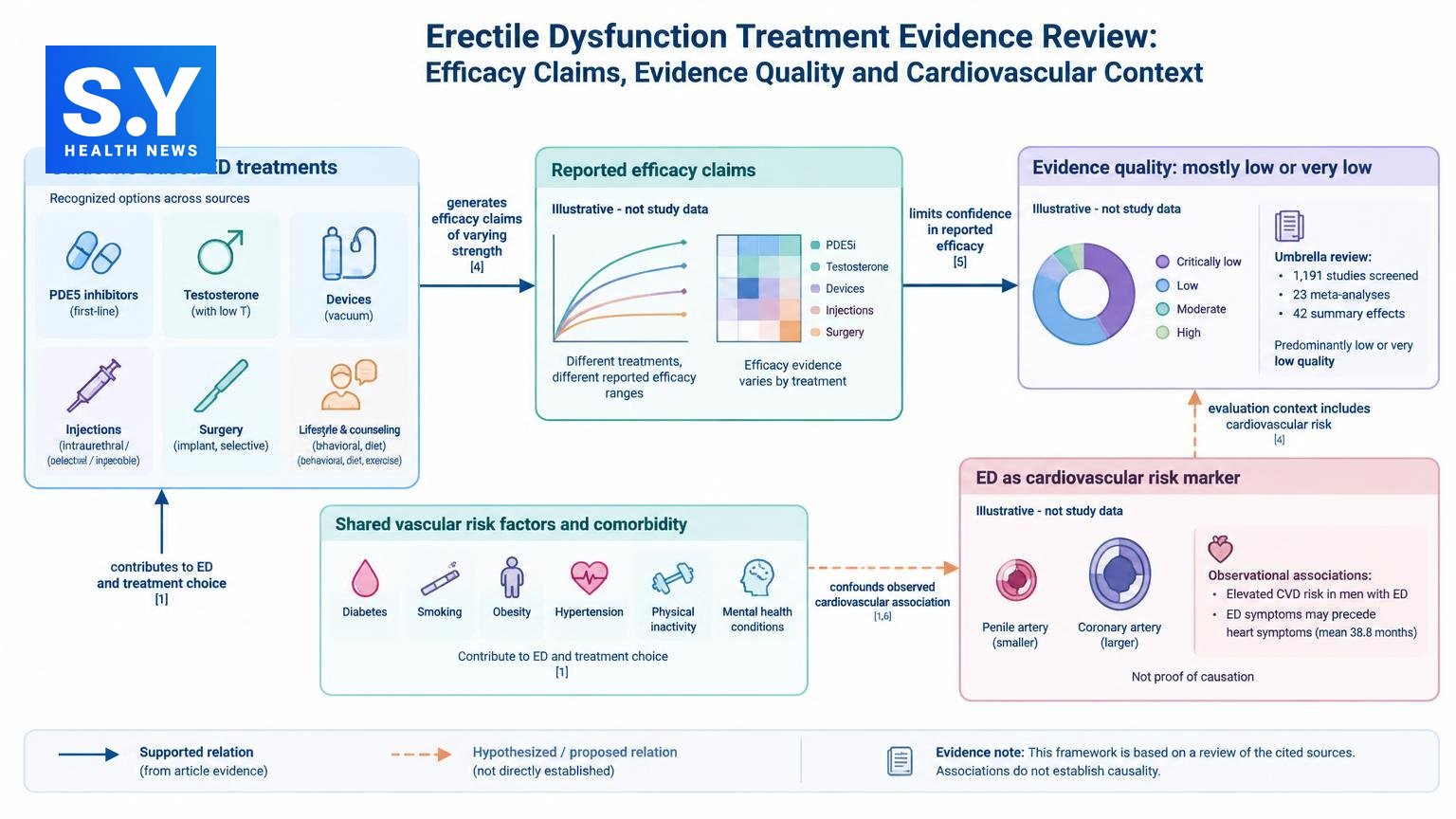
Conceptual framework: Conceptual framework, not study data. Guideline-recognized ED treatments generate efficacy claims of mixed strength, while an umbrella review finding mostly low or very low evidence quality limits confidence in those claims. ED is linked observationally to cardiovascular risk, with shared vascular risk factors as expected confounders. Supported and proposed relations are distinguished; no causal or mediation claim is made.
Academic References & Evidence
- Erectile Dysfunction (ED) – All Content – NIDDK.
- Treatment for Erectile Dysfunction – NIDDK.
- Latest ED Treatments 2026: Pills, Gels and Your Options.
- Parth Bhavsar. Erectile Dysfunction. 2026
- Current treatment for erectile dysfunction: an umbrella review of systematic reviews and meta-analyses. Figshare. 2026 DOI: 10.6084/m9.figshare.31562993.v1.
- Erectile dysfunction statistics 2026: 28 key figures.
- Sex Therapy vs. ED Pills: When Talking to a Therapist Helps | EdClinic.co. 2026
- Jen Adams; Josh Allen. New ED Treatments in 2026: What Works and What Is in Trials. 2026
SANYUN Science Center explains published research on men's reproductive and sexual health, connecting scientific evidence with everyday questions while making sources and limitations clear.
Disclaimer: This article is for scientific education and research communication only. It does not provide medical advice, diagnosis, or individualized treatment recommendations, and does not endorse any medication, supplement, device, penile enlargement procedure, or other intervention. Decisions about sexual and reproductive health should be made in consultation with a qualified healthcare professional. Do not delay seeking professional care because of information in this article.
Original Content & Copyright Notice
- This article is prepared for SANYUN Science Center, drawing on published research and publicly available academic literature on men’s sexual and reproductive health. Its editorial explanations and presentation are developed for this platform.
- Copyright in the original editorial content, selection, and arrangement is reserved by SANYUN Science Center to the extent protected by applicable law. Referenced research, quotations, and third-party materials remain subject to the rights of their respective owners. This notice does not claim ownership of scientific facts or third-party research.
- Except where permitted by applicable law or an applicable license, prior written permission is required to reproduce, republish, translate, adapt, redistribute, or commercially reuse protected content. Attribution alone does not grant permission for such reuse.
- For permitted quotation or authorized reuse, clearly identify the source and retain a link to the original article.
- Source: SANYUN Science Center
- Original URL: Retain the original article URL on science.san-yun.com.
- Copyright Holder: SANYUN Science Center, for its own protected editorial content.
- Quotation, excerpts, or authorized reuse must not distort the scientific meaning, omit material limitations or disclaimers, or imply unverified medical claims, product efficacy, or endorsement by SANYUN Science Center.



